Construction projects in Singapore operate within one of the most regulated safety environments in Asia, yet the examples of construction hazards that routinely claim lives and trigger enforcement actions are well documented and largely preventable. From scaffold collapses in high-rise residential builds to trench cave-ins during MRT infrastructure works, the types of construction hazards encountered on local sites mirror global patterns while carrying distinct local regulatory weight. Understanding these hazards with precision is not merely academic. For companies pursuing BizSAFE Star or ISO 45001 certification, systematic hazard identification in construction is a foundational requirement that auditors examine closely and that site outcomes ultimately validate.
Table of Contents
- Criteria for identifying critical construction hazards
- Fall hazards: the top kill risk on construction sites
- Excavation and trench hazards: silent but deadliest risks
- Struck-by and equipment-related hazards
- Electrical hazards and caught-between risks
- Comparing top construction hazards and mitigation priorities
- Why overlooked hazards sabotage safety efforts in Singapore construction
- Enhance your project safety and certification readiness with MOSAIC
- Frequently asked questions
Key Takeaways
| Point | Details |
|---|---|
| Fall hazards dominate fatalities | Falls are the leading cause of death and OSHA citations on construction sites. |
| Excavation risks are stealthy and severe | Cave-ins and toxic atmospheres make trenches among the deadliest hazards. |
| Struck-by incidents need strict controls | Falling objects and vehicle movements cause many fatal injuries. |
| Electrical and caught-between hazards are critical | Contact with power lines and machinery entrapment cause serious accidents. |
| Proactive safety culture is essential | Known hazards remain deadly without committed management and worker engagement. |
Criteria for identifying critical construction hazards
Having established why hazard identification matters, it is essential to define the criteria used to evaluate examples of construction risks before ranking or prioritizing them. Not every hazard warrants equal urgency, and a structured evaluation framework ensures that resources are directed where the risk profile is most severe.
The following criteria should guide your hazard evaluation process:
- Severity of harm: Hazards that carry a credible potential for fatality or permanent disability, such as falls from heights or electrocution, must rank highest regardless of their frequency.
- Frequency of occurrence: Hazards that appear routinely across site activities, such as vehicle movements or manual handling, demand continuous controls rather than periodic interventions.
- Regulatory and certification exposure: Hazards directly cited in BizSAFE audit criteria, the Workplace Safety and Health Act (Singapore), or ISO 45001 requirements carry compounded risk if left uncontrolled, as they simultaneously threaten workers and certification standing.
- Controllability: Some hazards, despite their severity, respond predictably to established engineering controls or administrative procedures. Prioritizing controllable hazards ensures faster risk reduction per unit of investment.
A thorough risk assessment for construction safety maps each identified hazard against these four criteria, producing a risk register that becomes the backbone of your safety management system and certification documentation.
Fall hazards: the top kill risk on construction sites
Next, we examine fall hazards, which consistently top the list for fatalities and safety citations across every jurisdiction that tracks construction accident examples systematically.
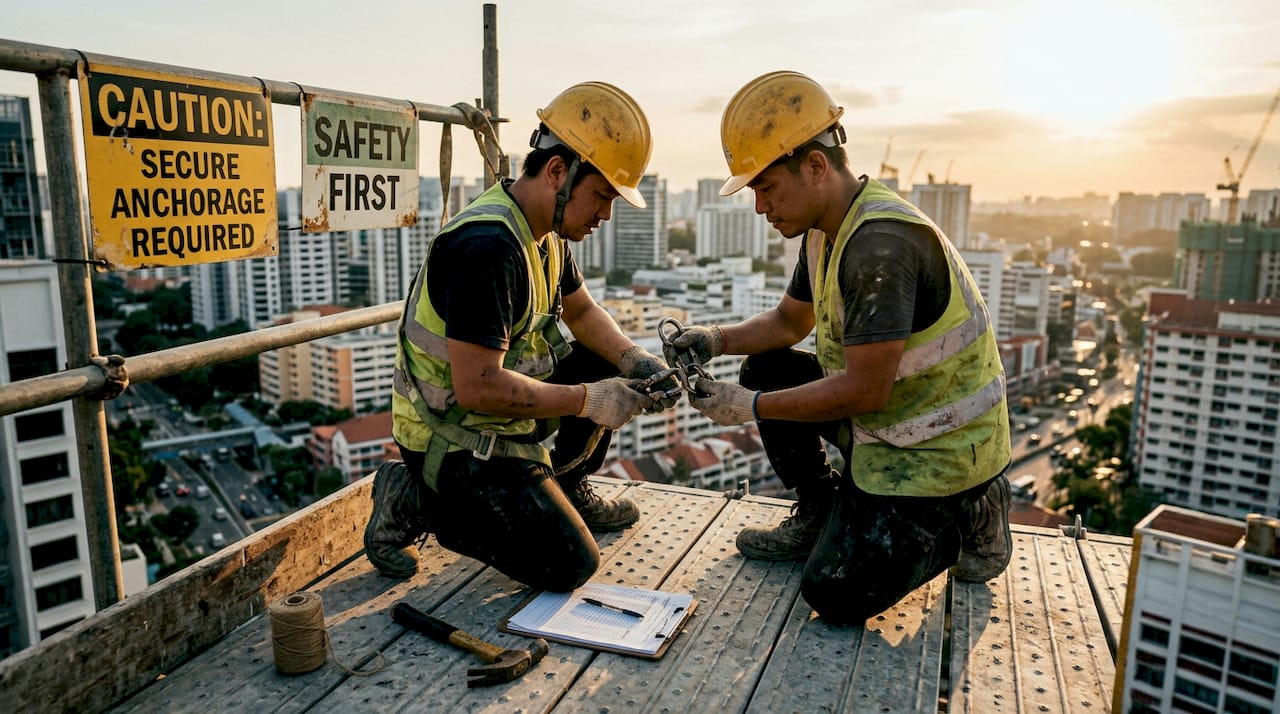
Falls from heights are not simply a compliance issue. They are the single most lethal category of construction site dangers worldwide. Falls caused 421 fatalities in 2023 alone, with OSHA repeatedly citing missing guardrails, improper harness use, and unstable ladders as the proximate failures. In Singapore, the Ministry of Manpower’s enforcement data mirrors this pattern, with falls from heights consistently appearing among the leading causes of workplace fatalities in the construction sector.
Common fall hazards on Singapore construction sites include:
- Unguarded floor openings and slab edges during formwork and concrete pours, where temporary covers are removed and not replaced
- Unstable or improperly erected scaffolding, particularly where tube-and-coupler systems are assembled without competent supervision
- Unsecured portable ladders that shift on smooth floor surfaces or extend insufficiently above landing platforms
- Missing or defective personal fall arrest systems, including harnesses with damaged webbing or lanyards anchored to non-rated points
- Fragile roof surfaces, especially on older industrial structures or temporary site shelters
Preventing falls requires layered controls. Engineering solutions such as permanent guardrails and net systems take priority over personal protective equipment under Singapore’s hazard control hierarchy. Training remains essential but must be supported by physical controls that workers cannot bypass under schedule pressure.
Pro Tip: During BizSAFE audits, inspectors specifically examine whether fall protection is present at all working edges above two meters, consistent with the Workplace Safety and Health (Work at Heights) Regulations. Documenting daily pre-work inspections of fall arrest equipment creates an auditable record that demonstrably reduces both risk and regulatory exposure. For further guidance, consult the detailed resource on preventing slips, trips, and falls in Singapore.
Excavation and trench hazards: silent but deadliest risks
After fall hazards, excavation hazards demand urgent attention given their exceptional lethality and the deceptive nature of their onset. A trench wall can collapse in seconds, with no audible warning, and a worker buried even at chest depth may die from asphyxiation before rescue teams reach them.
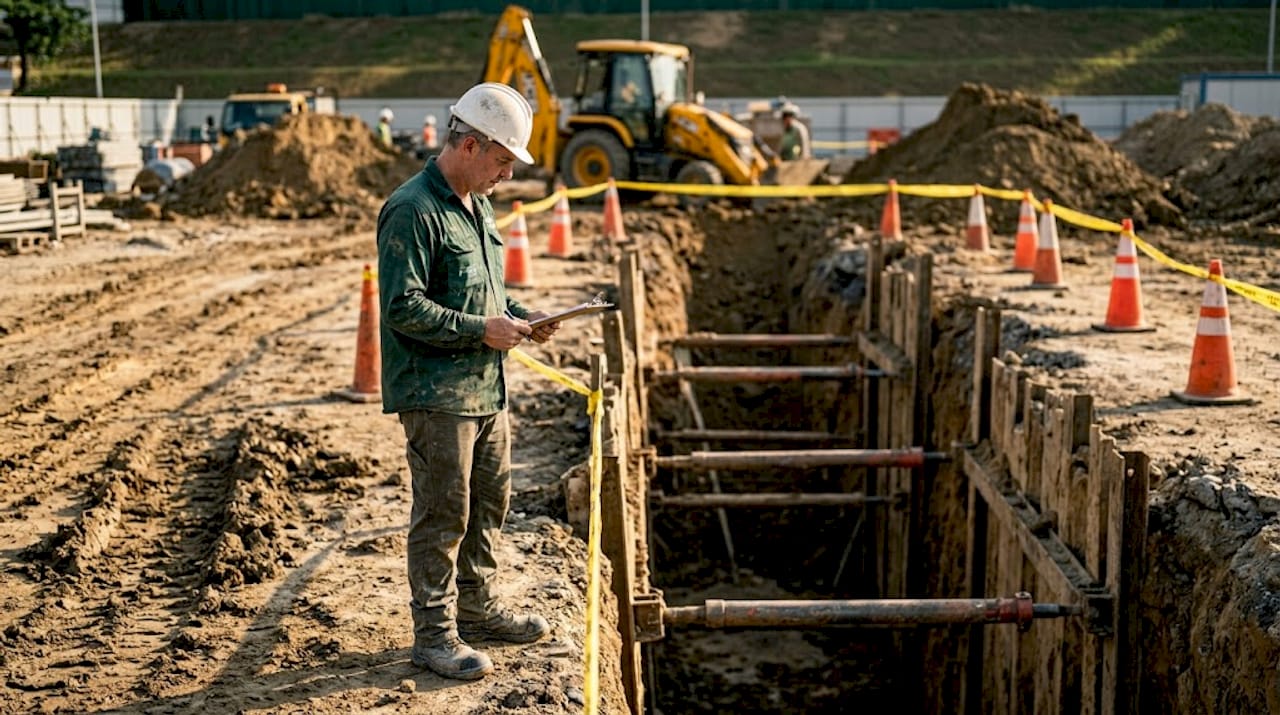
Cave-ins kill more excavation workers than any other excavation hazard, most commonly because protective shoring or shielding systems were absent or inadequate. The insidious quality of excavation risks is that the soil can appear stable for hours before saturation or vibration from nearby machinery triggers sudden failure.
Key excavation hazards that construction safety programs must address include:
- Cave-ins from unsupported trench walls, particularly in sandy or saturated soils common in Singapore’s reclaimed land zones
- Hazardous atmospheric conditions in excavations deeper than 1.2 meters, including oxygen-depleted air, hydrogen sulfide from decomposing organic material, and methane accumulation
- Underground utility strikes, which can trigger electrocutions, gas explosions, or flooding events when utility location surveys are skipped under schedule pressure
- Water accumulation following rainfall, which reduces soil bearing capacity and can cause rapid wall collapse even in previously stable excavations
- Falls into open excavations without adequate barricading, particularly during low-light conditions on night shifts
- Falling objects from workers or equipment operating at the trench edge, posing lethal risk to workers below
- Proximity of heavy plant to excavation edges, where vibration and surcharge loading accelerate wall instability
Pro Tip: Appoint a competent person, as defined under the Workplace Safety and Health (Construction) Regulations, to conduct documented inspections of all excavations at the start of each shift and after any rainfall or ground disturbance event. This single procedural control addresses multiple excavation hazard categories simultaneously.
| Excavation hazard | Primary cause | Key control measure |
|---|---|---|
| Cave-in | Unsupported walls | Shoring, shielding, or benching |
| Atmospheric hazard | Confined space conditions | Gas monitoring, forced ventilation |
| Utility strike | Inadequate survey | Utility locating before excavation |
| Flooding | Rainfall or groundwater | Sump pumps, weather monitoring |
| Falls into trench | Missing barricades | Perimeter barriers and covers |
For practical guidance on managing these conditions on active sites, the resource on construction site safety tips for Singapore provides locally contextualized controls.
Struck-by and equipment-related hazards
Beyond falls and excavations, struck-by and equipment hazards represent the second most significant category of construction site dangers and one that intensifies as sites become more congested with simultaneous trades and plant operations.
Struck-by accidents are the second leading cause of fatalities on construction sites globally, encompassing impacts from falling tools, swinging crane loads, and moving vehicles. The tragic example of a worker killed by a dump truck during road construction illustrates how vehicle movement protocols, when absent or ignored, convert routine site activities into fatal events.
Struck-by hazard sources include:
- Falling hand tools, fasteners, and materials from workers on elevated platforms
- Swinging loads from tower cranes or mobile cranes operating over pedestrian or worker zones
- Moving excavators and dump trucks with restricted operator visibility, particularly in reverse
- Airborne debris from cutting, grinding, and demolition activities without adequate enclosure
Effective controls, ranked by implementation priority, are:
- Establish and enforce exclusion zones around crane operating radii and active machinery, enforced by physical barriers rather than signage alone
- Install proximity warning systems and backup alarms on all mobile plant operating in congested site conditions
- Deploy trained spotters for all reversing or lifting operations involving limited operator visibility
- Require high-visibility personal protective equipment for all personnel in zones where vehicle and pedestrian paths intersect
- Conduct pre-lift risk assessments for all crane lifts involving loads over traffic or occupied work areas
Additional site safety protocols aligned with Singapore’s regulatory requirements are detailed at the construction site safety resource for local practitioners.
Electrical hazards and caught-between risks
Next, we cover electrical and caught-between hazards, both of which contribute significantly to the Fatal Four categories tracked by occupational safety regulators globally and by Singapore’s Ministry of Manpower domestically.
Electrocutions can result from contact with energized overhead lines where as little as 50 volts can be fatal under the right body resistance and contact conditions. On Singapore construction sites, the primary electrical hazard vectors include:
- Overhead power line contact during crane operations, scaffold erection, or material handling in proximity to live conductors
- Metal ladders contacting energized lines, which conduct lethal current through the user’s body with no protective resistance
- Defective temporary wiring installed by electrically unqualified personnel, particularly in areas subject to moisture exposure
- Absence of residual current device protection on temporary power distribution boards serving site tools and equipment
Caught-between hazards, by contrast, involve workers being trapped, pinched, or crushed between equipment components or structural elements. These include:
- Workers caught in unguarded rotating machinery such as mixers, augers, or conveyor systems
- Personnel trapped between moving plant and fixed structures in congested work zones
- Workers caught in trench or excavation collapses where escape routes are blocked
Lockout/tagout procedures, which systematically de-energize and physically lock out machinery before maintenance, are the most effective single control for both electrical contact and caught-between hazards. Addressing these risks at the design stage, through risk management during the design phase, eliminates many electrical and machinery hazards before they reach the construction site.
Comparing top construction hazards and mitigation priorities
To bring it all together, the following comparison table allows project teams to directly weigh these hazards against each other for safety planning and resource allocation.
| Hazard category | Frequency on site | Fatality severity | Primary control | Certification relevance |
|---|---|---|---|---|
| Fall from heights | Very high | Very high | Guardrails, fall arrest systems | BizSAFE, ISO 45001 |
| Excavation cave-in | Moderate | Extremely high | Shoring, competent inspections | BizSAFE, WSH Act |
| Struck-by (objects/vehicles) | High | High | Exclusion zones, spotters | BizSAFE, ISO 45001 |
| Electrocution | Moderate | Very high | Clearance distances, RCD protection | WSH Act, ISO 45001 |
| Caught-between | Moderate | High | Machine guarding, lockout/tagout | ISO 45001 |
Key takeaways from this comparison:
- Falls demand the greatest breadth of control investment given their combination of high frequency and very high fatality potential
- Excavation hazards carry the highest fatality rate per incident and require non-negotiable implementation of protective systems on every job
- Struck-by hazards are highly preventable through disciplined site traffic management and crane operation protocols
- Electrical and caught-between hazards respond predictably to engineering controls that, once installed, require minimal ongoing intervention
Why overlooked hazards sabotage safety efforts in Singapore construction
Understanding which hazards to address is necessary but not sufficient. The more consequential question for Singapore construction companies is why these well-documented hazards persist despite widespread awareness of their lethality and established control methodologies.
Excavation fatalities almost never result from unknown hazards but from known risks left uncontrolled due to schedule pressure or cost cutting. This observation, uncomfortable as it is, applies equally to fall protection failures, electrical incidents, and struck-by accidents. The knowledge gap is rarely the problem. The execution gap is.
On Singapore’s active construction sites, where project timelines are governed by tight milestones tied to contract penalties, the temptation to defer or dilute safety controls in favor of productivity is a structural pressure rather than an isolated behavioral failure. When competent persons feel insufficiently empowered to halt work for safety deficiencies, or when pre-task risk assessments become checkbox exercises rather than genuine hazard evaluation processes, the gap between written safety management systems and site reality widens to lethal proportions.
The solution is not more documentation. It is cultural repositioning, where safety authority is vested in competent persons at every level of the site hierarchy, and where project leadership treats a halted pour or a delayed lift as a professional success rather than a scheduling failure. Companies that have achieved and maintained BizSAFE Star certification sustainably share one characteristic: safety is visibly championed by top management and operationally embedded in daily work planning, not confined to a safety officer’s remit.
For Singapore companies pursuing ISO 45001 alongside BizSAFE, this cultural dimension is explicitly examined during certification audits. Clause 5.1 of ISO 45001 places leadership and commitment as a primary certification driver, meaning that the board room and the site hoarding must tell the same safety story.
Enhance your project safety and certification readiness with MOSAIC
With a clear understanding of how to identify, prioritize, and control the most critical examples of construction hazards, the next step is translating that knowledge into a certified, auditable safety management system that satisfies Singapore’s regulatory requirements and your clients’ expectations.

MOSAIC Ecoconstruction Solutions works alongside construction companies and project developers in Singapore to build exactly that. Our tailored BizSAFE Star certification support guides you through every stage of the certification process, from initial gap assessments to final audit preparation. Our safety audit services for Singapore construction are aligned with local WSH legislation and ISO 45001 requirements, providing the independent verification that regulators and main contractors increasingly demand. For projects with environmental obligations, our environmental compliance guidance integrates sustainability controls into your existing safety framework. MOSAIC’s expert team understands Singapore’s regulatory landscape with the precision your certification journey requires.
Frequently asked questions
What are the most common construction hazards causing fatalities?
Falls, struck-by incidents, electrocutions, and caught-between accidents, collectively known as the Fatal Four, account for the majority of construction deaths. Falls alone account for 39% of construction fatalities, with struck-by, electrocution, and caught-between incidents comprising most of the remainder.
How can excavation-related fatalities be prevented?
Implementing protective systems such as shoring or trench boxes, conducting daily competent person inspections, and rigorously locating underground utilities before breaking ground are the most effective preventive measures. Protective systems and regular inspections together address the two most common fatal excavation failure modes: cave-ins and utility strikes.
What fall protections are required for construction workers?
Employers must provide guardrails, personal fall arrest systems, and properly secured ladders for all workers exposed to fall heights above the regulatory threshold. OSHA requires fall protection at six feet and most frequently cites missing guardrails and improperly anchored harnesses as the specific violations observed during inspections.
What measures help prevent struck-by accidents on construction sites?
Implementing defined exclusion zones, deploying trained spotters for vehicle and crane operations, and installing backup alarms and proximity warning systems collectively reduce struck-by risk across all common hazard sources. Spotters, alarms, and visibility protocols are identified as the critical control gaps in fatal vehicle-related construction incidents.