MOM is Watching: Navigating Singapore’s WSH Act with an Expert by Your Side
Introduction to Singapore Safety Compliance
The Ministry of Manpower enforces workplace safety regulations strictly. Consequently, organizations must adopt proactive risk management strategies today. Safety compliance remains a non-negotiable operational necessity in Singapore. Furthermore, compliance failures result in severe financial and legal penalties.
Therefore, engaging a competent safety consultant is highly advisable. Understanding the Workplace Safety and Health Act is vital. This exhaustive report analyzes Singapore’s safety compliance framework comprehensively. It explores legislative updates, enforcement trends, and technological innovations. Moreover, it provides actionable strategies for maintaining rigorous compliance.
The Evolution of Safety Legislation
Singapore’s safety legislation evolved significantly over the past decades. Previously, the Factories Act governed industrial workplace safety standards.1 This older law focused mainly on reactive hazard containment.2
However, it primarily targeted high-risk manufacturing and construction environments.2 Many workers faced hazardous conditions with minimal protective measures.2 Furthermore, accidents were frequent due to a lack of clear guidelines.2
In 2006, Singapore introduced the Workplace Safety and Health Act.2 This landmark legislation replaced the outdated Factories Act entirely.3
Consequently, this transition represented a massive national paradigm shift.2 The regulatory focus moved from basic compliance to proactive risk management.2 The new law extended coverage to all workplaces nationwide.3
Importantly, the WSH Act assigns clear responsibilities to multiple stakeholders.3 Employers, supervisors, and employees now share safety accountability equally.2
This proactive framework aims to prevent accidents directly at the source.3 Therefore, stakeholders must anticipate and control hazards before incidents occur.2
The WSH 2028 National Strategy
The government continually pushes for better national safety outcomes. The WSH 2028 strategy guides Singapore’s long-term safety objectives.4
This initiative envisions a healthy workforce within safe workplaces.4 Furthermore, it aims to make Singapore a global safety leader.4
The strategy promotes the pervasive adoption of a Vision Zero culture.4 Vision Zero means committing to preventing all workplace injuries entirely.4
The WSH 2028 framework rests on three fundamental strategic pillars.5 First, it seeks to strengthen WSH ownership among all stakeholders.5
Second, it enhances the focus on holistic workplace health.5 Third, it promotes technology-enabled workplace safety and health solutions.5
Consequently, companies must make safety salient in all business decisions.5 Top management must align closely with these national ownership goals.5
Moreover, industries must expand their occupational disease prevention efforts.5 The development of a robust safety technology ecosystem is also crucial.5
Statistical Overview of Workplace Safety
Data from recent years reveals critical national safety trends. Singapore maintains an exceptionally strong global safety record overall.6
The five-year average fatality rate is 1.1 per 100,000 workers.6 However, specific annual fluctuations demand close industry attention.
In 2024, the fatal injury rate rose slightly overall.6 It reached 1.2 per 100,000 workers across all sectors.6 This tragic metric equated to 43 total workplace fatalities.6
Conversely, the major injury rate hit a decade-long low.6 It dropped impressively to 15.8 per 100,000 workers.6 Total reported injuries also decreased by 2.8 percent that year.6
High-Risk Sector Analysis
Certain industries consistently present higher safety risks to workers. The construction sector remains a primary concern for regulators.6
It accounted for 26 percent of all fatal and major injuries.6 Smaller-scale renovation works contributed heavily to these alarming statistics.6 Notably, falls from height were the leading cause of major injuries.6
The manufacturing sector showed significant improvements during 2024.6 Its fatal and major injury rate dropped notably year-on-year.6 Total severe injuries fell by an impressive 18 percent.6 Nevertheless, machinery incidents remained the primary risk factor here.6
The marine industry faced severe operational challenges in 2024.6 It recorded its highest severe injury rate since 2018.7
The rate reached 35.8 per 100,000 workers in this sector.7 Fatalities spiked drastically from zero in 2023 to five.6 Vessel work at anchorage presented extreme, unique occupational hazards.7
Fortunately, data from early 2025 shows renewed safety progress.8 The annualized fatal injury rate fell to 0.92.8 The major injury rate also dropped further to 15.5.8 Stricter enforcement efforts by MOM clearly drive these ongoing improvements.8
Core Legislative Provisions and Recent Updates
The safety legislative framework undergoes continuous, necessary refinement. Authorities regularly update laws to address newly emerging risks. The year 2025 introduced several critical regulatory changes for businesses.
The Platform Workers Act took effect on January 1, 2025.9 This law introduces vital safeguards for gig economy workers.9 It covers ride-hail and food delivery personnel extensively.9 The act mandates work injury compensation and CPF contributions.9 Furthermore, it strengthens the safety responsibilities of platform operators.10
The anticipated Workplace Fairness Bill will also impact operations.11 It aims to protect individuals from workplace discrimination entirely.11 Employers must establish fair, non-discriminatory employment practices moving forward.11
A second related bill will introduce private claim processes eventually.11 Consequently, clear HR policies must intertwine with safety management protocols.11
Approved Codes of Practice (ACOPs)
Approved Codes of Practice provide essential practical safety guidance.12 They serve as legal yardsticks during formal safety assessments.12 Compliance with ACOPs demonstrates reasonable practicable safety measures.12 Therefore, ignoring these codes invites severe legal liabilities.
The total number of ACOPs now stands at 103.13 Several key codes were updated for 2024 and 2025.14
- SS 485:2022 covers slip resistance of pedestrian surface materials.14
- SS 513:2024 details specifications for industrial safety footwear.14
- SS 532:2024 regulates the storage of dangerous flammable liquids.14
- SS 536:2023 guides the safe use of mobile cranes.14
- SS ISO 14120:2025 specifies general requirements for machinery guards.13
- The Platform Services ACOP is a newly added code.14
Organizations must integrate these updated standards into their protocols. Consequently, safety management systems must reflect the latest ACOP revisions.12
Enforcement Mechanics and Severe Penalties
The Ministry of Manpower enforces safety laws extremely rigorously.15 The penalty framework utilizes a tiered, escalating punitive system.15
Financial penalties depend directly on the severity of the breach.15 Authorities show no leniency for deliberate safety negligence.
Composition Fines
Composition fines address straightforward breaches found during routine inspections.15 The maximum fine recently increased to $50,000 for serious risks.16 Specific violations carry standard financial penalty ranges.
| Violation Type | Penalty Range |
| Failure to conduct risk assessments | $1,000 to $5,000 15 |
| Failure to report workplace accidents | $1,000 to $5,000 15 |
| Unsafe scaffolding or fall protection | $2,000 to $5,000 15 |
| Inadequate PPE provision | $1,000 to $3,000 15 |
| Missing required safety signage | $500 to $2,000 15 |
Multiple violations accumulate rapidly during a single site inspection.15 A company could easily face $25,000 in immediate fines.15 Therefore, maintaining continuous compliance is financially critical.
Court Prosecutions
Serious or repeat offenses result in direct court prosecutions.15 The financial and legal stakes are exceptionally high here. Under Section 12, employers face fines up to $200,000.15 Repeat corporate offenders can face a massive $500,000 penalty.15
General corporate penalties can reach $500,000 for first convictions.17 Subsequent corporate offenses may incur a $1,000,000 maximum fine.17
Individuals are certainly not immune to severe legal action.15 Directors and managers can be personally prosecuted for negligence.15
Individual fines reach up to $200,000 for first convictions.17 Negligence causing death carries a staggering $500,000 personal fine.15 Furthermore, it can result in up to two years imprisonment.15
Recent case studies illustrate these severe real-world consequences. In 2024, a construction company director was jailed.18 The five-month sentence followed fatal workplace safety lapses.18 Another site supervisor received an eight-month prison sentence.18
He failed to secure a concealed floor opening safely.18 Moreover, three other individuals were fined for this accident.18 These cases reflect a blatant lack of safety ownership.19
Stop-Work Orders (SWO)
Stop-Work Orders inflict massive financial damage on businesses immediately.15 They halt all operational progress and revenue generation instantly.15
However, companies still bear ongoing worker wages and equipment costs.15 Project delay penalties accumulate rapidly during the forced stoppage.15
Failing to comply with an SWO is a severe offense.17 The maximum fine for non-compliance is $500,000.17 An additional $20,000 fine applies for every day the offense continues.17 Imprisonment for up to 12 months is also possible.17
The Demerit Point System (DPS)
The Demerit Point System deters poor WSH performance systematically.20 It originally targeted only the high-risk construction sector.20 However, in late 2023, it expanded to the manufacturing sector.21 Points are accumulated over an 18-month rolling tracking period.22
Points are issued strictly based on incident severity.21 Even minor lapses contribute to a company’s risk profile.23
| Incident Severity | Type of Incident | Demerit Points |
| Potential harm | Composition fine | 1 22 |
| Potential harm | Partial Stop Work Order | 5 21 |
| Potential harm | Full Stop Work Order | 10 21 |
| Harm | Prosecution for major injury or single death | 25 21 |
| Severe harm | Prosecution for multiple deaths | 50 21 |
Consequences of DPS Accumulation
The critical danger threshold for companies is 25 demerit points.22 Reaching this number triggers immediate punitive administrative actions.21 Companies are debarred from employing new migrant workers instantly.21
The duration of this debarment scales with the accumulated points.21
| Accumulated Points | Debarment Duration | Renew Existing Workers? |
| 25 to 49 | 3 months 21 | Yes 21 |
| 50 to 74 | 6 months 21 | Yes 21 |
| 75 to 99 | 1 year 21 | Yes 21 |
| 100 to 124 | 2 years 21 | Yes 21 |
| 125 and above | 2 years 21 | No 21 |
Furthermore, accumulated points disqualify companies from public sector tenders.24 A contractor with 25 points is disqualified for three months.24 Over 100 points results in a two-year government disqualification.24 This directly destroys a company’s primary revenue generation capabilities.22
Transparency and the CheckSafe Portal
The government actively promotes corporate transparency regarding safety performance. The CheckSafe portal was launched specifically in 2021.25 It is a publicly accessible online safety tracking tool.26 It allows stakeholders to compare company safety records easily.27
CheckSafe displays up to three years of historical data.28 Users can view fatal injuries and major injury cases.25 They can track enforcement actions like Stop-Work Orders.25 Accumulated demerit points are clearly visible on the platform.25
This tool empowers developers and main contractors significantly.26 They can make informed decisions when selecting sub-contractors.26 A poor CheckSafe record can destroy a company’s competitive edge.27 Therefore, maintaining a pristine safety record is a commercial imperative.25
The Business Under Surveillance (BUS) Program
The Business Under Surveillance program targets poor-performing companies directly.29 It forces them to reform their safety management systems.29 Over 300 companies have entered this severe program since 2007.6
Entry into the BUS program is triggered by specific events.29 Fatal workplace accidents immediately prompt an official assessment.29 Multiple severe injuries or dangerous occurrences also trigger reviews.29 Accumulated demerit points or poor enforcement records are massive red flags.29
The process begins with a rigorous formal assessment phase.30 Authorities review the company’s existing risk management protocols deeply.30 If systemic lapses are found, the company enters surveillance.29
During surveillance, the company must develop a comprehensive action plan.30 Management must demonstrate a genuine, proven commitment to safety culture.30
Companies only exit the program after proving significant performance improvement.6 Being in the BUS program severely damages corporate reputation publicly.24 Furthermore, it disqualifies companies from public sector tenders.24
Safety and Health Management Systems (SHMS)
A robust Safety and Health Management System is vital.31 It is a systematic process for managing workplace safety effectively.32 It involves setting goals, planning, and measuring safety performance.32
Specific workplaces are legally required to audit their SHMS.31 The frequency of these mandatory audits varies by industrial sector.31
| Workplace Type | Audit Frequency |
| Worksites with contract sum ≥ $30 million | Every 6 months 31 |
| Shipyards employing ≥ 200 people | Every 12 months 31 |
| Factories manufacturing metal products (≥ 100 staff) | Every 12 months 32 |
| Factories processing petrochemicals | Every 24 months 31 |
| Factories storing ≥ 5,000 cubic meters of toxic liquids | Every 24 months 31 |
Workplaces falling below these thresholds must still conduct internal reviews.31 For instance, smaller worksites require thorough reviews every six months.31 An accredited auditing organization must conduct these formal external audits.31
The bizSAFE Certification Journey
The bizSAFE program helps companies build safety capabilities progressively.33 It is supported heavily by the Ministry of Manpower.33 The program consists of five structured, escalating certification levels.34
bizSAFE Level 1: This level requires visible top management commitment.35 The CEO must attend a dedicated safety leadership workshop.35 It establishes the foundational safety policy for the entire organization.36 This initial certification is valid for six non-renewable months.35
bizSAFE Level 2: The company appoints a dedicated Risk Management Champion.35 This individual must complete specific, rigorous risk management training.37 They are tasked with developing a comprehensive risk management plan.35 This certification is also valid for six non-renewable months.35
bizSAFE Level 3: This level signifies full risk management implementation.35 The plan must be audited by a MOM-approved organization.35Achieving Level 3 demonstrates legal compliance with Risk Management Regulations.33 It is valid for three years and is renewable.35
bizSAFE Level 4: The company develops a full SHMS implementation plan.35 A dedicated program lead manages this highly complex process.36 It builds securely upon the foundations of earlier levels.35 It is valid for three years and is renewable.35
bizSAFE Star: This is the absolute highest level of certification.37 It requires a third-party audit against strict international standards.37 Companies must achieve ISO 45001 certification to qualify ultimately.34 It proves the existence of a globally recognized safety system.34
Progressing through these levels requires significant time and dedicated resources.37 However, bizSAFE Level 3 is often a minimum tender requirement.38
The Role of Safety Professionals
Navigating these complex regulations alone is incredibly challenging for businesses. Many organizations choose to engage external safety consultants proactively.39 A consultant brings deep knowledge of complex regulatory requirements.39 They reduce the risk of costly non-compliance significantly.39
It is crucial to distinguish between WSH Officers and Consultants.38 A WSH Officer is a specific, legally mandated internal role.38
High-risk sites require a full-time WSH Officer on-site.38 They oversee daily safety operations and lead risk assessments.40 Furthermore, they investigate incidents and coordinate mandatory safety training.40
A Workplace Safety and Health Coordinator (WSHC) handles lower-risk projects.41 They assist in facilitating safety procedures and provide operational support.41 They are required for construction worksites valued under $10 million.42
A WSH Consultant is an external expert or advisory firm.38 They conduct independent audits and develop robust safety systems.38 Consultants can also supply WSH Officers on a contract basis.38 They provide specialized manpower like Lifting Supervisors and Safety Assessors.38
Engagement Models and Pricing
Consultants offer various flexible engagement models for different businesses.38 Small and medium enterprises often use part-time project engagements.38 This wisely avoids the high cost of a full-time safety officer.38 A full-time officer’s salary averages around $4,672 to $5,000 monthly.43
Consultancy pricing varies substantially based on the required scope.38 Achieving bizSAFE Level 3 typically costs between $1,500 and $3,000.38
This is a highly cost-effective strategy for smaller companies.38 Ongoing project-based safety management is usually billed via monthly retainers.38 Training for ISO 45001 Lead Auditor courses can cost $2,060.45
Consultants perform gap analysis, draft safe work procedures, and train staff.46 In the event of a Stop-Work Order, they are invaluable.38 They manage the rapid rectification of cited safety lapses.38 They also represent the firm during the crucial MOM appeal process.38
Surviving a MOM Inspection
MOM inspections can occur unannounced at any time today. Preparation is the key to surviving these highly stressful encounters. Regular internal safety audits act as a vital defensive strategy.47 They identify compliance gaps before external inspectors arrive unannounced.47
Pre-Audit Documentation Readiness
Inspectors heavily scrutinize a company’s entire documentation framework systematically. All documents must be controlled, dated, and updated regularly.47 The foundational safety policy must be signed by top management.47
Risk assessments must be comprehensive for every single work activity.39 Safe Work Procedures must be highly practical and clearly written.47 They should be accessible in languages the foreign workers understand.47
Training records are another critical area of strict regulatory focus. Companies must maintain a detailed training needs analysis document.47
Records must prove all workers received mandatory safety induction training.47 Task-specific training must be verified carefully for high-risk activities.47 Incident reports and safety committee meeting minutes must be available.47
Physical Workplace Preparation
The physical state of the workplace reflects the underlying safety culture. Housekeeping is often the very first indicator of compliance levels.47 Work areas must be clean, tidy, and free from clutter.47 Walkways and emergency corridors must remain completely unobstructed always.47
Personal Protective Equipment must be readily available to workers.47 Equipment must be in good condition and properly maintained.47 Inspectors will verify that workers are actually using the PPE correctly.
Electrical safety is another common focal point during routine inspections. Electrical installations must be tested and properly maintained safely.47 Machine guards must be securely in place and fully functional.48 Missing guards are a frequent cause for severe composition fines.15
Furthermore, fire safety equipment must be serviced and unexpired.47 The Construction Safety Audit Scoring System (ConSASS) checklist is exhaustive.49 It measures if objectives are consistent with the WSH policy.49
Common SME Compliance Mistakes
Small and medium enterprises frequently struggle with regulatory compliance demands. A common mistake is treating compliance as a one-time task.50 Safety management must be continuous, not a frantic yearly scramble.51
Another incredibly dangerous assumption is that small companies go unnoticed.51 MOM utilizes advanced, data-driven analytics to target enforcement operations.51 Size does not grant any immunity from strict regulatory oversight.51
SMEs often fail to maintain proper statutory documentation accurately.52 Missing training records or outdated risk assessments guarantee inspection failures.51 Mixing personal and company expenses also creates messy audit trails.51
Relying too heavily on untrained in-house staff is also risky.50 A lack of professional oversight inevitably leads to systemic lapses.50 Treating safety compliance purely as an unnecessary expense is fatal.50 Investing in safety systems prevents catastrophic financial losses later.50 A single major accident can bankrupt a smaller enterprise instantly.
Non-Industrial Sector Requirements
Safety compliance is not exclusively for construction or manufacturing sectors. Non-industrial sectors like retail and food services also face strict rules. Retail and office environments must conduct thorough, documented risk assessments.53
In the food and beverage industry, hazards differ but remain severe. Slips, trips, and falls are the leading cause of major injuries.8 Floors must be kept clean, dry, and free of hazards.54
Proper ventilation and ergonomics are crucial in commercial kitchens.54 Employees must be trained in safe manual handling lifting techniques.48 Burns and cuts are frequent, requiring appropriate protective equipment usage.54
The Singapore Food Agency also mandates strict hygiene standards.55 Food establishments must obtain a specific food shop license.55
Cross-contamination must be prevented through rigorous handling procedures.56 Raw meat must be stored away from ready-to-eat food.56 Therefore, non-industrial workplaces must blend WSH requirements with sector-specific laws.53
Mental Well-Being at the Workplace
Workplace safety now encompasses mental health and psychological well-being. The traditional focus on physical hazards has expanded significantly recently. The Tripartite Advisory on Mental Well-being provides critical guidance.57 It outlines highly practical measures for employers to support staff.57
Workplace burnout has reached alarming levels in Singapore today. A 2024 report indicates that one in three employees experiences burnout.58
This data was gathered via the iWorkHealth assessment tool.59 Burnout costs the Singapore economy roughly $15.7 billion annually.59 This stems from lost productivity, absenteeism, and high turnover rates.59
The iWorkHealth tool helps companies identify common psychosocial workplace stressors.60 It allows organizations to assess the mental health climate objectively.60 The tool evaluates burnout, depression, and senior management commitment perceptions.61
Employers are encouraged to implement specific, targeted organizational interventions. Establishing clear communication and trust is a foundational step.62
Companies should appoint mental wellness champions to raise awareness.63 Peer support programs and buddy systems provide crucial informal networks.63
Furthermore, demanding job workloads must be reviewed regularly.64 Adjusting workloads and improving supervision can reduce chronic stress.64 Fostering a psychologically safe environment encourages employees to seek help.65 Open conversations about mental health destigmatize these common challenges.65
Return-to-work adjustment periods should be provided for affected employees.65 Employers should not ask job applicants to declare mental health conditions.65
Changing individual behavior without addressing workplace stress sources is ineffective.64 Consequently, systemic organizational changes are required for true mental wellbeing.
Technological Innovations and Future Trends
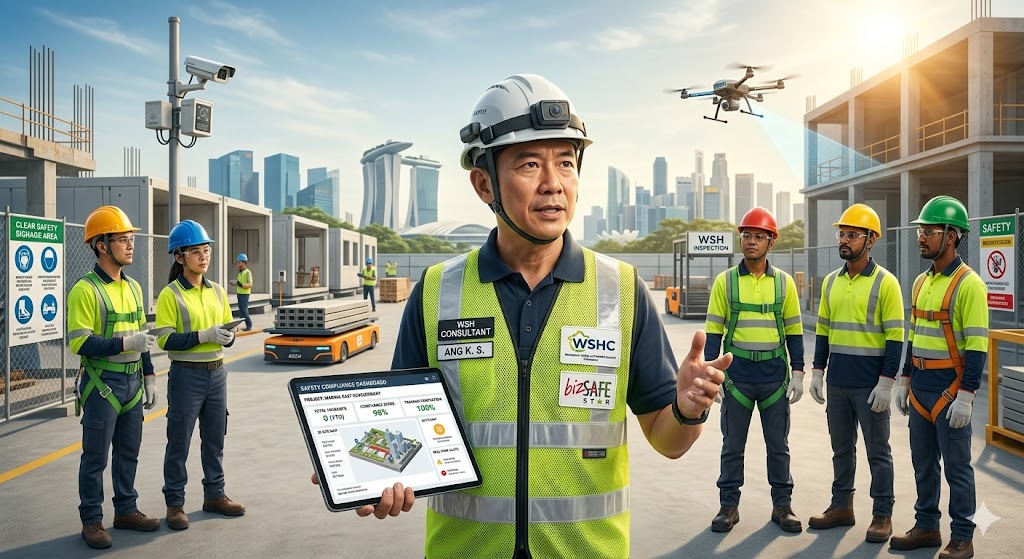
Technology is revolutionizing how modern companies approach workplace safety. The integration of Artificial Intelligence and the Internet of Things accelerates.66 These technologies shift safety protocols from reactive to highly predictive.67
Mandatory Video Surveillance Systems
In 2024, MOM mandated Video Surveillance Systems for construction worksites.68 This applies to projects with a contract value exceeding $5 million.68 VSS must be installed at locations with high-risk work activities.69
The technical specifications for these systems are stringent.70 Cameras must record at a minimum resolution of HD 1080.70
They must capture at least 12 frames per second continuously.70 The recordings must include a clear date and time stamp.70
These systems act as a powerful deterrent against unsafe behaviors.68 They force workers to internalize safety rules consistently.
This internalization shifts the culture from compliance to genuine care. They also facilitate rapid and accurate accident investigations.71 Failure to comply with VSS mandates results in a $20,000 fine.72
Wearables and Artificial Intelligence
Smart wearables are transforming on-site hazard detection capabilities rapidly. Smart helmets now feature impact detection and fatigue monitoring capabilities.73
Biometric vests track a worker’s core temperature and heart rate.73 This real-time data prevents heat stress and overexertion incidents effectively.73
GPS smart badges enable geofencing and precise location tracking.73 This is crucial for managing lone worker safety effectively.73
Fall detection devices use gyroscopes to sense sudden drops instantly.73 They directly address one of the construction industry’s deadliest hazards.73
| Wearable Type | Primary Function | Key Technology |
| Smart Helmet | Impact detection, fatigue monitoring | Accelerometer, Gyroscope 73 |
| Biometric Vest | Real-time health monitoring | Heart Rate Sensor, SpO2 73 |
| GPS Smart Badge | Location tracking, geofencing | GPS, RFID, BLE 73 |
| Fall Detection | Automatic detection of falls | 3-axis Accelerometer 73 |
AI-powered cameras can automatically detect PPE non-compliance instantly.73 They identify when workers enter predefined hazardous zones unsafely.73
Drones are utilized to inspect dangerous, hard-to-reach aerial locations.74 These innovations drastically reduce the need for human risk exposure.75 Therefore, technology acts as a behavioral modification and protection tool.
Government Grants and Financial Support
Many SMEs hesitate to adopt new safety technologies due to costs.76 However, the government provides substantial financial support schemes.76 The Productivity Solutions Grant provides essential funding for technology adoption.77
The PSG covers up to 50 percent of eligible costs.78 It applies to pre-approved digital solutions like safety management software.79 SMEs can receive up to $30,000 to improve their productivity.78 Utilizing these grants makes technological upgrades both practical and affordable.76
The application process for the PSG is highly structured. Companies must get a quotation from a pre-approved vendor first.77 Then, they submit an application on the Business Grants Portal.77 This financial support removes a significant barrier to safety modernization.
Digital Visibility and Compliance Communication
The demand for safety consultants has surged in recent years. This highlights the intersection of compliance services and digital visibility. Businesses actively search online for solutions to complex regulatory challenges. Understanding search intent is crucial for connecting experts with companies.
Long-tail keywords indicate high user intent and readiness to act.80 Broad terms like “consultant” attract high volume but low conversions.81
Specific phrases like “WSH consultant services Singapore” drive highly targeted traffic.82
These specific queries convert at significantly higher rates generally.81 They face less competition compared to highly generic head terms.83 Businesses searching for these terms are usually ready to engage services.80
Connecting these businesses with qualified experts improves national safety outcomes. A strong digital presence ensures companies find the exact compliance help needed. Thus, effective SEO strategies for consultants directly support broader WSH goals.
Building a Proactive Safety Culture
True safety excellence extends far beyond mere regulatory compliance checkboxes. It requires building a deeply ingrained, proactive safety culture.
This transformation begins with visible, unwavering commitment from top leadership.84 Leaders must allocate resources and participate in safety walkarounds actively.84
A transactional leadership style relies solely on rewards and punishments.85 Transformational leadership, however, alters the core value systems of employees.85
This approach engenders genuine, positive safety behaviors across the workforce.85
Employee involvement is another critical pillar of a strong culture. Workers possess invaluable insights into daily operational hazards.84
They must feel empowered to report near-misses without fear of blame.84 A blame-free reporting culture uncovers hidden risks before accidents occur.84
Transitioning to a proactive culture changes how organizations handle information.86 Reactive cultures punish bad news, leading to a culture of silence.86 Proactive cultures reward the reporting of hazards and near-misses actively.86
Continuous improvement must be the ultimate operational goal. Safety protocols require regular review against evolving industry best practices.84
Every worker needs relevant knowledge and skills to work safely.84 Competency assessments and regular refresher training are absolutely essential.84
Several companies have successfully championed this transformational WSH culture. Asiabuild Construction received the bizSAFE Enterprise Exemplary Gold Award recently.86 Zheng Keng demonstrated highly effective fall prevention and protection practices.86
ARLANXEO Singapore utilizes detailed Health, Safety, Security, and Environment assessments.87 They regularly meet with business partners to drive their Goal Zero plan.87 These case studies prove that WSH excellence is achievable for SMEs.
Conclusion
Navigating the complexities of Singapore’s Workplace Safety and Health Act is demanding. The regulatory landscape is intricate and subject to continuous, strict enforcement.
The Ministry of Manpower utilizes an escalating array of severe penalties. Massive fines, Stop-Work Orders, and debarment threaten non-compliant businesses constantly.
However, achieving total compliance is entirely manageable with the right expertise. Engaging a qualified WSH consultant provides an essential strategic advantage.
These experts streamline the implementation of robust safety management systems. They guide companies seamlessly through bizSAFE certification and compliance audits.
Furthermore, embracing modern technology elevates safety protocols significantly. AI, wearables, and mandatory surveillance systems provide unprecedented risk mitigation capabilities. Integrating mental health support systems is also now a critical responsibility.
Ultimately, safety is not merely a legal checkbox to mark off. It is a fundamental commitment to protecting human lives and livelihoods.
Fostering a proactive safety culture ensures long-term operational resilience and success. Businesses that prioritize safety protect their workers, their reputation, and their future.
Works cited
- What is the Workplace Safety & Health Act (WSHA) | Workday SG, accessed May 12, 2026, https://www.workday.com/en-sg/topics/hr/wsh-act-singapore.html
- The Evolution of Workplace Safety Standards in Singapore – Tripartism SG -, accessed May 12, 2026, https://tripartism.sg/the-evolution-of-workplace-safety-standards-in-singapore/
- Workplace Safety and Health Act – Wikipedia, accessed May 12, 2026, https://en.wikipedia.org/wiki/Workplace_Safety_and_Health_Act
- WORKPLACE SAFETY AND HEALTH 2028 TRIPARTITE STRATEGIES COMMITTEE’S REPORT Executive Summary Introduction 1. Singapore has made – MOM, accessed May 12, 2026, https://www.mom.gov.sg/-/media/mom/documents/safety-health/publications/executive-summary.pdf
- WSH 2028 – Singapore – MOM, accessed May 12, 2026, https://www.mom.gov.sg/-/media/mom/documents/safety-health/publications/wsh2028-report.pdf
- Workplace Safety and Health Report 2024 – Singapore – MOM, accessed May 12, 2026, https://www.mom.gov.sg/-/media/mom/documents/safety-health/reports-stats/wsh-national-statistics/wsh-national-stats-2024.pdf
- Workplace Safety Report: Workplace fatalities increase in 2024, despite major injuries hitting an all-time low – NTUC, accessed May 12, 2026, https://www.ntuc.org.sg/freelancer/news/Workplace-Safety-Report-2024-workplace-fatalities-increase-major-injuries-hit-an-all-time-low/
- MOM uncovers nearly 7,000 safety breaches in the first half of 2025 – NTUC, accessed May 12, 2026, https://www.ntuc.org.sg/uportal/news/MOM-uncovers-nearly-7000-safety-breaches-in-the-first-half-of-2025/
- Overview of Key Updates on Employment Laws and Guidelines in Singapore – 2025 & Ahead – Duane Morris Blogs, accessed May 12, 2026, https://blogs.duanemorris.com/duanemorrisandselvam/2025/04/29/overview-of-key-updates-on-employment-laws-and-guidelines-in-singapore-2025-ahead/
- Singapore Employment Law Update: September 2024 | DLA Piper, accessed May 12, 2026, https://www.dlapiper.com/insights/publications/2024/09/singapore-employment-law-update-september-2024
- 2024 Year in Review – Singapore Employment Law | Seyfarth Shaw LLP, accessed May 12, 2026, https://www.seyfarth.com/news-insights/2024-year-in-review-singapore-employment-law.html
- Legislation for workplace safety and health – Singapore – MOM, accessed May 12, 2026, https://www.mom.gov.sg/legislation/workplace-safety-and-health
- Workplace Safety and Health Approved Codes of Practice Notification 2025, accessed May 12, 2026, https://www.tal.sg/wshc/media/announcements/2025/workplace-safety-and-health-approved-codes-of-practice-notification-2025
- Workplace Safety and Health (Approved Codes of Practice) Notification 2024, accessed May 12, 2026, https://www.tal.sg/wshc/media/announcements/2025/workplace-safety-and-health-approved-codes-of-practice-notification-2024
- Workplace Safety Fines in Singapore: MOM Penalties and How to Avoid Them, accessed May 12, 2026, https://sageshield.com/workplace-safety-fines-mom-singapore/
- MOM implements increases in maximum fines and mandatory video surveillance to improve workplace safety and health – Allen & Gledhill, accessed May 12, 2026, https://www.allenandgledhill.com/sg/publication/articles/28276/mom-implements-increases-in-maximum-fines-and-mandatory-video-surveillance-to-improve-workplace-safety-and-health
- WSH Act: liabilities and penalties – Singapore – MOM, accessed May 12, 2026, https://www.mom.gov.sg/workplace-safety-and-health/workplace-safety-and-health-act/liabilities-and-penalties
- 2 jailed over safety lapses that led to worker deaths: MOM | The Straits Times, accessed May 12, 2026, https://www.straitstimes.com/singapore/2-found-guilty-of-workplace-safety-lapses-mom
- Company directors jailed, fined over safety lapses that led to workplace deaths – CNA, accessed May 12, 2026, https://www.channelnewsasia.com/singapore/construction-company-directors-jailed-safety-lapses-workplace-mom-4031281
- MOM/OSHD/2022-05 15 September 2022 All Contractors WORKPLACE SAFETY AND HEALTH (WSH) CIRCULAR ON REVISED DEMERIT POINTS SYSTEM F, accessed May 12, 2026, https://www.mom.gov.sg/-/media/mom/documents/safety-health/circulars/2022/circular-20220915-revised-dps-construction.pdf
- Demerit point system for construction and manufacturing sectors – MOM, accessed May 12, 2026, https://www.mom.gov.sg/workplace-safety-and-health/monitoring-and-surveillance/demerit-point-system
- A MOM Demerit Point Analysis | PDF – Scribd, accessed May 12, 2026, https://www.scribd.com/document/998577489/A-MOM-Demerit-Point-Analysis
- Beyond Fines: A C-Suite Guide to Singapore’s WSH Demerit Point System and the High Stakes of Non-Compliance, accessed May 12, 2026, https://mosaicsafety.com.sg/singapores-wsh-demerit-point-system/
- Safety disqualification criteria for public sector construction and construction-related projects, accessed May 12, 2026, https://www.mom.gov.sg/workplace-safety-and-health/monitoring-and-surveillance/safety-disqualification-criteria-for-public-sector-construction-and-construction-related-projects
- Launch of CheckSafe – Singapore – MOM, accessed May 12, 2026, https://www.mom.gov.sg/newsroom/announcements/2021/0121-launch-of-checksafe
- Launch of CheckSafe e-Service on MOM Website, accessed May 12, 2026, https://www.tal.sg/wshc/media/announcements/2021/launch-of-checksafe-e-service-on-mom-website
- STEP-BY-STEP GUIDE TO ACCESS CHECKSAFE E-SERVICE – MOM, accessed May 12, 2026, https://www.mom.gov.sg/-/media/mom/documents/safety-health/checksafe/checksafe-guide.pdf
- CheckSafe eService – Compare companies’ WSH performance easily – MOM, accessed May 12, 2026, https://www.mom.gov.sg/workplace-safety-and-health/checksafe
- Business Under Surveillance programme – MOM, accessed May 12, 2026, https://www.mom.gov.sg/workplace-safety-and-health/monitoring-and-surveillance/business-under-surveillance-programme
- Business Under Surveillance (BUS) Program – Dynamic Safety, accessed May 12, 2026, https://www.dynamicsafety.com.sg/index.php/consulting/index/business-under-surveillance-bus-program
- Safety and Health Management System, accessed May 12, 2026, https://www.tal.sg/wshc/topics/wsh-management-systems/safety-and-health-management-system
- Requirements for a safety and health management system – MOM, accessed May 12, 2026, https://www.mom.gov.sg/workplace-safety-and-health/safety-and-health-management-systems/safety-and-health-management-system-requirements
- About bizSAFE, accessed May 12, 2026, https://www.tal.sg/wshc/programmes/bizsafe/about-bizsafe
- What is bizSAFE: Certifications, Processes, Benefits and Requirements – SCAL Academy, accessed May 12, 2026, https://scal-academy.com.sg/courses/course_detail/What-is-bizSAFE-Certifications-Processes-Benefits-and-Requirements
- BizSAFE Singapore: All Levels, Requirements & Certification (2026) – AnjouHealth, accessed May 12, 2026, https://www.anjouhealth.com/bizsafe-singapore-complete-guide/
- Roadmap to bizSAFE STAR: Guide to Elevating Your WSH Performance in Singapore, accessed May 12, 2026, https://mosaicsafety.com.sg/roadmap-to-bizsafe-star-singapore/
- bizSAFE Singapore: The Complete Certification Guide (2026), accessed May 12, 2026, https://sageshield.com/bizsafe-guide/
- WSH Consultant Singapore- Choose The Best 1 – ProSkill Workforce …, accessed May 12, 2026, https://proskillworkforce.com/wsh-consultant/
- Safety Management System (SMS) in Singapore — Complete Implementation Guide, accessed May 12, 2026, https://sageshield.com/safety-management-system-singapore/
- Workplace Safety and Health Officer Singapore: Roles, Duties and Hiring Guide, accessed May 12, 2026, https://sageshield.com/wsh-officer-singapore-guide/
- Do You Need a WSHO or WSHC for Your Project? – QES Consultancy, accessed May 12, 2026, https://qesafety.com/do-you-need-a-wsho-or-wshc-for-your-project/
- Workplace Safety & Health Officers / Coordinators, accessed May 12, 2026, https://assuresafety.com.sg/workplace-safety-health-officers-coordinators/
- Safety Officer Salaries in Singapore for WSH Experts Pte Ltd | Indeed.com, accessed May 12, 2026, https://sg.indeed.com/cmp/Wsh-Experts-Pte-Ltd/salaries/Safety-Officer
- Safety Officer Salary in Singapore (May, 2026) – Jobstreet, accessed May 12, 2026, https://sg.jobstreet.com/career-advice/role/safety-officer/salary
- ISO 45001 Lead Auditor Course | CQI-IRCA approved Courses Singapore – Avanta Global, accessed May 12, 2026, https://avanta.com.sg/page/courses/cqi-irca-approved-iso-450012018-occupational-health-and-safety-management-system-lead-auditor-course/
- Workplace Safety and Health Services – Institute of Ergonomics and Hygiene, accessed May 12, 2026, https://ieh.sg/services/workplace-safety-and-health-services/
- Safety Audit Checklist Singapore — MOM Compliant 2026 | Sage S…, accessed May 12, 2026, https://sageshield.com/safety-audit-checklist-singapore/
- Workplace Safety Checklist Singapore | WSH Compliance Guide – AnjouHealth, accessed May 12, 2026, https://www.anjouhealth.com/workplace-safety-checklist-singapore/
- Checklist – MOM, accessed May 12, 2026, https://www.mom.gov.sg/~/media/mom/documents/services-forms/safety%20and%20health/consass%20checklist.xls
- Singapore Business Compliance: Avoid These Common Mistakes in Accounting and Operations – Raffles Corporate Services, accessed May 12, 2026, https://rafflescorporateservices.com/singapore-business-compliance-avoid-these-common-mistakes-in-accounting-and-operations/
- Key Compliance Mistakes Singapore SMEs Will Still Be Making in 2026 (And How to Avoid Them) – KOH Management, accessed May 12, 2026, https://www.shkoh.com.sg/post/key-compliance-mistakes-singapore-smes-will-still-be-making-in-2026-and-how-to-avoid-them/
- Top 10 SME Compliance Mistakes in Singapore – Entrust Public Accounting Corporation, accessed May 12, 2026, https://www.entrust.sg/singapore-sme-compliance-mistakes/
- Health and Safety Regulations for Opening a New Office/Retail Location in Singapore, accessed May 12, 2026, https://ddsinternationalsafety.eu/news-insights/health-and-safety-regulations-new-location-singapore/
- Workplace Safety and Health in Food and Beverage Operations, accessed May 12, 2026, https://assuresafety.com.sg/workplace-safety-and-health-in-food-and-beverage-operations/
- Business Must-Know: F&B Regulations in Singapore – StaffAny, accessed May 12, 2026, https://www.staffany.com/blog/fb-regulations-in-singapore/
- Food Safety Tips – Singapore Food Agency, accessed May 12, 2026, https://www.sfa.gov.sg/food-safety-tips/safe-food-practices/food-safety-tips
- Tripartite Advisory on Mental Health and Well-being at Workplaces, accessed May 12, 2026, https://www.tal.sg/tafep/resources/advisories/2020/tripartite-advisory-on-mental-health-and-well-being-at-workplaces
- 0922 Written Answer to PQ on Workplace Burnout – MOM, accessed May 12, 2026, https://www.mom.gov.sg/newsroom/parliament-questions-and-replies/2025/0922-written-answer-to-pq-on-workplace-burnout
- The December reset: Why burnt-out Singapore workers can’t afford to skip this break – NTUC, accessed May 12, 2026, https://www.ntuc.org.sg/ucarecentre/news/december-break-for-burnt-out-workers/
- iWorkHealth, accessed May 12, 2026, https://www.iworkhealth.gov.sg/
- Company iWorkHealth Report, accessed May 12, 2026, https://www.tal.sg/wshc/-/media/tal/wshc/programmes/files/iworkhealth-company-report-sample_20251125.pdf
- Recommended Interventions – Tripartite Alliance Limited, accessed May 12, 2026, https://www.tal.sg/wshc/programmes/iworkhealth/recommended-interventions
- TRIPARTITE ADVISORY ON MENTAL WELL-BEING AT WORKPLACES – Baker McKenzie, accessed May 12, 2026, https://insightplus.bakermckenzie.com/bm/attachment_dw.action?attkey=FRbANEucS95NMLRN47z%2BeeOgEFCt8EGQJsWJiCH2WAWHb/PDBPVvgqhOYPRAWh/b&nav=FRbANEucS95NMLRN47z%2BeeOgEFCt8EGQbuwypnpZjc4%3D&attdocparam=pB7HEsg/Z312Bk8OIuOIH1c%2BY4beLEAe/AuZuZP8E4o%3D&fromContentView=1
- About iWorkHealth and Workplace Stress, accessed May 12, 2026, https://www.tal.sg/wshc/programmes/iworkhealth/about-iworkhealth-and-workplace-stress
- Tripartite advisory on mental health and well-being at workplaces – MOM, accessed May 12, 2026, https://www.mom.gov.sg/employment-practices/tripartism-in-singapore/tripartite-guidelines-and-advisories/tripartite-advisory-on-mental-well-being-at-workplaces
- AI and IoT in Workplace Safety: Prevent Hazards Before They Happen | UniAthena, accessed May 12, 2026, https://uniathena.com/ai-iot-workplace-safety
- Top 5 Workplace Safety AI Trends in Singapore in 2026 – viAct, accessed May 12, 2026, https://www.viact.ai/post/top-5-workplace-safety-ai-trends-in-singapore-in-2026
- Video Surveillance System (VSS) for Construction Worksites: Enhancing Safety and Compliance – SafeTrolley, accessed May 12, 2026, https://www.safetrolley.com/video-surveillance-system-vss-construction-worksites/
- New WSH Measures from 1 June 2024: Increase in Maximum Fines, Mandatory Video Surveillance Systems for Relevant Construction Projects | Rajah & Tann Asia, accessed May 12, 2026, https://www.rajahtannasia.com/viewpoints/new-wsh-measures-from-1-june-2024-increase-in-maximum-fines-mandatory-video-surveillance-systems-for-relevant-construction-projects/
- Video surveillance system (VSS) for construction sector – MOM, accessed May 12, 2026, https://www.mom.gov.sg/workplace-safety-and-health/safe-measures/sectoral-level/video-surveillance-system-for-construction-sector
- FAQs for video surveillance system (VSS) for construction worksites with contract value of $5 million and above – MOM, accessed May 12, 2026, https://www.mom.gov.sg/-/media/mom/documents/safety-health/faqs-for-vss.pdf
- [ Video Surveillance System Requirement ] Workplace Safety & Health (General Provisions) (Amendments No. 2) Regulations – Redas, accessed May 12, 2026, https://redas.com/wp-content/uploads/2025/10/Video-Surveillance-System-Requirement-Workplace-Safety-Health-General-Provisions-Amendments-No.-2-Regulations-2024.pdf
- WSH Tech Singapore: How Wearables, AI & Drones Are Revolutionizing Construction Safety, accessed May 12, 2026, https://mosaicsafety.com.sg/wsh-tech-singapore-how-wearables-ai-drones-revolutionizing-construction-safety/
- WSH Technology & Innovation | Top Tech Advancements in Workplace Safety, accessed May 12, 2026, https://scal-academy.com.sg/courses/course_detail/WSH-Technology-and-Innovation
- Workplace Safety and Health (WSH) Technology – Singapore – MOM, accessed May 12, 2026, https://www.mom.gov.sg/workplace-safety-and-health/wsh-technology
- Debunking Myths, Boosting Safety: Guide to WSH Tech & Grants for SMEs – Hubble.Build, accessed May 12, 2026, https://hubble.build/newsroom/workplace-safety-health-wsh-tech-sme-grants-guide
- Productivity Solutions Grant (PSG) | GoBusiness, accessed May 12, 2026, https://grants.gobusiness.gov.sg/support/productivity-solutions-grant
- Productivity Solutions Grant (PSG) – Enterprise Singapore, accessed May 12, 2026, https://www.enterprisesg.gov.sg/financial-support/productivity-solutions-grant
- PSG Grant Singapore — Productivity Solutions Grant Guide 2026 | Sage Shield, accessed May 12, 2026, https://sageshield.com/psg-grant-singapore/
- Long-Tail Keywords: The Ultimate 2026 Guide – Yotpo, accessed May 12, 2026, https://www.yotpo.com/blog/long-tail-keywords-guide/
- Long-Tail Keywords vs Short-Tail Keywords: What Every Singapore Business Needs to Know, accessed May 12, 2026, https://www.bestseo.sg/blog/long-tail-vs-short-tail/
- Keywords in SEO: A Complete Guide for Businesses in Singapore – Absolute Digital, accessed May 12, 2026, https://www.absolutedigital.sg/post/keywords-in-seo-a-complete-guide-for-businesses-in-singapore
- Long-Tail Keywords: How to Effectively Use Them in SEO – Ematic Solutions, accessed May 12, 2026, https://www.ematicsolutions.com/long-tail-keywords-seo/
- How to Build a Safety Culture in Your Singapore Workplace, accessed May 12, 2026, https://sageshield.com/build-safety-culture-singapore-workplace/
- Impact of Transformational Leadership on Safety Culture – Department of the Built Environment – NUS College of Design and Engineering, accessed May 12, 2026, https://cde.nus.edu.sg/dbe/2017/02/impact-of-transformational-leadership-on-safety-culture/
- Beyond Compliance: Building a Proactive WSH Culture in Singapore SMEs, accessed May 12, 2026, https://mosaicsafety.com.sg/beyond-compliance-building-proactive-wsh-culture-singapore-smes/
Case studies: Employers championing WSH in Singapore | Human Resources Online, accessed May 12, 2026, https://www.humanresourcesonline.net/case-studies-employers-championing-wsh-in-singapore