

Singapore’s construction sector recorded a measurable decline in both fatal and major injury rates from 2024 to 2025, and that progress did not materialize through passive compliance exercises or perfunctory paperwork. It emerged because a growing number of owners and project managers began treating safety training as a dynamic, governance-embedded system rather than a one-time onboarding ritual. This article examines the regulatory foundations, role-specific frameworks, methodological choices, and audience segmentation strategies that collectively determine whether safety training functions as a genuine risk-control mechanism or merely as a compliance artifact.
Table of Contents
- Why safety training is a compliance cornerstone
- Role-specific safety training: Matching competencies to jobs
- Training methodology matters: From classroom to hands-on learning
- Tailoring content: Avoiding the ‘one message fits all’ pitfall
- Singapore construction: Training is not a shortcut, it’s a system
- Take safety training further: Consulting and compliance support for Singapore owners
- Frequently asked questions
Key Takeaways
| Point | Details |
|---|---|
| Compliance requires ongoing training | Singapore regulations mandate continuous, role-specific safety training—renewal is not optional. |
| Role-driven content is essential | Workers, supervisors, and PMs need tailored training to ensure regulatory coverage and practical site safety. |
| Hands-on methods outperform lectures | Interactive, site-based training boosts engagement and learning retention beyond classroom-only formats. |
| Segment your audience | Avoid one-size-fits-all content by calibrating training modules and assessments for each site role. |
| Benchmark beyond compliance | Use injury rate trends and upstream governance, not just training completion, to measure real safety performance. |
Why safety training is a compliance cornerstone
Singapore’s Workplace Safety and Health (WSH) framework, administered by the Ministry of Manpower (MOM), establishes a statutory obligation for employers to provide adequate instruction, training, and supervision to every worker exposed to site hazards. This obligation is not discharged by a single induction session completed at onboarding. The MOM accredited courses list treats safety competency as an ongoing, periodically renewed requirement, and any gap in that continuity constitutes a regulatory exposure for the principal contractor and site owner alike.
This distinction between a one-time checkbox and an ongoing competency requirement is the conceptual foundation on which all subsequent training investment decisions rest. When project managers treat competency as a living obligation, they simultaneously satisfy regulatory auditors and create the operational conditions under which workers actually recognize and respond to site hazards.
The importance of this distinction becomes quantifiable when you examine sector-level outcomes. Singapore’s construction WSH Report 2025 confirms that fatal and major injury rates fell from 2024 to 2025, with regulators attributing the trend in part to strengthened WSH ownership and heightened vigilance. Both ownership and vigilance are competency-dependent outcomes. They cannot be mandated through signage or policy documents alone; they require trained personnel who understand their responsibilities and recognize hazard signals in real time.
Key regulatory obligations that training must address include:
- Instruction and information: Workers must receive documented, task-specific hazard information before commencing work.
- Supervision quality: Supervisors require their own competency credentials that differ substantively from worker-level training.
- Periodic re-qualification: Re-qualification intervals are defined by the specific WSQ (Workforce Skills Qualifications) course, not by organizational preference.
- Appointment-linked training: Certain statutory appointments, such as the Workplace Safety and Health Officer role, carry mandatory prerequisite qualifications that training programs must explicitly satisfy.
“Strengthening WSH ownership and heightened vigilance, including training and competency, is the identified driver behind Singapore’s improving construction safety outcomes.” — MOM WSH Report 2025
Owners who understand these obligations as integrated system requirements rather than isolated compliance tasks are better positioned to pass MOM audits and, more critically, to protect their workforce. The Singapore safety standards overview and a rigorous construction compliance guide both reinforce that regulatory credibility is built on documented, role-matched, and periodically renewed training records, not on volume of training hours alone.
Role-specific safety training: Matching competencies to jobs
One of the most consequential errors construction companies make is deploying generic safety training across all personnel levels. The MOM accredited courses framework is explicitly stratified by role, recognizing that the competency a scaffolding worker needs differs fundamentally from what a site supervisor or a project manager must demonstrate to fulfill their respective statutory obligations.

Consider the following differentiated requirements across the three primary personnel tiers:
| Personnel tier | Core training scope | Regulatory anchor | Re-qualification |
|---|---|---|---|
| Construction worker | Task-specific hazard recognition, PPE use, emergency response | WSH (General Provisions) Regulations | As specified per WSQ module |
| Site supervisor | Hazard identification, permit-to-work oversight, incident reporting | WSH (Construction) Regulations, Reg. 10 | Periodic renewal required |
| Project manager / safety officer | Risk management systems, statutory appointment prerequisites, WSH governance | WSH (Construction) Regulations, WSH (Safety Officers) Regulations | Mandatory re-qualification cycle |
This stratification is not bureaucratic formalism. When a supervisor lacks the specific competency to verify a permit-to-work, or when a project manager cannot correctly interpret a risk assessment submitted by a subcontractor, the resulting oversight gap generates both regulatory and physical risk on the same site simultaneously.
The steps for building a defensible, role-specific training matrix are straightforward but require disciplined execution:
- Map every site appointment to its statutory competency prerequisite, referencing MOM’s accredited course catalog to confirm alignment.
- Audit current training records against role-based requirements, identifying personnel whose certifications are expired or misaligned with their actual responsibilities.
- Assign WSQ pathway enrollment based on role category, ensuring workers, supervisors, and managers each follow the appropriate track rather than a shared syllabus.
- Document re-qualification dates in a centralized training register, with calendar alerts triggering renewal enrollment at least 60 days before expiry.
- Validate competency through assessment, not attendance; completion of a course module does not guarantee operational competency without structured post-training evaluation.
Pro Tip: Owners who conduct a quarterly training matrix audit, cross-referencing current site appointments against current certification status, consistently achieve cleaner MOM audit outcomes than those who rely on ad-hoc training scheduling. This practice integrates naturally with broader safety management systems governance protocols.
Understanding the full scope of safety manager duties is particularly important for PMs who need to verify that their appointed safety officers hold current, role-appropriate WSQ credentials. Similarly, integrating training requirements upstream, at the design stage, is an approach explored in design for safety methodology, which specifies hazard control interventions before construction personnel ever set foot on site.
Training methodology matters: From classroom to hands-on learning
Even well-structured, role-specific training programs underperform when delivery methodology is not deliberately matched to learning objectives. Research on construction training effectiveness confirms that the format in which content is delivered materially shapes engagement levels, hazard recognition capacity, and knowledge retention over time.
A field experiment on construction safety training found that learner-centered and hands-on training components consistently outperformed passive lecture-based instruction on both engagement and hazard recognition learning outcomes. Workers who physically practiced hazard identification protocols in simulated site conditions demonstrated measurably stronger post-training recognition performance than those who received equivalent information through didactic instruction alone.
The implications for training program design are concrete:
- Scenario-based exercises that replicate actual site conditions activate recognition pathways that classroom discussions cannot.
- Interactive hazard-spotting modules, including walkthrough simulations, produce stronger competency transfer than slide-driven presentations covering identical content.
- Peer discussion and reflective debriefs after scenario exercises improve the consolidation of hazard recognition knowledge relative to passive review sessions.
- Digital and blended learning formats can serve as effective delivery channels for theoretical content, provided they are paired with on-site practical components rather than used as complete substitutes.
An additional dimension of methodology involves content sequencing. An MDPI study on construction training design found that structuring training content to mirror the actual work sequence improves cognitive effectiveness and recall compared to randomly organized material. When a scaffolding worker’s training follows the precise sequence of scaffold erection tasks, the learning maps directly onto the mental model the worker uses on site, reducing the cognitive load required to apply trained procedures under actual working conditions.
| Training format | Engagement level | Hazard recognition gain | Retention advantage |
|---|---|---|---|
| Lecture-based classroom | Low to moderate | Baseline | Minimal |
| Blended digital and classroom | Moderate | Moderate | Moderate |
| Learner-centered, hands-on | High | Significantly above baseline | Strong |
| Work-sequence-aligned training | Moderate to high | Moderate to high | Strong (up to 32% improvement) |
Pro Tip: The most effective training programs for Singapore construction contexts combine formal WSQ-accredited instruction with site-based interactive modules scheduled at intervals that reinforce prior learning. Pairing this with periodic site safety walkthroughs conducted immediately after training sessions consolidates learning while producing operationally useful hazard documentation. A structured safety audit process provides the formal mechanism through which post-training competency gaps are identified and remediated before they generate incidents.
Tailoring content: Avoiding the ‘one message fits all’ pitfall
Beyond structural methodology, the actual content of safety training must be segmented by audience. This is a subtler but equally critical variable. Research on safety training perceptions demonstrates that codified safety knowledge, such as standardized hazard classification schemes, risk matrix frameworks, or regulatory guideline summaries, affects workers and safety experts in measurably different ways.
An Econstor study on safety perceptions found that exposure to codified safety training content can influence risk perception differently depending on the recipient’s existing knowledge base and professional role. For workers with limited prior safety education, standardized content may anchor risk perception in ways that do not accurately reflect site-specific hazard severity. For safety professionals, the same content may trigger different cognitive calibration effects. The practical consequence is that undifferentiated training content, delivered identically to workers and managers, risks distorting the very risk perception it is designed to improve.
The corrective approach requires systematic audience segmentation, operationalized through the following practices:
- Conduct role-based needs assessments before finalizing training content, distinguishing between what workers need to recognize and respond to versus what supervisors and managers need to evaluate and govern.
- Include calibration exercises within training modules, requiring participants to apply codified hazard classifications to site-specific scenarios rather than simply recall definitions. This reveals perception gaps that written assessments alone will not surface.
- Design role-appropriate post-training assessments that validate operational judgment, not just content recall, since the goal is accurate risk perception and response, not theoretical knowledge accumulation.
- Revisit content relevance periodically, as site conditions, contract scope, and workforce composition evolve across a project lifecycle, creating new audience segmentation requirements even within a stable team.
“Safety training content segmentation, matched to the audience’s existing knowledge, role responsibility, and decision-making authority, is the mechanism through which training investment converts into accurate on-site risk perception.”
For organizations working with design for safety professionals at the upstream design stage, this segmentation imperative extends to the interface between design teams and construction personnel. Hazard control information embedded in design documentation must be translated into audience-appropriate training content for site-level personnel, a translation process that requires deliberate content adaptation rather than direct information transfer.
Singapore construction: Training is not a shortcut, it’s a system
After reviewing the regulatory mandates, role differentiation frameworks, methodological evidence, and content segmentation requirements, a direct assertion is warranted: organizations that approach safety training as a compliance shortcut, completed to satisfy MOM auditors and thereafter left static, are systematically underinvesting in the one intervention that would most predictably reduce their incident exposure.
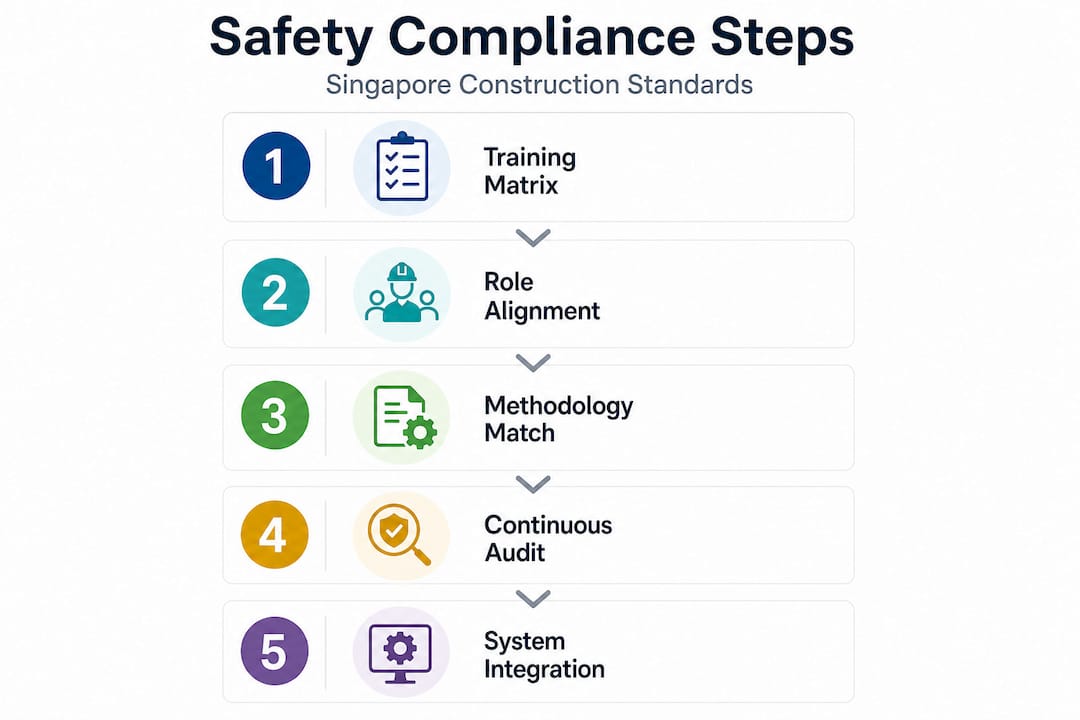
The WSH Report 2025 provides a useful calibration point. Singapore’s improving injury rate trends reflect not merely higher training volumes but deeper WSH ownership embedded within site governance structures. Training is the entry point, not the endpoint. The project managers and owners who achieve sustained safety performance are those who integrate training completions into a broader governance architecture that includes active safety committee resourcing, documented site vigilance protocols, and leadership accountability for competency maintenance.
This means using regulator-reported injury rate trends as a directional KPI while tying actual training interventions to upstream governance decisions, specifically WSH ownership structures, committee resourcing, and supervision quality standards. A training register that looks compliant on paper but is disconnected from how site supervision is actually resourced will not sustain risk control when conditions change mid-project.
The safety management systems guide positions this integration as structural, not aspirational. Training records must feed into incident investigation protocols, near-miss reporting systems, and periodic safety committee reviews, creating a feedback loop that keeps competency requirements calibrated to actual site risk rather than fixed to initial enrollment decisions. This is the architecture that distinguishes organizations with genuine safety culture from those with compliance documentation.
Take safety training further: Consulting and compliance support for Singapore owners
Owners and project managers who recognize the gap between current training practice and the integrated system described above often need structured support to close it efficiently.

MOSAIC Ecoconstruction Solutions works directly with Singapore construction firms to audit existing training matrices against MOM’s role-specific competency requirements, identify regulatory gaps before they surface during inspections, and design WSQ pathway implementation plans matched to each organization’s appointment structure and project scope. Our consultancy support extends beyond enrollment coordination to include training content review, post-training competency assessment design, and integration of training governance into your safety audit and WSH management protocols. If your organization is ready to move from compliance-minimum training to a system that demonstrably reduces incident exposure, contact us at mosaicsafety.com.sg to discuss a structured safety consultancy engagement.
Frequently asked questions
What are the legal requirements for construction safety training in Singapore?
Construction safety training in Singapore must follow role-specific WSQ courses aligned with MOM regulations, treating competency as an ongoing requirement rather than a one-time obligation, with accredited course coverage mapped to each statutory appointment and site role.
How often should construction workers and managers renew their safety qualifications?
Re-qualification intervals are defined by the specific WSQ pathway enrolled, and organizations should implement a centralized training register that triggers renewal enrollment well ahead of expiry to maintain unbroken compliance credibility.
Does hands-on training outperform lecture-based safety courses?
Yes. Learner-centered and hands-on training modules consistently produce higher engagement scores and stronger hazard recognition outcomes than traditional classroom lecture delivery, particularly when scenario exercises replicate actual site conditions.
How can owners verify if their training matches regulatory scope?
Owners should audit their training matrix by cross-referencing each site appointment against the corresponding MOM competency requirement, confirming that workers, supervisors, and managers each hold current, role-appropriate WSQ credentials rather than generalized safety certifications.