Singapore’s construction sector remains a higher-risk contributor to workplace fatalities nationwide, yet many site managers still operate under a fragmented understanding of what occupational health and safety (OHS) actually demands under Singapore law. The gap between regulatory intent and on-site execution is not simply a knowledge problem — it reflects a systemic underestimation of the discipline’s scope. This guide addresses that gap directly, unpacking Singapore-specific OHS definitions, the statutory framework governing construction worksites, concrete compliance requirements, and proven best practices that move organizations from minimum adherence to genuine safety leadership.
Table of Contents
- Understanding occupational health and safety in Singapore construction
- Legal framework: OHS laws and standards for Singapore construction
- Key compliance requirements for Singapore construction worksites
- Best practices: Building a proactive safety culture on-site
- Our perspective: Why OHS maturity outpaces checklists
- How Mosaic can help you strengthen workplace safety
- Frequently asked questions
Key Takeaways
| Point | Details |
|---|---|
| OHS is risk-based | OHS in Singapore construction means proactively managing workplace risks, not just reacting to incidents. |
| Legal compliance is mandatory | All construction sites must follow the WSH Act, sector-specific regulations, and implement a SHMS. |
| Construction has higher risk | The construction sector’s higher fatality rate makes rigorous OHS essential for every site. |
| Best practices go beyond law | Superior site safety requires systematic hazard management and building a proactive safety culture. |
| Benchmark for improvement | Use Singapore’s official injury rates to measure and improve your site’s safety performance. |
Understanding occupational health and safety in Singapore construction
With fatality risks at the forefront of industry discourse, it is essential to establish what OHS actually means within Singapore’s construction context, because the term is frequently misused or narrowly interpreted.
Occupational health and safety is fundamentally about managing workplace risks to protect people from work-related injury and illness through a prevention-focused, risk-based approach. The critical word here is systematic. OHS in construction is not a function reducible to issuing personal protective equipment or posting safety signage at site entrances. It demands a structured discipline that anticipates hazards before they materialize, assigns accountability to specific duty holders, and continuously verifies that risk controls are functioning as intended.
OHS is not a product you purchase or a certificate you hang on the wall. It is an ongoing operational commitment that permeates every phase of a construction project, from feasibility through to handover.
Under Singapore’s regulatory architecture, legal responsibility for OHS is distributed across multiple parties at a worksite. Employers bear the primary duty to ensure the safety and health of their workers, while occupiers of construction sites carry independent obligations to maintain safe premises and plant. Project managers, safety officers, and supervisors hold derivative duties based on the authority and control they exercise over worksite operations. This distribution of responsibility reflects a deliberate legislative philosophy: that safety outcomes improve when accountability is embedded at every tier of the organizational hierarchy, rather than concentrated in a single compliance function.
Key parties responsible under Singapore law include:
- Employers, who must provide safe systems of work, adequate training, supervision, and a workplace free from foreseeable risks
- Occupiers, who must ensure the safety of premises, machinery, and equipment within their control
- Persons at the workplace, including contractors and subcontractors, who must cooperate with safety requirements and not endanger others
- Manufacturers and suppliers of machinery or hazardous substances, who must ensure their products are safe when properly used
Understanding OHS management systems in this holistic sense is the essential precondition for meeting both the letter and spirit of Singapore’s statutory requirements.
Legal framework: OHS laws and standards for Singapore construction
With definitions established, it is crucial to identify precisely which laws and regulations set the binding standards for construction site OHS in Singapore.
The primary legislative instrument is the WSH Act 2006, which establishes broad, principle-based duties on all persons at workplaces regarding safety, health, and welfare. Rather than prescribing exhaustive technical specifications for every scenario, the WSH Act adopts a performance-based model: duty holders must take reasonably practicable measures to eliminate or mitigate risks, and the definition of “reasonably practicable” is calibrated against the severity and probability of harm, balanced against the cost and feasibility of control measures.
Singapore’s sector-specific subsidiary legislation for construction worksites, principally the WSH (Construction) Regulations 2007, adds a layer of prescriptive requirements that translate the WSH Act’s principles into concrete operational obligations. These regulations cover excavation safety, working at height, formwork and falsework, lifting operations, electrical safety, and the management of machinery and plant on construction sites.
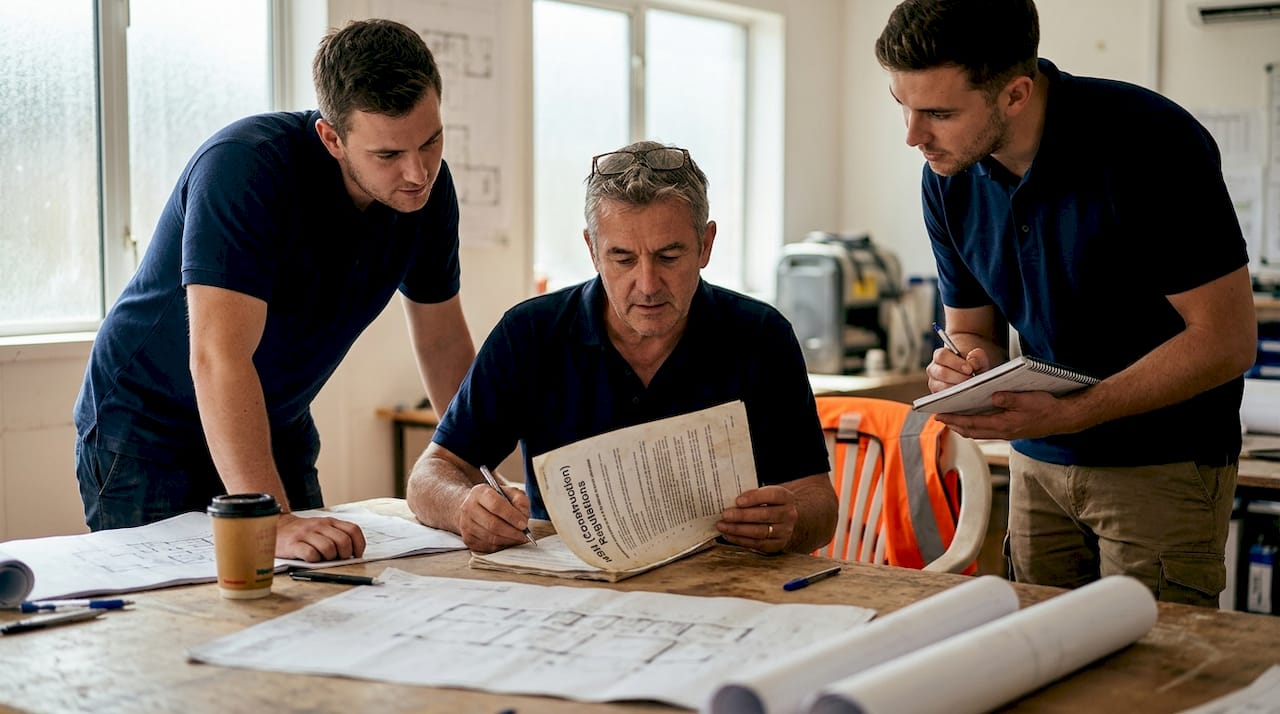
The table below summarizes the primary legislative instruments governing OHS in Singapore’s construction sector:
| Legislation | Scope | Key obligations |
|---|---|---|
| WSH Act 2006 | All workplaces, including construction sites | General duties for employers, occupiers, persons at workplace |
| WSH (Construction) Regulations 2007 | Construction worksites specifically | Site-specific controls: working at height, excavation, lifting |
| WSH (Risk Management) Regulations 2006 | All workplaces | Mandatory risk assessment and control documentation |
| WSH (Safety and Health Management System) Guidelines | Higher-risk worksites | SHMS implementation requirements |
| WSH (Incident Reporting) Regulations | All workplaces | Mandatory reporting of workplace accidents and dangerous occurrences |
For construction management teams, understanding compliance obligations as a sequential set of responsibilities is more actionable than treating them as an undifferentiated list. The structured approach follows this progression:
- Identify the legal classification of your worksite. Construction sites are classified as factories under the WSH Act, which triggers specific notification or registration requirements with the Ministry of Manpower (MOM) based on project size and risk level.
- Appoint the requisite statutory roles. Depending on contract value and site classification, this may include a Workplace Safety and Health Officer (WSHO), Safety Supervisor, and Contractor Safety Officer.
- Conduct and document mandatory risk assessments prior to commencing high-risk work activities, and update them when site conditions change materially.
- Implement a Safety and Health Management System (SHMS) that covers hazard identification, incident investigation, safety training, emergency preparedness, and performance monitoring.
- Maintain compliance records accessible for MOM inspections, including training registers, risk assessment documentation, and incident reports.
Pro Tip: The precise legal definition of “worksite” and “factory” under the WSH Act can determine whether your project triggers registration requirements and which subsidiary regulations apply. Site managers should verify their project’s classification at project inception, not after regulatory queries arise.
Understanding the full scope of construction safety standards applicable to your worksite is a non-negotiable foundation for any credible compliance program.
Key compliance requirements for Singapore construction worksites
These laws translate into very specific requirements for construction teams and site managers. Here is what you need to implement, and why the stakes justify the operational investment.
Construction worksites must implement an SHMS and remain continuously compliant with applicable regulations throughout the project lifecycle. The SHMS is not a static document produced at project commencement and filed away. It is a living system that governs how safety is planned, executed, monitored, and improved across every phase of site operations.
The following table presents Singapore’s construction sector fatality data, which illustrates the magnitude of risk that these compliance requirements are designed to control:
| Year | Fatal injuries (construction) | Fatality rate per 100,000 workers |
|---|---|---|
| 2022 | 15 | 2.9 |
| 2023 | 13 | 2.5 |
| 2024 | 20 | 3.7 |
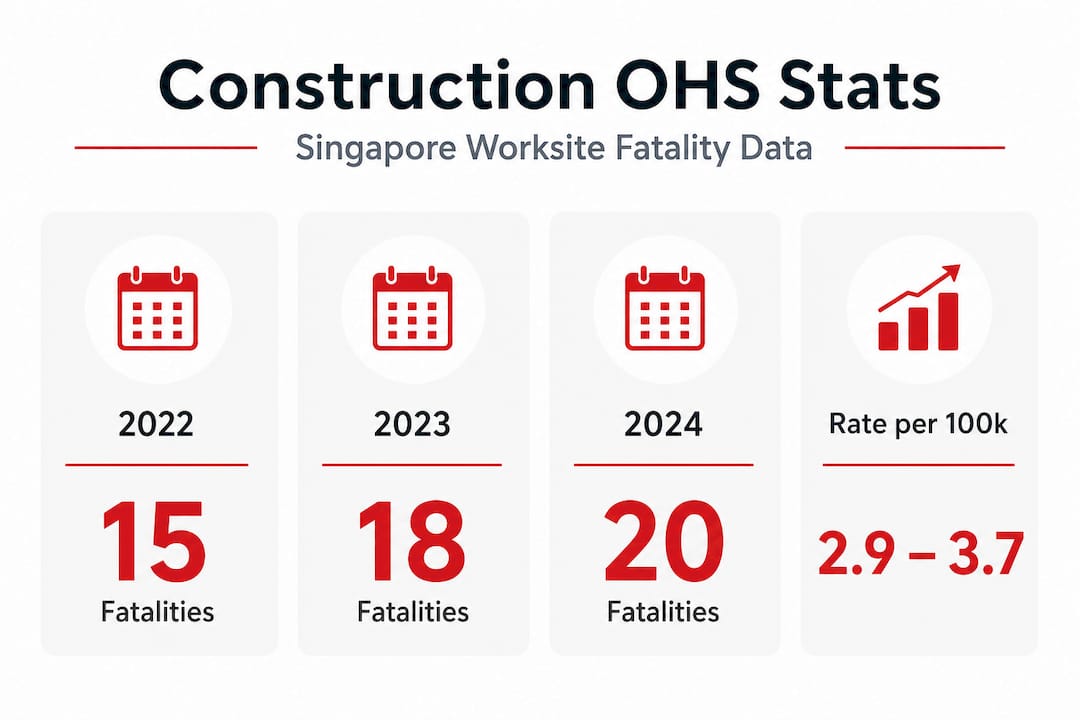
The 2024 fatality data represents a significant adverse trend, with 20 fatal injuries recorded in the construction sector and a fatality rate of 3.7 per 100,000 workers. This reversal of the prior downward trajectory underscores why compliance cannot be treated as a periodic exercise calibrated to inspection cycles.
The nuance of the “factory” classification merits particular attention. Under the WSH (Factories) Regulations, construction sites meeting certain criteria are classified and registered as factories, which imposes additional regulatory obligations including prescribed inspection intervals, competency requirements for operating specific plant and equipment, and mandatory notification timelines for structural alterations. Sites that incorrectly assume they are not subject to factory regulations risk compounding compliance exposure.
Key compliance implementation requirements include:
- Factory notification or registration with MOM, depending on project value and the nature of construction activities involved.
- WSHO appointment for projects with contract values exceeding the prescribed thresholds under the WSH (Construction) Regulations.
- Risk Assessment (RA) documentation for each work activity, with formal review and approval by competent persons before work commences.
- Safe Work Procedures (SWPs) communicated to all workers in a language they understand, covering high-risk activities including working at height, confined space entry, and lifting operations.
- Safety audits and inspections conducted at prescribed intervals, with corrective actions tracked to closure.
Pro Tip: Use MOM’s published fatality rates as internal benchmarks for your safety performance review meetings. A site with injury rates consistently above the sector average warrants formal investigation of its SHMS effectiveness, not merely surface-level corrective actions.
For guidance on structuring a compliant program, the SHMS guide provides a detailed framework aligned with MOM’s requirements and sector expectations.
Best practices: Building a proactive safety culture on-site
Legal compliance is only the baseline. Excellence in construction OHS means embedding preventive behaviors at every level of the project organization, not merely satisfying the minimum statutory threshold before MOM inspections.
The fundamental mechanics of effective OHS require identifying hazards, assessing risk, implementing controls, and managing the entire process through integrated systems rather than isolated PPE mandates. Organizations that achieve lasting safety performance improvements recognize that the quality of hazard identification upstream determines the efficacy of every downstream control measure.
Best practices for proactive site safety management include:
- Integrate Design for Safety (DfS) at project inception. Hazard elimination is most effective and least costly when addressed during the design phase, before physical construction commits the project to particular structural configurations, sequencing constraints, or access limitations.
- Conduct systematic Job Hazard Analysis (JHA) for every high-risk task. JHA breaks each work activity into discrete steps, identifies the specific hazards associated with each step, and prescribes controls calibrated to the hazard’s severity and probability.
- Establish a behavioral safety observation program. Supervisors and safety personnel conduct structured observations of at-risk behaviors, providing immediate feedback and trending data for management review. This converts safety oversight from a reactive to a predictive function.
- Conduct toolbox talks before every work shift, not as a checkbox. Effective toolbox talks are specific to the day’s planned activities, reference current site conditions, and generate genuine two-way dialogue rather than one-directional information delivery.
- Implement a formal incident and near-miss reporting culture. Near-miss events are statistically the most abundant leading indicator of serious injury potential. Organizations that suppress or ignore near-miss reporting sacrifice their most valuable source of predictive intelligence.
- Benchmark against industry peers using MOM’s published WSH statistics. Segment the data by construction subsector where possible, and set internal targets that are materially better than the sector average.
Pro Tip: Engage subcontractors in your safety culture program as active participants, not passive recipients of your site rules. Subcontractor workforce behavior is statistically one of the highest-risk variables on multi-party construction sites, and safety culture integration with subcontract procurement and management processes is among the highest-leverage interventions available to principal contractors.
Practical site safety tips and design for safety integration are both valuable components of a mature construction OHS program that extends well beyond regulatory minimums.
Our perspective: Why OHS maturity outpaces checklists
With best practices in mind, it is worth examining how industry leaders in Singapore’s construction sector convert OHS requirements into genuine competitive advantages, rather than treating them as a cost of regulatory compliance.
The checklist mentality is a pervasive and costly error in construction safety management. Organizations that approach OHS as a documentation exercise produce voluminous records and well-organized site offices, but their injury rates remain stubbornly elevated because the underlying system of behavioral and organizational controls never matures beyond procedural compliance. The checklist confirms that the form was completed. It does not confirm that the hazard was controlled.
The organizations achieving the best safety outcomes in Singapore’s construction sector share a common characteristic: they use MOM’s published WSH statistics not as a reference point for understanding sector-level risk, but as a continuous improvement benchmark against which internal performance is rigorously measured. When the sector fatality rate increases from 2.5 to 3.7 per 100,000 workers in a single year, mature organizations ask what systemic factors drove that deterioration and what they can implement proactively to ensure their own trajectory diverges from the sector average.
OHS maturity also requires senior leadership engagement that extends beyond attendance at monthly safety committee meetings. The construction projects in Singapore with the strongest safety cultures are those where project directors and general managers visibly and consistently prioritize safety in their decision-making, resource allocation, and communications with their teams. Safety culture is not manufactured by the safety department. It is produced by organizational leadership. The safety department is the technical expert; the leadership is the cultural driver.
This is why the most effective safety investment a construction organization can make is not in more documentation systems or compliance software, but in leadership development programs that cultivate genuine safety ownership at every tier of the project hierarchy.
Exploring construction compliance guidance from a systems perspective, rather than a procedural one, will accelerate your organization’s transition from compliance sufficiency to safety excellence.
How Mosaic can help you strengthen workplace safety
Ready to move forward with stronger compliance and safety performance? Here’s how Mosaic supports your next steps.
Mosaic’s team of specialist safety consultants works directly with Singapore construction organizations to implement compliant, operationally effective safety management systems, conduct rigorous safety audits, and build internal safety capability across all project roles. Whether your organization needs to prepare for regulatory inspection, develop a structured SHMS, or pursue BizSAFE certification, Mosaic provides the technical depth and sector-specific experience to deliver results that go beyond documentation.

For construction managers seeking a practical entry point, Mosaic’s library of construction safety audit examples provides concrete models of what compliant safety auditing looks like in the Singapore construction context. If your organization is approaching a forthcoming inspection or internal safety review, guidance on preparing for a safety audit offers a step-by-step framework for ensuring your SHMS and site documentation meet MOM’s current expectations. Mosaic is positioned as a trusted partner for organizations committed to making safety a structural advantage, not a periodic compliance burden.
Frequently asked questions
What are the main OHS laws for construction worksites in Singapore?
The WSH Act 2006 and sector-specific legislation apply to all construction worksites, with the WSH (Construction) Regulations 2007 providing prescriptive requirements specific to construction site operations and hazard controls.
Why is OHS compliance especially important in Singapore’s construction sector?
Construction consistently records higher fatality rates than most other sectors, with 20 fatal injuries and a rate of 3.7 per 100,000 workers recorded in 2024 alone, making rigorous OHS compliance both a legal obligation and a moral imperative.
What is a Safety and Health Management System (SHMS)?
An SHMS is a systematic framework for identifying, controlling, and monitoring workplace safety risks, mandated as a compliance obligation for construction worksites that meet prescribed size and risk thresholds under MOM regulations.
How can construction managers benchmark their site’s safety performance?
Construction managers can use MOM’s published fatal injury rates for the construction sector as quantitative benchmarks, comparing their site’s incident frequency and severity rates against the sector average to identify performance gaps requiring systemic intervention.