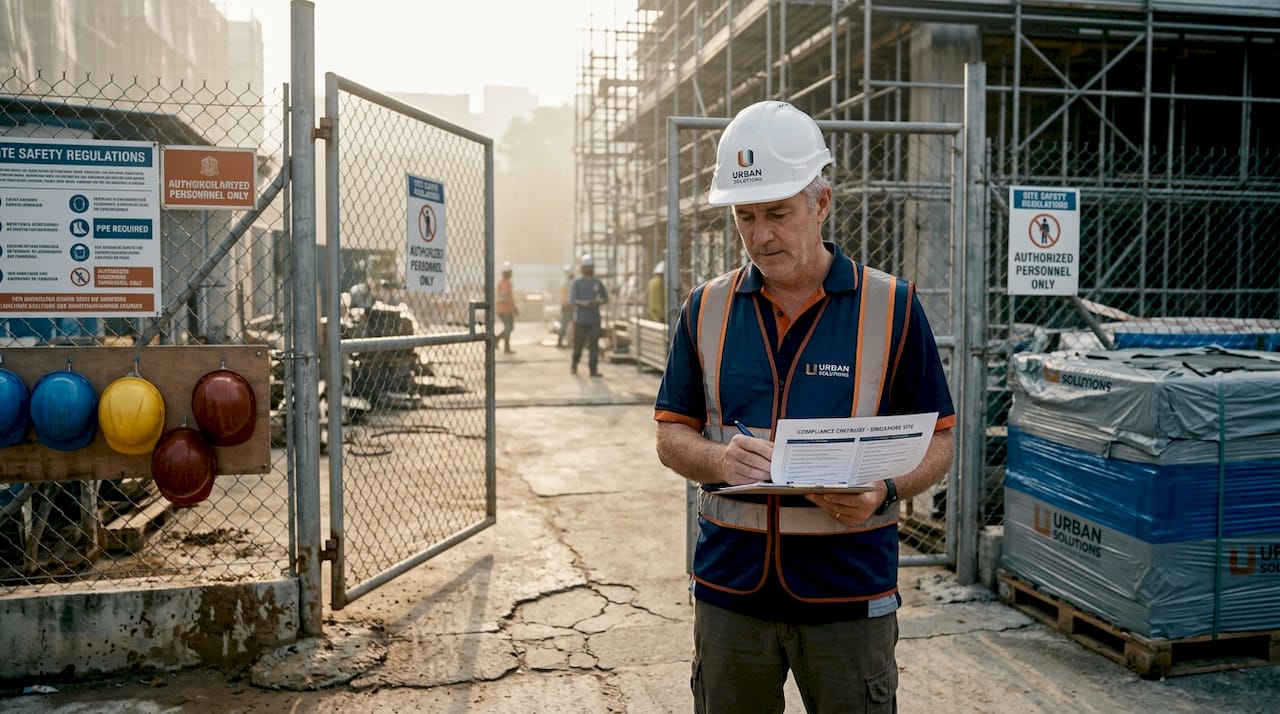
Environmental compliance in Singapore construction is far more operationally demanding than most project teams initially anticipate, and the consequences of underestimating its complexity are severe: project stoppages, six-figure fines, reputational damage, and in some cases, criminal liability for responsible individuals. The regulatory landscape spans multiple agencies, each with distinct statutory powers, and the obligations cascade from design through to project completion. This guide moves beyond surface-level summaries to deliver the actionable frameworks, regulatory references, and practical site protocols that construction executives and project managers need to keep projects on track and on the right side of Singapore law.
Table of Contents
- Understanding Singapore’s core environmental compliance regulations
- Key compliance components: From plan submission to site practices
- Frequently overlooked standards: COPEH 2025 and project-specific edge cases
- Integrating environmental and safety compliance: A unified risk management approach
- Why compliance is your strategic advantage, not just a legal hurdle
- Take the next step: Expert guidance and proven compliance solutions
- Frequently asked questions
Key Takeaways
| Point | Details |
|---|---|
| Know your thresholds | Environmental compliance standards apply at specific gross floor area triggers—verify these early. |
| Map out compliance workflow | Integrate regulatory steps into your project planning to avoid delays and penalties. |
| Don’t overlook site hygiene | Sanitation and waste management standards are crucial for smooth audits and site acceptance. |
| Unify environment and safety | Combining environmental and WSH compliance processes improves efficiency and reduces risks. |
| Adopt proactive culture | View compliance as a business lever, not a hurdle, to win contracts and build a resilient reputation. |
Understanding Singapore’s core environmental compliance regulations
Singapore’s environmental compliance framework for construction is administered by three primary agencies, each with distinct but overlapping jurisdictions. The Building and Construction Authority (BCA) governs structural and sustainability standards. The National Environment Agency (NEA) enforces pollution control and environmental health. The Ministry of Manpower (MOM) administers workplace safety and health, which intersects directly with environmental risk management on site.
The foundational legislation includes the Building Control Act, the Environmental Protection and Management Act (EPMA), and the Workplace Safety and Health Act (WSHA). Understanding how these statutes interact is essential, because a single construction activity can simultaneously trigger obligations under all three.
The GFA trigger for environmental sustainability standards is a critical threshold that many project teams misapply. The Building Control (Environmental Sustainability) Regulations require minimum environmental sustainability standards for new buildings and major additions and alterations (A&A) with a gross floor area (GFA) of 5,000m2 or more from December 2021 onward, with the prior threshold set at 2,000m2 for earlier periods. Qualified Persons (QPs) must submit declarations alongside building plans, and compliance is assessed against the Code for Environmental Sustainability of Buildings, which has been updated across multiple editions. Misidentifying the applicable edition for a given project submission is a recurring source of compliance failure.

| Regulatory area | Governing agency | Primary legislation | Key obligation |
|---|---|---|---|
| Environmental sustainability | BCA | Building Control Act | Minimum sustainability standards for qualifying GFA |
| Pollution control | NEA | EPMA | Pollution Control Study, emissions management |
| Workplace safety and health | MOM | WSHA 2006 | Risk assessments, safety plans, environmental hazard controls |
| Environmental health | NEA | Environmental Public Health Act | Sanitation, refuse, site hygiene |
It is also important to distinguish between mandatory minimum standards and voluntary environmental certifications such as the Green Mark scheme. Green Mark is aspirational and market-driven; the Building Control (Environmental Sustainability) Regulations are statutory and non-negotiable. Conflating the two leads to under-investment in compliance and over-investment in certification optics.
Regarding Singapore safety standards, the WSHA 2006 and the WSH (Construction) Regulations cover environmental risks like asbestos, noise, and confined spaces, making risk assessments and safety plans mandatory across all qualifying construction activities. Non-compliance consequences range from stop-work orders and financial penalties to prosecution under the EPMA or WSHA, with penalties that can reach S$200,000 per offense for corporate entities.
Regulatory reality check: Many project teams treat environmental compliance as a pre-construction checklist rather than a continuous site obligation. This is the single most common source of enforcement action in Singapore construction.
Understanding the full scope of environmental safety explained at the outset of a project is not merely good practice. It is a statutory requirement that begins at the design stage and does not conclude until the project is formally completed and handed over.
Key compliance components: From plan submission to site practices
Environmental compliance in Singapore construction is not a single event. It is a sequential, document-intensive process that spans design, submission, site execution, and ongoing monitoring. Understanding the workflow in its correct order prevents the most costly compliance failures.
The stepwise compliance workflow:
- Design and QP review: The Qualified Person (QP) responsible for the project must assess environmental sustainability requirements during the design phase, selecting building systems and materials that meet the applicable Code for Environmental Sustainability edition.
- Plan submission to BCA and NEA: Building plans submitted to BCA must include the QP’s environmental sustainability declaration. Where activities trigger EPMA obligations, concurrent submissions to NEA are required.
- Pollution Control Study (PCS): For activities likely to cause substantial pollution, a PCS must be completed before works commence.
- Environmental Control Officer (ECO) appointment: The ECO oversees day-to-day pollution control on site, ensuring that approved measures are implemented and monitored.
- Continuous monitoring and documentation: Monitoring records, inspection logs, and corrective action reports must be maintained throughout the project lifecycle.
- Completion and declaration: Final submissions confirm that constructed works meet the declared sustainability standards.
The Pollution Control Study is required under EPMA Section 36 for activities causing substantial pollution. It identifies air, effluent, waste, and noise emissions, and recommends controls per SS593:2013, best available technologies, and monitoring programs. The PCS is not a generic document; it must be site-specific, activity-specific, and calibrated to the actual pollution risks of the project.
| Compliance stage | Responsible party | Key deliverable | Regulatory reference |
|---|---|---|---|
| Design | QP | Sustainability declaration | Building Control (Environmental Sustainability) Regulations |
| Pre-construction | QP, ECO | Pollution Control Study | EPMA Section 36, SS593:2013 |
| Construction | ECO | Monitoring logs, incident reports | EPMA, WSHA |
| Completion | QP | Final sustainability declaration | Building Control Act |
The risk assessment process is integral to both the PCS and the broader WSH compliance framework. Critically, compliance is integrated into building plan submissions through BCA and NEA, with QPs declaring sustainability and ECOs overseeing site pollution control, making continuous monitoring and documentation essential to maintaining regulatory standing throughout the project.
Pro Tip: Appoint the ECO before the PCS is finalized, not after. The ECO’s site knowledge should directly inform the pollution control measures recommended in the study, producing a more accurate and implementable document.
The risk assessment steps for environmental hazards should be documented using the same structured methodology applied to safety hazards, enabling a unified register that satisfies both NEA and MOM requirements simultaneously.
Frequently overlooked standards: COPEH 2025 and project-specific edge cases
Most construction teams are reasonably familiar with the headline environmental regulations. The compliance failures that trigger audits, enforcement actions, and project delays most frequently originate in the finer details: site hygiene standards, refuse management protocols, and the specialized requirements for geotechnically sensitive sites.
The Code of Practice on Environmental Health (COPEH 2025) mandates refuse storage and collection systems, including mechanized systems and chutes for buildings exceeding four storeys, and specifies sanitary facilities for construction sites at a minimum ratio of one toilet per 25 workers. It also requires adequate ventilation for food shops on or adjacent to construction sites to prevent nuisance and pollution. These requirements are frequently treated as administrative details, but NEA enforcement officers inspect for exactly these conditions during site audits.
Common COPEH 2025 compliance failures on construction sites include:
- Insufficient toilet facilities relative to the on-site workforce count, particularly during peak construction phases when worker numbers fluctuate
- Inadequate refuse storage capacity, leading to overflow and environmental contamination of surrounding areas
- Poorly maintained portable sanitation units that create public health and odor nuisance complaints, which can trigger formal NEA investigations
- Absence of documented refuse collection schedules, which are required as part of the site’s environmental management records
- Food preparation or vending areas without compliant ventilation, particularly in longer-duration projects with on-site canteen facilities
Statistic callout: NEA enforcement data consistently shows that sanitation and refuse management violations account for a disproportionate share of construction site environmental infringements, many of which are entirely preventable with structured site hygiene protocols.
For projects in limestone areas, the compliance obligations extend into specialized geotechnical territory. The BCA guidelines for bored piles in limestone areas require specific measures to handle cavities and slump zones, including geophysical surveys, grouting programs, drainage blankets beneath slabs, impact assessments, monitoring programs, and contingency sumps. These requirements, which became more stringent from 2026 onward, represent a distinct compliance stream that must be integrated into the project’s overall environmental and geotechnical management plan.
Pro Tip: For limestone area projects, engage a geotechnical specialist with direct experience in Singapore’s karst geology during the design phase. Retrofitting geotechnical compliance measures after construction has commenced is exponentially more costly than front-loading this expertise.
The Design for Safety Professionals guide provides a structured framework for embedding these site-specific considerations into the project’s design documentation, ensuring that edge cases are captured before they become enforcement issues.
Integrating environmental and safety compliance: A unified risk management approach
The most operationally efficient construction firms in Singapore have recognized that environmental compliance and workplace safety compliance share significant structural overlap. Managing them as separate, parallel streams creates duplicated effort, inconsistent documentation, and gaps at the interface between the two frameworks.
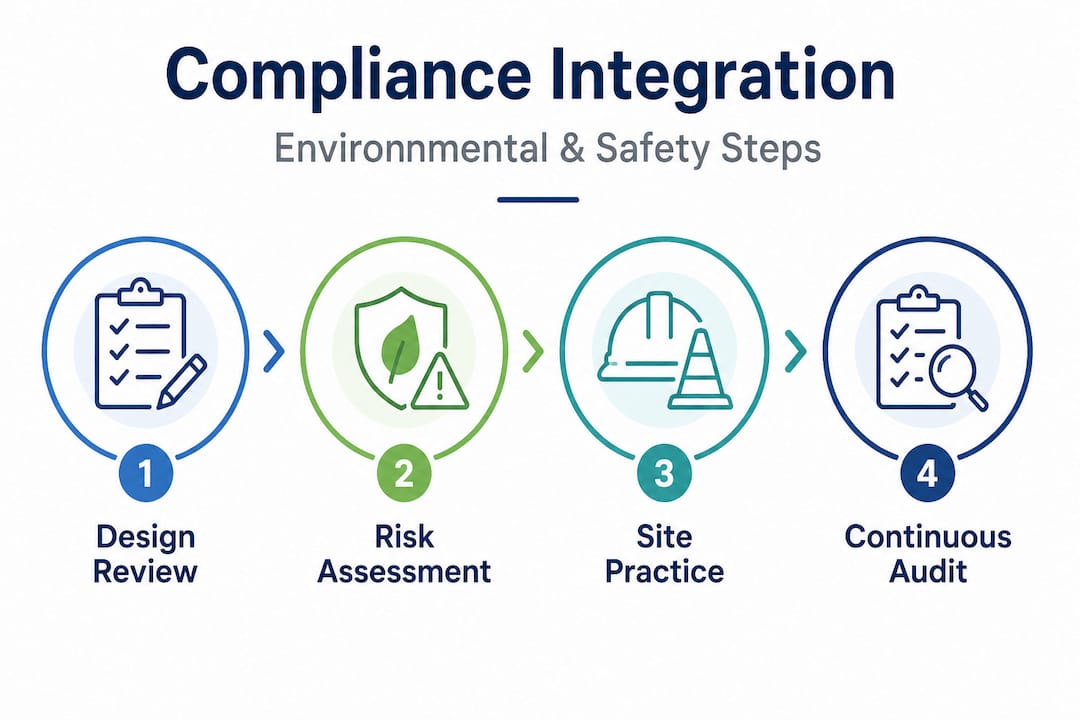
The WSHA 2006 and WSH (Construction) Regulations cover environmental risks including asbestos, noise, and confined spaces, with mandatory risk assessments and safety plans that directly parallel the environmental risk assessment obligations under the EPMA. A unified risk register that addresses both safety and environmental hazards satisfies both regulatory frameworks with a single, coherent document.
Practical integration strategies for Singapore construction firms:
- Develop a combined environmental and safety risk register at the project outset, using a single hazard identification methodology that captures both WSH and EPMA-relevant risks
- Assign joint monitoring responsibilities to the ECO and the project’s Safety Supervisor, with shared reporting lines to the project manager
- Standardize incident reporting templates to capture both safety and environmental data simultaneously, reducing administrative burden and improving data quality
- Integrate environmental monitoring schedules into the project’s overall WSH management calendar, ensuring that both sets of obligations are tracked through a single system
- Conduct combined environmental and safety audits at regular project milestones, using a unified audit checklist that covers BCA, NEA, and MOM requirements
The risk management during design phase is where the greatest efficiency gains are achievable. When environmental and safety risks are identified and controlled at the design stage, the cost of compliance on site is substantially reduced, and the probability of enforcement action diminishes significantly.
Critically, PCS best practices draw on best available technologies from global projects, and limestone and basement designs require sensitivity studies for groundwater impacts. In private contracts, unforeseen ground risks are typically shifted to contractors, whereas public contracts under PSSCOC allocate these risks differently. Understanding this contractual dimension is essential for accurate risk pricing and compliance budgeting.
The WSH management systems framework provides the structural backbone for this integrated approach, offering a scalable model that accommodates both environmental and safety obligations within a single management architecture.
Why compliance is your strategic advantage, not just a legal hurdle
There is a persistent misconception in the construction industry that environmental compliance is a cost center: a regulatory burden to be managed at minimum expense and maximum speed. This view is strategically shortsighted, and the firms that hold it are increasingly disadvantaged in Singapore’s competitive tendering environment.
Consider the long-term commercial calculus. A project that suffers a stop-work order due to an environmental violation does not merely incur the fine. It absorbs the full cost of site downtime, accelerated program recovery, subcontractor claims, and the reputational damage that follows a publicized enforcement action. These costs routinely exceed the investment required to achieve full compliance from the outset by an order of magnitude.
Beyond risk avoidance, proactive environmental compliance is becoming a genuine market differentiator. Public sector clients and major private developers increasingly evaluate tenderers on their environmental management track record, their ISO 14001 certification status, and their demonstrated capacity to manage complex regulatory environments. Firms that can present a structured, documented, and audited environmental compliance program win contracts that less-prepared competitors cannot access.
The voluntary adoption of ESG (Environmental, Social, and Governance) standards, including Green Mark aspirational targets that exceed the mandatory minimums, signals to clients and financiers that a firm operates at the leading edge of industry practice. This positioning commands premium contract values and attracts institutional clients who are themselves subject to ESG reporting obligations.
Executive buy-in is the non-negotiable prerequisite for a genuine compliance culture. When senior leadership treats proactive environment and safety as a strategic priority rather than a delegated administrative function, the entire organization aligns accordingly. Compliance becomes embedded in project planning, resource allocation, and performance measurement, rather than being retrofitted under enforcement pressure.
Take the next step: Expert guidance and proven compliance solutions
Navigating Singapore’s environmental compliance landscape requires more than familiarity with the regulations. It demands structured systems, experienced personnel, and the kind of institutional knowledge that only comes from sustained engagement with BCA, NEA, and MOM across a diverse project portfolio.

MOSAIC Ecoconstruction Solutions provides end-to-end QES consultancy that integrates environmental compliance, safety management, and certification support into a single, coherent service offering. Whether your immediate priority is preparing for a safety audit preparation or pursuing ISO 45001 consulting to strengthen your management systems, our team brings the technical depth and regulatory currency to deliver results. For firms evaluating certification pathways, our ISO certification checklist provides a practical starting point for selecting the right certification body and scope. Contact MOSAIC today to build a compliance program that protects your projects and positions your firm for sustained competitive advantage.
Frequently asked questions
What is the minimum GFA that triggers environmental sustainability regulations for new construction in Singapore?
As of December 2021, new buildings or major additions and alterations with a GFA of 5,000m2 or more must meet the minimum environmental sustainability standards under the Building Control (Environmental Sustainability) Regulations, with the prior threshold set at 2,000m2 for projects submitted between 2008 and 2021.
What is a Pollution Control Study (PCS) and when is it required?
A PCS is a mandatory technical study required under EPMA Section 36 for construction activities that may cause substantial pollution, covering air, effluent, waste, and noise impacts with recommended controls and monitoring programs. It must be completed before qualifying works commence, not after.
What site hygiene provisions are required under Singapore’s COPEH 2025 for construction projects?
COPEH 2025 mandates a minimum of one toilet per 25 workers on construction sites, along with compliant refuse storage and collection systems and adequate ventilation for any food preparation areas. These are enforceable requirements, not advisory guidelines.
How does Singapore handle environmental compliance for projects in limestone areas?
Projects in limestone areas must follow BCA’s specialized guidelines for bored piles, requiring geophysical surveys, grouting programs, drainage blankets, impact assessments, and contingency sumps to manage the unique ground risks associated with karst geology.
Can safety and environmental compliance efforts be integrated for efficiency in Singapore construction projects?
Yes, because the WSHA and EPMA frameworks share significant structural overlap in risk assessment and monitoring obligations, a unified compliance approach can satisfy both regulatory streams through a single integrated risk register, combined audit program, and shared monitoring schedule.
Recommended
- Essential Guide: Singapore Construction Safety Standards
- The Comprehensive Guide to Design for Safety Professionals (DFSP) in Singapore Construction Projects – MOSAIC Eco-construction Solutions Pte Ltd
- Safety management systems: A complete guide for Singapore construction
- The Ultimate Guide to EHS Compliance in Singapore: Navigating Key NEA & MOM Regulations for Your Business – MOSAIC Eco-construction Solutions Pte Ltd
- Health and safety compliance for surveyors