
Most construction professionals understand safety, quality, and environmental management as separate disciplines, each with its own documentation trail, responsible team, and regulatory framework. This fragmented approach creates dangerous compliance gaps, duplicated effort, and audit exposure that integrated practice would eliminate entirely. QHSE, which stands for Quality, Health, Safety, and Environment, consolidates these four domains into a single, coherent management system designed specifically for the demands of construction project delivery. This guide covers the foundational principles of quality environment safety, the practical tools that bring it to life on site, the standards governing high-risk scenarios, and a structured pathway for embedding QHSE from project inception through handover.
Table of Contents
- What is quality environment safety? Core principles explained
- How QHSE works on construction projects: Tools and digital platforms
- Navigating standards and edge cases in QHSE
- Embedding QHSE into your project lifecycle: Steps for success
- Why integrated QHSE is the construction sector’s competitive advantage
- Support and solutions for quality environment safety in construction
- Frequently asked questions
Key Takeaways
| Point | Details |
|---|---|
| Integrated approach wins | Combining quality, environmental, and safety systems reduces compliance risks and improves project performance. |
| Digital QHSE is essential | Using digital platforms for recordkeeping streamlines audit readiness and enables real-time compliance. |
| Know your standards | Special cases like high-risk projects or renovations trigger specific standards and extra contractor responsibilities. |
| Practical steps matter | Embedding QHSE in every project phase, from planning to handover, is key to continuous improvement and certification success. |
What is quality environment safety? Core principles explained
With the confusion around silos addressed, let’s clarify what quality environment safety actually means in construction.
QHSE is not a rebranding exercise. It is a structured, statutory-aligned framework that treats quality outcomes, worker health and safety, and environmental protection as interdependent variables rather than independent functions. In construction, where a single decision can simultaneously affect structural integrity, worker exposure to hazardous conditions, and environmental discharge, this interdependence is not theoretical. It is operational reality.
The four pillars of QHSE defined:
- Quality (Q): Conformance to specification, regulatory requirements, and client expectations across materials, workmanship, and processes. Includes inspection and test plans (ITPs), non-conformance reporting (NCR), and quality audits.
- Health (H): Protection of worker physical and psychological wellbeing through hazard identification, health surveillance, occupational hygiene monitoring, and welfare provision.
- Safety (S): Systematic hazard control through risk assessments, method statements, permit-to-work (PTW) systems, and incident investigation protocols.
- Environment (E): Management of site impacts including noise, dust, waste, water runoff, and protected species disturbance, governed by environmental management plans (EMPs) and statutory consents.
The critical insight is how these pillars interact. A structural steel erection activity, for example, generates quality requirements (weld inspection, dimensional tolerances), safety requirements (working at height controls, load management), health requirements (fume exposure monitoring during welding), and environmental requirements (spill containment for lubricants). A siloed approach manages each requirement in isolation, often by different personnel using different documentation systems. An integrated QHSE approach manages them through a unified workflow, reducing duplication and ensuring that no requirement falls through the organizational cracks.
Workplace safety management systems that operate in silos frequently produce exactly this failure mode: safety passes an activity while quality holds it, or environmental controls are not communicated to the safety team planning the method statement.
“In construction, QHSE systems integrate safety into project delivery via tools like Construction Phase Plans (CPP), Risk Assessments and Method Statements (RAMS), permit-to-work, and digital records linked to BoQ/WBS for compliance traceability.”
The business case for integration is equally compelling. Integrated QHSE systems reduce rework rates, lower incident frequency rates, and accelerate audit cycles because all compliance evidence is maintained within a single traceable record. Project teams that operate integrated systems consistently report stronger client confidence and fewer regulatory enforcement notices, outcomes that directly affect contract renewal and tender competitiveness.

How QHSE works on construction projects: Tools and digital platforms
Now that the core principles are defined, let’s look at how these are applied on project sites with actual systems and tech.
The practical architecture of a construction QHSE system rests on a set of interlinked documents and approval workflows that govern how work is planned, authorized, executed, and recorded. Each document type serves a distinct compliance function, and their integration is what distinguishes a mature QHSE system from a collection of standalone forms.
Core QHSE documents and their functions:
- Construction Phase Plan (CPP): The overarching safety and health management document for the project, required under CDM regulations. It describes site rules, emergency arrangements, welfare provisions, and the management structure for QHSE across all phases.
- Risk Assessments and Method Statements (RAMS): Activity-specific documents that identify hazards, assess residual risk after controls, and prescribe the precise sequence of safe working. RAMS must be reviewed and approved before work commences.
- Permit-to-Work (PTW): A formal authorization system for high-risk activities including hot work, confined space entry, excavation, and electrical isolation. PTW ensures that all preconditions for safe working are verified before authorization is granted.
- Inspection and Test Plans (ITPs): Quality-specific documents that define the inspection points, acceptance criteria, and responsible parties for each significant construction activity.
- Environmental Management Plans (EMPs): Site-level documents governing waste segregation, dust and noise controls, water management, and protected species protocols.
The ConSASS 2026 guide illustrates how modern scoring frameworks require precisely this kind of documented, integrated evidence to achieve higher safety ratings on construction projects.
Digital QHSE platforms such as ProjectQ and SmartQHSE have transformed how project teams manage this document ecosystem. Rather than maintaining paper-based files that are difficult to cross-reference and vulnerable to loss, digital platforms link RAMS, PTW, and ITPs directly to Bill of Quantities (BoQ) line items and Work Breakdown Structure (WBS) codes. This linkage means that every compliance document is traceable to a specific scope of work, a capability that is invaluable during regulatory audits and client reviews.
| QHSE document | Primary function | Audit value |
|---|---|---|
| Construction Phase Plan | Project-level safety governance | High: required by CDM regulations |
| RAMS | Activity-level hazard control | High: evidence of pre-task planning |
| Permit-to-Work | High-risk activity authorization | Critical: demonstrates formal control |
| Inspection and Test Plan | Quality conformance verification | High: supports defect liability defense |
| Environmental Management Plan | Site impact mitigation | Medium-High: regulatory and client requirement |
Pro Tip: Configure your digital QHSE platform to require RAMS approval as a prerequisite for PTW issuance. This single workflow linkage eliminates the most common audit finding: activities authorized without completed risk assessment documentation.
Understanding the importance of ConSASS reinforces why digital traceability is not optional. Audit assessors specifically examine whether safety documentation is current, activity-linked, and accessible at the point of work, requirements that paper systems routinely fail to satisfy.
Navigating standards and edge cases in QHSE
With foundational tools covered, it’s important to address the standards and unique cases that complicate real-world QHSE.
Regulatory compliance in construction QHSE is not uniform across project types. While ISO 9001 (quality), ISO 14001 (environment), and ISO 45001 (occupational health and safety) provide the internationally recognized management system frameworks, certain project categories trigger additional or sector-specific requirements that significantly elevate the compliance burden.
BS 99001 is the construction-specific quality management standard that embeds safety and environmental considerations directly into quality system requirements. Unlike generic ISO 9001, BS 99001 is designed for the construction supply chain and is increasingly specified by clients and principal contractors on high-risk building projects. It requires that quality management processes explicitly address safety-critical activities, making it the natural standard for organizations seeking a unified quality and safety management framework.
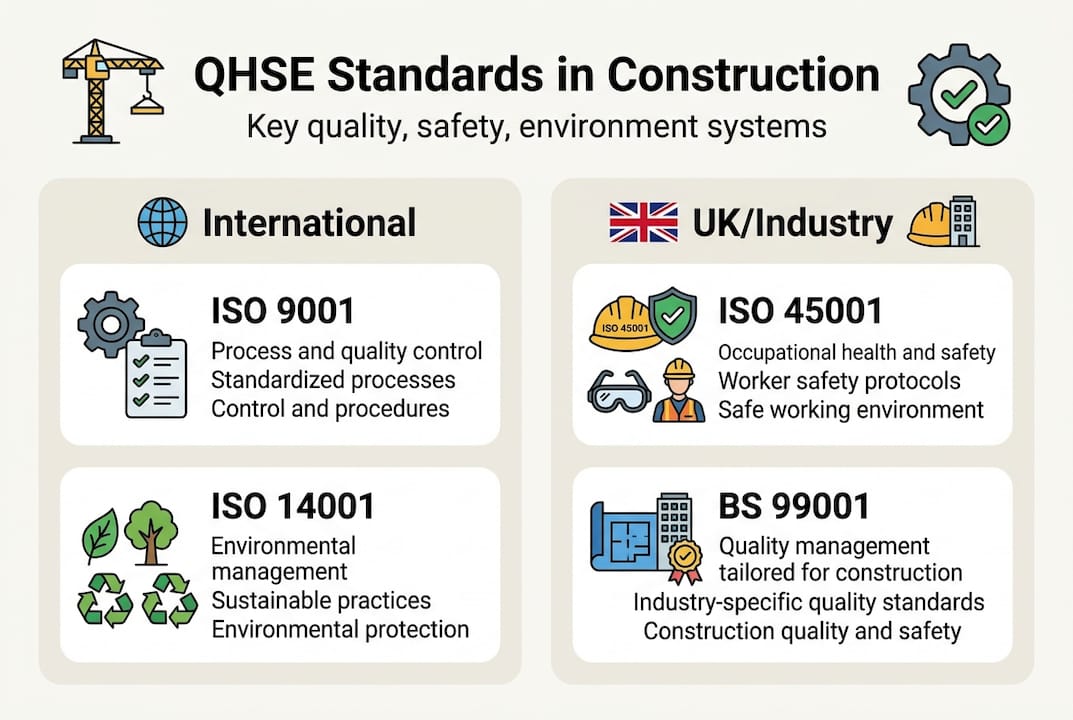
Edge cases in construction QHSE present particular compliance complexity: high-risk buildings require BS 99001 with quality and safety embedded together; renovation projects trigger asbestos and lead paint survey requirements under Control of Asbestos Regulations and related legislation; and principal contractors carry statutory liability for the QHSE performance of all subcontractors operating within their site boundary.
Compliance triggers and role responsibilities:
- High-rise or complex structures: BS 99001 certification, enhanced structural quality plans, third-party inspection regimes.
- Renovation and refurbishment: Mandatory asbestos management surveys, lead paint risk assessments, and heritage structure protection protocols.
- Demolition activities: Pre-demolition structural surveys, hazardous material registers, and specialized PTW systems.
- Principal contractor role: Statutory duty to verify subcontractor QHSE competence, approve subcontractor RAMS, and ensure subcontractor compliance with site rules and statutory requirements.
- Subcontractor management: QHSE prequalification, induction records, ongoing monitoring, and incident reporting integration.
Conducting thorough risk assessment steps before mobilization is the most effective mechanism for identifying which edge-case standards apply to a specific project, and for establishing the compliance baseline before work commences.
Pro Tip: Maintain a live compliance register that maps each applicable standard and regulation to the specific QHSE document or control that satisfies it. During an audit, this register demonstrates systematic compliance management rather than reactive document retrieval, a distinction that significantly influences audit outcomes.
The principal contractor liability dimension deserves particular emphasis. Regulatory authorities do not accept ignorance of subcontractor non-compliance as a defense. Principal contractors are expected to have active oversight mechanisms, including documented QHSE audits of subcontractors, corrective action tracking, and evidence that non-compliant subcontractors are removed from site when necessary. This obligation makes subcontractor QHSE management a core principal contractor function, not an administrative afterthought.
Embedding QHSE into your project lifecycle: Steps for success
Having understood the complexities, here’s a practical workflow for embedding quality environment safety throughout your projects.
Effective QHSE integration does not happen through documentation alone. It requires a structured, phase-aligned approach that builds compliance evidence progressively from pre-construction planning through to project handover and post-completion review.
The five-phase QHSE implementation cycle:
- Plan: Establish the QHSE management structure, identify applicable standards and regulations, develop the CPP, and produce the project-specific QHSE plan. Engage the design for safety process at this stage to eliminate hazards before they reach the construction phase.
- Implement: Deploy RAMS, PTW systems, ITPs, and EMPs aligned to the construction program. Conduct QHSE inductions for all personnel, establish site monitoring regimes, and activate digital recordkeeping platforms.
- Monitor: Execute scheduled and unannounced site inspections, track leading indicators (near-miss reports, observation cards, inspection completion rates) alongside lagging indicators (incidents, NCRs, environmental notices). Review subcontractor QHSE performance monthly.
- Review: Conduct formal management reviews at defined project milestones, analyze trends in monitoring data, update risk assessments when scope or conditions change, and implement corrective and preventive actions (CAPAs) systematically.
- Certify: Compile the QHSE closeout package, including all inspection records, audit findings and closures, incident investigation reports, and environmental compliance evidence, for handover to the client and retention for the statutory period.
Common pitfalls and how to avoid them:
- Producing RAMS as a post-mobilization formality rather than a pre-task planning tool. Resolve this by making RAMS approval a hard gate in the work authorization workflow.
- Treating environmental management as a separate function from safety. Integrate EMP requirements directly into RAMS for activities with significant environmental aspects.
- Failing to update QHSE documentation when design changes occur. Establish a formal change management process that triggers QHSE document review whenever a design or scope variation is issued.
- Inadequate subcontractor QHSE monitoring. Schedule monthly documented subcontractor QHSE audits as a contractual and program requirement.
Addressing risk management in design upstream is the single most impactful intervention available to project teams. Hazards eliminated at the design stage cost nothing to control. The same hazards managed on site through administrative controls and PPE carry ongoing cost, residual risk, and compliance exposure throughout the construction phase.
Digital QHSE platforms such as ProjectQ and SmartQHSE support this entire lifecycle by providing real-time BoQ-linked records, RAMS approval workflows, and PTW management that significantly enhance compliance performance and audit readiness. Teams using these platforms report materially faster audit preparation cycles and higher first-pass audit success rates.
Why integrated QHSE is the construction sector’s competitive advantage
The practical steps are vital, but what truly sets top construction teams apart is their mindset about QHSE.
The construction industry’s persistent tendency to treat quality, safety, and environmental management as parallel but separate functions is not merely an operational inefficiency. It is a strategic liability. Organizations that maintain siloed systems consistently experience higher rework rates, longer audit cycles, and more frequent regulatory enforcement actions, outcomes that erode margin and damage client relationships in ways that are difficult to quantify but impossible to ignore.
The contrarian insight that industry commentary rarely acknowledges is this: integrated QHSE is not primarily a compliance tool. It is a competitive differentiator. Project teams that operate genuinely integrated systems win tenders on safety and quality track records, retain clients through demonstrated reliability, and attract skilled professionals who prefer working within structured, well-governed environments.
Improving safety culture is the human dimension of this integration. Systems without culture produce documentation without behavior change. The organizations achieving the strongest QHSE outcomes are those where integration is a leadership commitment, not a document management exercise. Regulatory compliance is the baseline. Integrated QHSE, embedded in project culture and supported by capable digital systems, is the differentiator that separates leading construction organizations from the field.
Support and solutions for quality environment safety in construction
If you’re ready to transform your approach or need tailored guidance, here’s how MOSAIC can help.
MOSAIC Ecoconstruction Solutions provides specialist QHSE consultancy, certification support, and audit services tailored for construction project teams navigating complex compliance requirements. Whether your organization is pursuing BizSAFE Star support, strengthening its Design for Safety in Singapore capability, or preparing for a ConSASS audit, MOSAIC’s experienced team delivers structured, evidence-based support across every project phase.

From RAMS development and CPP preparation through to full ISO 45001 and BS 99001 certification pathways, MOSAIC’s integrated service model ensures that quality, safety, and environmental requirements are managed as a unified system rather than competing obligations. Contact MOSAIC to discuss how integrated QHSE consultancy can strengthen your compliance posture, reduce audit exposure, and build the project delivery track record that wins work.
Frequently asked questions
What does QHSE stand for in construction?
QHSE stands for Quality, Health, Safety, and Environment, an integrated management system that governs all four domains through unified documentation, workflows, and compliance traceability linked to project delivery milestones.
When do I need BS 99001 compliance for my project?
BS 99001 is required for high-risk building projects where quality and safety must be managed within a single certified framework, while renovation projects may additionally trigger asbestos and lead paint regulatory requirements.
How do digital QHSE platforms help with compliance?
Digital platforms enable real-time BoQ-linked records, automated RAMS approval workflows, and PTW management, significantly accelerating audit preparation and improving first-pass compliance rates.
What is the principal contractor’s responsibility in QHSE?
Principal contractors carry statutory liability for subcontractor HSE performance across their entire site, requiring documented prequalification, ongoing monitoring, and corrective action processes for all subcontractors.
What are the main documents in a construction QHSE system?
Essential QHSE documents include the Construction Phase Plan, RAMS and permit-to-work records, Inspection and Test Plans, and Environmental Management Plans, all linked to project scope and maintained for statutory retention periods.
Recommended
- Managing Risk During the Design Stage: A Proactive Approach to Safer, More Efficient Construction – MOSAIC Eco-construction Solutions Pte Ltd
- The Comprehensive Guide to Design for Safety Professionals (DFSP) in Singapore Construction Projects – MOSAIC Eco-construction Solutions Pte Ltd
- Design for Safety Professional Services Explained – MOSAIC Eco-construction Solutions Pte Ltd
- Mosaic Ecoconstruction Solutions Pte Ltd – MOSAIC Eco-construction Solutions Pte Ltd