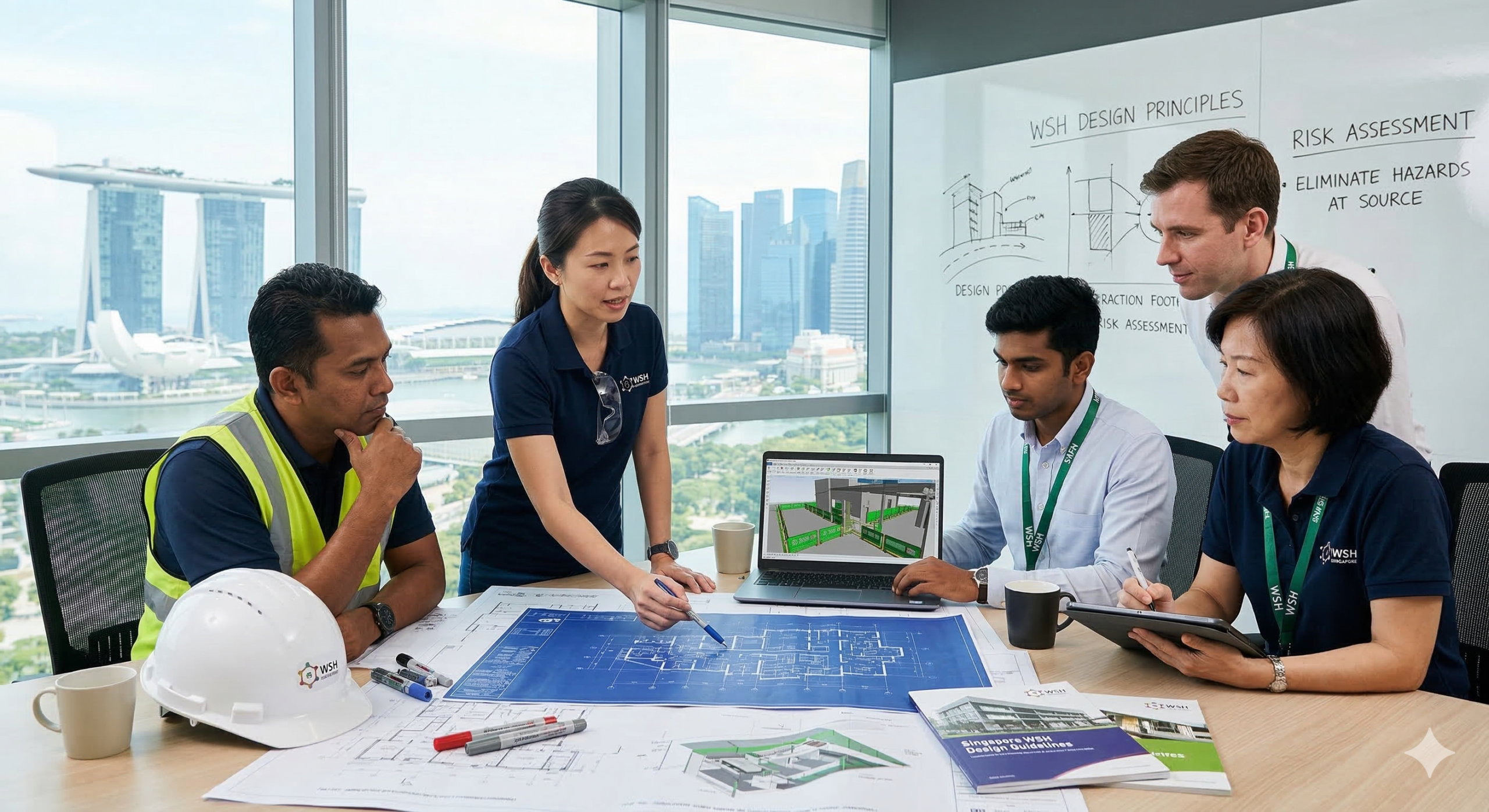
Navigating Singapore’s WSH (Design for Safety) Regulations: A 2025 Guide for Developers
1. Strategic Imperative: The 2025 Macroeconomic and Safety Landscape
The construction and built environment sector in Singapore operates within an unforgiving regulatory and economic landscape where the margin for error is continually shrinking.
The industry is currently experiencing a period of intense, unprecedented expansion. The Building and Construction Authority (BCA) projected total construction demand for 2025 to range between S53 billion in nominal terms, an increase driven heavily by mega-projects such as Changi Airport Terminal 5, the expansion of the Marina Bay Sands Integrated Resort, and extensive infrastructure works for the Tuas Port and mass rapid transit (MRT) network extensions.1
This high demand translates to an exceptionally strained labor market. A notable paradigm shift is occurring as mature estates enter cyclical upgrade programs, pushing the compound annual growth rate (CAGR) for renovation activities to 5.83%, while conventional on-site processes still dictate over 73% of construction volume.3
Against this backdrop of hyper-activity, workplace safety and health (WSH) remains the paramount concern.
During the first half of 2025, the Ministry of Manpower (MOM) recorded an overall improvement in WSH performance, with the major injury rate dropping to an all-time low of 15.5 per 100,000 workers, and the annualized fatal injury rate declining to 0.92 per 100,000 workers.4
Specifically, the historically high-risk manufacturing sector saw fatal and major injuries decline from 65 cases in the first half of 2024 to 55 cases in the corresponding period of 2025, while the construction sector witnessed a parallel decline from 81 to 76 cases.4
However, this statistical improvement is directly correlated with an uncompromising, iron-fisted enforcement regime.
In the first half of 2025 alone, MOM conducted over 3,000 workplace safety inspections across high-risk industries, uncovering nearly 7,000 safety breaches.4
The financial and operational repercussions for errant firms were severe, resulting in the issuance of over S$1.5 million in composition fines and 28 immediate stop-work orders.4
Furthermore, MOM is aggressively expanding the scope of compensable occupational risks.
Effective December 1, 2025, the updated Occupational Disease (OD) list will officially cover 38 reportable and compensable conditions under the WSH Act and the Work Injury Compensation Act (WICA), broadening the recognition of work-related musculoskeletal disorders and occupational infectious diseases.4
In this unforgiving climate, adherence to the Workplace Safety and Health (Design for Safety) Regulations 2015—commonly referred to as the WSH (DfS) Regulations—has transitioned from a reactive compliance checklist into a paramount strategic differentiator.
Developers can no longer rely on downstream contractors to manage safety on the ground; they must engineer safety into the very blueprint of the development.
2. Legislative Architecture and the Expansion of Statutory Duties
The WSH (DfS) Regulations represent a fundamental restructuring of safety accountability in Singapore, dismantling the antiquated, siloed approach where design and construction safety were treated as mutually exclusive domains.6
The legislation enforces the principle that the entity dictating the design and financing the project—the developer—holds the ultimate, overarching responsibility for its inherent safety across the entire lifecycle.8
The Threshold of Application and Scope
The mandatory application of the DfS Regulations is precise, intentionally targeting large-scale and high-stakes projects where design interventions yield the highest risk-reduction dividends.
A project falls strictly under the purview of these regulations if it meets three concurrent criteria: it is undertaken by a developer in the course of their business; the construction work contract sum is S$10 million or more; and it involves “development” as defined under Section 3(1) of the Planning Act.10
It is critical to note that domestic projects intended purely for personal dwelling, and not for business use, are statutorily excluded from these specific regulations, though general WSH duties still apply.12
Matrix of Legal Accountability
The legislation delineates explicit, non-overlapping duties for the primary stakeholders in a construction project, creating a chain of custody for safety risk information.
| Stakeholder | Primary Legal Duties under WSH (DfS) Regulations | Statutory Reference |
| Developer | Holds primary accountability. Must appoint competent designers and contractors, allocate adequate time and financial resources, convene DfS review meetings, ensure the creation and maintenance of the DfS Register, and guarantee that foreseeable design risks are eliminated or mitigated to the greatest extent reasonably practicable. | Regulations 4–8 & 11 8 |
| Designer | Prepares a design plan that explicitly eliminates or reduces foreseeable risks. Mandated to prioritize collective protective measures over individual personal protective equipment (PPE). Must disseminate all relevant safety information to the supply chain and attend DfS review meetings. | Regulation 9 8 |
| Contractor | Obligated to identify any foreseeable design risks that only become apparent during the physical construction phase and report them back to the developer or main contractor. Executes rigorous risk assessments on-site and physically ensures safety during the construction phase. | Regulation 10 8 |
| DfS Professional (DfSP) | Acts as the strategic facilitator and safety auditor. If delegated in writing by the developer, the DfSP assumes the strict legal duty of convening DfS review meetings and maintaining the DfS Register. | Regulation 8 8 |
| Building Owner / MCST | Assumes custody of the DfS Register post-completion. Statutorily required to communicate all foreseeable residual risks to maintenance personnel and future contractors undertaking additions, alterations, or demolition. | Regulation 11 8 |
Non-Delegable Duties and the Judicial Trajectory
A critical jurisprudential nuance within the WSH (DfS) Regulations is the concept of non-delegable duties.
While Regulation 8 permits a developer to formally delegate the administrative burden of convening review meetings and maintaining the DfS Register to a qualified DfSP, the developer categorically cannot abdicate the overarching responsibility for the project’s safety.8
The developer remains legally accountable for verifying the competence of appointed professionals and ensuring that resources are adequate for safe execution.6
Recent judgments by the General Division of the Singapore High Court reveal a highly uncompromising, punitive stance on corporate negligence and workplace fatalities.
In a landmark 2022 appellate ruling concerning Section 12(1) of the WSHA, the High Court established a stringent new sentencing framework that elevates penalties based concurrently on the employer’s culpability and the actual magnitude of harm caused.14
In this specific case, where a worker was fatally struck by a suspended jib due to negligent, non-manufacturer-compliant rigging by a supervisor, the High Court rejected the District Court’s lower fine and enhanced the employer’s penalty to S$250,000.14
The ruling cemented the legal principle that moderate fault resulting in catastrophic damage warrants severe financial punitive measures.15
Individual liability for developers and company directors is equally perilous.
In a separate 2024 High Court decision (SGHC 132), the sole proprietor of a transport company faced prosecution under Section 12(2) of the WSHA for failing to ensure the safety of non-employees affected by his business undertaking.16
The High Court summarily dismissed the appellant’s request to reduce his sentence to a fine, instead enhancing his punishment to a severe 14 months of imprisonment, explicitly citing the legislative objective of the WSHA to foster deep industry ownership of occupational safety standards and to ruthlessly penalize reckless conduct.16
These legal precedents serve as a stark, undeniable warning to developers: superficial compliance or the mere outsourcing of DfS requirements constitutes a profound legal vulnerability.17
3. The Design for Safety Professional (DfSP): Competency and Delegation
The linchpin of the DfS regulatory framework is the Design for Safety Professional (DfSP).
Unlike generic safety officers, the DfSP is positioned upstream as a strategic partner to the developer, requiring a profound understanding of structural engineering, architectural mechanics, and hazard mitigation.8
To achieve certification, a DfSP must meet rigorous competency prerequisites.
They must be a registered Professional Engineer (PE) or Architect with a practicing certificate, or possess a minimum of ten years of highly relevant design and construction experience.8
Furthermore, they must successfully complete a mandatory, 16-hour DfSP training course accredited by institutions such as the Singapore Contractors Association Ltd (SCAL) Academy or the Institution of Engineers Singapore (IES).18
The curriculum is exhaustive, covering the WSH Risk Management Code of Practice (RMCP), the facilitation of the GUIDE process, and the intricate coordination of review meetings to evaluate lifecycle hazards, extending even to the safe design parameters required for occupational disease control in light of lessons learned from SARS and COVID-19.18
Once appointed and delegated duties in writing under Regulation 8, the DfSP becomes the expert custodian of the project’s legal safety record.8
However, industry analyses frequently highlight a persistent bottleneck: the phenomenon of “surface compliance” wherein developers appoint a DfSP solely to generate paperwork for regulatory submissions, stripping the professional of the authority required to force actual design alterations.17
To extract genuine economic and safety value, developers must empower the DfSP to challenge architectural conventions during the earliest conceptual phases, ensuring that safety logic dictates design rather than merely reacting to it.17
4. The GUIDE Process and Lifecycle Risk Mitigation Mechanisms
The operationalization of the WSH (DfS) Regulations is achieved through the GUIDE process, an industry-standard, systematic methodology explicitly designed to unearth and neutralize hazards before physical construction commences.11
Orchestrating the Five Pillars of GUIDE
The GUIDE methodology demands intensive, cross-disciplinary collaboration, breaking down the traditional linear workflow of construction planning.11
- G – Group: The developer must assemble a multidisciplinary review team encompassing the developer’s representatives, lead designers (architectural, civil, structural, mechanical, and electrical), the main contractor (if already appointed), and the facilitating DfSP.11
- U – Understand: The team engages in a comprehensive analysis of the full design concept, evaluating proposed construction methodologies, structural load calculations, and the long-term maintenance intent of the facility.11
- I – Identify: The core analytical phase involves pinpointing foreseeable safety and health risks arising from the design. Crucially, this hazard identification extends beyond the temporary construction phase to encompass the safety of end-users, facility maintenance managers, and the eventual demolition teams decades in the future.11
- D – Design: The team rigorously applies the hierarchy of controls to eliminate the identified risks at the source. If complete elimination is not reasonably practicable, the team must engineer collective protective mitigations to reduce the residual risk.11
- E – Enter: All identified risks, fundamental design modifications, and lingering residual risks are meticulously documented into the statutory DfS Register.11
Phased DfS Review Meetings
The GUIDE process is executed through structured DfS Review Meetings phased across the project timeline to ensure continuous risk oversight.8
The initial Concept Design Review (GUIDE 1) is conducted during the preliminary architectural phase.
The primary objective is to identify gross structural or site-level risks. Strategic decisions finalized here—such as building orientation, deep excavation methodologies, or the decision to utilize prefabricated prefinished volumetric construction (PPVC)—yield the highest safety dividends with the lowest financial impact.22
As the structural and M&E plans mature, the Detailed Design and Maintenance Review (GUIDE 2) scrutinizes specific building components.8
The primary focus shifts to ensuring the structure is safe to construct, clean, and repair.8
For example, the review team will analyze whether technicians require hazardous rope access to service facade lighting or if safe internal access platforms can be designed instead.27
Finally, the Pre-Construction Review (GUIDE 3) facilitates the formal handover of the design risk information to the appointed main contractor, who must formally acknowledge the residual risks and integrate the DfS mitigation strategies into their site-specific safety and health management system prior to site mobilization.8
Integrating RAG Lists and the DfS Library
To systematize these reviews, practitioners increasingly rely on specialized heuristic tools such as Red Amber Green (RAG) lists.22
A RAG list categorizes design choices based on inherent danger: ‘Red’ items are hazardous materials or methods to be strictly avoided (e.g., fragile roof lights without permanent fall protection or working on roofs without edge barricades); ‘Amber’ items are permissible but require stringent, engineered mitigation; and ‘Green’ items are inherently safe best practices (e.g., modular MEP systems installed at waist height to prevent falls).30
Furthermore, the Institution of Engineers Singapore (IES) and the National University of Singapore (NUS) have bolstered industry capability by publishing the comprehensive DfS Library of Construction-Related Risks.28
This library provides standardized hazard scenarios and mitigation prompts for practitioners. For instance, the library explicitly highlights the severe risk of workers falling from height when servicing air-conditioning units installed at high ceiling elevations without proper access, prompting designers to relocate vents or engineer permanent, secure access platforms.28
5. Design for Maintainability (DfM) and the Maintenance Strategy Report
Recognizing that a commercial or institutional building spends the vast majority of its lifecycle in the operational phase, the Building and Construction Authority (BCA) has aggressively championed Design for Maintainability (DfM) as a natural, critical extension of DfS.33
DfM operates on the foundational F.A.M.E. principle, a strategic framework designed to minimize lifecycle upkeep costs and eliminate hazards for facility management personnel:
- Forecast maintenance: Designers must anticipate downstream upkeep requirements based on material degradation, climate exposure, and expected usage, making necessary upstream design provisions.33
- Access for maintenance: The design must ensure adequate spatial provision for personnel and maintenance equipment, explicitly minimizing confined space entries and perilous work-at-height scenarios.33
- Minimise maintenance interventions: Architects are encouraged to select highly durable, climate-appropriate materials that resist staining, water penetration, and premature deterioration, thereby reducing the frequency of required interventions.33
- Enable simple maintenance: The structural design should utilize standardized, easily accessible, and prefabricated components to allow for quick, plug-and-play replacements that do not require complex scaffolding or heavy lifting.33
To institutionalize these principles, BCA strongly mandates the formulation of a Maintenance Strategy Report (MSR) early in the design process, particularly for non-residential structures.22
The MSR serves as a comprehensive operational manual, documenting specific maintenance strategies, anticipated operational challenges, and detailed written descriptions of system operations.33
Crucially, guidelines such as the Façade Access Design Guide (FADG) dictate that buildings must incorporate inbuilt provisions—such as direct staircase or lift access to main roofs, and adequately loaded service lifts to transport Building Maintenance Units (BMUs)—to enable safe, efficient façade cleaning and inspection.27
The finalized MSR is ultimately integrated into the overarching DfS Register, establishing a seamless continuity of safety logic from the architect’s desk directly into the hands of the facility manager.22
6. Digital Transformation: CORENET X, BIM, and Cyber-Physical Systems
As Singapore races toward its 2030 Smart Nation objectives, the intersection of digital technology and construction safety is undergoing a radical, irreversible transformation.
The regulatory landscape in 2025 and beyond is defined by the rollout of new national digital infrastructure that fundamentally forces compliance through transparency.
The CORENET X Regulatory Mandate
Historically, regulatory approvals in Singapore required project teams to submit disparate 2D architectural, structural, and M&E plans sequentially to various government agencies.35
This fragmented, siloed process often obscured severe multi-disciplinary design clashes until they manifested as expensive, highly dangerous physical hazards on the construction site.35
To eradicate these systemic inefficiencies, BCA and the Urban Redevelopment Authority (URA) have launched CORENET X, a transformative, one-stop regulatory approval platform designed to promote Integrated Digital Delivery (IDD).36
CORENET X replaces the linear submission process with a concurrent, highly collaborative digital model, streamlining over 20 disparate agency approval touchpoints into three unified key gateways: Design, Construction/Piling, and Completion.35
| Implementation Timeline | CORENET X Statutory Mandate |
| 1 October 2025 | Mandatory CORENET X submission required for all new projects with a Gross Floor Area (GFA) ≥ 30,000m².2 |
| 1 October 2026 | Mandatory CORENET X submission enforced for all new projects, regardless of GFA size.2 |
| 1 October 2027 | Mandatory onboarding to the CORENET X platform required for all ongoing legacy projects.2 |
The implications for DfS execution under CORENET X are profound. Qualified Persons (QPs) are now statutorily required to submit fully coordinated Building Information Modelling (BIM) models within a shared Common Data Environment (CDE).35
Because regulatory agencies review the holistic 3D model simultaneously, major spatial conflicts—such as an HVAC duct obstructing a critical maintenance walkway or a structural beam interfering with safe lifting operations—are surfaced and resolved entirely in the digital realm long before physical construction begins.35
This regulatory enforcement of BIM coordination inherently forces design teams to engage in rigorous, multidisciplinary DfS practices, effectively rendering “surface compliance” obsolete.17
Advanced BIM and the Rise of Digital Twins
BIM technology serves as the foundational digital architecture for modern DfS execution. Beyond basic spatial clash detection, advanced 4D BIM (which integrates complex construction scheduling algorithms) allows developers and DfSPs to visually simulate the entire construction sequence.38
By virtually modeling the erection of heavy steel members or the deployment trajectories of tower cranes, the DfSP can identify transient risks—such as temporary instability during structural assembly or perilous blind spots during lifting—and engineer bracing solutions proactively.39
A comprehensive PRISMA-based literature review confirms that BIM significantly enhances early hazard identification, conflict detection, and virtual safety simulations across the asset lifecycle.39
The evolution of BIM culminates in the creation of Digital Twins—dynamic, bi-directional virtual representations of physical assets, often referred to as cyber-physical systems.41
While traditional BIM represents the static, intended design, a Digital Twin continuously ingests real-time sensor data from the physical structure during its operational phase.41
A paramount case study demonstrating this technological zenith is the Woodlands Health Campus in Singapore.
Designed by SAA Architects and managed with input from Rider Levett Bucknall (RLB), this 7.8-hectare, rainforest-inspired integrated healthcare complex utilized digital twin technology to achieve a 15% optimization in commissioning.43
The integration of digital twins and smart building technologies allows the facility management team to conduct automated air-change verification, rigorous infection control monitoring, and highly predictive maintenance of critical MEP systems.43
By accurately forecasting equipment degradation through data analytics, maintenance teams can intervene safely before a catastrophic failure occurs, thereby preventing emergency repair scenarios which historically pose the highest risk of occupational injury to technicians.43
7. Design for Manufacturing and Assembly (DfMA) and PPVC
Concurrently, the adoption of Design for Manufacturing and Assembly (DfMA), particularly Prefabricated Prefinished Volumetric Construction (PPVC), has become a central pillar of Singapore’s Construction Industry Transformation Map (ITM) and an essential DfS strategy.25
By shifting complex, dangerous construction activities from a chaotic, open-air site to a highly controlled, ergonomic factory environment, PPVC directly addresses both the nation’s severe labor shortages and its stringent safety imperatives.3
Despite its benefits, industry surveys indicate that roughly 57.45% of respondents have not yet participated in PPVC projects, though adoption is accelerating rapidly as HDB mandates PPVC for most high-rise blocks.3
Research confirms that PPVC adoption drastically reduces onsite manpower requirements by 25% to 40% and exponentially shortens floor cycle construction times from a conventional 14-21 days down to merely 4 days.26
From a strict risk management perspective, the safety dividends are immense. Moving labor-intensive tasks off-site drastically reduces worker exposure to the construction industry’s most lethal hazards: falls from height, struck-by incidents, and complex scaffolding collapses.25
While PPVC introduces new, specialized logistical risks—such as the complex hoisting of massive 15 to 20-ton steel or concrete modules—these isolated risks are highly predictable.26
The primary risks identified in PPVC projects include volatile economic conditions, poor jointing execution, and delays in module delivery.25
However, the physical safety risks can be meticulously managed through stringent lifting plans and digital innovations.
For example, award-winning solutions like QR SAFE leverage cloud technology and QR codes to ensure complete traceability and enhanced safety during heavy fabrication and lifting operations.48
8. The Economics of Safety: Cost-Benefit Analysis and WICA Insurance
A pervasive, highly damaging misconception among some industry stakeholders is that the DfS Regulations represent mere bureaucratic red tape—an administrative burden that artificially inflates project costs, delays timelines, and offers no tangible return on investment.6
In reality, rigorous empirical data demonstrates that robust DfS implementation offers one of the highest returns on investment available to a developer, transforming regulatory compliance from a sunk cost into a distinct competitive and financial advantage.6
The Financial Architecture of Proactive Prevention
The fundamental economic premise of DfS relies on the widely accepted cost-of-change curve.
Mitigating a hazard during the early concept design phase costs a fraction of what it would cost to issue a complex site variation order during construction, and it is exponentially cheaper than addressing the catastrophic financial fallout of a workplace fatality.11
Comprehensive cost-benefit analyses for construction safety indicate that allocating approximately 2.5% to 3.5% of the total project budget to comprehensive safety planning and upstream design modifications yields profound dividends for routine projects, while highly complex operations may require an allocation of 6% to 7%.49
When hazards are explicitly “designed out,” the project’s reliance on complex, recurring administrative controls and expensive, inefficient personal protective equipment (PPE) is eliminated.51
Furthermore, safer, simpler designs—such as DfMA components—inherently boost worker productivity, significantly lower material wastage, and accelerate project delivery timelines.7
Conversely, the direct and indirect costs of a single workplace fatality—encompassing medical compensation, prolonged regulatory work stoppages, exorbitant legal defense fees, and permanent reputational destruction—can financially paralyze a mid-sized development firm.11
In a specific cost evaluation of redesigning a loading platform, DfS integration resulted in a 25% decrease in the occurrence of accidents and a 15% drop in mechanical failures, easily offsetting a marginal 10% increase in initial system price.52
WICA Premiums and Financial Risk Mitigation
The impact of DfS on insurance premiums is a highly tangible, immediate economic driver. Under Singapore’s Work Injury Compensation Act (WICA), contractors are legally obligated to provide compensation for all workplace injuries, a liability covered through mandatory WIC insurance.53
Historically, general insurers in Singapore suffered highly detrimental loss ratios due to inadequate risk assessments, poor premium-rating frameworks, and persistently high accident rates in the construction sector.53
To rectify this market failure and force accountability, MOM has fundamentally aligned insurance economics with empirical safety performance.
Since 2021, employers’ historical WIC insurance claims data and safety records have been made fully transparent and accessible to WIC insurers.54
This transparency allows underwriters to aggressively differentiate premiums. Contractors and developers demonstrating superior safety records—facilitated by rigorous upstream DfS implementation—benefit from significantly reduced premium rates.54
Conversely, firms exhibiting poor safety cultures and high injury rates face punitive, crippling premium hikes.54
By investing heavily in DfS, a developer ensures that their appointed contractors operate in an inherently safer physical environment, thereby depressing the frequency and severity of WICA claims and ultimately reducing the project’s overall, long-term insurance overhead.47
9. Fostering a Safety Culture: Industry Recognition and WSH Awards
The economic incentives for embracing DfS extend beyond insurance savings to encompass direct financial bonuses and immense market prestige.
For large-scale public sector construction projects valued at S$50 million or above, the government administers a highly lucrative WSH Bonus Scheme.11
Contractors that achieve and meticulously sustain exemplary WSH standards throughout the construction phase receive substantial monetary bonuses, a portion of which is mandated to be distributed directly to workers and sub-contractors to foster a pervasive, grassroots safety culture.57
In the broader market, high-performing developers leverage prestigious recognition schemes, such as the annual WSH Awards organized by the WSH Council, to dramatically augment their corporate brand equity.58
To qualify for the highly coveted WSH Developer Awards, a developer must demonstrate immaculate performance: zero fatal injuries, zero major breaches or stop-work orders, and they must ensure that their entire supply chain holds a minimum of bizSAFE Level 3 certification.60
Furthermore, developers are evaluated favorably if their projects secure the Safety and Health Award Recognition for Projects (SHARP), which requires achieving injury rates drastically below the industry average.60
Exceptional case studies from the 2024/2025 WSH Awards highlight the power of safety innovation.
SMRT Corporation achieved multiple accolades, including the WSH Innovation Award for developing a Signal Warning & In-Cabin Alertness Monitoring System, and the WSH Award for Supervisors, awarded to Tan Hock Hing for pioneering a creative QR code system that rewards staff for achieving accident-free milestones.58
Similarly, Shing Leck Engineering Service Pte. Ltd. revolutionized their safety data management by developing a digital dashboard for LPSA Touches, resolving critical inefficiencies in manual hazard recording.48
In an increasingly ESG-conscious real estate market, possessing a pristine safety record and institutionalizing award-winning DfS practices elevates a developer’s standing with institutional investors and premium property buyers.
10. Communicating Safety Excellence: SEO and Digital Visibility in 2025
As developers invest heavily in advanced safety protocols and secure prestigious WSH accolades, communicating these achievements to stakeholders, investors, and the public has become a critical marketing imperative.
In 2025, search engine optimization (SEO) in Singapore has evolved far beyond rudimentary keyword stuffing; it now demands authoritative, AI-optimized content.62
With search engines increasingly prioritizing Google’s SGE (Search Generative Experience) and E-E-A-T guidelines (Experience, Expertise, Authoritativeness, Trustworthiness), developers must strategically publish their safety records and DfS methodologies online.62
A website that merely lists a WSH Award is insufficient; developers must build comprehensive “topical authority” by publishing detailed content clusters focusing on their specific safety innovations, such as their adoption of PPVC, their integration of digital twins, or their zero-fatality records.63
Furthermore, as voice search queries such as “safest construction companies in Singapore” grow in prominence, optimizing for conversational, long-tail keywords becomes essential.64
By maintaining structured, verifiable local citations and publishing high-quality, human-centric content detailing their rigorous DfS implementations, developers can dominate search visibility, translating their safety excellence into measurable corporate credibility and lead generation.63
11. Global Benchmarking: Singapore DfS vs. UK CDM and US PtD
To fully contextualize the sophistication and pragmatism of Singapore’s framework, it is highly instructive to benchmark the WSH (DfS) Regulations against the international standards from which they evolved: the United Kingdom’s Construction (Design and Management) Regulations 2015 (CDM 2015) and the United States’ Prevention through Design (PtD) initiatives.7
While all three frameworks share the foundational ethos of upstream risk elimination, their scope, enforcement mechanisms, and specific role definitions exhibit critical, structural divergences.12
| Feature / Criteria | Singapore WSH (DfS) Regulations 2015 | UK CDM Regulations 2015 | US Prevention through Design (PtD) |
| Applicability Threshold | Highly targeted. Mandatory only for projects with a contract sum of S$10 million or more.11 | Exceptionally broad. Applies to virtually all construction projects, including small-scale domestic works.12 | Largely voluntary, driven by ANSI A10 guidelines rather than strict federal OSHA mandates.51 |
| Key Safety Role | Design for Safety Professional (DfSP). Functions as an expert facilitator, convening meetings and maintaining the DfS Register.12 | Principal Designer (PD). Takes overarching control of the pre-construction phase to coordinate health and safety.66 | Relies on general safety engineers and architect collaboration; lacks a universally mandated singular role.51 |
| Operational Mechanism | Strictly mandates formalized DfS Review Meetings (the GUIDE process) and the creation of a statutory DfS Register.12 | Focuses heavily on the creation of a comprehensive Health and Safety File and the broad coordination of risk information.7 | Emphasizes a “life cycle design” approach but lacks universal statutory enforcement for private projects.51 |
| Economic Impact | Focuses enforcement on high-capital projects to ensure resources match regulatory burden.11 | Criticized for adding 10-20% to the cost of small, short-duration projects due to blanket applicability.51 | Relies heavily on the threat of civil litigation and voluntary insurance reductions to drive adoption.51 |
The Singaporean model is characterized by its strategic pragmatism.
By establishing a high financial threshold (S$10 million), MOM ensures that the regulatory burden is imposed only on projects possessing the capital, operational complexity, and scale necessary to support the dedicated appointment of a DfSP and the rigorous administrative overhead of the GUIDE process.11
This prevents the framework from stifling minor works while concentrating regulatory bandwidth on high-impact developments.
Furthermore, the explicit requirement in Singapore for formalized, minuted DfS review meetings ensures that risk mitigation is not merely an abstract, philosophical concept but a scheduled, heavily auditable milestone within the project lifecycle.12
12. Overcoming Implementation Bottlenecks: From Surface to Deep Compliance
Despite the compelling legal mandates and undeniable economic benefits, the implementation of DfS in Singapore is not devoid of intense operational friction.
Industry surveys and deep qualitative analyses reveal several pervasive bottlenecks that continuously threaten to undermine the efficacy of the regulations.21
The most prominent and dangerous challenge is the persistence of “surface compliance” over genuine “deep compliance”.17
In surface compliance scenarios, project teams view DfS entirely through the lens of penalty avoidance.
DfS review meetings devolve into perfunctory, tick-box exercises orchestrated solely to generate a DfS Register for regulatory submission, rather than serving as dynamic, collaborative forums for true risk elimination.17
This behavioral failure is compounded by a frequent lack of active participation from key stakeholders.
DfSPs report consistent difficulty in eliciting meaningful input from traditional architects and structural engineers, who often still harbor the antiquated belief that physical construction safety is purely the contractor’s domain.6
Furthermore, there is a lingering ambiguity among some developers regarding the true scope of their liabilities and the value of early intervention.21
In highly leveraged projects operating on compressed timelines, developers may exert immense pressure on designers to bypass rigorous DfS evaluations in order to expedite the tender process, viewing comprehensive safety coordination as a costly adversary to speed.21
To permanently dismantle these bottlenecks, a multifaceted, aggressive strategic response is required from industry leaders:
- Elevated Procurement Strategies: Developers must transition completely away from the archaic practice of awarding contracts based solely on the lowest bid. Integrating WSH performance metrics, ConSASS audit scores, and verified DfS competency into the Price Quality Method (PQM) ensures that only firms capable of executing inherently safe designs are engaged.9
- Technological Enforcement of Compliance: As the CORENET X platform mandates the concurrent submission of fully coordinated BIM models, “surface compliance” will become technologically impossible to mask.35 The absolute transparency inherent in a Common Data Environment forces design teams to resolve spatial and safety conflicts explicitly, effectively mandating deep compliance by rendering physical clashes highly visible to regulators upstream.35
- Enhanced Competency Building and Resource Utilization: Academic and industry institutions must continually expand open-source resources like the IES-NUS DfS Library and the BCA Façade Access Design Guide.27 By transforming abstract risk concepts into highly tangible, visual prompts and standardized architectural detailing, designers can seamlessly integrate safety solutions into their workflows without reinventing the wheel for every project.28
13. Synthesizing a Culture of Proactive Risk Management
As Singapore navigates the complex, high-stakes intersection of intense construction demand, stringent regulatory enforcement, and rapid digitalization in 2025, the Workplace Safety and Health (Design for Safety) Regulations stand as the definitive blueprint for sustainable, profitable development.
The empirical data provided by MOM and industry analysts is absolutely unequivocal: attempting to manage safety retroactively on a bustling, highly congested construction site is a strategy fraught with lethal risk and devastating financial consequences.5
The modern, successful developer must view DfS not as a statutory imposition to be outsourced and forgotten, but as an indispensable, highly powerful instrument for risk transfer and asset optimization.6
By diligently executing the five pillars of the GUIDE process, empowering the DfSP with genuine authority, fully integrating advanced BIM and Digital Twin technologies, and aggressively leveraging DfMA methodologies like PPVC, developers can systematically eradicate hazards at their very inception.11
Ultimately, mastering the DfS framework transcends the mere avoidance of stop-work orders or the evasion of High Court prosecutions.5
It is fundamentally about forging a highly resilient supply chain, permanently depressing long-term WICA insurance overheads, elevating corporate reputation to award-winning levels, and guaranteeing the structural and operational safety of Singapore’s built environment for generations to come.
In the unforgiving crucible of the 2025 construction sector, proactive design for safety is not just a legal requirement; it is the ultimate competitive advantage.
Works cited
- Singapore Construction Industry Report 2025: Output to – GlobeNewswire, accessed March 15, 2026, https://www.globenewswire.com/news-release/2026/02/23/3242718/0/en/Singapore-Construction-Industry-Report-2025-Output-to-Expand-by-4-5-in-2026-After-5-2-in-2025-Forecasts-2027-2029.html
- Construction Demand To Remain Strong For 2025, accessed March 15, 2026, https://www1.bca.gov.sg/about-us/news-and-publications/media-releases/2025/01/23/construction-demand-to-remain-strong-for-2025
- Singapore Construction Market Size, Share & 2031 Growth Trends Report, accessed March 15, 2026, https://www.mordorintelligence.com/industry-reports/singapore-construction-market
- Singapore’s WSH performance in 1H 2025 reflects continued progress, with major injury rate at an all-time low – MOM, accessed March 15, 2026, https://www.mom.gov.sg/newsroom/press-releases/2025/3009-singapore-wsh-performance-in-1h
- MOM uncovers nearly 7,000 safety breaches in the first half of 2025 – NTUC, accessed March 15, 2026, https://www.ntuc.org.sg/pme/news/MOM-uncovers-nearly-7000-safety-breaches-in-the-first-half-of-2025/
- Common Misconceptions about DfS in Singapore – MOSAIC Eco-construction Solutions Pte Ltd, accessed March 15, 2026, https://mosaicsafety.com.sg/common-misconceptions-about-dfs-in-singapore/
- How has design and construction changed due to safe design? (as percentages) … – ResearchGate, accessed March 15, 2026, https://www.researchgate.net/figure/How-has-design-and-construction-changed-due-to-safe-design-as-percentages_tbl5_252931219
- WSH (Design for Safety) Regulations 2015: A Guide for Developers …, accessed March 15, 2026, https://mosaicsafety.com.sg/wsh-design-for-safety-regulations-2015-a-guide-for-developers-and-designers/
- Guidelines on Design for Safety in Buildings and Structures, accessed March 15, 2026, https://designforconstructionsafety.org/wp-content/uploads/2018/05/dfs-in-buildings-and-structures-guidelines-nov-08-singapore.pdf
- Guide to the Design for Safety Professional (DFSP) in Singapore: A Lifecycle Approach to Construction Safety, accessed March 15, 2026, https://mosaicsafety.com.sg/key-responsibilities-dfsp-singapore/
- DFSPs: Revolutionizing Construction Safety in Singapore, accessed March 15, 2026, https://mosaicsafety.com.sg/dfsps-revolutionizing-construction-safety-in-singapore/
- Mandatory design requirements for construction safety in the United Kingdom and Singapore, accessed March 15, 2026, https://app7.legco.gov.hk/rpdb/en/uploads/2025/IN/IN07_2025_20250225_en.pdf
- About Design for Safety, accessed March 15, 2026, https://www.tal.sg/wshc/topics/design-for-safety/about-design-for-safety
- What’s the Penalty for Breach of Workplace Safety Measures? – Rajah & Tann Asia, accessed March 15, 2026, https://www.rajahtannasia.com/wp-content/uploads/2023/04/2022_07_Penalty_Breach_Workplace.pdf
- Singapore: High Court’s ruling on employer liability for workplace safety offences, accessed March 15, 2026, https://industrialrelationsnews.ioe-emp.org/industrial-relations-and-labour-law-september-2022/news/article/singapore-high-courts-ruling-on-employer-liability-for-workplace-safety-offences
- [2024] SGHC 132 – :: eLitigation ::, accessed March 15, 2026, https://www.elitigation.sg/gd/s/2024_SGHC_132
- Beyond Compliance: A Two-Axis Model of Design for Safety Implementation in Mandatory Contexts | Journal of Management in Engineering | Vol 41, No 5 – ASCE Library, accessed March 15, 2026, https://ascelibrary.org/doi/10.1061/JMENEA.MEENG-6492
- DfS | WSQ Perform Design for Safety Professionals Duties – SCAL Academy, accessed March 15, 2026, https://scal-academy.com.sg/courses/course_detail/Perform-Design-for-Safety-Professionals-Duties/7903
- Perform Design for Safety Professionals Duties | SCAL ACADEMY PTE. LTD., accessed March 15, 2026, https://courses.myskillsfuture.gov.sg/courses/TGS-2020504733–Perform-Design-Safety-Professionals-Duties-2
- Design for Safety (DfS) for PMEs (Professional, Manager and Executive) – SCAL Academy, accessed March 15, 2026, https://scal-academy.com.sg/courses/course_detail/Design-for-Safety-for-PMEs
- Knowledge, Attitude, and Practice of Design for Safety: Multiple Stakeholders in the Singapore Construction Industry – ASCE Library, accessed March 15, 2026, https://ascelibrary.org/doi/10.1061/%28ASCE%29CO.1943-7862.0001279
- Workplace Safety and Health Guidelines, accessed March 15, 2026, https://www.tal.sg/wshc/-/media/tal/wshc/resources/publications/wsh-guidelines/files/dfs.ashx
- Workplace Safety and Health Guidelines – Design for Safety, accessed March 15, 2026, https://www.tal.sg/wshc/-/media/tal/wshc/resources/publications/wsh-guidelines/files/wsh-guidelines-design-for-safety.pdf
- Safety Incorporated – – SGH Experience, accessed March 15, 2026, https://www.tal.sg/wshc/-/media/tal/wshc/resources/event-resources/presentation-slides/files/safety-incorporated—sgh-experience.pdf
- Prefabricated and Prefinished Volumetric Construction: Assessing Implementation Status, Perceived Benefits, and Critical Risk Factors in the Singapore Built Environment Sector – ASCE Library, accessed March 15, 2026, https://ascelibrary.org/doi/10.1061/JMENEA.MEENG-5455
- PPVC – A DfMA Game-Changing Technology for Singapore – CITF, accessed March 15, 2026, https://www.citf.cic.hk/Product_Photo/files/PPT%20Sharing/05_PPVC%20-%20A%20DfMA%20Game%20Changing%20Technology%20for%20Singapore.pdf
- F A C A DE A C C ESS D E S IGN G U IDE – Building and Construction Authority (BCA), accessed March 15, 2026, https://www1.bca.gov.sg/docs/default-source/dfm/fa%C3%A7ade-access-design-guide-(fadg).pdf?sfvrsn=2e18f993_0
- Design for Safety (DfS) Library Examples of Hazards – Mechanical & Electrical Design – IES, accessed March 15, 2026, https://www.ies.org.sg/wp-content/uploads/DfS-Library-Mechanical-Electrical-Rev-2.pdf
- REDAS DfS and WSH Good Practice Guide, accessed March 15, 2026, https://redas.com/wp-content/uploads/2025/10/Updated-REDAS-WSH-Dfs-Good-Practice-Guide-2025-Final.pdf
- WSH Guidelines on Working Safely on Roofs, accessed March 15, 2026, https://www.tal.sg/wshc/-/media/TAL/Wshc/Resources/Publications/WSH-Guidelines/Files/Guidelines_on_WorkingSafelyonRoofs_2013.pdf
- Design for Manufacturing and Assembly (DfMA) | Building and Construction Authority (BCA), accessed March 15, 2026, https://www1.bca.gov.sg/buildsg/productivity/design-for-manufacturing-and-assembly-dfma
- IES-NUS DfS Library of Construction & Maintenance Related Design Risks, accessed March 15, 2026, https://cde.nus.edu.sg/dbe/wp-content/uploads/sites/26/2021/12/IES-NUS-DfS-Library-GohYM-20211209v3.pdf
- DESIGN FOR MAINTAINABILITY GUIDE: – Building and …, accessed March 15, 2026, https://www1.bca.gov.sg/docs/default-source/dfm/design-for-maintainability-guide—non-residential-(version-2-0).pdf?sfvrsn=f1de84d3_0
- Design for Maintainability Guide (Non-residential) – Building and Construction Authority (BCA), accessed March 15, 2026, https://www1.bca.gov.sg/docs/default-source/docs-corp-buildsg/sustainability/dfm-guide-non-residential.pdf
- CORENET X COP 3 Edition 2025-09, accessed March 15, 2026, https://info.corenet.gov.sg/docs/default-source/default-document-library/corenet-x-cop—third-edition-2025-09.pdf?sfvrsn=a7e34c36_5
- BCA Structural Design Approvals in Singapore (2025 Edition), accessed March 15, 2026, https://structures.com.sg/bca-structural-design-approvals-singapore-2025/
- One-stop digital platform for built environment industry to be mandatory from October, accessed March 15, 2026, https://govinsider.asia/intl-en/article/one-stop-digital-platform-for-built-environment-industry-to-be-mandatory-from-october
- Process-Based Digital Twin for Industrialized Construction Efficiencies | Autodesk University, accessed March 15, 2026, https://www.autodesk.com/autodesk-university/article/Process-Based-Digital-Twin-Industrialized-Construction-Efficiencies-2021
- Revolutionizing Construction Safety: Unveiling the Digital Potential of Building Information Modeling (BIM) – MDPI, accessed March 15, 2026, https://www.mdpi.com/2075-5309/15/5/828
- BIM for DfMA (Design for Manufacturing and Assembly) Essential Guide, accessed March 15, 2026, https://info.corenet.gov.sg/docs/default-source/bim-guides/essential/bim_essential_guide_dfma.pdf?sfvrsn=bd43d1d4_2
- A REVIEW OF DIGITAL TWIN APPLICATIONS IN CONSTRUCTION – ITCON.org, accessed March 15, 2026, https://www.itcon.org/papers/2022_08-ITcon-Madubuike.pdf
- Digital Twin Solutions in Singapore: Benefits, Costs & Implementation – BIM Consultants, accessed March 15, 2026, https://www.bim.com.sg/blog/digital-twin-singapore-cost-timeline/
- Digital Twins and BIM: Enhancing Efficiency in Construction Projects – ABC Greater Tennessee, accessed March 15, 2026, https://abctn.org/digital-twins-and-bim-a-practical-roadmap-for-modern-construction-leaders/
- Woodlands Health Campus – Project Case Study – RLB Americas, accessed March 15, 2026, https://www.rlb.com/americas/projects/woodlands-health-campus/
- Woodlands Health Campus | Singapore | ICN Design – World Landscape Architecture, accessed March 15, 2026, https://worldlandscapearchitect.com/woodlands-health-campus-singapore-icn-design/
- Redefining patient care through a Design-Driven Sustainable approach to Healthcare and Environmental Stewardship – BioSpectrum Asia, accessed March 15, 2026, https://www.biospectrumasia.com/opinion/54/25483/redefining-patient-care-through-a-design-driven-sustainable-approach-to-healthcare-and-environmental-stewardship-.html
- Digital Construction Safety Management & Workplace Injuries – Hubble.Build, accessed March 15, 2026, https://hubble.build/newsroom/ways-digital-safety-management-systems-reduce-workplace-injury-compensation-claims
- WSH Innovation Awards 2025 – ASPRI, accessed March 15, 2026, https://aspri.com.sg/wsh-innovation-awards-2025/
- A Cost–Benefit Analysis of Construction Safety Implementation in Developing Countries | Request PDF – ResearchGate, accessed March 15, 2026, https://www.researchgate.net/publication/384826328_A_Cost-Benefit_Analysis_of_Construction_Safety_Implementation_in_Developing_Countries
- Designing a Scalable Safety Cost Model for the Surveying Industry: A Dual Approach for Routine and High-Risk Projects – MDPI, accessed March 15, 2026, https://www.mdpi.com/2075-5309/15/16/2868
- An Update on Global Comparisons of Design for Construction Safety and Health among the United Kingdom, Singapore, South Korea, a – ISOES, accessed March 15, 2026, https://isoes.info/wp-content/uploads/2025/03/Choi22024.pdf
- COST BENEFIT ANALYSIS IN DESIGN FOR SAFETY, accessed March 15, 2026, https://www.designsociety.org/download-publication/19872/cost_benefit_analysis_in_design_for_safety
- A framework for computing workers’ compensation insurance premiums in construction | Request PDF – ResearchGate, accessed March 15, 2026, https://www.researchgate.net/publication/24078039_A_framework_for_computing_workers’_compensation_insurance_premiums_in_construction
- Written Answer to PQ on increased WICA compensation limits incentivise businesses to prioritise WSH – Ministry of Manpower, accessed March 15, 2026, https://www.mom.gov.sg/newsroom/parliament-questions-and-replies/2024/0227-written-answer-to-pq-on-increased-wica-compensation-incentivise-businesses-to-prioritise-wsh
- A framework for computing workers’ compensation insurance premiums in construction, accessed March 15, 2026, https://scholarbank.nus.edu.sg/entities/publication/7af17669-3e89-46cc-b4d6-501b48b7ff16
- A framework for computing workers’ compensation insurance premiums in construction, accessed March 15, 2026, https://ideas.repec.org/a/taf/conmgt/v25y2007i6p563-584.html
- WSH requirements in public sector construction and construction-related projects, accessed March 15, 2026, https://www.mom.gov.sg/workplace-safety-and-health/safe-measures/sectoral-level/wsh-requirements-in-public-sector-construction-and-construction-related-projects
- SMRT shines at WSH Awards 2025 with multiple wins – The Independent Singapore News, accessed March 15, 2026, https://theindependent.sg/smrt-shines-at-wsh-awards-2025-with-multiple-wins/
- WSH Awards 2026, accessed March 15, 2026, https://www.tal.sg/wshc/wsh-awards
- Workplace Safety and Health Awards 2025 WSH Developer Awards Application Guidelines, accessed March 15, 2026, https://www.tal.sg/wshc/-/media/tal/wshc/awards-and-competitions/files/wsh-developer-awards-2025—application-guidelines_.ashx
- Workplace Safety and Health (WSH) Awards 2025 – Briefing, accessed March 15, 2026, https://www.tal.sg/wshc/-/media/tal/wshc/awards-and-competitions/files/wsh-awards-2025-briefing-20250207.ashx
- Top SEO Trends for 2025: Stay Ahead in Singapore – BThrust, accessed March 15, 2026, https://www.bthrust.com/seo-trends-2025.html
- 7 SEO Trends for 2025 | Best SEO Agency in Singapore – brandsynthesisglobal, accessed March 15, 2026, https://brandsynthesisglobal.com/best-seo-agency-in-singapore/
- Top SEO Trends in Singapore to Watch in 2025 – W360 Group, accessed March 15, 2026, https://w360.asia/news-updates/top-seo-trends-in-singapore-to-watch-in-2025/
- Singapore SEO Landscape in 2025: Trends and Opportunities (Updated August 2025), accessed March 15, 2026, https://hashmeta.com/blog/singapore-seo-landscape-in-trends-and-opportunities/
- Exploring regulatory capabilities for design for safety in construction: the case of Malaysia, accessed March 15, 2026, https://www.emerald.com/bepam/article/16/2/221/1302528/Exploring-regulatory-capabilities-for-design-for
- COMPARISONS OF PTD/DFCS APPROACHES BETWEEN US VS. UK CONSTRUCTION SECTORS . NORA SECTOR COUNCIL MEETING NOVEMBER 16 -17, 2022 – CPWR, accessed March 15, 2026, https://www.cpwr.com/wp-content/uploads/PR-NORA24-Choi-PTD_Update.pdf
- Challenges for DfS in Singapore – Department of the Built Environment, accessed March 15, 2026, https://cde.nus.edu.sg/dbe/2020/05/challenges-for-dfs-in-singapore/
- Workplace Safety and Health (WSH) Awards 2023 – Public Briefing, accessed March 15, 2026, https://www.tal.sg/wshc/-/media/tal/wshc/resources/event-resources/presentation-slides/files/public-briefing—wsh-awards-2023.pdf
Construction risk library – standardising data to manage risks – Discovering Safety, accessed March 15, 2026, https://www.discoveringsafety.com/construction-risk-library-standardising-data-manage-risks/