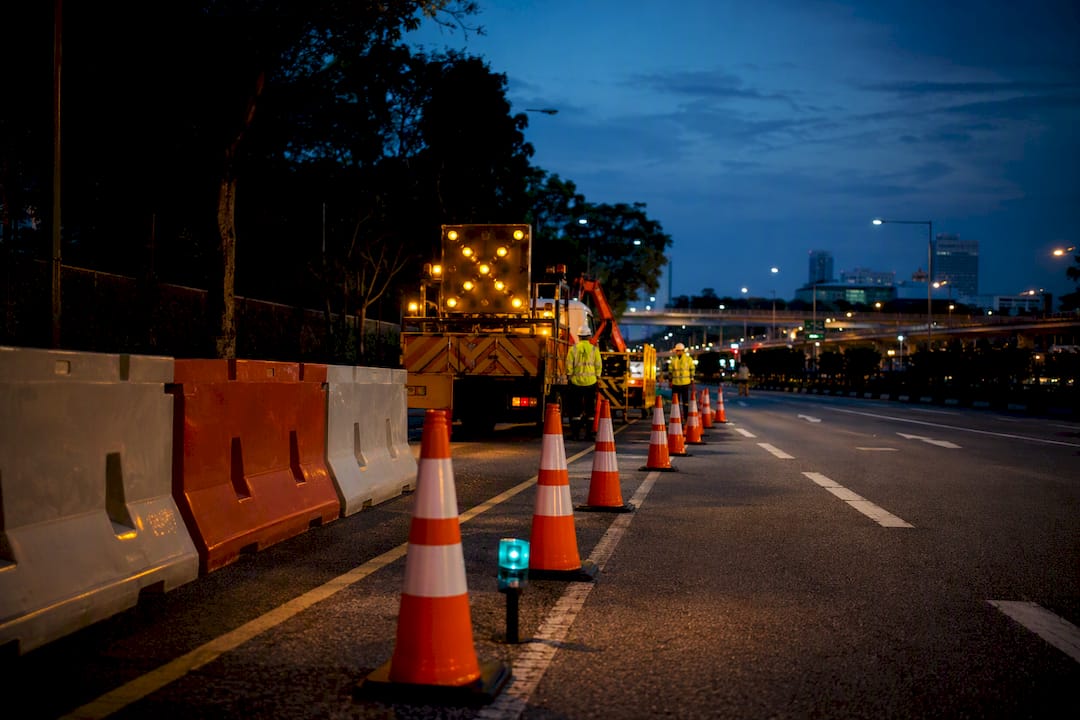
To run temporary traffic control legally in Singapore, prepare a Traffic Control Plan aligned with the LTA Code of Practice, submit the required permits through LTA.PROMPT, and secure ASO or APO authorization at least five working days before deployment. The two documents every project manager should keep open on a second monitor are the LTA Code of Practice for Traffic Control at Work Zone and the Traffic Police road-closure guidance. Miss the lead times on either and the project stalls before the first cone hits the ground.
TL;DR:
- Permits must be submitted through LTA.PROMPT at least five working days before traffic control deployment to avoid project delays or enforcement actions.
- Roads requiring lane occupation and significant traffic disruptions demand separate approvals from both LTA and Traffic Police, depending on work scope and closure type.
- Traffic control plans must follow the five phases of planning, design, implementation, operation, and close-out, with design referencing specific COP clauses to prevent rejection.
- Proper zone segmentation and device selection adhere to COP standards, with taper lengths calculated based on posted speeds and tailored for expressways versus local roads.
- Site inspections, staff training, and thorough documentation substantially reduce the risk of non-compliance violations during audits.
Table of Contents
- What Governs Temporary Traffic Control Compliance in Singapore?
- How Do You Submit Permits for Road Works Through LTA.PROMPT?
- What Are the Phases of a Traffic Control Plan?
- What Zones and Devices Does the COP Require?
- Who Is Authorized to Direct Traffic on Singapore Roads?
- When Do You Need to Coordinate With LTA ITS or iTransport?
- Why Do Traffic Control Plans Fail LTA Audits?
- What Documents Belong in a Submission-Ready TCP Package?
- What Training Prepares You for Traffic Control Compliance?
- How specialized consultants support TCP approvals and reduce rectification risk
- Lessons From Work-Zone Projects in Singapore
- Get TCP Design and Approval Support From Com
- Sources
- FAQ
What Governs Temporary Traffic Control Compliance in Singapore?
The Land Transport Authority’s Code of Practice for Traffic Control at Work Zone is the baseline document for every contractor putting cones, barriers, or signage on a public road. It sets out zone definitions, taper geometry, device specifications, and the phased approach a Traffic Control Plan (TCP) must follow from planning through close-out. Its legal footing comes from the Street Works Act and its subsidiary regulations, which give LTA the authority to require permits for any work that disrupts a public street, including excavation, hoarding, and lane occupation.
Two agencies share enforcement duties, and confusing their roles is one of the most common early mistakes contractors make. LTA administers the permit and notification system for street works, reviews TCP submissions, and holds authority over devices, signage, and lane configurations on the road network. Traffic Police, separately, issues road-closure permits for events and works that require a full or partial road shutdown, and it enforces the code of practice for lifting closures safely once work finishes.
The overlap matters in practice. A contractor doing a night resurfacing job might need an LTA street-works permit for the occupation itself and a separate Traffic Police road-closure permit if the job requires shutting a carriageway rather than just narrowing it. Treating these as one submission is a frequent cause of rejected paperwork.
A few things worth bookmarking before you start drafting anything:
- The COP is updated periodically. Always confirm you’re working from the latest edition posted on LTA’s website rather than a saved PDF from a previous project.
- Regulation 12 requirements under the Street Works framework apply regardless of project size. A short-duration cable pull has the same baseline obligations as a multi-month excavation.
- LTA’s review looks specifically at whether your TCP matches COP zone and device standards. Generic templates borrowed from other jurisdictions almost always fail this check.
- Traffic Police involvement is triggered by closure type, not project size. A one-lane closure on an expressway can require more scrutiny than a full closure on a quiet estate road.
How Do You Submit Permits for Road Works Through LTA.PROMPT?
Every temporary traffic control project in Singapore touches at least one of three permit pathways, and knowing which applies to your scope saves weeks of back-and-forth.
- Street works notification. Routine works affecting the road reserve, including most lane narrowing and shoulder work, get submitted through LTA.PROMPT, the Permit for Road Occupation Management Portal. Section 115 notifications for certain works must reach LTA at least 7 days before commencement.
- Road-closure permits. Full or partial closures, especially those affecting traffic flow beyond the immediate work site, require a separate application to Traffic Police, assessed case by case with its own lighting and placement conditions.
- Security officer authorization (OVM-related deployments). If your TCP relies on Authorized Security Officers to direct traffic, that authorization is a distinct LTA.PROMPT submission, filed at least five working days ahead of deployment, per LTA’s guidance on ASO authorization.
Registration on LTA.PROMPT is a prerequisite, not a formality. Companies need to be registered before they can lodge any notification, and the person submitting typically needs to be listed as an authorized representative of the contractor or the appointed traffic management subcontractor. Larger firms often centralize this with one or two staff who handle all PROMPT submissions across active sites, which cuts down on duplicate registrations and lost login credentials.
Submitting at the minimum notice period is legally sufficient, but it leaves zero margin for revision requests. LTA reviewers routinely send back TCPs with clarification requests on taper length, signage wording, or device spacing. If your only buffer is the statutory seven days; a single round of corrections can push your start date past the planned mobilization. Experienced project managers on recurring work submit ten to fourteen days ahead as standard practice, treating the statutory minimum as a floor, not a target.
Missing these timelines carries real cost. A rejected or incomplete submission means the work simply cannot start, which on a critical-path task can cascade into liquidated damages exposure or resequencing of other trades. Worse, contractors who deploy without a live, approved permit risk enforcement action from either agency, plus reputational damage that makes future submissions face heavier scrutiny.

What Are the Phases of a Traffic Control Plan?
A TCP that gets approved on the first pass usually follows the same five-phase structure the COP implies, even though the document doesn’t always spell it out as neatly as a project schedule would.

Planning starts with understanding the road classification, traffic volume, and adjacent land use. A TCP for a quiet residential lane looks nothing like one for an expressway shoulder, and LTA reviewers can tell within seconds when a template has been copied across road types without adjustment.
Design is where most of the technical content lives: taper lengths, zone layout, device selection, signage wording, and the sequence of works. This phase must document sightlines, pedestrian routes, and any conflicts with bus stops, school zones, or existing utilities.
Implementation covers how the plan gets executed on day one, including who deploys devices, in what order, and how the site is verified against the approved drawing before traffic is diverted.
Operation is the ongoing phase, covering daily checks, marshal deployment, and how the TCP adapts if site conditions change, such as an unplanned excavation extension.
Close-out is often skipped in informal planning but shouldn’t be. It covers the sequence for lifting closures and restoring the road to its original configuration, along with confirming all devices and signage are removed.
Formal LTA approval, rather than simple notification, gets triggered specifically when a TCP proposes continuous lane closures spanning multiple days, major diversions affecting bus routes, or any change to a signalized junction’s operation. These trigger a more detailed review cycle because the downstream effects on network traffic are harder to predict.
Pro Tip: Draft your TCP with the reviewer’s checklist in mind, not just your site’s logistics. Reference the specific COP clause number next to each design decision (taper length, device spacing, buffer zone) so the reviewer can verify compliance without having to cross-check the code themselves. This single habit cuts revision cycles dramatically on repeat submissions.
Common rejection triggers include mismatched taper lengths for the stated road speed, missing pedestrian diversion routes, and TCPs that don’t account for peak-hour traffic patterns specific to the site. A TCP built once and reused across similar sites without re-checking sightlines and speed limits is one of the fastest ways to collect avoidable rejections.
What Zones and Devices Does the COP Require?
The COP structures every work zone into four functional segments, and understanding what each one does prevents the most basic layout mistakes.
The advance warning zone gives approaching drivers time to recognize the change ahead and adjust speed before reaching any physical obstruction. The transition zone is where the taper happens, guiding vehicles out of their normal lane. The activity zone is the actual work area, buffered from traffic by barriers or channelizing devices. The termination zone returns traffic to its normal lane configuration once past the site.
Taper length isn’t a matter of judgment. It’s calculated from the posted or prevailing speed of the road, and the COP’s taper tables set out different formulas for expressways versus local roads, reflecting the very different stopping distances involved. An expressway taper calculated using local-road assumptions is a common failure point, because it leaves drivers too little warning at higher closing speeds.
Device selection has to match the zone it’s protecting:
- Cones and delineators mark transition and advance warning zones on lower-speed roads.
- Water-filled or concrete barriers protect the activity zone on higher-speed roads where impact protection matters.
- Truck-mounted attenuators (TMAs) are used ahead of mobile or short-duration works on expressways, absorbing impact before it reaches the crew.
- Retroreflective signage and delineation devices must meet minimum height and spacing standards set out in the code, so visibility holds up in Singapore’s frequent heavy rain.
One structural fact worth internalizing: the COP treats expressway and arterial road tapers as fundamentally different calculations from local-road tapers, not a scaled-up version of the same formula. Applying an arterial-road spacing table to an expressway job is one of the more common design errors flagged during LTA review.
Night work adds another layer. Devices need supplementary lighting beyond standard retroreflective treatment, and the COP sets expectations for illuminating the transition zone specifically, since that’s where a driver’s judgment about lane position matters most in low visibility. Vendors like 3M Singapore supply retroreflective sheeting and delineation products commonly specified for these night-work zones, alongside other local suppliers offering equivalent COP-compliant materials.
Who Is Authorized to Direct Traffic on Singapore Roads?
Not everyone standing in a high-visibility vest with a stop sign is legally authorized to direct traffic, and this is one of the more frequently misunderstood parts of the whole system.
Authorized Security Officers (ASOs) are security officers who’ve received specific authorization from LTA to regulate traffic at road works. They’re a practical, cost-effective option for many lower-speed and lower-complexity sites, but road category determines whether an ASO is sufficient or whether an Auxiliary Police Officer (APO) is required instead. Higher-speed roads, more complex junctions, or situations with greater enforcement risk typically call for APOs, who carry broader authority.
Getting this wrong is a genuinely easy mistake to make. Some contractors assume that hiring a licensed security agency automatically covers the authorization requirement, but registration and authorization are two distinct steps. The agency needs to hold the underlying license, and each specific deployment needs its own authorization filed through LTA.PROMPT, submitted at least five working days ahead, per LTA’s authorization requirements.
What a properly authorized traffic marshal needs on site:
- Valid ASO or APO authorization documentation matching the specific work site and dates.
- High-visibility clothing meeting the standard specified in the COP.
- A two-way radio or equivalent communication method to coordinate with other marshals and the site supervisor.
- Familiarity with the approved TCP layout, not just general traffic-directing experience.
Road category isn’t the only variable. Expected traffic volume, time of day, and proximity to schools or transport hubs all factor into whether your TCP should call for ASOs, APOs, or a combination across different zones of the same site. Professional planning at the TCP design stage, not last-minute staffing decisions, is what gets this right.
When Do You Need to Coordinate With LTA ITS or iTransport?
Major arterial works and anything affecting a signalized junction require proactive coordination with LTA’s Intelligent Transport Systems operations, and this step is increasingly treated as a standard expectation rather than an optional extra for complex submissions.
ITS and its public-facing arm, iTransport, monitor traffic flow across the road network in real time, feeding data into signal timing, incident response, and public traveler information. When your TCP proposes a diversion that touches a major arterial road, a bus route, or a junction’s signal phasing, LTA’s review process typically checks whether you’ve accounted for that network-level impact, not just the immediate work site.
Practical engagement starts early. Contact LTA’s traffic operations team during the TCP design phase, before finalizing your submission, so any concerns about network impact get resolved before the formal application clock starts running. This is especially important for diversions that affect bus services, since changes to a bus route or stop location require separate coordination with the relevant operator on top of the LTA submission.
The benefit isn’t just regulatory box-checking. Real-time monitoring coordination means that if your work zone causes unexpected congestion, ITS operations can adjust signal timing or push updated information to drivers through digital signage and traffic apps, reducing the ripple effect on the wider network. Contractors who skip this step often find out about network impact only after complaints or Traffic Police queries arrive.
Document this coordination explicitly in your TCP submission. A short note confirming you’ve engaged ITS operations, with the date and outcome of that conversation, gives LTA reviewers confidence that network effects were considered rather than overlooked.
Why Do Traffic Control Plans Fail LTA Audits?
Site audits turn up the same handful of problems again and again, and nearly all of them are avoidable with better daily discipline rather than better paperwork.
The single most common finding is safety zones being used as informal storage. A buffer zone meant to protect the activity area from traffic gets filled with spare materials, equipment, or parked vehicles, defeating its purpose entirely. The second most frequent issue is incorrect device deployment: cones spaced too far apart, barriers placed in the wrong sequence, or signage that doesn’t match what was actually approved in the TCP. Missing or inadequate night lighting rounds out the top three, particularly on longer-duration jobs where the original setup degrades over weeks without anyone re-checking it against the approved plan.
- Safety zones used for material or equipment storage instead of remaining clear buffers.
- Devices spaced or sequenced differently from the approved TCP drawing.
- Night lighting that was adequate at setup but wasn’t maintained as bulbs failed or devices shifted.
- Incomplete submissions where the deployed layout diverges from what LTA actually approved.
Fixing this pattern comes down to routine, not heroics. Staged inspections at shift start and shift end catch drift before it becomes a violation. A daily checklist that a supervisor physically signs, rather than a verbal confirmation, creates the paper trail that matters if an auditor does show up. Training every marshal and supervisor on what “compliant” actually looks like against the approved drawing, not just general safety awareness, closes the gap between the plan on paper and the site.
Pro Tip: When lifting a road closure, work from the point furthest away from incoming traffic back toward the entry point. This sequence, reflected in Traffic Police guidance, reduces the risk of reopening a lane before the far end is actually clear.
LTA and Traffic Police audits typically involve unannounced site visits checked against the approved TCP drawing on file. Findings that don’t match trigger a rectification notice with a set correction window; repeated or serious noncompliance can escalate to permit suspension for that contractor’s future submissions, which is a far more expensive outcome than the fix itself would have been.
What Documents Belong in a Submission-Ready TCP Package?
A complete package rarely gets flagged for missing information if it follows a consistent structure every time. Before submission, confirm you have the following:
- Site plan showing the work area, road classification, and surrounding land use (schools, bus stops, junctions).
- TCP drawing detailing zone layout, taper calculations, and device placement, referenced against specific COP clauses.
- Method statement covering the sequence of works, from setup through close-out.
- Marshal deployment plan specifying ASO or APO staffing, shift coverage, and communication protocols.
- ITS coordination note, where the works affect an arterial road or signalized junction.
- Copies of relevant authorizations, including security agency licensing and ASO/APO documentation.
- Contact details for the site supervisor and an emergency escalation point.
Internal sign-off matters as much as the external submission. A typical handover sequence runs from the site engineer, who confirms the drawing matches physical site constraints, to the safety officer, who checks the plan against COP requirements, to the project manager, who confirms staffing and timeline before the package goes to LTA.PROMPT.
| Checklist Item | Owner | Confirms |
|---|---|---|
| Site plan and road classification | Site engineer | Physical constraints match drawing |
| TCP drawing with COP clause references | Safety officer | Compliance with taper and zone rules |
| Marshal deployment and authorization | Project manager | ASO/APO staffing confirmed and filed |
| ITS coordination note (if applicable) | Traffic coordinator | Network impact reviewed |
| Final submission via LTA.PROMPT | Project manager | Timeline meets minimum notice period |
Keeping a standing template for this package, rather than rebuilding it from scratch each time, is exactly the kind of groundwork Com’s Traffic Management Plan checklist is built around, structured specifically to reduce LTA rectification risk on repeat submissions.
What Training Prepares You for Traffic Control Compliance?
Course completion isn’t just a professional development line item. It’s often the evidence LTA reviewers want to see attached to a permit package when the TCP involves anything beyond a simple, low-speed work zone.
The Fundamentals of Traffic Control & Safety at Temporary Road Diversions course, delivered through LTA Academy, is aimed at consultants, engineers, and site managers who need to understand the engineering logic behind diversion design, not just the compliance checklist. The WSQ Conduct Crowd and Traffic Control course targets the personnel actually directing vehicles and pedestrians on site, covering practical deployment skills alongside the regulatory basics.
Attaching a training certificate to a permit application doesn’t replace the ASO or APO authorization itself, but it strengthens the credibility of the submission and can shorten the review conversation when LTA staff can see the site team has formal grounding in COP requirements. Site managers overseeing multiple concurrent work zones benefit most from the LTA Academy course, since it covers the design reasoning they need to sanity-check a subcontractor’s TCP before it goes out the door. Frontline marshals and supervisory staff are the right audience for the WSQ track.
How specialized consultants support TCP approvals and reduce rectification risk
Getting a TCP through LTA review on the first pass is largely a documentation and sequencing problem, and it’s where a lot of Com’s day-to-day consultancy work sits. Services like EHS Advisory and Documentation and WSH Audit and Inspection map directly onto the two failure points this article has walked through: submissions that don’t match COP clause requirements, and site implementation that drifts from the approved drawing over time.
A typical engagement starts with a site survey to understand road classification and constraints, moves into TCP drafting with clause-level references built in from the start, then covers submission support through LTA.PROMPT, and finishes with periodic on-site checks against the approved layout. On one recent project, a contractor’s draft TCP had storage material sitting inside the buffer zone, exactly the kind of finding that triggers a rectification notice during an LTA audit. Catching it during a pre-deployment walkdown, rather than during an unannounced inspection, avoided the notice entirely and kept the project on schedule.
That kind of catch is the difference between a checklist that exists on paper and one that’s actually used daily on site.
Lessons From Work-Zone Projects in Singapore
The plans that go smoothly almost always share one habit: someone has walked the actual site before finalizing the drawing. Desk-based TCPs that skip a physical walkdown consistently miss things like a hidden sightline behind a hoarding or a bus stop that got relocated since the last survey.
Daily device checks matter more than any single design decision. A perfectly calculated taper is worthless if half the cones have been knocked over by afternoon traffic and nobody’s checked since morning. Rehearsing night-work transitions before the actual shift, even briefly, catches lighting gaps that look fine on a drawing but fail in practice.
Delegating sign-off authority clearly, so one person owns the daily verification rather than assuming someone else has it covered, closes more compliance gaps than any additional paperwork would. Construction sequencing will always create pressure to shortcut the traffic plan. The projects that hold up under audit are the ones where road-user safety wins that argument every time, not just on the days an inspector might show up.
— Aman
Get TCP Design and Approval Support From Com
Building a compliant Traffic Control Plan without walking the same rejection cycle twice usually means having someone who’s seen the LTA review process from the inside. Com is a direct route to that experience for construction teams in Singapore who need a TCP that clears review the first time, not a generic template adapted from a different jurisdiction.

Com’s Design for Safety Professional service integrates traffic control planning into your project design from the earliest stage, so diversions get resolved before they collide with site logistics later. For teams that already have a TCP drafted but want a second set of eyes before submission, WSH Audit and Inspection checks it against COP requirements and flags the kind of gaps that trigger LTA rectification notices. ConSASS assessments and EHS Advisory and Documentation round out the support for teams juggling multiple compliance obligations on the same site.
Request a TCP review or site survey through Com’s consultancy services page to get a compliance check started before your next submission deadline.
Sources
- Code of Practice for Traffic Control at Work Zone (LTA) — Apr 2026
- LTA | Authorisation of security officers to regulate traffic for road works
- Traffic Police — Apply for road closure permit (User guide and info)
- LTA.PROMPT — FAQs and Section 115 notification details
FAQ
What Is Temporary Traffic Control?
Temporary traffic control refers to the signage, devices, barriers, and personnel deployed to safely manage traffic flow around a short-term work zone, such as a construction site or road repair. In Singapore, it’s governed by the LTA Code of Practice for Traffic Control at Work Zone, which sets zone layouts, device standards, and approval requirements.
How Much Does the Basic Traffic Controller Course Cost in Singapore?
Course fees for traffic control and marshal training vary by provider and aren’t standardized across the industry, so current pricing is best confirmed directly with the training provider or LTA Academy before enrolling. Contractors should factor course fees into project mobilization budgets well ahead of any deployment requiring authorized marshals.
Is There Currently a Traffic Jam in Singapore?
Real-time traffic conditions, including congestion caused by ongoing road works, are published on LTA’s OneMotoring traffic updates page, which lists live closures and expected durations. Contractors planning new works should check this resource to avoid scheduling conflicts with existing closures nearby.
What Is the Minimum Length of a Traffic Control Taper?
Taper length is calculated from the road’s speed limit rather than fixed at a single number, with separate formulas for expressways and local roads set out in the LTA Code of Practice. Using the wrong table, applying local-road spacing to an expressway job, for instance, is one of the more common reasons a TCP gets sent back for revision.
Does Com Help With Traffic Control Plan Submissions?
Com supports TCP drafting, site surveys, and submission preparation through services like Design for Safety Professional and WSH Audit and Inspection. These services are structured around reducing the documentation and layout errors that most often trigger LTA rectification notices.