

Digital tools and AI shift occupational safety from reactive incident management to predictive, data-driven hazard control — detecting risks before they escalate, guiding immediate corrective action, and enabling the organizational learning that drives sustained injury reduction. For safety managers in construction and other high-hazard sectors, the practical implication is clear: the technology infrastructure to prevent the next incident already exists; the challenge is deploying it with governance rigor and measurable intent.
Immediate priorities for safety decision-makers:
- Assess your current hazard profile against the technology categories available (wearables, IoT sensors, AI analytics, computer vision, drones, AR/VR, BIM-integrated workflows) to identify the highest-value use case for a first pilot.
- Design a bounded pilot with defined objectives, a control group or baseline period, and a 90-day data collection plan before committing to enterprise-wide deployment.
- Establish governance rules upfront — purpose-limited data collection, role-based access, and a worker communication plan — to prevent surveillance concerns from undermining adoption.
- Define leading and lagging KPIs (near-miss reporting rate, time-to-alert, recordable incident rate) before the pilot launches so ROI can be demonstrated to finance and executive stakeholders.
Authoritative bodies including NIOSH, OSHA, the International Labour Organization (ILO), and EU-OSHA have each published guidance affirming that digital safety systems represent a structural shift in how occupational risk is managed, not merely a technology upgrade.
Table of Contents
- How digital technologies improve safety outcomes and business performance
- What the key technology categories actually do on a jobsite
- A phased roadmap for adopting digital safety tools
- Building worker trust and governing data ethically
- How to measure impact: KPIs, evaluation design, and ROI
- Real-world deployments and what they demonstrate
- Limitations, pitfalls, and technical risks that practitioners must anticipate
- Key Takeaways
- The gap between digital safety promises and what actually determines success
- How MOSAIC Eco-construction Solutions supports digital safety adoption
- Authoritative references and further reading
How digital technologies improve safety outcomes and business performance
The business case for digital safety investment in construction rests on three converging value streams: direct injury prevention, operational continuity, and regulatory compliance efficiency. Each is measurable, and each compounds the others.
On the prevention side, AI-driven video surveillance and environmental sensors detect hazards — improper lifting mechanics, PPE non-compliance, hazardous gas accumulation — in real time, issuing alerts before conditions become critical. The ILO’s 2025 World Safety Day report documents that smart OSH monitoring systems, including AI-powered sensors and wearable devices, enable real-time hazard detection, predictive risk assessments, and proactive safety management across high-risk sectors including construction, mining, and chemicals. Predictive analytics platforms analyze historical incident data alongside real-time sensor feeds to surface near-miss patterns that human observers routinely miss, enabling targeted interventions before a recordable event occurs.
Statistic callout: A survey of 102 occupational health and safety professionals in the construction sector found that A significant portion reported that parts of their work could be automated, and many were already using AI-based solutions in daily practice. For safety managers facing documentation and reporting burdens, that figure signals a concrete productivity recovery — hours redirected from paperwork to field observation.
The operational and financial returns are equally concrete. Reduced lost-time incidents translate directly into lower workers’ compensation claims, reduced OSHA recordable rates, and improved experience modification rates (EMR) that drive down insurance premiums. Ergonomic wearables that detect biomechanical overloading reduce musculoskeletal disorder exposures — the leading category of construction injuries by lost workdays according to Bureau of Labor Statistics occupational injury data. For lone workers in confined spaces or remote sites, geofencing and physiological monitoring can shorten rescue response times from hours to minutes, a distinction that is often the difference between a near-miss and a fatality.
Compliance and reporting efficiency rounds out the value proposition. Digital inspection platforms and mobile reporting tools automate the documentation chain from field observation to OSHA recordkeeping, reducing the administrative burden on safety officers and creating an auditable data trail that supports both internal review and regulatory inspection.
What the key technology categories actually do on a jobsite
Understanding the role of digital safety tools requires a clear-eyed technology map — what each category does, where it fits in a construction or hazardous-environment context, and what deployment constraints practitioners should anticipate.
AI analytics platforms
AI platforms ingest data from multiple sources (sensors, cameras, inspection records, incident logs) and apply machine learning to identify risk patterns, predict equipment failures, and generate prioritized safety alerts. On a construction site, an AI analytics layer can correlate weather data, crew fatigue indicators, and historical near-miss locations to flag elevated-risk windows before a shift begins. Deployment constraint: these platforms require consistent, clean data inputs; poor sensor maintenance or incomplete inspection records degrade model accuracy rapidly.
IoT environmental sensors
Sensor networks monitor air quality, noise levels, temperature, humidity, and hazardous gas concentrations continuously, triggering automated alerts when thresholds are breached. In confined-space operations — a leading fatality category in U.S. construction — gas sensors provide the continuous atmospheric monitoring that manual pre-entry checks alone cannot sustain across a full shift. Edge-computing configurations allow sensors to operate and alert locally even when site connectivity is intermittent, a critical requirement for remote or underground worksites.
Wearable devices
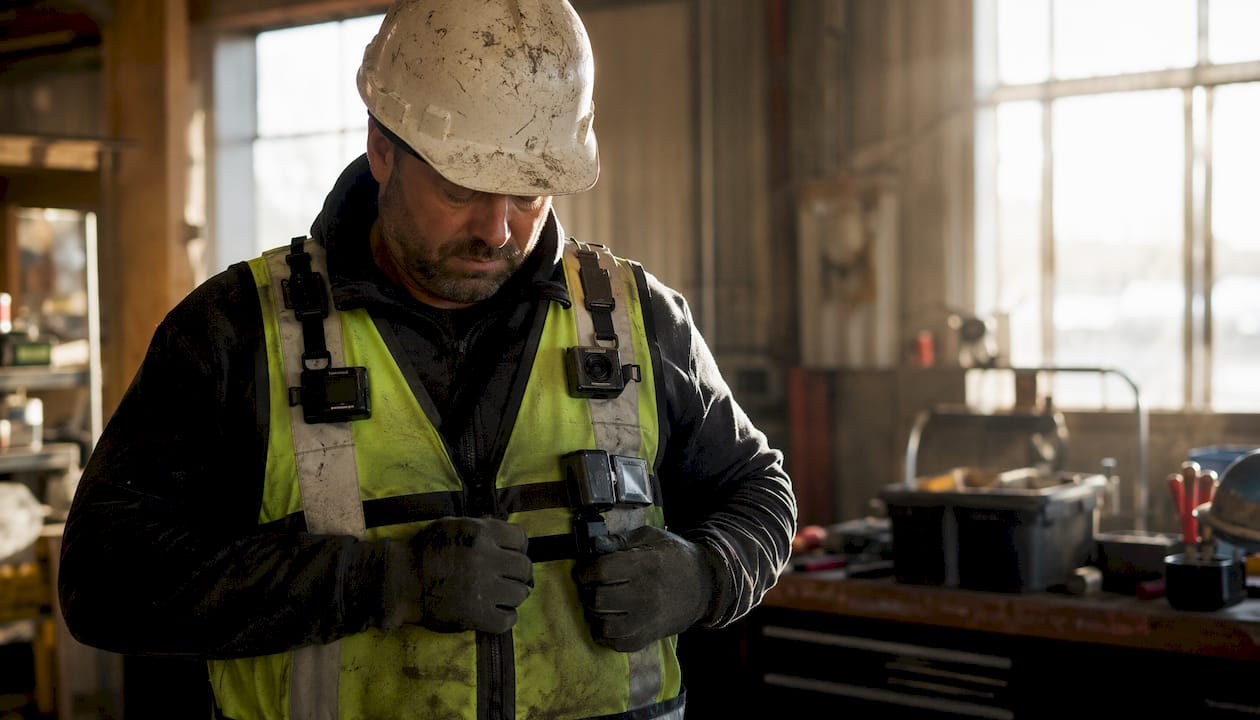
Smart helmets, biometric vests, and exoskeleton-integrated sensors enable multimodal monitoring of physiological parameters (heart rate, core temperature, fatigue indicators) and biomechanical loading (posture, repetitive motion, force exertion). A systematic review of 60 wearable technology studies confirms strong potential for early detection and decision support, while also noting that longitudinal evidence directly linking wearables to sustained accident reduction remains limited. This is a critical nuance for ROI projections: wearables are most defensible as early-warning and data-collection tools, not as standalone accident-prevention guarantees. For construction site ergonomics, posture-detection wearables represent one of the most practical near-term applications.
Computer vision (CV) for PPE compliance and behavioral monitoring
Camera-based CV systems analyze video feeds in real time to detect PPE non-compliance (missing hard hats, absent high-visibility vests), unsafe proximity to exclusion zones, and hazardous behaviors such as improper manual handling. CV eliminates the sampling bias inherent in periodic human inspections — it monitors continuously across every camera-covered zone. The primary deployment challenge is lighting variability and occlusion on active construction sites, which can elevate false-positive rates and erode worker trust if not calibrated carefully.
Drones (UAVs)
Drones equipped with cameras, thermal sensors, and gas detectors provide aerial hazard assessment of areas inaccessible or dangerous for ground-based inspection — roof structures, tower crane rigging, post-incident debris fields, and confined-space approach zones. The ILO notes that drones are particularly valuable in remote or hazardous environments where human access is limited. U.S. operators must comply with FAA Part 107 regulations for commercial drone operations, which govern flight altitude, line-of-sight requirements, and airspace authorization near construction sites in urban areas.
Augmented and virtual reality (AR/VR)
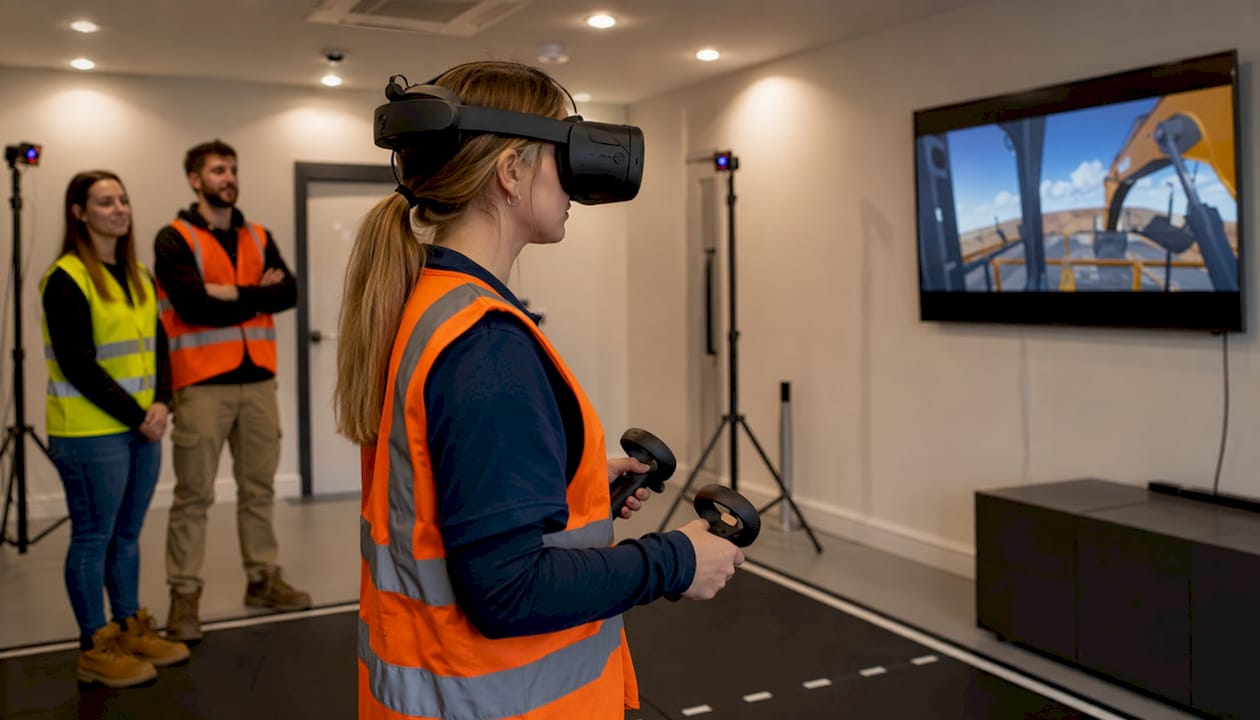
VR training platforms place workers in photorealistic simulations of high-risk tasks — working at height, operating heavy plant near excavations, emergency evacuation procedures — allowing repeated practice without physical exposure. AR overlays safety data (hazard zones, equipment status, procedural checklists) onto a worker’s field of view via smart glasses or tablet interfaces. Beyond training, XR enables safety professionals to conduct virtual risk assessments of work environments before physical construction begins, identifying hazards in confined or hard-to-reach locations proactively.
BIM-integrated digital workflows
Building Information Modeling platforms with integrated safety modules allow Design for Safety (DfS) principles to be embedded at the design stage, flagging constructability hazards before they become site conditions. Digital method statements, permit-to-work systems, and inspection checklists tied to BIM model elements create a spatially referenced safety record that supports both real-time site management and post-project analysis. Safety monitoring on construction sites becomes substantially more effective when the digital monitoring layer is anchored to a BIM model that reflects actual site conditions.
Pro Tip: Before investing in high-cost wearables or enterprise AI platforms, deploy a combination of smartphones with mobile inspection apps and low-cost environmental sensors. Mobile tools in construction management demonstrate that familiar devices dramatically reduce adoption friction and generate the baseline data quality needed to justify more sophisticated investments. Start with what workers already carry.
A phased roadmap for adopting digital safety tools
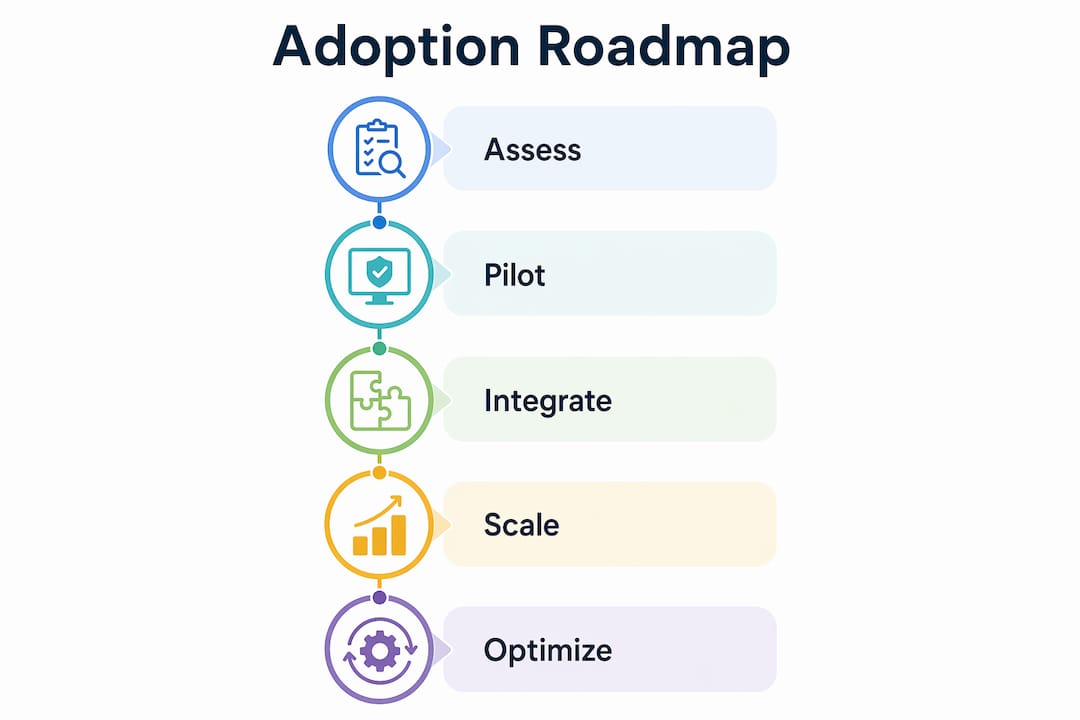
Successful adoption follows a disciplined four-phase sequence. Compressing or skipping phases is the single most common cause of failed deployments in construction safety technology programs.
Phase 1 — Assess (Weeks 1–6) | Owner: Safety Lead + Operations
Map your current hazard profile against OSHA recordable data, near-miss logs, and worker feedback. Identify the two or three highest-frequency or highest-severity risk categories. Audit existing technology infrastructure: connectivity coverage, device availability, current safety management system (SMS) architecture, and data storage capacity. This phase produces a prioritized use-case shortlist and a gap analysis that informs vendor selection.
Phase 2 — Pilot (Weeks 7–22) | Owner: Safety Lead + IT + Operations
Select one bounded use case — for example, CV-based PPE compliance monitoring on a single active floor, or environmental sensor deployment in a confined-space work zone. Define the pilot parameters using the numbered steps below:
- Set a specific, measurable objective (e.g., reduce PPE non-compliance observations by 40% within 90 days).
- Establish a baseline measurement period of at least four weeks before activating the technology intervention.
- Define the sample: minimum one crew or one work zone with sufficient activity volume to generate statistically meaningful data.
- Assign a data steward responsible for daily data quality checks and weekly reporting.
- Schedule a mid-pilot review at week eight to assess data quality, false-positive rates, and worker feedback.
- Document all deviations from the pilot plan and their causes.
Pilot success criteria:
| Criterion | Measurable Signal | Threshold |
|---|---|---|
| Data quality | Percentage of sensor readings within valid range | — |
| Alert accuracy | False-positive rate on safety alerts | — |
| Worker acceptance | Adoption rate among pilot crew | — |
| Safety outcome | Change in near-miss reporting rate vs. baseline | Positive trend |
| Operational impact | Unplanned downtime attributable to technology | < 2% of shift hours |
Phase 3 — Integrate (Weeks 23–40) | Owner: IT + Safety Lead
Connect the validated pilot tool to the existing SMS, OSHA recordkeeping system, and incident management workflow. This phase addresses interoperability: API compatibility, data format standardization, and user access provisioning. Building a site safety management system that treats digital tools as embedded components rather than bolt-on additions is the architectural principle that separates durable programs from short-lived experiments.
Phase 4 — Scale (Weeks 41+) | Owner: Operations + Safety Lead
Expand validated configurations to additional sites or work zones, incorporating lessons from the pilot. Real-time data for construction managers becomes most valuable at scale, when cross-site pattern analysis can surface systemic hazards invisible at the single-site level.
Major cost drivers to budget for: hardware procurement and replacement cycles, cellular or mesh connectivity infrastructure, cloud data storage and processing fees, SMS integration development, and ongoing training for new crew members and supervisors. For SMEs, cross-sector partnerships and pooled resources represent a practical mechanism for accessing advanced capabilities without bearing full platform costs independently.
Building worker trust and governing data ethically
The most technically sophisticated digital safety program will fail if workers perceive it as a surveillance apparatus rather than a protective tool. EU-OSHA’s implementation guidance is unambiguous: worker involvement and purpose-limited data collection are not optional governance niceties — they are the primary determinants of whether a deployment succeeds or produces the mistrust that reverses safety benefits.
The governing principle is Safety by Design: privacy protections, data minimization, and role-based access controls must be architected into the system from the outset, not retrofitted after deployment. The WEF’s intervention roadmap identifies continuous monitoring and transparency reporting as core elements of a trustworthy digital safety program — meaning workers should be able to see what data is collected about them and how it is used.
Worker communication checklist for rollout:
- Co-create the use case with worker representatives before vendor selection; involve crews in testing and in-situ trials.
- Publish a plain-language data use policy specifying exactly what is collected, who can access it, how long it is retained, and what it will never be used for (performance management, disciplinary action).
- Conduct pre-deployment training covering both the technology operation and the data governance policy.
- Establish a feedback channel for workers to report false positives, discomfort, or concerns without fear of reprisal.
- Review data governance compliance quarterly and share summary findings with worker representatives.
On the regulatory side, U.S. employers must navigate OSHA’s General Duty Clause obligations alongside applicable state privacy laws — several of which impose specific requirements on biometric data collection (Illinois BIPA being the most stringent). NIOSH guidance on worker health monitoring emphasizes that physiological data collected for safety purposes must be handled with the same confidentiality standards applied to medical records.
Pro Tip: Avoid disclosing the full technical architecture of your alert algorithms to the general workforce. Detailed system specifications can enable adversarial exploitation — workers who understand exactly which behaviors trigger alerts may modify behavior to evade detection rather than to work safely. Communicate the purpose and the protections clearly; reserve technical implementation details for the governance committee and IT security team.
How to measure impact: KPIs, evaluation design, and ROI
Measurement discipline is what separates a credible digital safety program from a technology procurement exercise. The evaluation framework must be established before the pilot launches — retrofitting metrics after the fact produces data that neither safety teams nor finance leaders will trust.
Leading indicators (predictive, actionable in real time):
- Near-miss reporting rate per 100 workers per month
- Safety observation completion rate (percentage of scheduled inspections completed on time)
- Time-to-alert: elapsed time from hazard detection to worker notification
- PPE compliance rate across monitored zones
- Training completion rate for digital tool users
Lagging indicators (outcome-based, used for ROI and regulatory reporting):
- OSHA recordable incident rate (RIR)
- Lost-time incident rate (LTIR)
- Days away, restricted, or transferred (DART) rate
- Workers’ compensation claim frequency and average cost
- EMR trajectory over rolling 12-month periods
KPI measurement framework:
| KPI | Definition | Data Source | Frequency |
|---|---|---|---|
| Near-miss reporting rate | Near-misses reported per 100 workers per month | Digital incident management system | Monthly |
| Time-to-alert | Minutes from sensor trigger to worker notification | Platform alert log | Per event |
| PPE compliance rate | Percentage of CV-monitored observations with full PPE | CV analytics dashboard | Weekly |
| OSHA RIR | (Recordable injuries × 200,000) / hours worked | OSHA recordkeeping log | Quarterly |
| Claim cost per incident | Total workers’ comp costs / number of claims | Insurance carrier report | Annually |
Safety analytics in construction risk management provides the analytical infrastructure that converts these raw metrics into prioritized intervention decisions.
Worked ROI example: A mid-size general contractor with 200 field workers experiences an average of 8 recordable incidents per year at an average direct and indirect cost of $38,000 per incident (a conservative figure consistent with published OSHA cost estimates). A CV-based PPE compliance and behavioral monitoring program reduces recordable incidents substantially, preventing several incidents annually. That prevention generates $76,000 in avoided costs per year. Against a platform cost of $40,000 annually (hardware, connectivity, licensing), the net first-year return is $36,000, with the return improving as the system’s predictive accuracy compounds over time. This calculation excludes EMR-driven insurance premium reductions, which can be substantial for contractors with high claim histories.
Real-world deployments and what they demonstrate
Published evidence and field deployments across construction and hazardous industries provide a clear picture of what measurable outcomes look like — and what implementation conditions produce them.
Case 1: Wearable biometric monitoring in high-heat construction
A deployment of biometric wearables monitoring core temperature and heart rate among outdoor construction crews in high-heat conditions enabled supervisors to intervene before workers reached physiological thresholds associated with heat stroke. The primary lesson: the technology’s value was realized only after supervisors received structured training on interpreting alert thresholds and were empowered to act on them without production pressure override. The tool without the protocol produced alerts that were routinely ignored.
Case 2: Environmental sensor networks in confined-space operations
A utility contractor deployed continuous atmospheric monitoring sensors in confined-space entry operations, replacing periodic manual gas checks with real-time continuous readings transmitted to a surface monitor. The intervention eliminated two near-miss atmospheric exposure events in the first six months of operation that pre-deployment manual checks had failed to detect. The critical implementation note: sensor calibration schedules must be enforced rigorously; a single uncalibrated sensor that produces false-safe readings is more dangerous than no sensor at all.
Case 3: SME digital safety adoption patterns
Research on Italian metalworking SMEs — a structural analog to small U.S. construction subcontractors — found that higher adoption rates cluster around familiar devices: smartphones, cameras, and environmental sensors, rather than high-cost wearables. The practical lesson for U.S. construction SMEs is direct: pilot with the technology your workforce already uses before committing capital to specialized hardware.
MOSAIC client example: A mid-tier construction contractor engaged Com to integrate DfS advisory with a digital monitoring program across a multi-story commercial build. The intervention combined Design for Safety reviews at the design stage with mobile inspection app deployment for daily hazard reporting and a CV-based PPE compliance system on the primary work floors. The DfS consultancy integration identified three constructability hazards at design stage that would have required costly re-engineering if discovered during construction. Over the project duration, the near-miss reporting rate increased by over 60% relative to the contractor’s previous project baseline — a leading indicator of improved safety culture, not merely improved technology coverage.
Limitations, pitfalls, and technical risks that practitioners must anticipate
No technology category in occupational safety is without failure modes. Practitioners who enter deployments without a clear-eyed risk register for the technology itself will encounter preventable problems.
Technical risks:
- Sensor drift and calibration failure: Environmental sensors lose accuracy over time without scheduled recalibration. A gas sensor reading safe when conditions are hazardous is a catastrophic failure mode, not a minor inconvenience.
- False positives from CV systems: Camera-based behavioral detection on active construction sites — with variable lighting, dust, occlusion, and worker density — can generate false-positive alert rates that erode supervisor trust and produce alert fatigue. Calibration and threshold-setting must be site-specific, not vendor-default.
- Connectivity outages: Cloud-dependent platforms that lose functionality when site cellular or Wi-Fi coverage drops are unsuitable for underground, remote, or structurally shielded work zones. Edge-computing configurations or offline modes are non-negotiable requirements for these environments.
- Battery life and charging logistics: Wearable devices with 8-hour battery lives create operational gaps on 10- or 12-hour shifts unless charging infrastructure and device rotation protocols are established before deployment.
- Integration gaps: Safety data siloed in a vendor platform that does not connect to the existing SMS, OSHA recordkeeping system, or incident management workflow produces analytical dead ends and doubles administrative burden.
Organizational pitfalls:
- Treating digital tools as standalone safety solutions rather than components of an integrated SMS.
- Deploying monitoring technology without worker involvement, producing the surveillance dynamic that EU-OSHA identifies as a primary adoption failure mechanism.
- Repurposing safety data for performance management or disciplinary action — a governance failure that destroys worker trust and may create legal exposure under state biometric privacy statutes.
- Selecting vendors based on feature lists rather than data governance practices, offline capability, and integration architecture.
Red flags in vendor proposals:
- No documented data governance policy or data retention schedule.
- No offline or edge-computing mode for connectivity-constrained environments.
- Opaque or proprietary alert algorithms with no explainability for safety officers.
- No reference deployments in comparable construction or hazardous-environment contexts.
- Contractual terms that grant the vendor rights to aggregate or resell anonymized worker data.
Key Takeaways
Digital tools and AI deliver measurable safety improvements in construction and hazardous environments when deployed within a governed, worker-centered program anchored to defined KPIs and integrated into the existing safety management system.
| Point | Details |
|---|---|
| Start with low-friction technology | Smartphones, mobile inspection apps, and environmental sensors deliver the highest adoption rates and generate the baseline data quality needed for advanced deployments. |
| Governance precedes technology | Purpose-limited data collection, role-based access, and a worker communication plan must be established before any monitoring system goes live. |
| Measure leading indicators first | Near-miss reporting rate, time-to-alert, and PPE compliance rate provide actionable signals during a pilot; lagging indicators confirm ROI over time. |
| Worker co-creation determines adoption | Top-down rollouts without worker involvement consistently produce limited acceptance and can reverse safety benefits, per EU-OSHA field evidence. |
| Com supports the full adoption cycle | MOSAIC Eco-construction Solutions provides DfS advisory, safety audits, pilot program design, and compliance support to guide organizations from assessment through scaled deployment. |
The gap between digital safety promises and what actually determines success
The construction industry’s conversation about digital safety tools has a persistent blind spot: it focuses almost entirely on the technology and almost never on the governance and cultural conditions that determine whether the technology produces safety outcomes or merely safety theater.
The evidence is consistent across EU-OSHA’s implementation guide, MITRE’s human-machine teaming analysis, and the SME adoption research: the organizations that extract durable safety value from digital tools are not the ones with the most sophisticated hardware. They are the ones that involved workers in the design of the program, established clear data governance before deployment, and treated the technology as an augmentation of human judgment rather than a replacement for it.
The practical implication for safety managers is counterintuitive. The first investment in a digital safety program should not be a vendor evaluation. It should be a governance design session with worker representatives, the safety lead, IT, and legal counsel — establishing the data use policy, the access controls, and the communication plan before a single sensor is procured. Organizations that sequence it the other way — technology first, governance later — consistently find themselves managing worker resistance, data quality problems, and legal exposure simultaneously, while the safety outcomes they purchased the technology to achieve remain elusive.
The technology is ready. The question is whether the organizational conditions are.
How MOSAIC Eco-construction Solutions supports digital safety adoption
For construction firms and project teams ready to move from technology awareness to structured implementation, Com provides the consultancy infrastructure that converts digital safety ambitions into measurable program outcomes. MOSAIC’s QES advisory services map directly to the adoption cycle described in this article: DfS integration at the design stage, safety audit frameworks that establish the baseline data needed for pilot design, training programs that address both technology operation and governance compliance, and ConSASS and ISO 45001 alignment support that ensures digital monitoring programs satisfy statutory and certification requirements.

Where many firms struggle with the pilot-to-scale transition, Com’s structured approach to regulatory compliance best practices provides the governance and measurement architecture that makes ROI demonstrable to finance and executive stakeholders. For organizations with no current digital safety program, the practical starting point is a scoped safety audit that identifies the highest-value use case and the governance gaps that must be addressed before deployment. Contact MOSAIC Eco-construction Solutions to schedule an initial consultation and define the scope of your first pilot.
Authoritative references and further reading
The sources below represent the highest-authority references for practitioners designing, evaluating, or governing digital safety programs in construction and hazardous environments.
Regulatory and institutional guidance:
- ILO World Safety Day 2025 Report: Revolutionizing Health and Safety — Comprehensive overview of digitalization’s impact on OSH, including automation, smart monitoring, and algorithmic management.
- EU-OSHA: Smart Digital Systems Implementation Guide — Operationally detailed guidance on deployment, worker involvement, and governance for smart safety systems.
- EU-OSHA: Artificial Intelligence and OSH Summary — Focused summary of AI applications and risks in occupational safety.
- Bureau of Labor Statistics: Industry Injury and Illness Rates — U.S. baseline data for benchmarking recordable incident rates by industry sector.
Implementation and governance frameworks:
- WEF: Digital Safety — A Guide to Implementing Interventions — Partnership models, continuous monitoring, and SME resource strategies.
- WEF: The Intervention Journey — A Roadmap to Effective Digital Safety Measures — Safety by Design lifecycle framework from risk identification through evaluation.
- MITRE: The Next Level of Safety — Evolving Safety in the Digital Age — Human-machine teaming analysis and system-of-systems integration principles.
Peer-reviewed evidence:
- MDPI: The Use of Digital Tools by OHS Specialists in the Polish Construction Sector — Survey evidence on AI adoption rates and automation potential in construction OHS practice.
- MDPI: Wearable Technologies in Occupational Safety and Health — A Systematic Review — Systematic review of 60 studies on wearable monitoring; essential reading for evidence-based ROI projections.
- ScienceDirect: Digital Solutions for Workplace Safety — SME Adoption Study — Empirical evidence on adoption patterns and barriers in SMEs; directly applicable to small U.S. construction subcontractors.
- The Future of Construction Safety Compliance — Practitioner-oriented analysis of compliance trends and digital monitoring implications for construction firms.
