

A permit-to-work system is the formal authorization process that controls who can perform high-risk work, when, and under what verified safeguards. For high-risk construction work in Singapore, it is not optional. The Workplace Safety and Health (Construction) Regulations 2007 mandate one, with defined duties for project managers, safety assessors, and supervisors. What follows is the lifecycle, the templates, and the coordination controls that turn that requirement into a system that actually holds up on site.
TL;DR:
- Permits must be issued by competent, independent authorities without commercial or scheduling pressure to ensure safety and compliance.
- Specific hazards like hot work, confined space entry, and electrical isolation require tailored controls documented in each permit.
- The permit lifecycle includes application, evaluation, active monitoring, and a strict close-out process with no informal extensions allowed.
- Digital permit systems enhance conflict detection and record keeping, but require thorough training and a hybrid rollout to prevent failure.
- Ongoing site inspections, regular audits, and clear assignment of permit owners are crucial to maintaining effective permit discipline and safety.
Table of Contents
- Permit to Work System Scope: What Triggers a Permit
- Legal Requirements and Roles Under the WSH Construction Regulations
- Permit to Work Examples by Hazard Type
- The Permit Lifecycle From Application to Close-Out
- Building a Permit to Work Template That Actually Works
- Managing SIMOPS and Incompatible Work on the Same Site
- Paper vs Digital Permit to Work Systems
- Monitoring, Audits, and Competence Requirements
- What Most Sites Get Wrong About Permit Discipline
- MOSAIC’s Permit to Work Documentation Setup
- Sources
Permit to Work System Scope: What Triggers a Permit
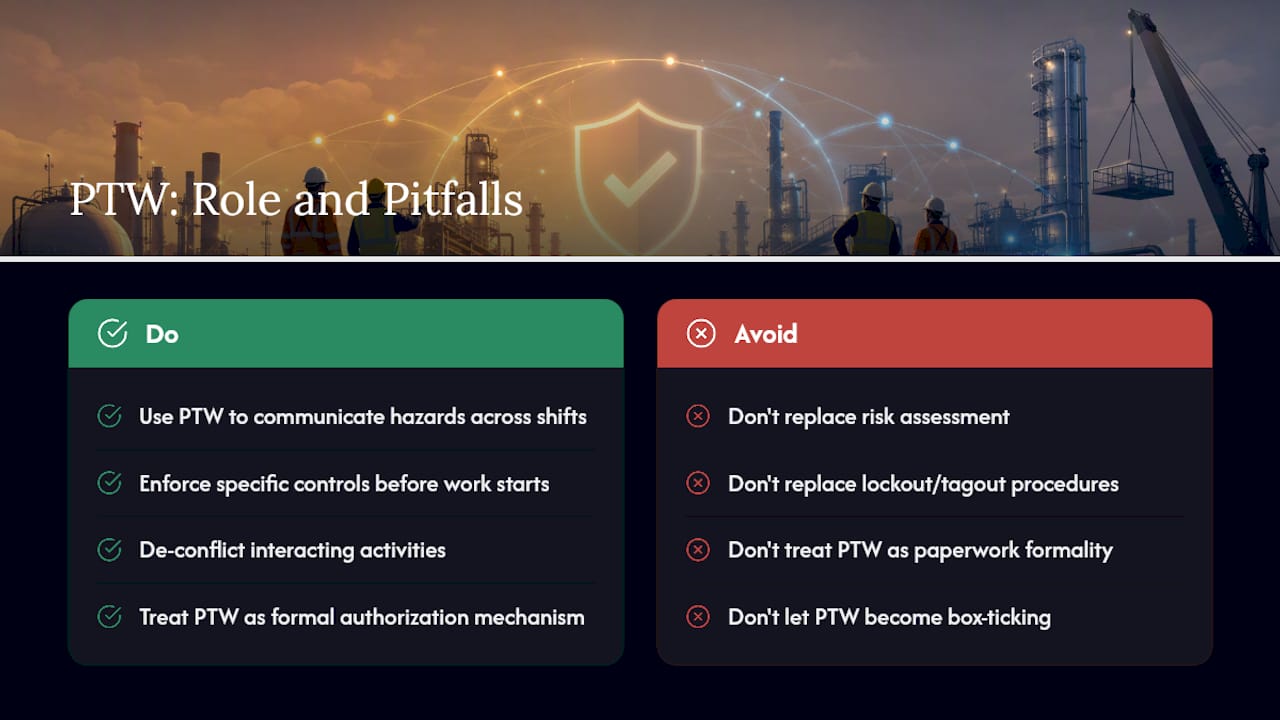
A permit-to-work system exists to do three things: communicate hazard information across shifts and trades, enforce specific controls before work starts, and de-conflict activities that could interact dangerously. The Ministry of Manpower frames it as a formal authorization mechanism, not a paperwork formality.
Common triggers include hot work, confined space entry, electrical isolation, excavation, lifting operations, and work at height. Each carries a distinct hazard profile that a generic risk assessment cannot fully capture on its own. That’s the key distinction to hold onto: a permit-to-work system supplements risk assessment and lockout/tagout procedures. It does not replace either one, and treating it as a substitute is one of the fastest ways a PTW program collapses into box ticking.
Legal Requirements and Roles Under the WSH Construction Regulations
The Workplace Safety and Health (Construction) Regulations require a permit-to-work system for defined high-risk construction activities, and the regulation assigns specific duties rather than leaving roles vague. The project manager must appoint a safety assessor, typically a workplace safety and health officer or another competent person, to implement and oversee the system. Supervisors handle day-to-day application and site verification.
MOM’s guidance adds a critical detail often missed in practice: the PTW authority must be competent and able to approve or reject a permit free of commercial or scheduling pressure. That independence is what separates a functioning permit system from one that rubber-stamps whatever the project timeline demands.
On the legal lifecycle, the regulations require posted permit copies at the work area, retention of records by the project manager, and a fresh application whenever work extends beyond the permit’s original validity window. There is no informal extension. If the clock runs out, the work stops until a new permit is issued, and someone with revocation authority needs to be identified before the first permit is ever signed.
Permit to Work Examples by Hazard Type
Different high-risk activities need different controls built into the permit itself. A one-size-fits-all form invites gaps.
- Hot work: Combustible materials cleared or shielded, gas testing before and during the task, and a dedicated fire watch posted for the duration and a defined period after work ends.
- Confined space entry: Continuous atmospheric monitoring, a standby person at the entry point, and a written rescue plan tested before entry, not drafted after an incident.
- Electrical isolation: Full lockout and a test-for-dead verification, issued only by someone qualified to certify the circuit is genuinely de-energized.
- Work at height: Scaffold and edge protection checks, fall arrest systems inspected before use, and an exclusion zone below the work area.
- Excavation and lifting: Underground services verification before digging starts, plus exclusion zones and lift plans that account for ground conditions and load paths.
The Permit Lifecycle From Application to Close-Out
A permit-to-work system runs on a sequence that has to be followed in order, every time, with no shortcuts for familiar tasks.
- Application. The supervisor submits the permit request with task scope, hazards, and proposed controls clearly stated.
- Evaluation and endorsement. The safety assessor reviews the application against the linked risk assessment and either endorses it or sends it back for revision.
- Issue. The project manager or an authorized designate signs off and the permit becomes active, with a defined validity window stated on the document itself.
- Pre-issue site inspection. Someone physically checks the work area matches what the paperwork describes before signing off.
- Monitoring. The permit holder and issuer verify conditions remain safe throughout the shift, especially where hazards can change, such as gas levels or weather.
- Handover, suspension, or revocation. Any shift change requires a documented handover; anyone with revocation authority can pull the permit the moment conditions shift.
- Close-out and record retention. The area is confirmed safe, the permit is formally closed, and the record is retained per the Workplace Safety and Health (Construction) Regulations.
Missing close-outs and expired permits still in circulation are the two most common failure points in this sequence, and both are entirely preventable with a clear owner at each step.
Building a Permit to Work Template That Actually Works
A permit form is a working document, not a formality to file away. It needs to carry enough detail that anyone picking it up mid-shift understands exactly what is happening and why.
- Permit ID and location, ideally with a simple site sketch marking the work area
- Task description and a direct link to the relevant risk assessment
- Isolation points identified and verified, with reference numbers to any linked isolation certificates
- Required PPE and emergency contact numbers specific to the task
- Validity window stated as a specific start and end time, not a vague shift reference
- Signatures from both the permit holder and the authorizing issuer
Close-out verification deserves its own checklist: the area confirmed safe, all isolations physically removed, fire detection systems re-enabled where they were bypassed, and a final sign-off from someone other than the person who requested the work.
HSE’s HSG250 guidance recommends single-shift validity as standard practice, since a permit that spans multiple shifts invites the exact ambiguity the document exists to prevent. Keep the layout readable at arm’s length, not crammed with fine print nobody reads on site.
Pro Tip: Post a physical copy of every active permit at the actual work location, not just in the site office. A supervisor walking the floor should be able to see, at a glance, what work is authorized and until when.
Managing SIMOPS and Incompatible Work on the Same Site
Simultaneous operations, or SIMOPS, happen when two or more activities run at the same time in overlapping or adjacent areas, and some combinations are simply incompatible. Hot work near a confined space entry point is a textbook example. So is lifting equipment operating above an excavation crew.
Managing this requires more than good intentions:
- An incompatibility matrix that flags which permit types cannot run concurrently in the same zone
- A central permit control point, whether a physical board or a digital dashboard, where every active permit is visible to whoever is coordinating the site
- Clear authority to resolve conflicts through sequencing work, erecting physical barriers, or adding controls rather than just hoping trades stay out of each other’s way
HSE’s guidance on permit to work systems is explicit that PTW is fundamentally a communication tool, and SIMOPS management is where that function gets tested hardest.
Paper vs Digital Permit to Work Systems
Paper permits work fine on smaller sites with a handful of concurrent activities. Once a site regularly runs multiple simultaneous permits with real SIMOPS complexity, a digital permit management system starts paying for itself through automated conflict detection, expiry alerts that flag before a permit lapses, and an audit trail that survives long after the job is done.
The catch is that digital rollouts fail for predictable reasons: clunky interfaces and training that covers the software but not the underlying process. A complete guide to PTW systems from DNV makes the same point HSE does. Train people on the permit process itself, not just which buttons to press.
Pro Tip: Run a hybrid period during rollout, keeping paper backups live for the first few weeks while teams build confidence in the digital workflow.
Monitoring, Audits, and Competence Requirements
Reliability depends on routine checking, not annual reviews. Issuers should physically inspect the site at the start and completion of every permit, and management should sample-audit closed permit records regularly for gaps.

Anyone issuing or holding a permit needs documented training, with competence logged and refreshed on a set schedule. Track late close-outs, suspended permits, and SIMOPS conflicts as leading indicators. A rising trend in any of the three is your earliest warning that the system needs intervention before it needs an incident report.
What Most Sites Get Wrong About Permit Discipline
Three moves fix most weak permit-to-work systems fast: map every permit type against a named owner, appoint and properly train a PTW authority with real independence, and enforce close-out discipline without exception. Watch for single-signature permits, forms nobody can read under site lighting, and missing handover records. Those three failures show up again and again, and each one is preventable with a five-minute fix once someone is actually looking for it.
— Aman
MOSAIC’s Permit to Work Documentation Setup
Sites running multiple contractors and overlapping SIMOPS need more than a template. They need a system built for their specific hazard mix, verified against the regulations, and trained into every supervisor who will sign a permit. Com’s permit to work documentation setup does exactly that, giving you forms, workflows, and issuer training designed around your actual site conditions rather than a generic download.

That service pairs naturally with our environment health safety training for employees, which builds the competence your PTW authority needs under MOM’s independence requirement. If your site has multiple trades, complex SIMOPS, or audit findings pointing at gaps in permit control, get in touch with Com to scope a documentation setup that fits your project before the next audit finds the same weak points twice.
Sources
- Workplace Safety and Health (Construction) Regulations 2007
- Permit-to-Work (PTW) Systems – Ministry of Manpower
- HSG250 — Guidance on permit-to-work systems (HSE)