

Construction compliance terminology comprises the specialized vocabulary governing laws, standards, contracts, and safety requirements that every contractor and compliance officer must command to execute projects without legal exposure. This body of language spans building codes enforced by the ICC (International Code Council), federal labor statutes such as the Davis-Bacon Act and Miller Act, OSHA safety regulations, and contractual frameworks that define liability, scope, and remedies. Mastery of this vocabulary is not a clerical task. It is a risk-management discipline that determines whether a project closes cleanly or ends in arbitration. This guide covers construction compliance terminology explained across four critical domains: code and standard classification, role definitions, safety inspection terms, and contract risk language.
What are the essential types of construction compliance terminology?
The first distinction every construction professional must internalize is the legal difference between a code and a standard. Codes are legally mandatory regulations adopted by jurisdictions, while standards such as ASTM International or ISO specifications are voluntary best practices unless specifically referenced by a code or contract. This distinction carries direct liability implications: a contractor who assumes ASTM compliance satisfies the local building code without confirming that the code actually references that standard has created an undefended gap in compliance.

Building codes in the United States operate primarily through ICC model codes. All 50 U.S. states have adopted some version of ICC model codes, with local amendments varying by jurisdiction. The two most referenced are the International Building Code (IBC), which governs commercial and multi-family construction, and the International Residential Code (IRC), which governs one and two-family dwellings. Knowing which code applies to a specific project type is the starting point for every compliance plan.
Beyond codes and standards, construction compliance terminology falls into three additional categories:
- Regulatory terms: OSHA standards, federal statutes (Davis-Bacon Act, Miller Act), and state-level licensing requirements. These are non-negotiable legal obligations, not contractual preferences.
- Contractual terms: Prime contractor, subcontractor, change order, statement of work, liquidated damages, and defects liability period. These define the legal relationship between parties and the remedies available when obligations are not met.
- Safety and inspection terms: Authority Having Jurisdiction (AHJ), special inspections, Certificate of Occupancy (CO), Certificate of Completion, and dutyholder. These govern site operations and occupancy approval.
Pro Tip: Precise use of contractual terms in bid documents and subcontracts is the single most effective way to prevent disputes before they start. A change order is not a verbal instruction. A statement of work is not a scope email. Treat every term as a legal instrument.
The construction terms glossary used in formal tendering and contract administration reflects a body of knowledge that separates competent compliance management from reactive crisis response. Contractors who treat vocabulary as peripheral rather than foundational consistently face avoidable disputes.
How do construction compliance terms influence project roles and responsibilities?
Role terminology in construction is not organizational shorthand. It carries specific legal, tax, insurance, and licensing consequences that vary by jurisdiction and contract type. The four primary role classifications are client, prime contractor, subcontractor, and independent contractor. Each classification triggers a distinct set of compliance obligations.
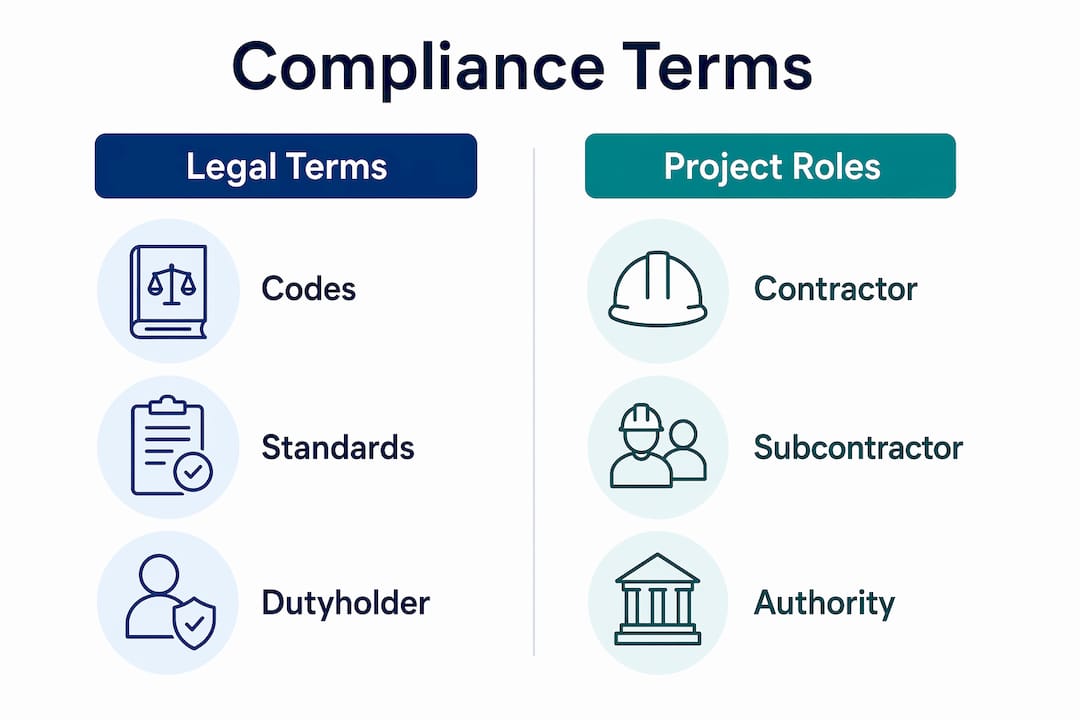
The prime contractor holds the master contract with the client and bears primary legal responsibility for project delivery, safety, and regulatory compliance on site. Subcontractors operate under contracts with the prime contractor, not the client, and their compliance obligations flow through that relationship. Independent contractors occupy a legally distinct category: they control their own work methods, supply their own tools, and are not employees. Misclassifying an employee as an independent contractor creates tax liability, insurance gaps, and wage law violations.
A further distinction that generates significant compliance risk is the difference between contractor services and contractor supply. Confusing these two classifications creates legal risks affecting tax treatment, insurance, and compliance obligations including prevailing wage laws. Contractor services involve installation and labor. Contractor supply involves material delivery only. A supplier who installs the materials they deliver has crossed into contractor services territory and must meet the associated licensing, bonding, and wage compliance requirements.
- Licensing and bonding: Prime contractors on federally funded projects exceeding $150,000 must provide payment and performance bonds under the Miller Act. Projects exceeding $2,000 trigger prevailing wage requirements under the Davis-Bacon Act. Compliance officers must verify these thresholds at contract award, not at project close.
- Insurance obligations: Role classification determines which party carries general liability, workers’ compensation, and professional indemnity coverage. Subcontract agreements must specify these requirements explicitly.
- Compliance officer scope: The compliance officer’s role is defined by the terminology in the safety management plan and the contract. Where the contract uses “dutyholder” language drawn from the Building Safety Act framework, the compliance officer must understand that this term carries statutory obligations distinct from CDM coordinator responsibilities.
- Risk allocation: Indemnification clauses, limitation of liability provisions, and insurance requirements all depend on accurate role classification. A subcontractor misidentified as a supplier in a contract may find their indemnification obligations are undefined when a claim arises.
Pro Tip: Before executing any subcontract, map every role term used in the agreement against the applicable statutory definition in your jurisdiction. A term that is standard in a U.S. federal contract may carry a different legal meaning in a Singapore or UK context.
Understanding how WSH Design for Safety regulations assign responsibilities to developers and designers illustrates how role-based terminology directly shapes statutory accountability from the earliest project stages.
What are the key terms related to construction safety and regulatory compliance?
Safety compliance terminology governs the operational layer of every construction project. These terms define who has authority, what inspections are required, and what documentation must exist before a building can be occupied. Misunderstanding any one of them can halt a project or void an occupancy certificate.
The Authority Having Jurisdiction (AHJ) is the organization, office, or individual responsible for enforcing the requirements of a code or standard, or their designated representative. On most U.S. projects, the AHJ is the local building department. On fire safety matters, it may be the fire marshal. Knowing which AHJ governs each system on a project prevents the common error of seeking approval from the wrong authority.
Special inspections are inspections required by the building official for specific materials and construction methods that carry elevated structural risk, including high-strength concrete, structural steel welding, and driven piles. These are distinct from routine building inspections and must be performed by approved special inspectors, not general site supervisors.
The following table summarizes the key inspection milestones and certificates that construction compliance officers must track:
| Term | Definition | Compliance Trigger |
|---|---|---|
| Foundation inspection | Verification of footing depth, reinforcement, and soil bearing before concrete pour | Required before any concrete is placed |
| Framing inspection | Review of structural framing, blocking, and bracing after rough-in work | Required before insulation or drywall |
| MEP rough-in inspection | Inspection of mechanical, electrical, and plumbing systems before concealment | Required before walls are closed |
| Certificate of Occupancy (CO) | Official document confirming a building meets all code requirements for habitation | Required before any occupancy |
| Certificate of Completion | Confirms work is complete per approved plans; does not authorize occupancy | Issued for non-habitable structures |
The golden thread is a term originating from the UK’s Building Safety Act and refers to the continuous, traceable record of every design decision, product change, and inspection throughout a building’s lifecycle. The golden thread requirement mandates that every design decision, product change, and inspection be logged and fully traceable. Omission of any link in this chain disrupts occupancy approval for higher-risk buildings (HRBs), defined under the Act as structures reaching 18 meters or 7 storeys.
The term dutyholder under the Building Safety Act assigns specific statutory accountability to the client, principal designer, and principal contractor throughout the project lifecycle. This is distinct from CDM coordinator responsibilities under the Construction (Design and Management) Regulations. CDM experience alone does not satisfy competence requirements under Building Safety Act regimes. Compliance officers working on HRBs must understand both frameworks as separate statutory obligations.
Pro Tip: Maintain a compliance documentation register that maps every inspection milestone to its required certificate, responsible party, and AHJ sign-off. This register becomes the evidentiary backbone of any regulatory audit or occupancy dispute.
For a structured approach to building these documentation systems, the site safety management system framework provides a practical model for integrating terminology into operational compliance controls.
How does mastering compliance terminology reduce legal and contractual risk?
Terminology errors are among the leading causes of contract disputes in construction, generating ambiguities that arbitration associations track as a primary driver of claims. The mechanism is straightforward: when two parties use the same term with different legal understandings, every obligation tied to that term becomes contested. Three contractual terms generate the highest volume of disputes.
- Change order: A formal written amendment to the contract scope, schedule, or price. Verbal instructions to proceed with additional work, absent a signed change order, create uncompensated scope creep and disputed payment claims. The term must be defined in the contract with a specific approval process.
- Liquidated damages: A pre-agreed sum payable for each day of delay beyond the contract completion date. This is not a penalty clause. It is a genuine pre-estimate of loss. Courts in most jurisdictions will void a liquidated damages clause that functions as a penalty, so the amount must be defensible at the time of contract execution.
- Defects liability period (DLP): The period after practical completion during which the contractor is obligated to return and remedy defects at no additional cost. The DLP is distinct from the warranty period and from latent defect liability, which may extend for years beyond practical completion under statute.
Regulatory terminology precision carries equal weight. On federally funded U.S. projects, the Davis-Bacon Act requires contractors to pay prevailing wages to laborers and mechanics. Misclassifying a laborer’s trade category to apply a lower wage rate constitutes a federal compliance violation, not merely a contract dispute. Similarly, the Miller Act’s bonding requirements protect subcontractors and suppliers on federal projects. A prime contractor who fails to obtain the required bonds exposes the project owner to direct claims from unpaid lower-tier parties.
The construction compliance management guide provides a structured framework for mapping these regulatory requirements to specific project types and contract structures, reducing the risk of terminology-driven compliance failures.
Key takeaways
Mastery of construction compliance terminology is the foundational risk-management practice that prevents contract disputes, regulatory violations, and occupancy failures across every project phase.
| Point | Details |
|---|---|
| Codes vs. standards distinction | Codes are legally mandatory; standards become mandatory only when referenced by a code or contract. |
| Role classification accuracy | Misclassifying contractor services as contractor supply triggers tax, insurance, and wage compliance violations. |
| Safety inspection milestones | Each inspection milestone requires a specific certificate and AHJ sign-off before work can proceed. |
| Golden thread documentation | Every design decision and product change must be logged and traceable to satisfy Building Safety Act requirements. |
| Contract term precision | Change orders, liquidated damages, and defects liability periods must be defined explicitly to prevent arbitration. |
Why terminology is the compliance officer’s most underrated tool
From my experience working across construction compliance programs in Singapore and internationally, the most persistent source of project risk is not a missing permit or a failed inspection. It is a vocabulary gap that no one acknowledges until a dispute surfaces. I have reviewed contracts where “subcontractor” and “supplier” were used interchangeably across different clauses of the same document. The downstream consequences included contested indemnification obligations, uninsured work, and a payment dispute that took eight months to resolve.
The construction industry has a tendency to treat terminology as a documentation formality rather than a legal instrument. That tendency is expensive. When a compliance officer does not understand the statutory difference between a dutyholder under the Building Safety Act and a principal contractor under CDM, they cannot advise their client accurately on which competence framework applies. When a project manager treats a change order as a courtesy confirmation rather than a contract amendment, they have already lost the legal protection that term was designed to provide.
My practical recommendation is to build a project-specific compliance glossary at contract award, not at project close. Map every key term used in the contract to its statutory or regulatory definition in the applicable jurisdiction. Where terms are used in non-standard ways, document the agreed definition in writing. This takes two hours at the start of a project and can prevent two years of litigation at the end.
The compliance environment is also evolving faster than most teams update their vocabulary. The Building Safety Act’s gateway inspection regime, the golden thread requirement, and the dutyholder framework represent a structural shift in how compliance accountability is assigned and documented. Teams that carry CDM-era terminology into Building Safety Act projects are operating with an outdated map.
— Aman
How MOSAIC supports your compliance terminology practice

MOSAIC Ecoconstruction Solutions provides safety consultancy and audit services specifically designed for construction professionals operating within Singapore’s regulatory framework and international compliance environments. The team translates complex construction compliance requirements into operationally precise guidance, helping contractors and compliance officers apply the correct terminology within their safety management systems, contracts, and regulatory submissions. Whether you are preparing for a BizSAFE certification audit, implementing a Design for Safety program, or building documentation systems that satisfy gateway inspection requirements, MOSAIC’s consultants work directly with your team to close terminology gaps before they become compliance failures. Explore MOSAIC’s safety audit services to see how terminology precision translates into measurable compliance performance.
FAQ
What is the difference between a building code and a standard?
A building code is a legally mandatory regulation adopted by a jurisdiction, while a standard such as ASTM or ISO is a voluntary best practice that becomes mandatory only when referenced by a code or contract. Assuming standard compliance satisfies code requirements without confirming that reference is a common and costly error.
What does AHJ mean in construction compliance?
AHJ stands for Authority Having Jurisdiction, the organization or individual responsible for enforcing code requirements on a specific project. On most U.S. projects, the AHJ is the local building department, though fire safety systems may fall under a separate fire marshal authority.
What is the golden thread in building safety?
The golden thread is the continuous, traceable record of every design decision, product change, and inspection required under the UK Building Safety Act for higher-risk buildings. Gaps in this record can block occupancy approval and create statutory liability for dutyholders.
How do Davis-Bacon and Miller Act thresholds affect contractors?
The Davis-Bacon Act applies prevailing wage requirements to federally funded construction projects exceeding $2,000, while the Miller Act requires payment and performance bonds on federal projects exceeding $150,000. Both thresholds must be verified at contract award to avoid federal compliance violations.
Why do terminology errors cause contract disputes?
Terminology errors create ambiguity about the legal obligations each party has accepted, which arbitration associations track as a primary driver of construction claims. Terms such as change order, liquidated damages, and defects liability period must be explicitly defined in every contract to prevent contested interpretations.


