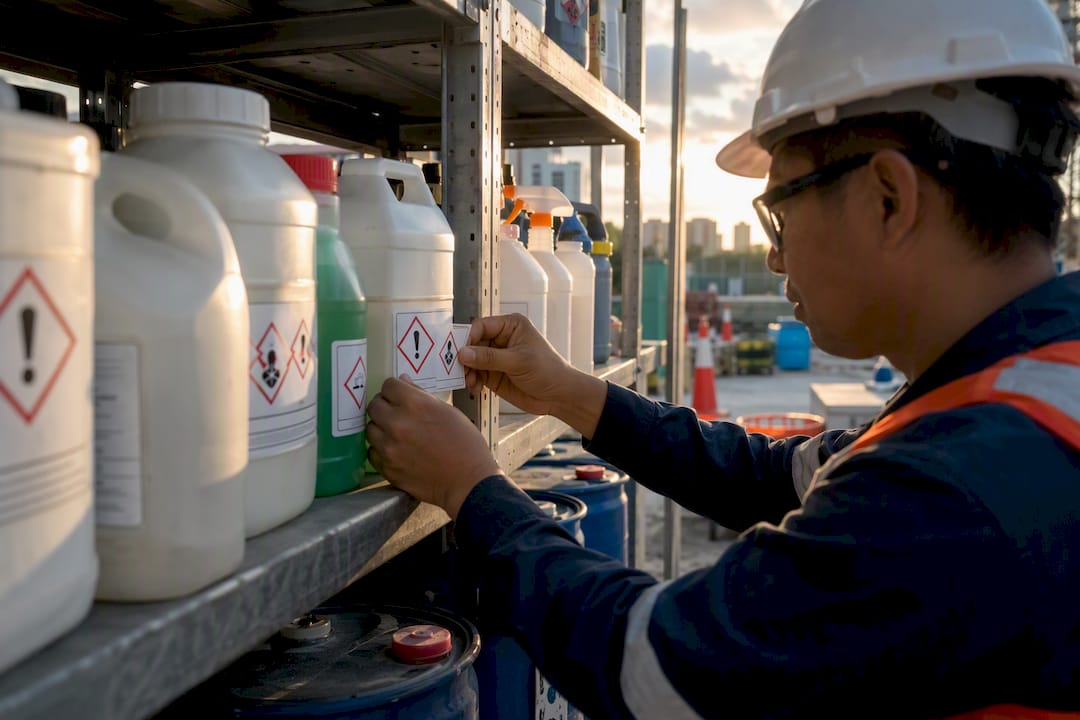
Singapore requires every hazardous chemical container in a workplace to carry a GHS-compliant label under SS 586 and Regulation 42 of the Workplace Safety and Health (General Provisions) Regulations. Supplier containers need full seven-item GHS labels; reduced workplace labels apply only to specific cases like containers at or below the small-container threshold specified by regulations. Labels must match the Safety Data Sheet on file, and workers must be able to read and understand what is on the container. SS 586 revisions tied to newer GHS editions may change what a compliant small-package label looks like.
TL;DR:
- Labels must match the current revision of SS 586 and GHS standards; outdated labels on containers or SDSs can trigger noncompliance.
- Reduced labels are only permissible for small containers of 125 ml or less, or for in-house, immediate-use decanted or lab-only substances.
- Mismatched or missing label elements, especially on secondary containers or bulk drums, are the most common violations found during inspections.
- Regularly review SDS updates and link them to label revalidation to prevent drift, using audit routines and record-keeping to demonstrate ongoing compliance.
- Imported chemicals with foreign labels must be relabeled in English to meet Singapore standards before use on site.
Table of Contents
- How Singapore Implements GHS Through SS 586
- Regulation 42 and SS 586: Your Legal Obligations
- The Seven Label Elements Every GHS Label Needs
- Reduced Workplace Labels and the 125 ml Exception
- An On-Site Checklist for Applying Compliant Labels
- Keeping Labels Current After the Initial Fix
- Where to Find the Official Standards and Guidance
- Common Labeling Mistakes and What They Cost You
- What a Compliant Label Actually Looks Like
- Imported Chemicals and Multi-Language Labeling
- Staying Current as SS 586 and GHS Requirements Evolve
- Priority Actions for Safety Officers This Week
- How MOSAIC Supports Your Labeling Compliance
- Sources
How Singapore Implements GHS Through SS 586
The Globally Harmonized System (GHS) is the United Nations framework for classifying chemical hazards and communicating them through standardized pictograms, signal words, and hazard statements. Singapore adapts GHS locally through SS 586, a three-part Singapore Standard: Part 1 covers classification, Part 2 governs labeling, and Part 3 sets Safety Data Sheet content.
Three bodies shape how this plays out on your site. The Ministry of Manpower (MOM) enforces the Workplace Safety and Health Act and its regulations. The Workplace Safety and Health Council (WSHC) publishes interpretive guidance, including its GHS booklet, which walks through the seven label elements in plain language. Enterprise Singapore’s standards arm maintains SS 586 itself and issues revisions.
Singapore has been moving to align SS 586 with newer GHS revisions, including provisions tracking UN GHS Revision 7. That matters because label content for small containers, certain hazard classes, and precautionary statement wording can shift with each edition. A label that passed inspection two years ago is not automatically compliant today.
Regulation 42 and SS 586: Your Legal Obligations
Regulation 42 of the Workplace Safety and Health (General Provisions) Regulations places the duty squarely on the occupier: containers of hazardous substances at a workplace must be affixed with labels in accordance with Singapore Standards or a WSH Council–approved code of practice. That is not a suggestion buried in a guidance note. It is a statutory requirement, and it is the clause an inspector cites when a drum turns up bare in a site store.
SS 586 is the specification that gives Regulation 42 its teeth. Part 2 defines exactly what a compliant label contains and how it should be laid out, down to annexes with sample layouts for small containers. Part 3 sets the parallel rules for SDSs, so the two documents are built to match.
There are limited exemptions. Consumer products sold in retail packaging under separate consumer protection rules follow a different labeling regime, and finished articles that do not release the hazardous substance during normal use generally fall outside the scope. Neither exemption covers a typical construction site. Thinners, sealants, adhesives, cleaning agents, and fuel stored in bulk or decanted into secondary containers are squarely inside Regulation 42’s reach, and that is where most site-level noncompliance actually happens.
The Seven Label Elements Every GHS Label Needs
A compliant chemical label under SS 586 contains seven fixed items, and missing even one is a common reason labels fail inspection.
- Product identifier: the chemical name or product name matching the SDS
- Pictogram(s): the red diamond hazard symbols corresponding to the substance’s classification
- Signal word: either “Danger” or “Warning,” set by the severity of the hazard class
- Hazard statement(s): standardized wording describing the nature of the hazard
- Precautionary statement(s): handling, storage, and emergency response instructions
- Supplier identification: name, address, and emergency contact number
- Supplementary information: any additional hazard or regulatory detail not captured above
Picking the right pictogram and signal word comes down to classification, not judgment call. If a substance is classified under multiple hazard categories, the label needs the pictogram and signal word for the most severe applicable class, per the criteria the WSHC’s GHS booklet lays out. On precautionary statements, SS 586 guidance favors brevity. Cramming every possible statement onto a small drum label makes the label unreadable, which defeats the point. Keep the statements that are actually relevant to that substance’s use on your site.
Reduced Workplace Labels and the 125 ml Exception
Not every container needs the full seven-element label. MOM permits a reduced workplace label in a narrow set of cases: containers holding 125 ml or less, chemicals decanted into secondary containers for immediate use, and substances confined to lab or research settings that never leave the workplace.
A reduced label still needs the product identifier and the relevant pictogram, at minimum. It is not a blank exemption. Before your team relies on reduced labels, workers handling those containers need documented training on what the shorthand label means and where to find the full SDS.
- Reduced labels apply to small containers, decanted secondary containers, and in-house lab use only
- The product name and pictogram(s) are the non-negotiable minimum content
- Training on interpretation must happen before reduced labels go into use, not after
Pro Tip: If an inspector finds a reduced label on a large bulk drum in your site store, that is an automatic red flag. Reduced labels are for small, transient, in-use containers, not bulk storage. Save the full drum label for anything above the 125 ml threshold.
An On-Site Checklist for Applying Compliant Labels
Walking a site with a labeling audit in mind is faster when you work through it in order rather than container by container at random.
- Confirm the supplier label and matching SDS are both present and the SDS is the current revision, not an outdated printout from a previous order.
- Apply a full GHS label immediately if the supplier container arrived unlabeled or the original label has degraded past legibility.
- Use a reduced label only when the container meets the 125 ml, decanted, or lab-use conditions, and only after handlers have been trained on it.
- Record supplier contact details and SDS version in your chemical inventory so the paper trail survives a staff change or an audit request.
On language, English is the default for GHS label elements in Singapore, but the WSHC is explicit that if your workforce cannot read English hazard statements, you need translated supplementary material or structured pictogram training to close that gap. A migrant workforce that recognizes pictograms without reading a word of the hazard statement is common on Singapore sites; do not assume literacy where none exists.
Label size and placement follow tables set out in SS 586 Part 2, which specifies minimum dimensions scaled to container size. Do not eyeball it. The consistent thread through every step here is that the label and SDS form one hazard communication system: if they disagree with each other on classification or precautions, you have a compliance gap regardless of how good either document looks individually.
Keeping Labels Current After the Initial Fix
Labeling compliance is not a one-time exercise you close out and forget. Tie your label review cadence directly to supplier SDS update notices and to SS 586 revision cycles, since a periodic audit schedule anchored to those triggers catches drift before an inspector does.
Fold label checks into your existing chemical inventory audits and permit-to-work procedures rather than running them as a separate program. A permit-to-work system that already tracks which chemicals are on site is the natural place to flag a label that needs updating.
- Set a review trigger for every SDS revision or hazard reclassification received from a supplier
- Log training records showing which handlers understand reduced-label shorthand
- After any reclassification, update the label, notify affected handlers, and record the change date
Pro Tip: Keep a simple log linking each chemical’s SDS revision date to its last label check date. When MOM or a WSHC-trained auditor asks how you know your labels are current, that log answers the question in one glance instead of a scramble through file folders. For construction sites juggling dozens of substances at once, our guide on managing chemical hazards in Singaporean workplaces walks through building that system from scratch.
Where to Find the Official Standards and Guidance
Keep these on hand for inspections, training packs, and SDS preparation.
- SS 586 Part 2 preview: the label specification itself, including small-container annexes
- MOM’s re-labeling FAQ: the clearest statement of when reduced labels apply
- WSHC’s GHS booklet: plain-language training material for toolbox talks
- Regulation 42 statutory text: what an inspector cites when writing up a labeling breach
Confirm the current SS 586 edition with Enterprise Singapore’s standards store before printing new labels in bulk. A revision mid-cycle can quietly change label content requirements without much fanfare.
Common Labeling Mistakes and What They Cost You
The single most frequent finding on Singapore construction sites is an unlabeled secondary container, typically a decanted solvent or cleaning agent in an unmarked bottle sitting near a work area. The second most common issue is a reduced label used where it should not be, most often on bulk drums that clearly exceed the 125 ml threshold that reduced labeling is meant for.
Mismatched SDS and label information ranks close behind. A supplier updates their SDS after a reclassification, but the physical label on the drum in your store never gets updated to match. That gap is exactly what Regulation 42 enforcement targets, since the label and SDS are treated as one hazard communication system, not two independent documents.
Penalties for noncompliance escalate with the breach. A first-time labeling gap discovered during a routine MOM inspection typically draws a corrective notice with a deadline to fix it. Repeated or willful breaches, especially where a labeling failure contributes to a workplace incident, can result in composition fines or prosecution under the Workplace Safety and Health Act. The financial penalty rarely matches the real cost, though: a mislabeled or unlabeled container that leads to a chemical exposure incident carries downtime, incident investigation, and reputational fallout that dwarf any fine.
Training gaps compound all of this. A worker who cannot read a hazard statement or recognize a pictogram is not protected by a technically compliant label sitting six inches from their hand. Auditors increasingly ask for training records alongside the physical labels, treating documented worker competence as part of the compliance picture rather than a nice-to-have.
What a Compliant Label Actually Looks Like
A supplier container of a corrosive cleaning concentrate, for example, should show the product name matching its SDS exactly, the corrosion pictogram, the signal word “Danger,” a hazard statement like “causes severe skin burns and eye damage,” precautionary statements on protective equipment and first aid, and the supplier’s name and emergency number. That is the standard seven-element label SS 586 Part 2 describes, and it is what you should expect on any full-strength industrial chemical arriving on a delivery truck.
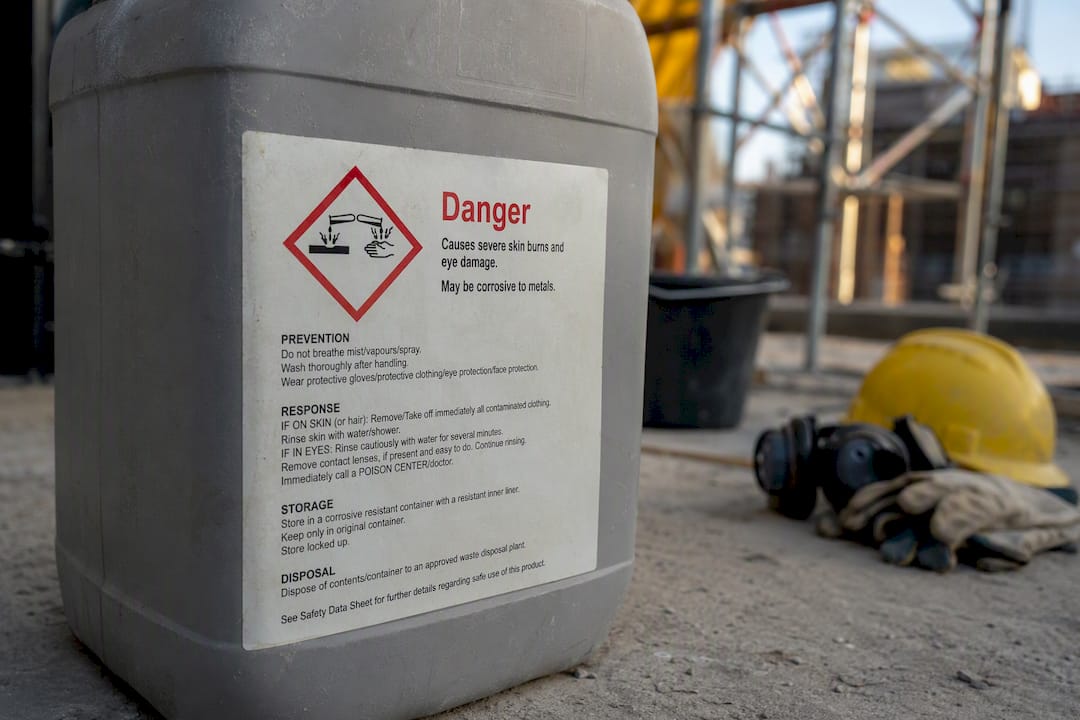
A decanted container of the same diluted cleaning solution, sitting in a maintenance closet for same-shift use, can carry a reduced label instead: product name and the corrosion pictogram, nothing more, provided the worker using it has been trained to know that “corrosion pictogram, no further detail” means “check the full SDS before doing anything beyond routine use.”
SS 586 Part 2’s annexes include illustrative layouts for exactly these cases, including how to fit seven elements legibly on a small container without the label becoming a wall of text nobody reads. The layout matters as much as the content. A label crammed edge to edge with eight-point font technically contains all seven elements and still fails its actual purpose, which is getting a worker to register the hazard in the two seconds they glance at it before picking the container up.
Imported Chemicals and Multi-Language Labeling
Chemicals arriving from overseas suppliers often land with labels in the manufacturer’s home language, or with GHS elements formatted to a different national standard than Singapore’s. Neither situation exempts the container from Regulation 42. If the supplier label does not meet SS 586 Part 2’s content and language requirements, the importer or occupier needs to relabel it before it goes into use on site.
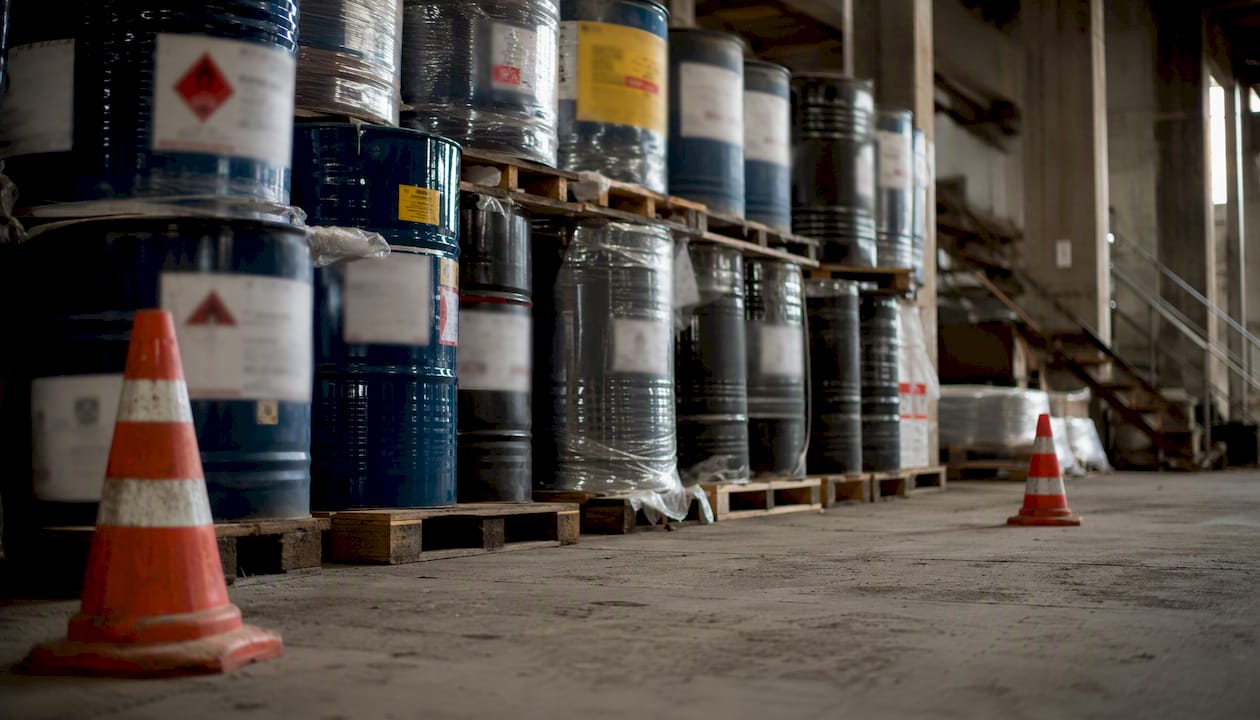
English is the default language for GHS label elements under Singapore practice, and that applies regardless of where the chemical was manufactured. A drum arriving with a label printed entirely in Mandarin, Korean, or German needs an English-language label meeting the seven-element standard before it reaches a work area, even if the original packaging already carries GHS pictograms.
Pictograms themselves are standardized internationally, so a correctly classified hazard pictogram from an overseas supplier will typically match what SS 586 expects. The gap usually shows up in the text: hazard statements, precautionary statements, and supplier contact details need translation and verification against the Singapore SDS, not just a pictogram check. Import agents handling regular shipments from the same overseas supplier often find it more efficient to arrange relabeling at the point of import rather than at the construction site, which also reduces the window where an unlabeled or foreign-language container sits in a site store awaiting fix-up.
For workforces where English literacy varies, the practical answer is not necessarily translating every label into multiple languages; SS 586 does not require that. It is combining English-language compliant labels with structured pictogram and hazard-recognition training in the languages your crew actually speaks, so the label’s legal content and the worker’s practical understanding both hold up.
Staying Current as SS 586 and GHS Requirements Evolve
SS 586 does not sit still. Singapore has tracked successive GHS revisions since first adopting the framework, and the shift toward incorporating UN GHS Revision 7 content into SS 586-2 and SS 586-3 is the most recent example. Each revision cycle can touch label content requirements, particularly around small-container annexes, new hazard classes, and precautionary statement wording.
The practical risk is not that you will actively violate a new requirement. It is that a label printed under the previous edition quietly becomes noncompliant while sitting unchanged on a shelf, and nobody notices until an audit. Enterprise Singapore’s standards store is the authoritative place to check which SS 586 edition is currently in force and what transition period, if any, applies to labels printed under the prior version.
Building a habit of checking for SS 586 updates alongside your annual chemical inventory review, rather than waiting for an inspection to surface the gap, keeps your labeling program ahead of the compliance curve instead of catching up to it. Subscribing to WSHC circulars and MOM safety alerts covers most of the advance notice you will get before a revision takes effect.
Priority Actions for Safety Officers This Week
Most labeling failures I see on construction sites are not classification errors. They are process gaps: a decanted container nobody relabeled, an SDS update that never reached the label on the drum. Fixing that means building label checks into audits you already run, not adding a separate compliance track.
Start small. Spot-check ten of your highest-risk containers this week and verify their SDS dates match what is printed on the label. MOSAIC’s audits, SDS reviews, and worker training programs exist to catch exactly this gap before an inspector does.
— Aman
How MOSAIC Supports Your Labeling Compliance
Getting SS 586 labeling right across an active construction site, with new deliveries, subcontractors, and SDS updates arriving constantly, is a moving target most safety teams manage on top of a dozen other priorities. MOSAIC is Singapore-based and works directly with SS 586’s requirements day to day, which means a compliance audit catches the decanted containers and outdated SDS references before MOM does.

Our services cover the full labeling compliance picture: on-site labeling audits, SDS-label consistency checks, worker training on pictogram and hazard-statement interpretation, and BizSAFE and ISO certification support that folds labeling into your broader safety management system. If your team needs relabeling training specifically, our safety training programs cover interpretation competence for reduced workplace labels alongside broader hazard communication topics.
If you are not sure where your current labeling program stands, start with a compliance review through our environmental compliance services for Singapore construction projects. Request an audit and get a clear picture of where your labels, SDSs, and training records stand before your next inspection.
Sources
Keep these bookmarked for inspector citations, training material, and SDS preparation reference.
- Workplace Safety and Health (General Provisions) Regulations – AGC Singapore
- Do I need to re-label containers with the Globally Harmonised System (GHS) labels? – MOM
- Specification for hazard communication for hazardous chemicals and dangerous goods – Part 2: GHS – Singapore adaptations (SS 586-2:2022 Preview)
- Singapore adopts GHS 7th edition for labelling and SDSs (UL news)