
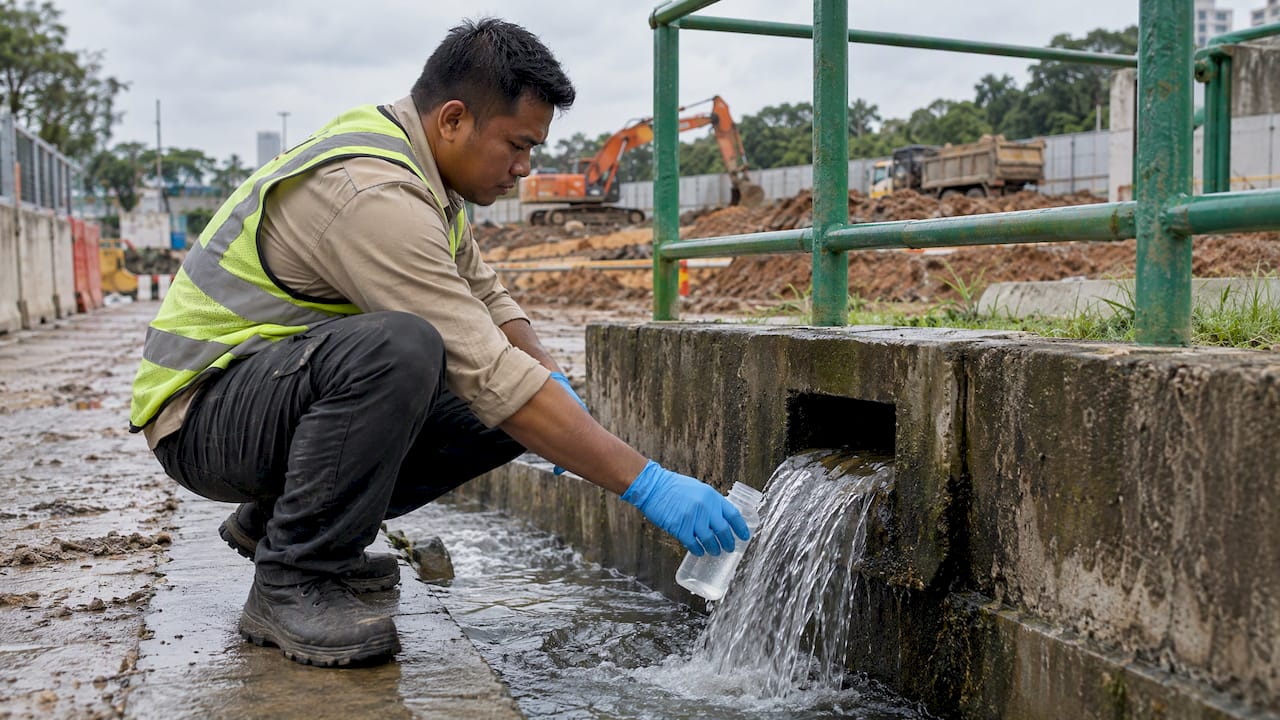
Water leaving a Singapore construction site is regulated by the Public Utilities Board (PUB) under the Sewerage and Drainage Act. Treated runoff released into a public drain must not exceed 50 mg/L of total suspended solids (TSS). Trade effluent sent to a public sewer needs PUB’s written approval and must meet a separate set of limits, including pH 6 to 9 and TSS of 400 mg/L. This article sets out which rule applies to which discharge, what approvals come first, how sites monitor compliance, and what a breach costs.
TL;DR
- Silty stormwater runoff discharged into drains must not exceed 50 mg/L TSS, and all silty runoff must be collected and treated before release.
- Earthworks require an Earth Control Measures (ECM) plan designed by a Qualified Erosion Control Professional (QECP) and approved by PUB before works start.
- Trade effluent going into a public sewer requires PUB’s written approval and must meet limits such as pH 6 to 9, BOD 400 mg/L, COD 600 mg/L and TSS 400 mg/L.
- Sites of 0.2 hectares and above must install CCTV to monitor treated-water discharge into public drains.
- First-conviction fines for trade effluent breaches reach $15,000, rising to $30,000 on later convictions, with imprisonment of up to 3 months possible.
Table of Contents
- Which Rules Govern Construction Water Discharge
- How the Rules Differ by Discharge Destination
- Earth Control Measures: The Approval Before the First Excavation
- Managing Silty Runoff, Groundwater and Dewatering Water
- Trade Effluent: Approval and Water Quality Limits
- Monitoring, CCTV and Records
- Penalties for Non-Compliance
- A Practical Compliance Sequence
- Perspective
- How MOSAIC Supports Site Water Compliance
- FAQ
- Sources
Which Rules Govern Construction Water Discharge
The legal base is the Sewerage and Drainage Act, administered by PUB, Singapore’s national water agency. PUB’s Code of Practice on Surface Water Drainage sets the minimum engineering requirements for surface water drainage in new developments, and it is the document that governs how a construction site handles rainfall that touches exposed soil. Its seventh edition dates from December 2018 and has been updated by addenda, the latest being Addendum No. 3 of April 2025.
For wastewater, a second document applies: PUB’s Code of Practice on Sewerage and Sanitary Works, third edition, March 2025. It governs what may enter the public sewerage system and under what approval.
The practical consequence is that a construction site rarely has one discharge. It typically has at least three streams, each under a different regime:
- Silty stormwater from exposed ground, controlled through ECM.
- Trade effluent, such as wash water or process water, which may go to a public sewer only with approval.
- Sanitary water from site offices and worker facilities, which belongs in the sewerage system and never in a drain.
Keeping these streams physically and procedurally separate is the foundation of compliance. The code requires that used water, sullage water and slurry be handled separately from silty runoff, rather than being blended into one holding pond and released together.
How the Rules Differ by Discharge Destination
The destination determines the standard. A drain, a watercourse and a sewer are not interchangeable, and the limits that apply to one cannot be borrowed for another.
| Discharge | Typical source on site | Key requirement | Controlling document |
|---|---|---|---|
| Public drain or watercourse | Treated silty stormwater | TSS not above 50 mg/L; ECM plan approved by PUB | Code of Practice on Surface Water Drainage; ECM requirements |
| Public sewer | Trade effluent, used water | Prior written approval from PUB; effluent limits met | Code of Practice on Sewerage and Sanitary Works; trade effluent water quality standards |
| Paved or covered areas | Rain on surfaces that cause no silty discharge | May drain directly where no silty discharge arises | PUB guidance on ECM |
The first row is the one that most contractors meet daily. PUB states that treated water discharged into public drains must not exceed 50 mg/L TSS. The second row is a regulated approval process, discussed below. The third is a narrow allowance: areas within a site that are already paved or covered, and therefore will not produce silty discharge, can drain directly, as PUB’s own guidance on the topic notes.
One point deserves emphasis. Water that looks clear is not automatically exempt. The test is the measured concentration of suspended solids at the point of release, and the approval status of the site’s drainage arrangements.

Earth Control Measures: The Approval Before the First Excavation
PUB places the compliance obligation at the start of the project, not at the outlet. Before earthworks begin, the site operator must engage a Qualified Erosion Control Professional to design an ECM plan, and that plan requires PUB approval. Under the sewerage code, the ECM proposal must be endorsed by the QECP before submission, and works may not start until approval is in hand.
PUB’s rationale is geographic. Two-thirds of Singapore’s land serves as water catchment, so silt that reaches the drainage network accumulates in drains, reduces their capacity and raises flood risk. That is why the 50 mg/L limit is enforced on construction sites specifically, where bare soil is the dominant source of sediment.
The ECM plan is not a one-time drawing. Contractors are expected to plan ECM for each construction phase and to have the QECP review its effectiveness at regular intervals as the work progresses. PUB’s sample specifications also direct that the contractor shall not remove the ECM until the works have reached the stage the specification allows. Dismantling sediment controls early, because the visible earthworks seem finished, is a recognized source of non-compliance.
For a deeper treatment of how plans are designed and what measures work on local sites, the client’s guide to Singapore earth control measures covers the design sequence in detail.
Managing Silty Runoff, Groundwater and Dewatering Water
The Code of Practice on Surface Water Drainage requires that all silty runoff be collected and treated in a holding pond or sump before discharge. The code also sets a working target: runoff should be treated and released within 10 hours of a rainstorm, so that the pond or sump has capacity for the next event. A pond that remains full from the previous storm offers no buffer, and overflow of untreated water is the most common way a site exceeds the limit.
In practice, a compliant arrangement has these components:
- Perimeter diversion. Cut-off drains keep clean water from outside the site from flowing across exposed soil, which reduces the volume needing treatment.
- Collection. Internal drains direct silty water to a sump or holding pond sized for the contributing catchment.
- Treatment. Sedimentation, with chemical dosing or filtration where settling alone cannot bring TSS to the limit.
- Controlled release. A designated outlet with a sampling point, so that the water leaving is the water that was treated.
- Slurry and sullage handling. Separate collection, never released with stormwater.
Dewatering and groundwater pumped from excavations carry the same silt risk and should be routed through the same treatment train before they reach a drain. Where the pumped water carries contaminants beyond silt, such as cement wash or oil, it falls outside the stormwater regime and into trade effluent territory, which means the sewer approval route applies rather than the drain limit.
Subsurface and surface drainage principles transfer across fields, and a general primer on drainage in horse arenas illustrates how graded surfaces and drainage layers move water away from a footprint. Construction sites, however, must design to PUB’s specific limits and not to general rules of thumb.
Trade Effluent: Approval and Water Quality Limits
Trade effluent is liquid waste from a trade, business or construction process. Discharging it to a public sewer requires prior written approval from PUB, as mandated by the Sewerage and Drainage Act. The application must describe the process, the raw materials used, estimated water consumption and the nature of the effluent, as the sewerage code specifies.
PUB’s published general standards for effluent entering a sewer, as of the June 2023 document, include:
| Parameter | Limit |
|---|---|
| Temperature | Not above 45°C |
| pH | Between 6 and 9 |
| Biochemical oxygen demand (BOD) | 400 mg/L |
| Chemical oxygen demand (COD) | 600 mg/L |
| Total suspended solids (TSS) | 400 mg/L |
The same document lists further parameters, including specific substances, so the table above is a subset rather than the full schedule. Always read the current PUB document for your discharge type, since PUB revises its codes through editions and addenda.
Note how the two TSS figures differ: 50 mg/L for treated water released to a drain, 400 mg/L for effluent released to a sewer. The difference reflects what happens downstream. Drains lead to waterways and reservoirs; sewers lead to treatment works designed to process a heavier load. Treating a sewer discharge to the drain standard is not required, and sending a drain discharge at the sewer standard is a breach.
Monitoring, CCTV and Records
Monitoring is where the 50 mg/L limit becomes enforceable in real time. Sites of 0.2 hectares and above must install CCTV to monitor treated-water discharge into public drains. The ECM Guidebook sets the technical bar: at least 96% uptime, and the ability to provide at least 15 days of snapshots at 5-minute intervals to PUB on request.
Those numbers have operational consequences:
- A camera that is offline for a weekend can breach the uptime figure, so power supply, network connectivity and fault alerts need to be designed in.
- Footage must be retrievable, which means storage sizing and a named person responsible for exports.
- The camera views the discharge point, so lighting, lens cleanliness and mounting position affect whether the image is usable as evidence.
PUB also encourages going beyond camera observation. Automation that includes auto-intervention, ceasing discharge when TSS readings exceed 50 mg/L, reduces dependence on manual oversight. Sites that adopt inline turbidity or TSS sensors linked to a pump cut-off hold a stronger compliance position than those relying on a guard to notice discoloured water.
Beyond equipment, maintain a written record of ECM inspections after rain, desilting dates, QECP review reports, sample results and any corrective action. When an officer asks how the site controls discharge, documents answer faster than recollection. The client’s checklist on preparing for a PUB inspection sets out what is normally requested.
Penalties for Non-Compliance
The Sewerage and Drainage (Trade Effluent) Regulations, as amended on 1 March 2025, set out the offences. Breaches of regulations 8, 9, 9A, 10(1)(a) to (d) or 11(2) carry fines of up to $15,000 on first conviction and $30,000 on subsequent convictions, or imprisonment of up to 3 months. Continuing offences add daily fines under the same regulations, for example $1,000 per day for non-hazardous substances and up to $2,000 per day for hazardous ones.
The financial penalty is only part of the exposure. A discharge incident can trigger stop-work pressure, remedial works, reputational damage with the developer and consequences for the company’s safety and environmental standing in tendering. These indirect costs usually exceed the fine itself, and they are the reason experienced contractors treat discharge control as a project-critical system. The client’s discussion of ECM as an operational system develops this view.
A Practical Compliance Sequence
For a project team starting from a clean slate, the following order avoids the usual rework:
- Map the water streams. List every source: rainfall on bare soil, dewatering, wheel wash, concrete wash, sanitary water.
- Appoint the QECP early. The ECM plan needs endorsement and PUB approval before earthworks; design it for each phase of work.
- Size collection and treatment. Holding ponds and sumps must allow treated release within about 10 hours of a storm.
- Separate the trade effluent stream. Apply to PUB in writing for sewer discharge, with the process details the code asks for.
- Install monitoring. For sites of 0.2 hectares and above, CCTV meeting the uptime and retention figures; consider automated TSS cut-off.
- Inspect and record. Check controls after every significant rainfall, and keep QECP reviews on file.
- Retain controls until released. Do not remove ECM until the specification allows.
Environmental duties on a site extend beyond water. The client’s environmental compliance guide places discharge alongside other obligations, and its note on air quality monitoring on construction sites covers the parallel regime for dust.
Perspective
Across more than 20 years of working with construction firms, we have seen water discharge treated as a late-stage compliance checkbox far more often than as a design input. That sequencing is where problems begin. By the time a site is excavated, the ECM layout, pond sizing and outlet position are already constrained by what has been built.
Our position is that discharge control belongs in the same integrated framework as Design for Safety and the wider quality, environment and safety management system. When the QECP’s design, the contractor’s daily inspection routine and the project’s documentation are aligned from the first week, monitoring becomes a routine record and not an emergency exercise.
We also advise clients to audit their own controls before PUB does. A structured review of the ECM, the CCTV set-up and the trade effluent approvals, supported by continuing consultant involvement through the project, is far less costly than remediation after an incident.
Aman
How MOSAIC Supports Site Water Compliance
MOSAIC Ecoconstruction Solutions provides quality, environment and safety consultancy for construction firms, including EHS advisory and documentation, WSH audit and inspection and wider consultancy for contractors and developers. Our team can review your discharge arrangements, align documentation with PUB expectations and support your site staff with training and outsourced EHS manpower where needed.

To discuss a specific project, contact the team through the MOSAIC website.
FAQ
What is the maximum TSS for water discharged from a construction site into a public drain?
Treated water discharged into public drains must not exceed 50 mg/L of total suspended solids. PUB applies this limit to stormwater runoff from construction sites, and the water must first be collected and treated in a holding pond or sump.
Do I need PUB approval before discharging water from my site?
Yes, in both main cases. Earthworks require an ECM plan designed by a QECP and approved by PUB before works start. Trade effluent going into a public sewer requires PUB’s prior written approval under the Sewerage and Drainage Act.
Is CCTV monitoring of discharge compulsory?
For sites of 0.2 hectares and above, yes. The system must be monitoring treated-water discharge into public drains, with at least 96% uptime and at least 15 days of 5-minute interval snapshots available to PUB on request.
Can clear water from a site be discharged without treatment?
Not as a blanket rule. Paved or covered areas that will not cause silty discharge can drain directly, but water from exposed ground must be treated to the limit, and the site’s arrangements must match what PUB approved.
What fines apply to a trade effluent breach?
For the listed regulations, fines reach $15,000 on first conviction and $30,000 on later convictions, or imprisonment of up to 3 months. Continuing offences add daily fines, such as $1,000 for non-hazardous and up to $2,000 for hazardous substances.
Sources
- PUB Code of Practice on Surface Water Drainage
- PUB Code of Practice on Sewerage and Sanitary Works, 3rd Edition
- PUB ECM announcement
- PUB water quality standards for trade effluent discharge
- PUB ECM Guidebook
- PUB ECM sample specifications
- Sewerage and Drainage (Trade Effluent) Regulations, Singapore Statutes Online