
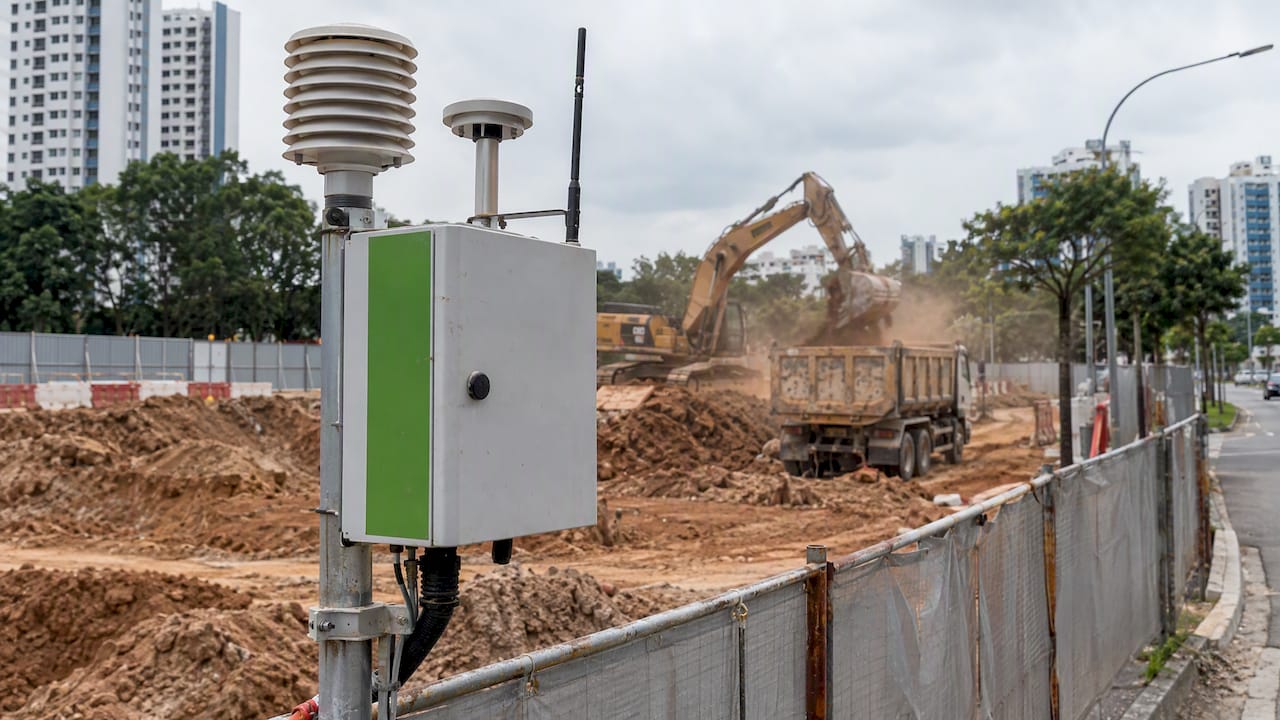
Air quality monitoring on a Singapore construction site means measuring dust and other airborne pollutants at the boundary and in the work zone, comparing the readings with action levels agreed in advance, and using the results to change site controls before a complaint or enforcement notice arrives. The law does not set one universal numeric dust limit for sites. It requires the occupier to prevent or minimize air pollution through the best practicable means, and monitoring is how that duty is demonstrated in practice.
This guide covers what to measure, how Singapore’s agencies frame the obligation, what an environmental monitoring plan should contain, which permits and approvals may apply, and how water discharge and sediment control fit into the same compliance picture.
TL;DR
- Construction sites are treated as industrial or trade premises under Singapore’s pollution-control law, so the occupier must keep air impurities within prescribed standards or, where none exists, use the best practicable means.
- Three different exercises are often confused: ambient (boundary) monitoring, personal exposure sampling for workers, and indoor air checks on completed or renovated premises. Each has its own method and owner.
- Specified construction sites must employ an Environmental Control Officer, and the site’s environmental management plan must cover air pollution and dust abatement, among other issues.
- Silty runoff is regulated separately by PUB through Earth Control Measures, with a Qualified Erosion Control Professional designing the plan before earthworks start.
- Monitoring has value only when readings trigger defined responses: water spraying, shielding, equipment checks, or a stop-work review.
Table of Contents
- What air quality monitoring measures on a construction site
- Three kinds of monitoring, three different purposes
- The legal basis for monitoring
- What an environmental monitoring plan should contain
- Dust controls the regulator expects to see
- Responding when levels rise
- Worker exposure is a separate duty
- Is indoor air quality monitoring mandatory?
- Permits and approvals that may apply
- Water discharge and sediment control
- Our perspective
- How MOSAIC supports your monitoring and compliance programme
- FAQ
- Sources
What air quality monitoring measures on a construction site
Construction generates coarse dust from earthworks, demolition, cutting and aggregate handling, finer particles from diesel engines and generators, and occasionally gases and vapors from coatings, adhesives or hot works. The monitoring programme should reflect which of these are present rather than copying a generic parameter list.
For reference, Singapore’s national ambient network reports PM10, PM2.5, sulphur dioxide, nitrogen dioxide, ozone and carbon monoxide, and these six parameters determine the Pollutant Standards Index published by the Ministry of Sustainability and the Environment. That network is a useful background for interpreting site readings. Particulate matter is the pollutant most directly attributable to construction, so PM10 and PM2.5 are the usual core parameters at a site boundary. Gas parameters are added when diesel plant density, enclosed work or specific chemical processes justify them.

Three kinds of monitoring, three different purposes
Most confusion about requirements comes from treating all air monitoring as one activity. The table separates them.
| Type | What it answers | Typical location | Principal framework |
|---|---|---|---|
| Ambient (boundary) monitoring | Is the site affecting neighbors and the surrounding area? | Site perimeter, nearest sensitive receivers | Environmental Protection and Management Act, NEA Code of Practice for ECOs |
| Personal exposure sampling | Are workers breathing hazardous concentrations? | Worker’s breathing zone | MOM workplace hygiene monitoring and sampling guidelines |
| Indoor air quality checks | Is the finished or renovated space safe to occupy? | Inside the completed premises | Project specifications, NEA indoor air programmes |
A site that has a boundary dust monitor has not discharged its duty to assess worker exposure to silica or welding fumes, and the reverse is equally true.
The legal basis for monitoring
The Environmental Protection and Management Act defines construction sites as industrial or trade premises for the relevant pollution-control provisions. The occupier must not emit air impurities above prescribed standards, and where no standard is prescribed, the occupier must use the best practicable means to prevent or minimize air pollution.
That second limb matters. Because there is rarely a single numeric dust limit to point to, the defensible position is a documented system: identified dust sources, controls matched to each, readings that show whether the controls work, and records of what was done when they did not. Monitoring that is only reviewed after a complaint offers little protection.
The second pillar is the environmental public health regime. Under the NEA’s requirements, specified construction sites must employ an Environmental Control Officer, with part-time or full-time status determined by the project’s contract sum. Under the Environmental Public Health (Specified Construction Sites) Regulations 2021, the officer must develop and monitor a site environmental control programme, identify implementation defaults and recommend remedial measures, and a site environmental control report is generally submitted at least monthly after works commence. For the qualification, registration and renewal path, see our guide to Environmental Control Officer requirements.
What an environmental monitoring plan should contain
The NEA states that the site’s environmental management plan covers vector control, food hygiene, waste management, noise management, air pollution and dust abatement, earth littering, water pollution and earth control, and sanitary facilities. The occupier must endorse and submit it, and keep it available for inspection by public health officers. Air quality monitoring therefore belongs inside a single integrated plan, not a separate document that nobody reconciles with the rest.
A workable air quality section has these elements:
- Source register. List each dust and emission source by work stage: excavation, piling, demolition, concrete cutting, stockpiles, haul routes, generators, mobile plant.
- Receptors. Identify the nearest residences, schools, clinics, food outlets and other sensitive neighbors, with distances and prevailing exposure directions.
- Parameters and instruments. State what is measured (typically PM10 and PM2.5 at the boundary), the instrument type, calibration schedule and logging interval.
- Monitoring points. Fix locations between the source and the receptor, with a reason for each, and record when points move as the works progress.
- Action levels. Define site-specific alert and action thresholds, agreed with the project team and the ECO, with a named person who must respond.
- Response measures. Tie each trigger to a control and a time limit for implementing it.
- Records and reporting. Keep logs, calibration certificates, complaint records and corrective actions, and feed summaries into the monthly site environmental control report.
The action levels deserve care. Because no single figure is written into the legislation for all sites, thresholds are a project decision. They should be justified against the surrounding environment, contract requirements and the ambient baseline, and should be conservative enough to trigger action before neighbors notice dust.
Dust controls the regulator expects to see
The NEA’s 5th-edition Code of Practice for Environmental Control Officers, published on 9 June 2022, treats air pollution and dust abatement as a required environmental issue. It recommends water spraying, shielding, netting, and covers or hoarding for aggregate and sand storage, together with prompt debris removal.

The same code addresses combustion sources: construction equipment must be well maintained and must not emit dark smoke, generators should be minimized and sited to reduce nuisance, and open burning of construction and other waste is not allowed at the worksite.
In practice, the controls fall into groups:
- Suppression: water spraying on haul roads, stockpiles and during demolition or cutting; wheel washing at exits.
- Containment: hoarding, netting and screens at the perimeter and around dusty operations; covered stockpiles and enclosed material chutes.
- Housekeeping: frequent removal of debris and settled dust before it is re-suspended by traffic or wind.
- Plant management: servicing schedules, smoke checks, and generator placement away from receptors.
Monitoring is what tells you which of these is underperforming. A boundary reading that rises every afternoon during a particular cutting activity is a specific, fixable finding. A reading that stays flat while spraying is in use is evidence that the control works.
Responding when levels rise
A response ladder removes argument in the moment. A common structure, adapted to each project, is:
- Alert level: the site supervisor checks that existing controls are operating and logs the check.
- Action level: the activity causing the rise is identified, extra suppression or shielding is deployed, and the ECO is informed.
- Sustained exceedance: the activity is paused or modified until readings recover, the cause is documented, and the plan is revised.
Record the time of the trigger, the cause, the measure taken and the time the reading returned to normal. Under the regulations the ECO is expected to identify defaults and recommend remedial measures, so these records feed directly into the monthly report. The legal standard is the best practicable means, so a response log that shows prompt, proportionate action is the strongest evidence you can hold.
Worker exposure is a separate duty
Boundary monitors say little about what a worker breathes while cutting concrete. MOM’s guidance is specific: sampling should represent personal exposure, with the device as close as possible to the worker’s breathing zone, and area samplers, when used, generally placed 1.2 to 1.8 m above the floor. The same guidance requires the method to match the hazard. For example, respirable aerosol sampling applies to substances with a respirable-particulate permissible exposure level, and both particulate and vapor phases are collected where applicable.

MOM also states that companies must conduct workplace hygiene monitoring for noise and toxic substances and send employees for medical examinations when exposed to specific occupational hazards. Silica is among the hazards for which specified medical examinations are required, which allow early detection of occupational disease and help gauge whether control measures are effective. According to MOM’s 2018 national statistics, workplaces with chemical exposures above 10% of the Permissible Exposure Levels must monitor at least annually, conducted by a competent person.
The practical consequence: a dust monitoring plan for the neighborhood and an exposure assessment for the workforce should be scoped together but documented separately. Our WSH audit and inspection work routinely tests whether the two have been kept distinct.
Is indoor air quality monitoring mandatory?
Readers often ask this because of how renovation projects are procured. The research we reviewed does not point to a blanket statutory requirement for indoor air quality testing at handover of every construction or renovation project. Indoor air targets more often arise from contract specifications, green building criteria or tenant requirements, so the project documents are the first place to check.
The regulator does pay attention to the subject. The NEA has been monitoring formaldehyde levels in indoor premises and, as stated in a 6 August 2024 parliamentary reply, received 19 feedback cases since 2020 about levels arising from renovation works. Contractors who specify low-emission materials, ventilate before handover and measure where the contract requires it reduce the risk of post-occupancy disputes.
Permits and approvals that may apply
There is no single “environmental permit” for construction in Singapore. Several approvals and appointments apply depending on the project:
- NEA appointments and plans: the ECO appointment and site environmental management plan for specified construction sites, described above.
- PUB Earth Control Measures clearance: for earthworks and silty discharge, described below.
- Written Permission for Scheduled Premises: Scheduled Premises require Written Permission from the Pollution Control Department before operation, and technical requirements to prevent or mitigate environmental impacts are imposed at the Development Control and Building Plan clearance stages. Check whether any permanent facility in your development, such as a plant or process, falls within that category.
Because the applicable combination differs by project type, size and location, confirm it with your qualified professionals early. Our environmental compliance guide for Singapore construction projects sets out how these obligations fit together across a project’s life.
Water discharge and sediment control
Water is the other environmental issue that draws enforcement, and it uses a separate approval route from air.
PUB requires that construction sites implement adequate Earth Control Measures to contain and treat silty water before discharging it into public drains. Before earthworks begin, a Qualified Erosion Control Professional must design a comprehensive plan for PUB approval. The same notice states that sites of 0.2 hectares and above must install CCTV to monitor treated water discharge into public drains, with feeds analyzed in real time and automatic alerts if silty discharge is detected.
A sediment control plan generally includes an erosion control plan, sediment control measures such as cut-off drains, silt fences, silt traps, holding ponds and treatment systems, and a management system. PUB’s sample specification states that contractors must implement the measures before earthworks, keep records, and have the professional review effectiveness regularly. The timing rule is also stated in PUB’s guidelines for stakeholders: the measures must be in place before earthworks start.
Where water goes to a public sewer rather than a drain, different limits apply. PUB’s June 2023 requirements specify that trade effluent must have a pH between 6 and 9 and a total suspended solids limit of 400 mg/L. For the drain-discharge limit and the practical design of the controls, read our guide to Earth Control Measures and the PUB limit.
A useful habit is to review air and water together at each site inspection. Both are driven by the same activities: excavation, stockpiling and haulage. A stockpile that is dusty in dry weather and silty in rain needs a cover that solves both problems.
Our perspective
In our experience across more than 20 years of construction safety and environmental consultancy, most monitoring failures are failures of design, not of instruments. Sites buy a sensor and place it where power is convenient, rather than between the dust source and the receptor. Readings accumulate with no named owner and no defined trigger, so the data never changes site behavior.
We advise clients to treat monitoring as one component of the hierarchy of controls. Eliminate or reduce the dust at source through planning and sequencing, which is where Design for Safety thinking pays off, then contain it, then measure whether the combination works. Measurement confirms the design. It does not replace it.
We also see value in integrating the environmental monitoring plan with the safety management system. When the ECO’s monthly report, the WSH audit findings and the corrective action register share one set of records, inspectors and clients see a coherent system rather than three separate files. Singapore’s best-practicable-means standard rewards precisely that coherence.
— Aman
How MOSAIC supports your monitoring and compliance programme
If you need the plan, the audits and the documentation to hold together, our EHS advisory and documentation service builds site environmental and safety systems that match the requirements above. Our consultancy team can scope a project-specific monitoring approach, and our guide to building EHS documentation that works shows how we structure the records. To discuss a live project, start at mosaicsafety.com.sg.
FAQ
Is there a fixed dust limit for construction sites in Singapore?
The Environmental Protection and Management Act prohibits emitting air impurities above prescribed standards. Where no standard is prescribed, the occupier must use the best practicable means to prevent or minimize air pollution. In practice, projects set site-specific alert and action levels and document the controls triggered when those levels are reached.
Who is responsible for environmental monitoring on a construction site?
The occupier is legally responsible, and specified construction sites must employ an Environmental Control Officer. That officer develops and monitors the site environmental control programme, identifies defaults and recommends remedial measures. Contract sum determines whether the role is part-time or full-time.
What is the difference between ambient and personal air monitoring?
Ambient monitoring measures what leaves the site and reaches neighbors, usually at the boundary. Personal sampling measures what a worker inhales, with the device placed as close as possible to the breathing zone. They answer different questions and sit under different frameworks, so one does not replace the other.
Do I need approval for construction water discharge?
Yes, where earthworks are involved. A Qualified Erosion Control Professional designs an Earth Control Measures plan for PUB approval, and the measures must be installed before earthworks begin. Sites of 0.2 hectares and above must also install CCTV on treated discharge points.
Is indoor air quality testing compulsory after renovation?
The sources we reviewed do not show a general statutory requirement. It is more commonly set by contract, green building criteria or tenant requirements. Check your project specifications, and take formaldehyde and ventilation seriously, as the NEA has handled feedback cases linked to renovation works.
Sources
- Clean Air, Ministry of Sustainability and the Environment
- Environmental Protection and Management Act 1999, Singapore Statutes Online
- Environmental Control Officers for Specified Construction Sites, NEA
- Environmental Public Health (Specified Construction Sites) Regulations 2021
- Code of Practice for Environmental Control Officers for Specified Construction Sites, NEA
- Guidelines on Sampling Strategies and Submission of Toxic Air Sampling Results, MOM
- Monitoring and surveillance, MOM
- Requirements for medical monitoring, MOM
- Workplace Safety and Health Report 2018, MOM
- Oral reply to parliamentary questions on indoor formaldehyde levels, MSE
- EPD Report 2016, NEA
- Earth Control Measures press release, PUB
- ECM Guidelines for Stakeholders, PUB
- ECM sample specifications, PUB
- Water quality standards for trade effluent discharge, PUB, June 2023