Bowtie analysis and FMEA answer different questions. Bowtie maps one serious hazard from its causes to its consequences and shows which barriers stand in between. FMEA works through a process, task or component step by step and asks how each step can fail, what that failure causes and which control catches it. For a Singapore construction or industrial team, the working rule is simple: use Bowtie to understand and communicate a major hazard, use FMEA to find weak points inside a process, and use HAZOP when the object of study is a process plant.
TL;DR
- Bowtie is a visual, mostly qualitative picture of one hazard: threats on the left, consequences on the right, preventive and mitigative barriers on both sides.
- FMEA is a tabular, step-by-step review of failure modes, their effects and the controls that reduce likelihood or severity.
- HAZOP examines deviations from design intent in process plants, so it suits plant and piping systems more than general site tasks.
- The methods are complementary. Singapore’s 2017 WSH Guidelines on process hazard analysis describe Bowtie being applied after Checklist, What-If or HAZOP to test the strength of controls.
- None of the three is a stand-alone compliance badge. They are techniques that support the risk assessment duties your site already carries.
Table of Contents
- What each method is designed to do
- Bowtie vs FMEA side by side
- Choosing between them in Singapore
- A worked illustration: tower crane erection rope
- FMEA in a Singapore post-incident review
- Are these methods required in Singapore?
- Common mistakes when applying either method
- Our perspective
- Putting the methods to work with MOSAIC
- FAQ
- Sources
What each method is designed to do
Bowtie: one hazard, seen end to end
A Bowtie diagram is a visual risk-management tool that shows hazards, threats, outcomes and safeguards on one page. According to a Singapore Chemical Industry Council practitioner bulletin, it is typically built in a workshop with experts from different disciplines, who map the connections and separate preventive controls from mitigative ones.
The structure is consistent. A central top event, the moment control of the hazard is lost, sits in the middle. Threats and causes feed in from the left, consequences spread out to the right, and barriers are drawn on both sides. ICAO’s safety risk guidance notes that the method draws on Fault Tree Analysis, Event Tree Analysis and barrier management, which explains its shape: a fault tree on one wing, an event tree on the other.
The practical value is communication and prioritization. The same bulletin presents Bowtie as a way to explain a complex major-hazard scenario clearly, expose gaps in safeguards, prioritize risk-reduction work and support a demonstration that risks are controlled to ALARP, meaning as low as reasonably practicable.
FMEA: how things fail, one step at a time
FMEA is a bottom-up method. Singapore’s National Healthcare Group, in its FMEA Handbook, defines it as a systematic, proactive evaluation of a process that identifies where and how it might fail, assesses the relative impact of the failures and identifies process changes. The handbook comes from healthcare, but the logic transfers directly to a lifting sequence, a formwork cycle or a maintenance routine.
A practitioner comparison from Headline Podcast makes a useful point: FMEA draws attention to failure modes that are too small for a high-level major-risk diagram yet significant enough to cause injury, downtime or escalation. It is the method that finds the loose pin, not the one that draws the whole crane collapse.
HAZOP: deviations in a process plant
Because many readers arrive at this topic comparing FMEA and HAZOP, the distinction matters. Singapore’s WSH Guidelines on process hazard analysis describe HAZOP as a structured methodology that identifies deviations and the corresponding hazards or operability problems in process plants, by working out possible causes and consequences so that preventive actions can be decided. The same guidelines consider it suitable for continuous and batch operations, and applicable at the design stage of new plants or to existing ones.

In short, FMEA starts from an item or step and asks how it fails. HAZOP starts from a process parameter, such as flow, pressure or temperature, and asks what happens if it deviates. A fabrication yard, a chemical works or a pharmaceutical facility will meet HAZOP regularly. A building site will more often meet FMEA-style task reviews and Bowtie-style major-hazard pictures.
Bowtie vs FMEA side by side
| Criterion | Bowtie | FMEA | HAZOP |
|---|---|---|---|
| Starting point | A hazard and a top event | A process step, task or component | A process node and a deviation from design intent |
| Direction | Causes to event to consequences | Failure mode to effect to control | Deviation to cause to consequence |
| Typical output | One-page diagram of barriers | Worksheet of failure modes, effects, controls and actions | Worksheet of deviations, causes, consequences and recommendations |
| Best for | Major hazards, communication, barrier gaps | Detailed process or task weaknesses | Process plants, new or existing |
| Main limitation | Detail on small failure modes is thin | Scores can create false precision | Needs well-defined process drawings and a trained team |
| Nature | Mostly qualitative and visual | Systematic and tabular | Systematic and workshop-based |
The false-precision trap deserves emphasis. The practitioner comparison cited above warns that FMEA teams can fixate on scores in a spreadsheet rather than ensuring that someone actually owns each critical control. A worksheet with a neat risk priority number proves nothing on site if no one checks the control on Tuesday morning.
Choosing between them in Singapore
The WSH Council and the Ministry of Manpower advise in the same PHA guidelines that the right technique depends on factors such as the complexity of the process, whether it is unique or common, and the history of previous assessments. Translated into decisions for a contractor or industrial operator:
- A single, severe scenario that senior people must understand (a lifting operation near a live facility, work in a confined space, a hot work campaign): start with Bowtie.
- A repeated process with many small steps (a precast installation cycle, a scaffold erection and handover routine, a plant maintenance task): use FMEA.
- A process plant, new or existing, with parameters that can drift: use HAZOP, then consider Bowtie.
- Existing controls whose real strength is uncertain: add Bowtie after the earlier study. The 2017 guidelines state that Bowtie Analysis and LOPA may be applied after Checklist, What-If or HAZOP to evaluate the effectiveness of existing and proposed control measures.
Team size and time matter too. A Bowtie workshop needs people who know the hazard from several angles: operations, engineering, safety and, where possible, a supervisor who has done the work. An FMEA needs people who know each step intimately, so the best participants are often the crew leads rather than the managers.
A worked illustration: tower crane erection rope
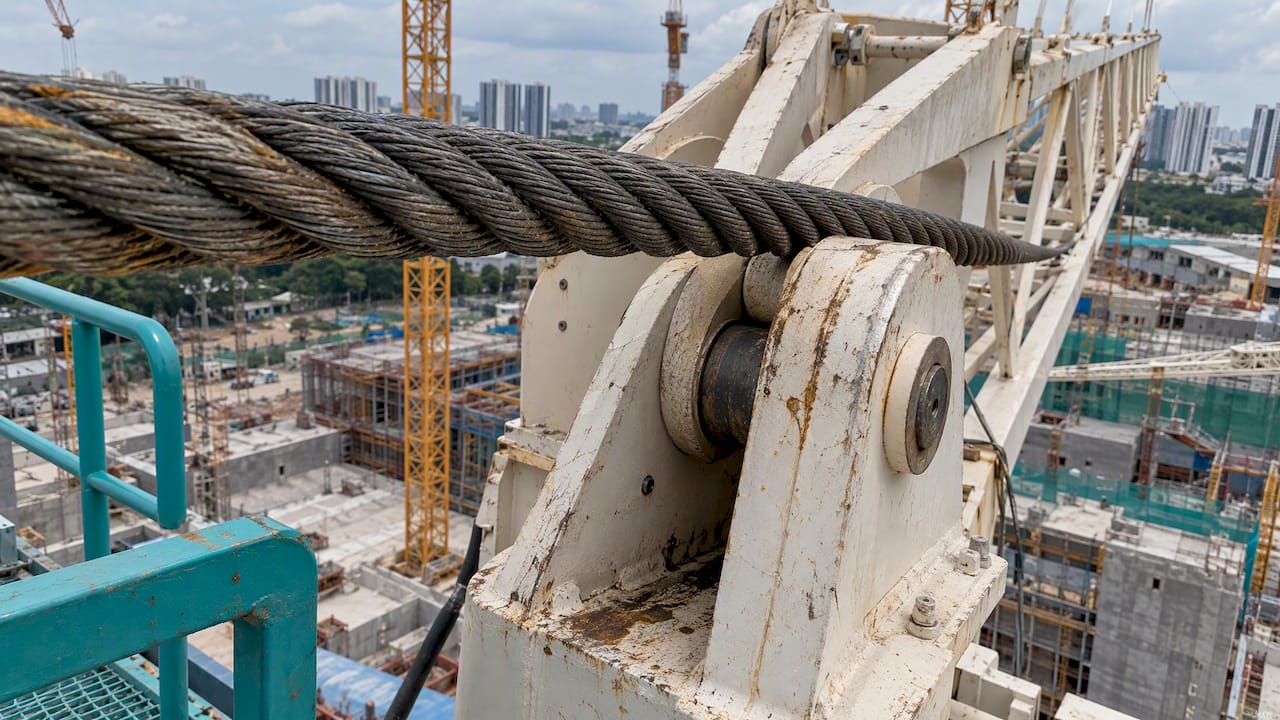
MOM’s learning report on a tower crane failure describes an incident on 4 November 2019 in which an erection rope became entangled at an A-frame pivot, restricted jib lowering, failed under load and caused the hook block and load to fall, resulting in one fatality and one injury. The report did not use Bowtie or FMEA to present its findings. The following is our illustration of how each method would frame the same hazard on a site.
Bowtie view. The hazard is a suspended load. The top event is loss of control of the load. Threats might include a rope fouling, overload and operator error. Consequences include a fatality, injury and damage. Preventive barriers include the lifting plan and the removal or stowing of redundant ropes. Mitigative barriers include exclusion zones and emergency response. The diagram makes plain whether a threat has no barrier at all, or only one barrier that depends on a person remembering.

FMEA view. The process is jib installation and lowering. Each step is listed, for example connecting the erection rope, raising the jib, disconnecting the rope and lowering. For each step the team asks how it can fail, such as a rope left connected or snagging at the pivot gap. They record the effect and the control, and assign an action owner. The method naturally finds the small physical condition, the pivot gap, that a high-level diagram might only label as “equipment failure”.
The report’s recommendations are the kind of actions either method should lead to: remove or disconnect and securely stow erection ropes after jib installation, or eliminate the pivot gap or fit a protective guard. It also says lifting operations should have a lifting plan supported by a risk assessment, permit-to-work, safe-work procedures and method statements. Those documents are where the analysis is turned into instruction for the crew.
FMEA in a Singapore post-incident review
FMEA also works retrospectively. MOM’s inquiry into the 24 February 2021 accident at Stars Engrg applied FMEA to five stages of the accident sequence: heat transfer fluid filling, heating, heating-jacket integrity, aerosol release and combustible dust. For each, it identified causes, consequences, existing measures and recommendations. MOM stated that the exercise targeted gaps in safety systems, regulations and standards, not specific mixer-component failures.
The lesson for a safety manager is that FMEA is flexible about scale. It can examine a bolt, a procedure or an entire accident chain, provided the team defines the boundaries first and keeps asking what the existing measures really do.
Are these methods required in Singapore?
Not by name, in most cases. They are techniques that help you meet duties that are defined elsewhere.
- The Workplace Safety and Health (Risk Management) Regulations require risk management, which MOM explains goes beyond a one-off risk assessment by adding the active control, monitoring and communication of identified risks.
- WSH Council training material updated in 2024 for the bizSAFE Level 2 risk management plan lists HAZOP, FMEA, What-if Analysis, Fault Tree Analysis and Event Tree Analysis among risk assessment methodologies, and says organizations should ensure their assessments cover WSH risks from any workplace activity or exposure.
- For major hazard installations, MOM’s Safety Case Technical Guide says a safety case may require studies such as PHA (for example HAZOP), quantitative risk assessment, fire safety studies and risk assessments. It also requires a systematic process to identify initiating events and combinations of events that could cause major accident hazards, considering operational, internal and external causes, including human factors.
So a regulator or auditor will not ask whether you drew a bowtie. They will ask whether your hazard identification was systematic, whether controls are effective and whether the findings reach the people doing the work. The method is your evidence, not your obligation.
Common mistakes when applying either method
- Treating the diagram as the deliverable. A bowtie on a wall is not a control. Each barrier needs an owner, a check and a frequency.
- Scoring for its own sake. Debating whether a likelihood is a 3 or a 4 consumes time better spent on what could be changed.
- Choosing the method by habit. Teams that always run the same technique tend to see only the hazards that technique reveals.
- Excluding the workforce. The people who do the task know which barriers are routinely bypassed.
- Stopping at the workshop. Findings must flow into the lifting plan, permit-to-work, safe-work procedures and method statements, or the exercise has no effect on site.
For the wider framework these methods sit in, our guides on risk assessment in Singapore construction and the five-step risk assessment process set out the baseline that Bowtie and FMEA refine.
Our perspective
We see the same pattern on projects of every size: the method chosen matters less than whether its output survives contact with the site. A beautifully constructed Bowtie that never reaches the supervisor’s briefing has the same value as no study at all.
Our view is that construction teams should treat these techniques as a sequence, not a contest. Use a conventional hazard identification and risk assessment as the baseline. Use Bowtie where a scenario is severe enough that management must see, in one picture, which barriers truly stand between a worker and a fatality. Use FMEA where a repeated task has hidden single points of failure. Where Design for Safety is in play, these exercises are most valuable early, when removing a hazard through design is cheaper than controlling it with procedure. Above all, ask of every barrier: who owns it, how do we know it works today, and what happens if it is missing?
— Aman
Putting the methods to work with MOSAIC
If your team needs a structured study but not the in-house capacity to facilitate it, our consultancy service supports risk assessment and risk management planning for construction and related industries. Where the outcome has to stand up to an auditor, our WSH audit and inspection work tests whether the controls identified on paper are operating on site, and our Design for Safety professional service brings hazard elimination into the design stage. Pricing is project-based, so contact us with your scope for a proposal.
FAQ
Is Bowtie better than FMEA?
Neither is better in general. Bowtie is stronger for explaining one major hazard and showing the barriers against it, while FMEA is stronger for dissecting a process or component for failure modes. Many teams use both on the same project, at different levels of detail.
What is the difference between FMEA and HAZOP?
FMEA starts from items or process steps and asks how each can fail and with what effect. HAZOP, as described in Singapore’s WSH Guidelines, examines deviations and the resulting hazards or operability problems in process plants, for continuous or batch operations, new or existing. HAZOP therefore fits plant and piping systems, while FMEA fits tasks and equipment more broadly.
Can Bowtie, FMEA and HAZOP be combined?
Yes. The 2017 WSH Guidelines on process hazard analysis state that Bowtie Analysis and LOPA may follow Checklist, What-If or HAZOP to evaluate the effectiveness of existing and proposed controls. A common pattern is to find failure modes or deviations first, then place the serious scenarios into a Bowtie to test the barriers.
Does Singapore require a Bowtie or FMEA for bizSAFE or WSH compliance?
The sources we reviewed do not make either method mandatory by name. Training material for bizSAFE Level 2 lists FMEA and HAZOP among recognized risk assessment methodologies, and the regulations require systematic risk management. For a major hazard installation, MOM’s safety case guidance may call for studies such as HAZOP, so confirm requirements for your facility with MOM.
Sources
- MHI Safety Knowledge Sharing, Bowtie Analysis bulletin (Singapore Chemical Industry Council)
- ICAO, Safety Risk Management Methodologies: Bowtie guidance
- NHG FMEA Handbook
- Headline Podcast, Bow-Tie vs FMEA vs Critical Control Verification
- Workplace Safety and Health Guidelines: Process Hazard Analysis (2017)
- MOM Learning Report: Tower Crane Failure
- MOM Stars Engrg Inquiry Committee Report, Part 2 Annex 4
- MOM Guide to the WSH (Risk Management) Regulations
- WSH Council bizSAFE Level 2 risk management training material
- MOM Safety Case Technical Guide