
Most government and GLC tenders in Singapore set bizSAFE Level 3 as the minimum eligibility threshold. High-risk or high-value contracts, particularly major infrastructure and CW01/CW02 construction work, commonly push that expectation to Level 4 or bizSAFE Star. Individual tenders still vary, and the Safety Disqualification framework can bar firms with poor safety records regardless of certification level. So the first move on any tender is checking its stated eligibility criteria on GeBIZ and lining up your evidence early.
TL;DR:
- Most Singapore government tenders require at least bizSAFE Level 3, with high-risk projects often demanding Level 4 or bizSAFE Star certification.
- The Safety Disqualification framework, effective April 1, 2024, can bar firms with poor safety records even if they hold a valid bizSAFE certificate.
- Bid eligibility depends on precise tender criteria, which may treat bizSAFE as a pass/fail gate or weighted score, so thorough document cross-checking is essential.
- External audits and renewal timing are common delays; scheduling audits well in advance and renewing certificates ahead of expiry ensure eligibility.
- Registering properly on GeBIZ and aligning your compliance documents with tender instructions prevent disqualification due to mismatched or incomplete submissions.
Table of Contents
- How Procurement Uses BizSAFE: Gatekeeper, Scorecard, or Both
- Matching BizSAFE Levels to Tender Categories
- Applying for BizSAFE: Steps, Timeline, and What Buyers Want to See
- Where to Find Tenders and What Registrations You Need First
- Common Pitfalls That Cost Firms Their Tender Eligibility
- Getting Tender-Ready: A Practical Path Construction Firms Can Follow
- Why BizSAFE Discipline Separates Serious Bidders From the Rest
- Let MOSAIC Handle the Certification Work While You Focus on the Bid
- Sources
- FAQ
How Procurement Uses BizSAFE: Gatekeeper, Scorecard, or Both
Government agencies do not treat bizSAFE as a single, uniform hurdle. Some tenders list it as a critical criterion, meaning a bid without the required level gets excluded before anyone reads the pricing page. Others fold it into a weighted scoring matrix under a heading like “Quality” or “Vendor Capability,” where it contributes points alongside experience, manpower, and technical proposals rather than determining pass or fail outright. That distinction shows up in how GeBIZ tenders structure their evaluation matrices, and getting it wrong is one of the more common ways bidders waste weeks preparing a submission that never had a chance.
The safety stakes go beyond scoring. The Safety Disqualification framework, effective April 1, 2024, can temporarily bar firms with poor workplace safety and health records from bidding on public-sector construction work. It applies specifically to tenders called under BCA Contractor Registration System (CRS) workheads CW01, CW02, CR, and ME. A firm can hold a valid bizSAFE certificate and still fail an SDQ check if its incident history or enforcement record is poor enough, which is why certification alone is never the full compliance picture.
Government-linked companies and large corporate developers tend to mirror these standards even when they are not legally bound by GeBIZ rules. Main contractors routinely cascade the same bizSAFE expectations down to their subcontractors, so a Level 3 requirement on the head contract often becomes a Level 3 requirement for every trade package underneath it.
Before drafting a single page of your bid, confirm what the tender document actually demands:
- Read the “Critical Criteria” or “Mandatory Requirements” section first, not the technical scope.
- Note whether bizSAFE appears as a pass/fail gate or a scored line item.
- Check whether the requirement applies to your firm, a joint-venture partner, or a named subcontractor.
- Cross-reference the compliance matrix embedded in the tender documents so nothing gets missed between the instructions to tenderers and the actual evaluation form.
Matching BizSAFE Levels to Tender Categories
Not every tender category demands the same level, and assuming otherwise is how firms either over-invest in certification they do not need or under-prepare for one they do.
Construction subcontractors working on general building, addition and alteration, or renovation packages typically face a Level 3 baseline. That level requires an external audit, which signals to procurement teams that a functioning risk management system, not just a training certificate, is behind the bid.
Large infrastructure, civil engineering, and high-risk works (think MRT-adjacent projects, deep excavation, or major mechanical and electrical packages) usually expect Level 4 or bizSAFE Star. These tenders carry higher consequence-of-failure profiles, and buyers want proof of a mature safety management system, not a company that just cleared the entry bar.
ICT and facilities management tenders are less predictable. Pure software or helpdesk contracts rarely reference bizSAFE at all. But once the scope includes on-site installation, cabling, or building works, a Level 3 requirement often reappears, because the buyer is really screening for construction-site safety competence rather than IT capability.
A few other mapping details matter:
- Some external certifications, such as SLOTS, SgMA, or JCI alignments, qualify a company for direct entry into a bizSAFE level without repeating the full application sequence.
- Direct-entry pathways are accepted only when the external certification’s scope and validity period line up with what the tender specifies, so check the fine print before assuming equivalence.
- Agencies do customize requirements, and reading the eligibility clause of each tender beats relying on what a similar tender required last year.
Applying for BizSAFE: Steps, Timeline, and What Buyers Want to See
Getting to Level 3 or above is a sequence, not a single form submission. Skipping a step almost always costs more time than doing it properly the first time.
- Appoint a senior management representative. This person becomes the named point of accountability for the company’s WSH system and signs off on the application.
- Complete the required WSQ courses. Level 3 typically requires the WSQ Risk Management course; higher levels add further coursework tied to safety leadership.
- Commission the external Risk Management Implementation Audit. This is mandatory from Level 3 upward and is what separates bizSAFE from a paper exercise.
- Collect the audit report and supporting evidence. Buyers want to see the actual audit findings, not just a pass notification.
- Submit the bizSAFE application with company registration details (ACRA/RCB records), the audit report, and course certificates attached.
- Wait for processing. Applications are free to submit, though the training and audit costs sit with the applicant, and processing times typically range around 10 working days when submissions are complete once the submission is complete.
Once approved, the company receives its bizSAFE Enterprise e-certificate and logo by email, and its status updates on the bizSAFE Marketplace for anyone verifying your credentials.
For a tender submission, procurement teams generally expect a documentation set including the bizSAFE e-certificate, the external audit report, individual course completion certificates for named personnel, and any aligned external certifications you are relying on for direct entry. A more detailed breakdown of these documents lives in this guide to bizSAFE certification for SMEs.
Pro Tip: Build in a buffer before submitting for renewal. Renewal applications should be submitted well ahead of the certificate’s expiry date to avoid lapses, and if an external audit turns up a sample verification issue, the whole audit has to be redone rather than patched, which can blow past that window fast.
Where to Find Tenders and What Registrations You Need First
GeBIZ is the government’s central procurement portal, and it is where nearly every public-sector tender opportunity in Singapore gets published. Registering as a GeBIZ trading partner is the first gate: without that registration, you cannot download tender documents or submit a bid, regardless of your bizSAFE level.
Beyond GeBIZ registration, specific tender categories layer on additional requirements. Construction-related tenders often require BCA Contractor Registration System (CRS) registration under the relevant workhead before you are even eligible to bid, and some agencies ask for Government Supplier Registration (GSR) as a baseline vendor record. These registrations and your bizSAFE level are separate checks that procurement teams verify independently, so having one does not substitute for the other.
A few practical actions keep this process from stalling your bid preparation:
- Register as a GeBIZ trading partner well before you need to submit anything, since account setup is not instant.
- Confirm your BCA CRS workhead and grading match the tender’s construction category.
- Monitor the indicative government procurement opportunities listing to plan certification timelines around upcoming tenders rather than reacting after they close.
- Keep CorpPass credentials current, since most GeBIZ and government portal actions run through it.
- Attach your bizSAFE e-certificate and audit report directly to the tender submission rather than assuming the buyer will look it up on the Marketplace themselves.
Buyers frequently cross-check your claimed status against the bizSAFE Marketplace listing, so a mismatch between what you submit and what is publicly recorded is an easy way to lose credibility on an otherwise strong bid.
Common Pitfalls That Cost Firms Their Tender Eligibility
Most bizSAFE-related tender failures trace back to timing, not capability. The company usually could have met the requirement; it just did not manage the clock.
The external audit is the single biggest source of delay. If the auditor’s sample verification turns up problems, the entire audit has to be redone, not just the failed portion. Firms that schedule their audit two weeks before a tender deadline are gambling on a clean pass with no room for error.
Renewal timing trips up otherwise well-run companies just as often. Missing the 60-day renewal window can let a certificate lapse right when a tender submission is due, and a lapsed certificate is functionally the same as never having one at all in the eyes of a procurement evaluator.
There is also a recurring confusion between individual training and company recognition. Completing a WSQ course gets an individual a personal certificate; it does not grant the company bizSAFE status. Only a completed application with audit evidence does that, and bidders sometimes submit training certificates alone, assuming they demonstrate compliance.
If you find yourself close to a deadline with a certification gap:
- Contact the tendering agency early with proof that renewal is in progress, since some evaluators allow a short grace period with documentation.
- Book an emergency re-audit slot rather than waiting for your original auditor’s next opening.
- Bring in a consultant experienced with re-audits and renewals to compress the remediation timeline.
Pro Tip: Treat your bizSAFE renewal date as a tender-planning input, not a background administrative task. Mark it on the same calendar you use to track upcoming GeBIZ opportunities.
Getting Tender-Ready: A Practical Path Construction Firms Can Follow
Firms that move smoothly from “not yet certified” to “bid submitted” tend to follow a consistent sequence rather than tackling documentation, training, and audits in isolation.
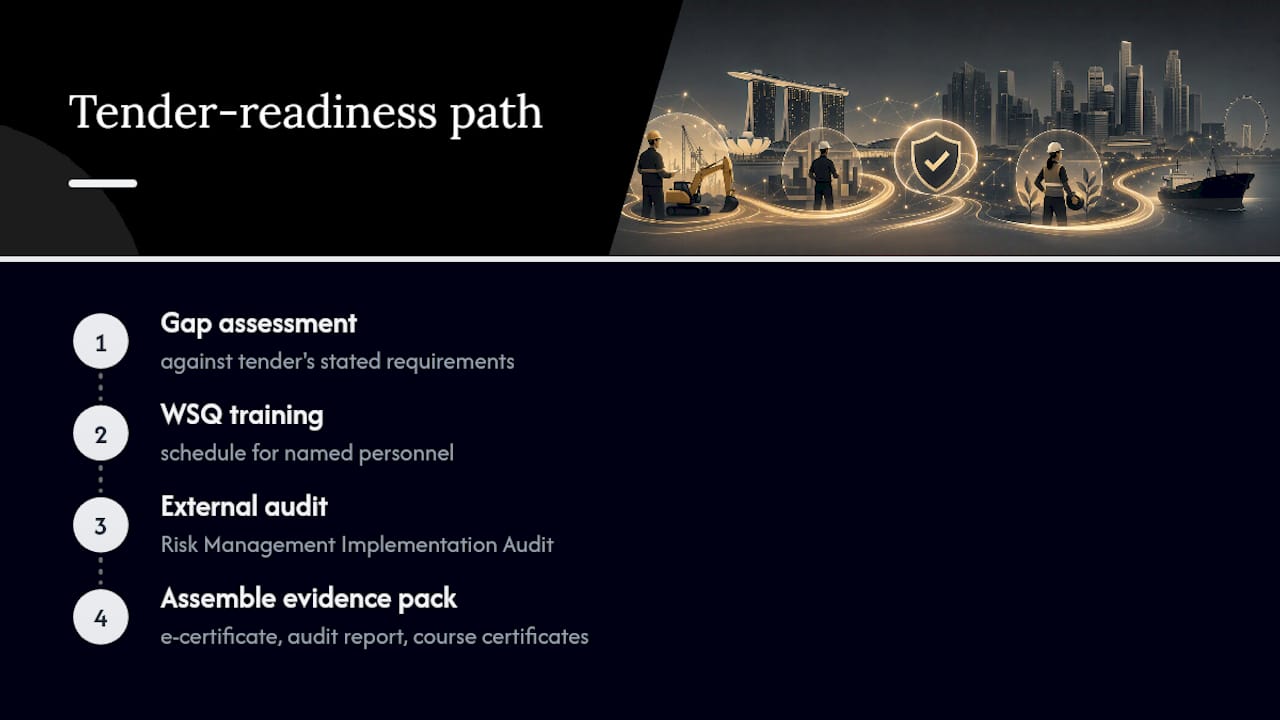
A workable path starts with a gap assessment against your target tender’s stated requirements, followed by scheduling the necessary WSQ training for named personnel, commissioning the external Risk Management Implementation Audit, and finally assembling the evidence pack, e-certificate, audit report, and course certificates, into the format procurement teams expect on GeBIZ.
Com works across each stage of that path: bizSAFE Level 3, 4, and Star certification support, WSH audits and inspections, ConSASS assessments, Design for Safety advisory, and EHS documentation for the evidence pack itself. The firm has operated in this space for over 20 years, working with construction companies across certification, audit, and compliance engagements. For firms juggling a live tender deadline against an audit backlog, that kind of continuous, multi-service support matters more than any single certificate.
Why BizSAFE Discipline Separates Serious Bidders From the Rest
The firms that consistently win tenders are not necessarily the ones with the lowest price. They are the ones whose safety paperwork never becomes a last-minute scramble. Certification treated as a standing operational habit, audited on schedule, renewed well ahead of the 60-day window, evidence organized before a tender even drops, functions completely differently from certification treated as a box to check once a bid deadline looms.
The gap between those two approaches shows up most starkly when a tender closes in three weeks and a company’s audit is six months overdue. At that point, no amount of urgency fixes a problem that needed a 60 to 90-day runway. My recommendation for any firm serious about GeBIZ work: map your bizSAFE renewal calendar against the tender pipeline you expect over the next two quarters, and build in that buffer now rather than after a missed opportunity forces the conversation.
— Aman
Let MOSAIC Handle the Certification Work While You Focus on the Bid
Chasing an external audit slot, tracking a renewal deadline, and assembling a tender evidence pack all at once is exactly how firms lose bids they were otherwise qualified to win. A single point of contact for the certification and documentation work that GeBIZ evaluators actually check can help construction firms avoid juggling separate consultants for training, audits, and paperwork.

Our team supports the full sequence: bizSAFE Level 3, 4, and Star certification, WSH audits and Risk Management Implementation Audits, ConSASS assessments, and EHS documentation for tender evidence packs. Because these services run under one team, sample verification issues get caught and corrected faster than when audit, training, and paperwork sit with three separate vendors. If your certificate is approaching its 60-day renewal window or you have a tender closing soon, reach out through the Biz Safe level 3,4, Star service page to get a gap assessment scheduled this week.
Sources
- MOM — WSH requirements in public-sector construction and construction-related projects
- bizSAFE Frequently Asked Questions — WSH Council / TAL
- GeBIZ — Government Electronic Business System
FAQ
Where can I find tender opportunities in Singapore?
Government tender opportunities are published on GeBIZ, the Singapore Government’s procurement portal. Register as a GeBIZ trading partner to download tender documents, and check the indicative procurement listing to plan ahead of upcoming opportunities.
What are the requirements to achieve bizSAFE Level 3?
BizSAFE Level 3 requires your senior management representative to complete the WSQ Risk Management course, followed by commissioning an external Risk Management Implementation Audit. Once the audit report and supporting documents are submitted, processing times typically range around 10 working days when submissions are complete for a complete application.
How do I check if a company is bizSAFE certified?
A company’s bizSAFE status and level are listed on the bizSAFE Marketplace, which buyers and procurement teams use to verify a supplier’s certification independently of the documents submitted. Always cross-check the level shown there against what a bidder claims in their tender submission.
What triggers a Safety Disqualification under MOM’s framework?
The Safety Disqualification framework, effective April 1, 2024, temporarily bars firms with poor workplace safety records from bidding on public-sector construction tenders under CRS workheads CW01, CW02, CR, and ME. A valid bizSAFE certificate does not override an SDQ disqualification if the underlying safety record triggers it.
Does attending bizSAFE training automatically give my company certification?
No. Course completion certificates are issued to individuals, not companies, and do not by themselves grant company-level bizSAFE recognition. Your company only receives its bizSAFE status after submitting a complete application with audit evidence and supporting documents.
Recommended
- Why bizSAFE Level 3 is Becoming a Baseline Requirement for Singapore Corporate Tenders
- The bizSAFE Advantage: How to Unlock Tender Eligibility and Secure Government Contracts in Singapore
- Bizsafe Level 3 for Singapore Construction Subcontractors: Site Safety Tender Requirements
- Achieving bizSAFE Level 3 in Singapore: The Ultimate Guide to the Risk Management Audit