
To work as a lifting supervisor in Singapore, you must hold the WSQ Supervise Safe Lifting Operations (SSLO) competency, meet the rigging and signalman prerequisite, and satisfy the employer’s minimum experience threshold. Start by confirming your eligibility, then enroll in an accredited SSLO course through MySkillsFuture or NTUC LearningHub. The Workplace Safety and Health (Operation of Cranes) Regulations 2011 sets the legal floor for appointment; everything else is negotiation with an employer.
TL;DR:
- Employers require documented lifting experience, including signed ground condition reports and toolbox-talk logs, alongside certification to consider candidates for lifting supervisor roles.
- Meeting the minimum age of 21 and holding the WSQ Perform Rigger and Signalman competencies are prerequisites before enrolling in an accredited SSLO course.
- The legal duties of a lifting supervisor include coordinating lifts, verifying site safety, briefing teams, and stopping lifts if conditions change unexpectedly.
- Salary levels and job prospects depend heavily on years of lifting experience and the specific equipment supervised, with listings tying pay to demonstrated site judgment.
- Certification alone is insufficient; a strong record of practical judgment calls and thorough documentation significantly increase chances of employment.
Table of Contents
- What Does the Lifting Supervisor Singapore Job Market Look Like?
- What Are the Legal Duties of a Lifting Supervisor in Singapore?
- What Qualifications Do You Need for the SSLO Course?
- How Do You Become a Certified Lifting Supervisor in Singapore?
- What Do Employers Actually Verify Before Hiring?
- What the Data Actually Tells You About This Career Path
- Sources
- FAQ
What Does the Lifting Supervisor Singapore Job Market Look Like?
Job boards such as JobStreet and JobCube consistently list multiple open lifting supervisor roles across construction, marine, and logistics sectors at any given time. Demand tracks closely with Singapore’s construction pipeline, so postings cluster around major developments and yard turnarounds rather than flowing in a steady drip.
Employers rarely ask for a single qualification in isolation. Most listings stack requirements: prior experience in construction or ERSS (Earth Retaining and Stabilizing Structures) work, working knowledge of crane and rigging operations, a completed or in-progress SSLO certificate, and the demonstrated confidence to halt a lift the moment something looks wrong.
Snapshot: Postings on JobStreet and JobCube for lifting supervisor roles in Singapore typically describe salary bands tied directly to years of on-site lifting experience and the breadth of equipment a candidate has supervised, not just certification alone.
To position yourself well against these listings:
- Mirror the exact phrasing employers use, like “crane supervisor,” “lifting operations manager,” or “lifting safety officer,” across your resume headline and summary.
- Attach scanned copies of your SSLO certificate and rigger/signalman credentials directly to applications rather than just referencing them.
- Set job alerts on JobStreet and LinkedIn using both “lifting supervisor” and “crane supervisor” as separate saved searches, since employers don’t standardize titles.
- List specific crane types or lift categories you’ve worked with (mobile crane, tower crane, crawler crane) since generic phrasing gets filtered out early.
What Are the Legal Duties of a Lifting Supervisor in Singapore?
The Workplace Safety and Health (Operation of Cranes) Regulations 2011 doesn’t treat the lifting supervisor as an honorary title. It imposes specific, enforceable duties on anyone appointed to the role.
Under the regulation, a lifting supervisor must:
- Coordinate every lifting activity at the worksite from planning through completion.
- Confirm that only registered crane operators and appointed riggers or signalmen take part in the lift.
- Verify ground conditions are safe for the crane being deployed, particularly for mobile crane setups.
- Brief the entire lifting team on the approved lifting plan before work begins.
- Stop the lift immediately if conditions deviate from what was planned or briefed.
The employer carries a parallel obligation: appointing a supervisor who genuinely meets the regulation’s competency and experience bar, not just someone with a convenient title. In practice, this appointment ties into the site’s permit-to-work system and its approved lifting plan, both of which the Guidebook for Lifting Supervisors from the WSH Council outlines in detail.
On-site, this translates into concrete sign-off responsibilities. The supervisor typically signs the toolbox-talk log before the lift, confirms the lifting plan matches actual site conditions, and retains records that an inspector or investigator can review after the fact. If you’re researching what documentation a compliant lifting plan actually requires, MOSAIC’s lifting plan requirements guide breaks down what a compliant plan needs to include.
What Qualifications Do You Need for the SSLO Course?
The entry bar has two distinct layers, and conflating them is the most common mistake candidates make. The first layer is course eligibility: to enroll in SSLO, you generally need to be at least 21 years old and hold the WSQ Perform Rigger and Signalman competency as a prerequisite. The second layer is appointment eligibility: even after passing SSLO, regulations reference relevant experience in lifting operations commonly interpreted as around one year, before an employer can formally appoint you as lifting supervisor.
When evaluating a course, check for these specifics before enrolling:
- Duration: Accredited providers such as THT Academy run the SSLO course over roughly 32 to 35 hours.
- Assessment: Expect a mix of written, oral, and practical evaluation components, not a single exam.
- Accreditation check: Confirm the provider and course code appear on MySkillsFuture before paying anything.
- Funding: NTUC LearningHub’s SSLO course page publishes fee and subsidy examples that vary depending on whether you’re self-sponsored or company-sponsored.
| Requirement type | What it covers | Where to verify |
|---|---|---|
| Course prerequisite | WSQ Perform Rigger and Signalman, minimum age 21 | Provider entry requirements |
| Course content | SSLO competency unit, theory and practical assessment | NTUC LearningHub |
| Appointment requirement | Relevant lifting operations experience | Employer, per Operation of Cranes Regulations |
| Funding eligibility | SkillsFuture Credit, company sponsorship | MySkillsFuture |
Subsidy amounts shift depending on the sponsorship route and the provider’s own pricing, so treat any fee figure you see online as a starting point to confirm directly with the training center, not a fixed national rate.
How Do You Become a Certified Lifting Supervisor in Singapore?
- Confirm or obtain your Rigger and Signalman competency. This WSQ credential is the gatekeeper prerequisite for SSLO enrollment, so sort it out first if you don’t already hold it.
- Enroll in an accredited SSLO course and complete all assessments. Keep your certificate, both the physical copy and a scanned backup, since employers ask for it repeatedly across applications.
- Build and document lifting experience deliberately. Track the crane types, lift categories, and site conditions you’ve worked with, not just a vague job title on a resume.
- Assemble the paperwork employers expect at appointment. This includes past lifting plans you’ve contributed to, toolbox-talk logs you’ve signed, and certified copies of your credentials.
- Tailor your job search materials. Rewrite your resume around the specific language in job postings, line up references from site supervisors who can vouch for your judgment under pressure, and prepare to discuss real scenarios where you stopped or delayed a lift.
Pro Tip: Bring a physical folder of your lifting plans and toolbox-talk logs to interviews. Employers hiring for lifting operations manager or crane supervisor roles often ask candidates to walk through a real decision they made on-site, and a documented example beats a rehearsed answer every time.
What Do Employers Actually Verify Before Hiring?
Certificates get you shortlisted. What gets you hired is proof you can execute the job’s actual discipline, and experienced hiring managers know exactly where to look for it.
Ground condition checks are the first thing a seasoned reviewer probes. Confirming a site is safe for a mobile crane means more than a visual glance. Best practice, per the WSH Council’s Guidebook for Lifting Supervisors, includes checking soil bearing capacity reports or confirming temporary steel plates are correctly placed. Candidates who can describe this process specifically stand out immediately.
Documentation habits matter just as much. A signed attendance log for toolbox talks is often the first record an investigator requests after an incident, and it doubles as a strong signal of on-site discipline when an employer reviews your application. Keep dated, signed copies of every briefing you’ve led or attended.
- Photograph or scan every certificate and lifting plan you’ve worked on, filed by date and site.
- Maintain a running log of toolbox talks with signatures, not just a mental tally.
- Practice describing a specific moment you halted a lift; vague answers read as inexperience.
- Ask former site supervisors for references that specifically mention your judgment calls, not just attendance.
Pro Tip: If you’re transitioning from a related role like site safety supervisor, review what documentation and authority employers expect at that level too. MOSAIC’s site safety supervisor overview covers adjacent evidence employers accept, which often overlaps with lifting supervisor expectations.
Construction firms managing multiple concurrent lifts sometimes bring in outside consultancy support to keep lifting plans and compliance documentation audit-ready. If your organization needs that kind of structured backup, MOSAIC’s WSH Audit and Inspection service reviews site documentation and compliance gaps before regulators or clients do it for you. For companies also pursuing broader certification like BizSAFE alongside their lifting operations, MOSAIC’s training and consultancy services cover both ends of that requirement.
What the Data Actually Tells You About This Career Path
Most guidance on becoming a lifting supervisor treats the SSLO certificate as the finish line. It isn’t. The regulation itself splits the requirement into two separate hurdles, course completion and relevant field experience, and candidates who only clear the first one keep getting passed over without understanding why.
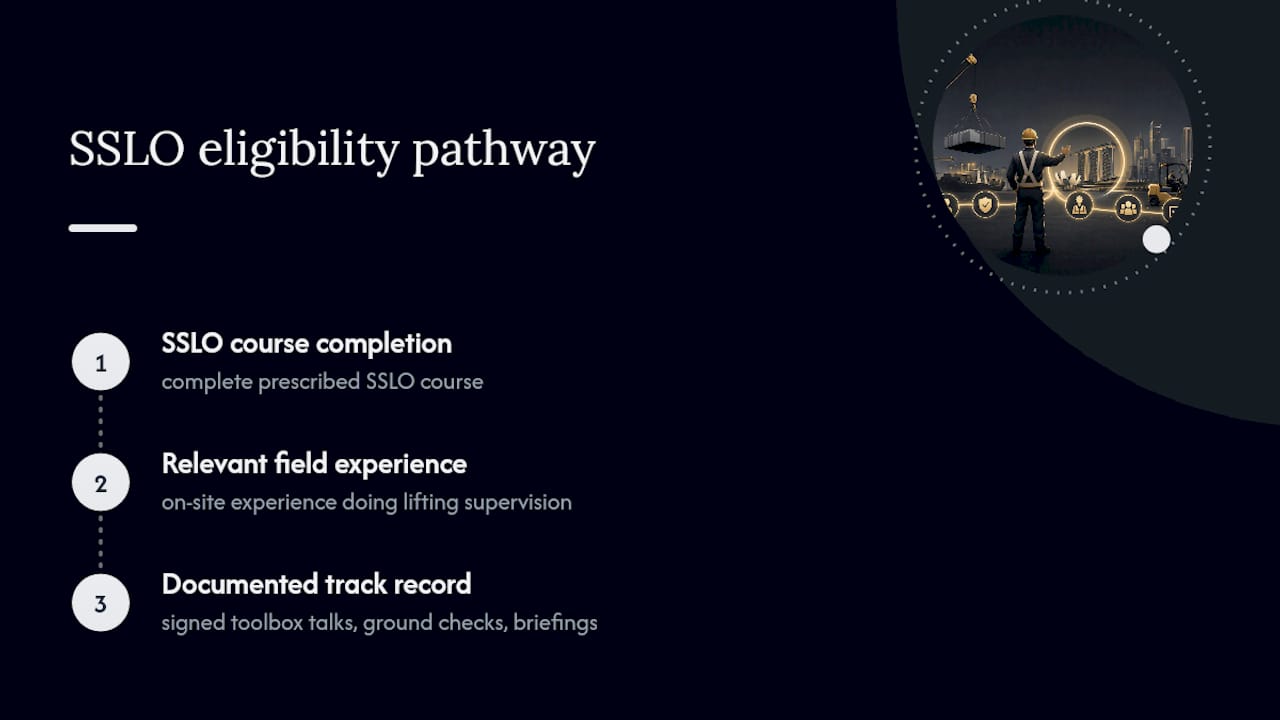
The overlooked leverage point isn’t the certificate at all. It’s documentation discipline. Two candidates with identical SSLO credentials and similar years on-site will not get equal consideration if one can produce signed toolbox-talk logs and ground-condition verification records while the other offers only a verbal account. Employers hiring for a role built entirely around stopping unsafe work want evidence you’ve already been doing that job informally, in writing, before they hand you the title.
If there’s one piece of conventional advice worth ignoring, it’s “get certified and the job will follow.” Certification opens the door. What gets you through it is a documented track record of judgment calls, ground checks, and briefings you can hand to an interviewer without hesitation. Build that file starting on your very first site assignment, not after you’ve enrolled in SSLO.
— Aman
Sources
- Workplace Safety and Health (Operation of Cranes) Regulations 2011 – Singapore Statutes Online
- Guidebook for Lifting Supervisors (WSH Council / TAL)
- SSLO: Supervise Safe Lifting Operations – NTUC LearningHub
- MySkillsFuture — course search and funding portal
FAQ
What Is the Average Salary for a Lifting Supervisor in Singapore?
Salary depends heavily on years of lifting experience and the range of crane equipment supervised, based on listings across JobStreet and JobCube. Rather than a single fixed figure, expect postings to scale pay with documented experience and the complexity of past lifts supervised.
What Does a Lifting Supervisor Actually Do?
A lifting supervisor coordinates every lift on-site, confirms only registered operators and appointed riggers or signalmen take part, checks ground conditions are safe, and briefs the team on the approved lifting plan. They also hold the authority to stop a lift immediately if anything deviates from that plan, under the Operation of Cranes Regulations.
What Are the Fees for the Lifting Supervisor Course in Singapore?
Fees vary by provider and whether you’re self-sponsored or company-sponsored, with NTUC LearningHub’s SSLO course page publishing example fee and subsidy tables to help estimate out-of-pocket cost. Always confirm current pricing and subsidy eligibility directly through MySkillsFuture before enrolling.
What Qualifications Are Required to Become a Lifting Supervisor?
You need the WSQ Perform Rigger and Signalman competency as a prerequisite, completion of the WSQ Supervise Safe Lifting Operations (SSLO) course, and relevant lifting operations experience before an employer can formally appoint you. Course entry typically requires a minimum age of 21, and accredited providers such as THT Academy run the SSLO course over roughly 32 to 35 hours.