Singapore’s National Environment Agency (NEA) caps residential daytime noise at 75 dBA (Leq 12hr) from 7am to 7pm, tightening to 65 dBA in the evening and 55 dBA overnight. Sites within 150 meters of a noise-sensitive premises face a hard stop on Sundays and public holidays, with restricted hours the rest of the week, unless NEA grants a permit exception. These figures come directly from the Environmental Protection and Management (Control of Noise At Construction Sites) Regulations and NEA’s own guidance.
TL;DR:
- Noise thresholds are stricter in the evenings and at night, with Leq 12hr limits dropping to 65 dBA in the evening and 55 dBA overnight.
- Construction within 150 meters of noise-sensitive premises is prohibited from working on Sundays and public holidays, with limited hours on weekdays and weekends.
- Compliance requires pre-construction baseline surveys, proper placement of calibrated Class 1 sound meters, and real-time alert systems to prevent violations.
- Noise mitigation relies heavily on perimeter barriers, strategic site layout, and scheduling of loud activities within permitted hours to minimize complaints.
- Exceeding NEA limits leads to escalating fines and potential prosecution, emphasizing the importance of early monitoring, proper planning, and strict adherence to approved noise management plans.
Table of Contents
- What Are Singapore’s Legal Construction Noise Limits?
- When Must Construction Sites Stop Work Under the 150m Rule?
- How Do You Set Up Compliant Noise Monitoring and an NMP?
- What Noise Mitigation Measures Do Regulators Expect to See?
- What Happens If a Site Exceeds NEA’s Noise Limits?
- How Does a QES Consultant Help You Stay Compliant?
- Where Can You Find the Official Noise Regulations?
- Why Compliance Officers Keep Getting This Wrong
- Sources
What Are Singapore’s Legal Construction Noise Limits?
The Environmental Protection and Management Act (EPMA), Chapter 94A, sets tiered limits depending on how sensitive the receiving premises is and how far the site sits from it. Hospitals, schools, and homes for the aged get the strictest protection. Residential buildings within 150 meters of the site come next, and everything else falls under a looser “other buildings” category.
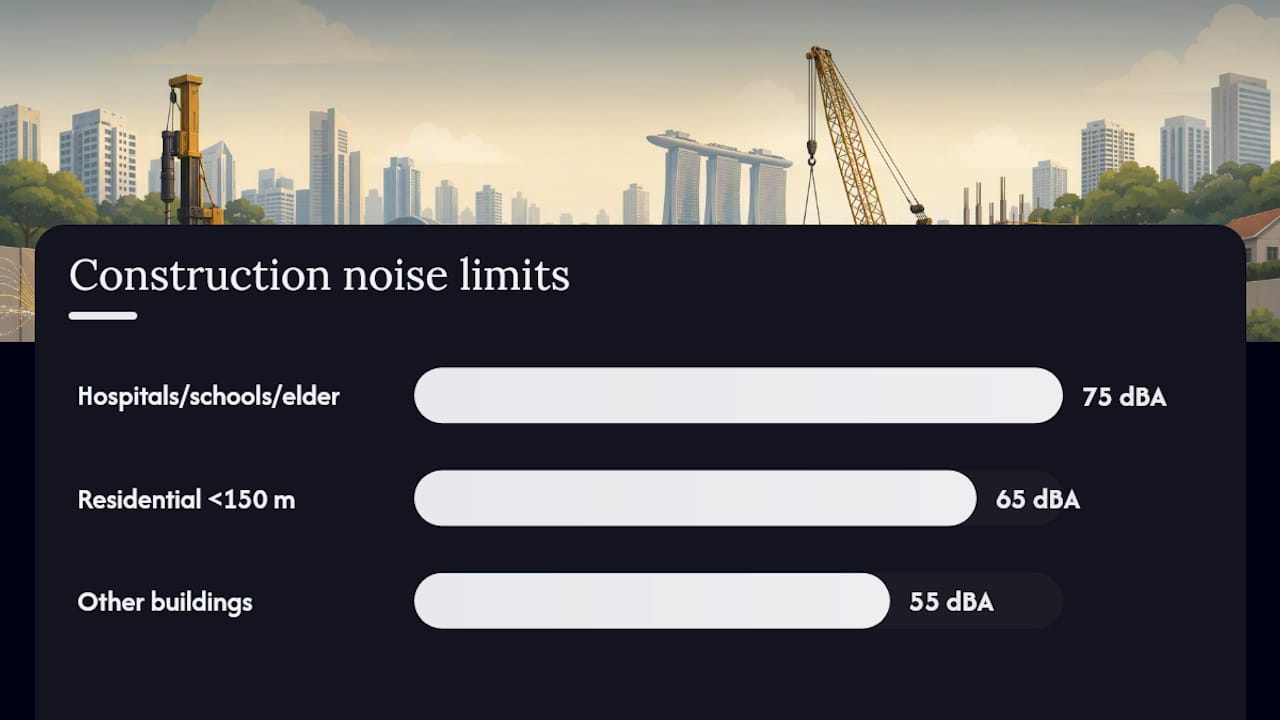
Here’s how the NEA construction noise limits break down by receptor type and time band:
Alongside the hourly and 12-hour averages, NEA enforces short-window peak checks using Leq 5min values, capped at 90 dBA, 70 dBA, and 55 dBA across the same three time bands for residential receptors. These matter because a single loud operation, like a pile driver striking at 11pm, can breach the 5-minute limit even if the hourly average still looks compliant.
Leq simply means the equivalent continuous sound level averaged over a stated period. Regulators use Leq 12hr to judge whether a full workday is compliant, Leq 1hr to catch problems during evening and night shifts, and Leq 5min to flag sudden spikes that a longer average would smooth over and hide.
Sites can also apply for an adjusted permissible limit based on documented background noise levels, following the methodology outlined in SS 602. If ambient traffic noise near an MRT viaduct already sits at 70 dBA, NEA may allow a correction rather than penalize the site for background conditions it didn’t create.
When Must Construction Sites Stop Work Under the 150m Rule?
A noise-sensitive receptor, or NSR, is any hospital, school, home for the aged, or residential building that construction noise could reasonably disturb. The 150-meter threshold determines which set of rules a site falls under, and it’s one of the most consequential distances in Singapore construction planning.

Sites within 150 meters of an NSR are barred from working on Sundays and public holidays entirely. The prohibited window runs from 10pm Saturday to 7am Monday, which effectively removes a full weekend shift for any project close to housing.
On regular weekdays and Saturdays, work is generally permitted, but the evening and night limits tighten sharply after 7pm and again after 10pm. A contractor running a Saturday shift near a condominium needs to plan noisy activities before the 7pm cutoff, not after it.
Permit exceptions exist for genuinely quiet or safety-critical work, such as certain testing procedures, emergency repairs, or activities that don’t generate impact noise. To secure one, contractors typically need to:
- Submit a written application to NEA describing the specific activity and equipment involved
- Provide predicted or measured noise levels showing the work stays under residential limits
- Demonstrate the work cannot reasonably be rescheduled to permitted hours
How Do You Set Up Compliant Noise Monitoring and an NMP?
Getting monitoring right starts before a single pile is driven. NEA and industry guidance from LTA recommend a structured sequence that most compliance officers can run in under two weeks.
- Run a 7-day baseline survey. Capture continuous Leq 5min, Leq 1hr, and Leq 12hr data before work begins, so you have a defensible reference point if a resident later disputes the site’s contribution to ambient noise.
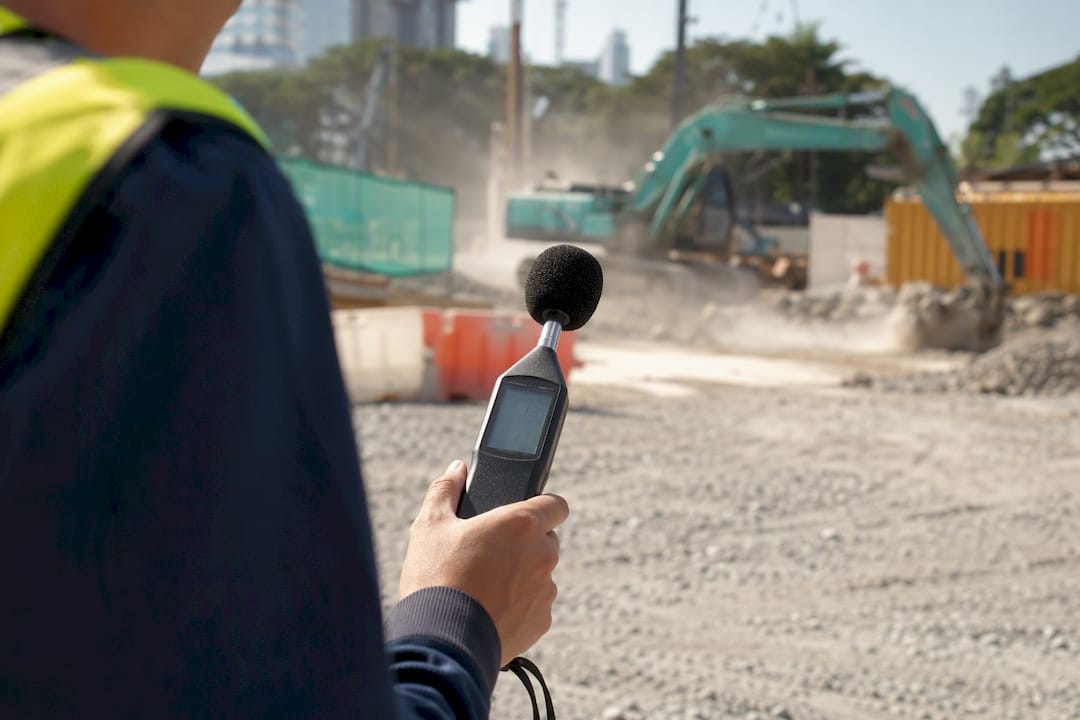
- Site the meter correctly. Place it roughly 1 meter from the nearest wall and 1.5 meters above ground level, ideally on a rooftop or elevated position with a clear line to the affected NSR, per LTA’s noise management plan guidance.
- Use a Class 1 sound level meter, calibrated annually. NEA’s FAQ page is explicit that handheld phone apps carry no weight as enforcement evidence.
- Set up continuous monitoring with alerting. Many approved setups now push SMS alerts to the site’s Environmental Control Officer (ECO) as readings approach the adjusted limit, giving crews time to halt or switch equipment before a breach registers.
- Calculate your adjusted permissible limit using the background correction method, then submit your Noise Management Plan to NEA with baseline data, mitigation hierarchy, and monitoring procedures attached.
Retain your calibration certificates and raw monitoring logs for the life of the project. A tool like Lifesafety can centralize that dashboard and alerting function so records don’t live scattered across spreadsheets.
Pro Tip: Keep at least 90 days of rolling Leq data archived, not just the current week. NEA investigators frequently ask for historical trends when a complaint references “ongoing” disturbance rather than a single incident.
What Noise Mitigation Measures Do Regulators Expect to See?
Perimeter noise barriers remain the workhorse mitigation measure on most Singapore sites. A properly detailed barrier includes a 45-degree cantilever at the top edge, which redirects sound energy upward rather than letting it travel flat toward nearby windows, built from material meeting the STC (Sound Transmission Class) rating specified for the site’s category in SS 602.
Beyond fixed barriers, contractors have several practical levers:
- Portable or inflatable barriers around localized noisy operations like concrete cutting
- Full or partial acoustic enclosures around generators and compressors
- Muffled or low-noise plant selection at the procurement stage, before equipment ever reaches site
- Sequencing so multiple loud activities don’t stack simultaneously, which drives cumulative Leq higher than any single source would alone
NEA’s own guidance on mitigation notes that projects integrating acoustic thinking into site layout and scheduling at the design stage rely far less on expensive enclosures later. Placing the batching plant or piling rig on the side of the site farthest from residential blocks, decided during layout planning, costs nothing extra and does more than a barrier retrofitted after the first complaint arrives.
Pro Tip: Cluster your loudest activities into a single continuous block during permitted daytime hours rather than spreading them across the week. Fewer, more concentrated intrusion periods generate measurably fewer complaints than the same total noise spread thin.
What Happens If a Site Exceeds NEA’s Noise Limits?
The financial exposure under the EPMA Regulations escalates fast once a breach is confirmed. First convictions carry a fixed fine, and continuing offenses attract an additional daily fine for every day the exceedance persists after notice, which turns a single missed correction into a compounding liability.
NEA’s enforcement path typically runs:
- A resident or affected party lodges a complaint, often triggered by a specific event like night piling
- NEA officers or the site’s own Class 1 meter data establish the measured Leq against the permissible limit
- A notice or advisory is issued requiring corrective action within a set timeframe
- Continued non-compliance moves toward prosecution, with monitoring records serving as primary evidence either way
If your meter shows an exceedance mid-shift, stop the specific activity immediately, log the reading with a timestamp, and document the corrective step taken. That response record often matters more to NEA than the initial breach itself.
How Does a QES Consultant Help You Stay Compliant?
Getting an NMP approved on the first submission is rarer than most project managers expect. Com works with construction teams from the planning stage, running baseline surveys, building the adjusted permissible limits table, and drafting an NEA submission-ready Noise Management Plan that reflects the mitigation hierarchy regulators actually want to see documented, not just implied.
On the operational side, engagements typically cover:
- Sourcing and calibrating Class 1 sound level meters to the annual standard NEA expects
- Setting up monitoring dashboards with SMS alerting so your ECO gets warned before a breach, not after
- Building an exceedance response protocol your site team can execute without waiting for a consultant call
- Reviewing site layout and sequencing at the design stage to reduce reliance on costly enclosures later
Projects that document design-stage acoustic planning tend to face fewer complaint-driven investigations over the construction period, based on NEA’s own guidance favoring early integration. A typical engagement runs from initial site assessment through NMP approval in a matter of weeks, not months, when baseline data is captured early and the submission is built around NEA’s actual schedule rather than a generic template.
Where Can You Find the Official Noise Regulations?
Start with NEA’s construction noise control page for the current permissible limits and FAQs. For the legal text itself, including the schedules, Singapore Statutes Online hosts the EPMA Regulations in full. Technical design details on barriers and enclosures sit in SS 602, while LTA’s NMP guidance PDF walks through the submission format NEA expects.
Why Compliance Officers Keep Getting This Wrong
The conventional advice on construction noise treats it as a paperwork exercise: file the NMP, install a meter, move on. That framing misses where most Singapore projects actually get into trouble. It’s rarely the daytime Leq 12hr limit that trips contractors up. It’s the 7pm and 10pm transitions, when a shift running slightly long suddenly puts the site 10 or 15 dBA over a much stricter threshold without anyone adjusting the work plan.
The 150m rule gets underweighted, too. Project managers often treat it as a scheduling inconvenience rather than what it is: a binary compliance line that either forces a full weekend shutdown or doesn’t, depending on a distance measurement made at the planning stage, not the construction stage. Get that measurement wrong early and you inherit a scheduling problem for the entire project.
If there’s one priority worth acting on immediately, it’s baseline monitoring before any adjusted limit gets calculated. Skip that step and every subsequent compliance claim rests on assumption rather than evidence, which is exactly the gap NEA’s enforcement process is designed to find.
— Aman
Sources
- Construction Noise Control – Singapore
- Environmental Protection and Management (Control of Noise At Construction Sites) Regulations – Singapore Statutes Online
- Noise guidance – developing a noise management plan (LTA PDF)
- SS 602: Code of practice for noise control on construction and demolition sites (preview)
- Construction noise control FAQs – NEA