Site safety supervisor roles are actively open across Singapore’s construction sector right now, with listings on JobStreet numbering in the thousands and Indeed carrying 500 or more live postings at any given time. The credential nearly every contractor screens for first is the WSQ course “Supervise Construction Work for WSH,” still widely referred to by its older acronym, BCSS. For higher-risk or larger contract-sum projects, employers also expect WSHO registration through the Ministry of Manpower.
If you’re job hunting this week, three moves matter more than anything else:
- Update your CV to list BCSS completion date, WSH training record entries, and any refresher certificates by name.
- Set daily job alerts on JobStreet, Indeed, and LinkedIn using the terms “site safety supervisor,” “safety coordinator,” and “WSHC.”
- Book a BCSS course or a WSH Coordinator refresher now if yours has lapsed. Processing and course seats fill up faster than most candidates expect.
Pro Tip: Screenshot your MOM WSH training record page before you apply anywhere. Recruiters ask for proof of currency far more often than they ask for a resume summary.
Hiring managers in this sector move fast when a candidate’s paperwork is already in order, and slow to a crawl when it isn’t.
Key Takeaways
Site safety supervisor jobs are actively available across Singapore’s construction sector, and BCSS certification combined with organized documentation determines who gets hired fastest.
| Point | Details |
|---|---|
| Job availability | Thousands of listings on JobStreet and 500+ on Indeed confirm steady hiring demand right now. |
| Baseline credential | BCSS (“Supervise Construction Work for WSH”) is the certificate nearly every employer requires before shortlisting. |
| Registration cost and timeline | WSHO registration through MOM costs $110 and takes up to 30 working days to process. |
| Pay varies by sector | Sector specialization, such as MRT or petrochemical work, tends to command higher pay than general building supervision. |
| Supported pathway | Com offers training support, audit readiness, and BizSAFE/ISO guidance for candidates and employers pursuing compliance. |
Table of Contents
- Where to Find Current Site Safety Supervisor Jobs in Singapore
- What Training and Certifications Do Singapore Site Safety Supervisors Need?
- What Does a Site Safety Supervisor Actually Do Each Day?
- How Much Do Site Safety Supervisors Earn in Singapore?
- How Do You Apply for a Site Safety Supervisor Role or WSHO Registration?
- How MOSAIC Ecoconstruction Solutions Supports Candidates and Employers
- Understanding the Workplace Safety and Health Act’s Role in Singapore Construction
- What Hazards Do Singapore Construction Sites Present, and How Do Supervisors Handle Them?
- Which Safety Standards and Codes Should Supervisors Know?
- Can Foreign Workers Apply for Site Safety Supervisor Roles in Singapore?
- What Do Employers Ask in Site Safety Supervisor Interviews?
- Why the Standard Job-Hunting Advice Falls Short Here
- Get Support Meeting Singapore’s Site Safety Requirements
- Sources
Where to Find Current Site Safety Supervisor Jobs in Singapore
Job volume and job quality don’t come from the same source, so treat your search channels differently depending on what you want.
- JobStreet carries the highest volume of safety supervisor listings in the country, making it the best starting point for a broad sweep of what’s currently open.
- Indeed aggregates postings from smaller contractors and staffing agencies, and its 500-plus safety supervisor listings often include role variants that JobStreet misses.
- JobCube and similar niche boards list construction-specific safety roles that rarely surface on the bigger platforms, useful for smaller or specialized main contractors.
- LinkedIn works best for targeted applications to specific developers or Tier 1 contractors that post directly rather than through an agency.
Search using every likely variant of the title, not just “site safety supervisor.” Try “safety coordinator,” “WSHC,” and “site supervisor” combined with “safety” or “WSH” in the keyword field, since listings are rarely standardized across employers.
When you scan a posting, look for three signals before applying:
- The contract sum or project type mentioned, since this hints at whether WSHO registration is a hard requirement.
- Whether the role sits on-site or in a corporate safety department, which changes the daily workload significantly.
- Which certifications are listed as “required” versus “preferred,” since some listings inflate their wish list.
Tailor your CV for each application by naming specific inspections, toolbox talks, or incident reports you’ve handled rather than listing generic duties.
What Training and Certifications Do Singapore Site Safety Supervisors Need?
Employers in Singapore treat the WSQ course “Supervise Construction Work for WSH,” commonly called BCSS, as the entry ticket for this role. The course directory listing covers WSH statutory duties, inspection procedures, and incident reporting, which lines up almost exactly with what a supervisor does on-site every day. Without it, most contractors won’t shortlist a candidate regardless of prior experience.
If your role involves acting as a WSH Coordinator, refresher training is mandatory once every two years. According to the WSH Coordinator refresher training FAQ, that refresher consists of 10 e-learning modules with quizzes, followed by a one-day in-person workshop, and the resulting certificate stays valid for two years before you need to repeat it.
Beyond BCSS, MOM’s WSHO registration page lists a set of accepted WSH-related qualifications that count toward eligibility for the registered officer role, which sits a tier above a site-level supervisor in scope and statutory authority.
A few things employers check before making an offer:
- Whether your BCSS and refresher certificates appear in MOM’s WSH training record system, not just as scanned PDFs.
- Whether you can produce an employer testimonial confirming hands-on site experience.
- Whether your certificates are current, not expired, since lapsed refreshers are an automatic disqualifier at many firms.
Keep digital copies of everything and upload training completions promptly. A candidate with organized, verifiable records beats one with more years of experience but messy paperwork almost every time.
What Does a Site Safety Supervisor Actually Do Each Day?
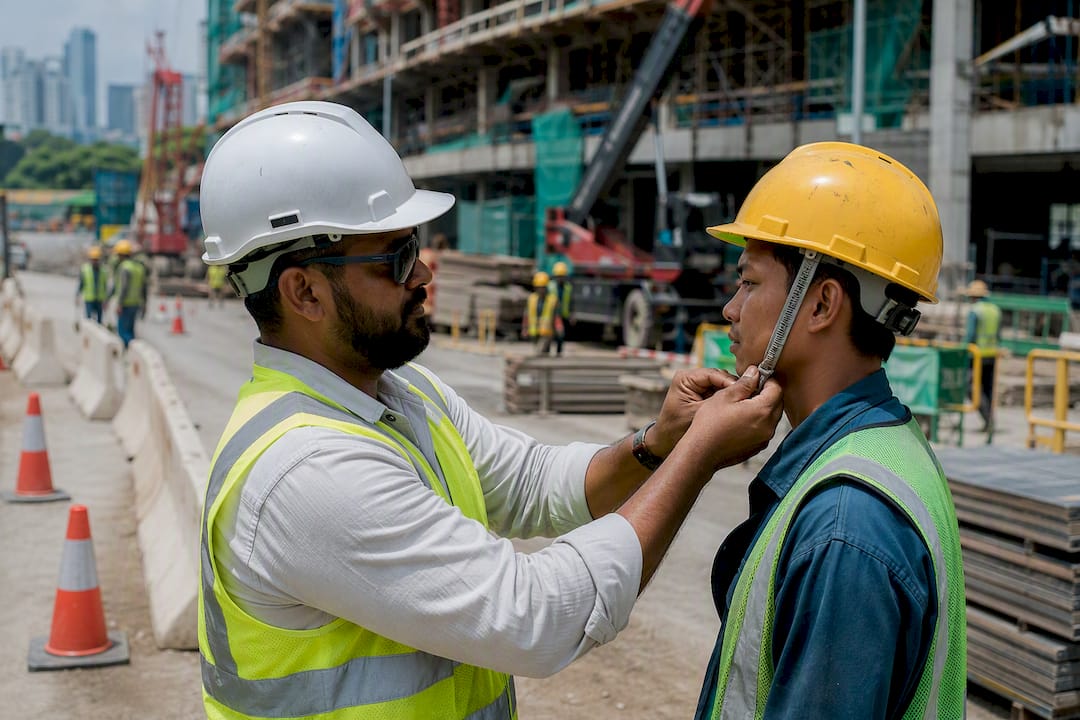
The job is less about paperwork and more about being the person on-site who notices problems before they become incidents. A typical day includes hazard identification walks, formal site inspections, toolbox talks before shifts start, permit-to-work checks, and confirming PPE compliance across trades.
You’ll usually report into a WSH Coordinator or, on larger contract sums, a registered WSHO, who carries broader statutory responsibility for the site’s safety management system. The difference between WSHO and WSHC roles matters here: a WSHC handles daily activities, while a WSHO holds formal registration and answers directly to MOM on larger or higher-risk projects.
Documentation employers expect to see includes:
- Completed daily or weekly inspection checklists with dated signatures.
- Incident and near-miss reports written in the format your site safety plan specifies.
- Toolbox talk attendance sheets showing topics covered and workers present.
Pro Tip: Bring two or three redacted sample documents to your interview. A real inspection checklist tells an employer more about your competence than any answer you can give verbally.
The most common red flag on an application is a candidate who lists “site safety experience” with no certificates or documentation to back it up. Fix this by naming specific projects, dates, and the type of site (residential, industrial, MRT) you worked on.
How Much Do Site Safety Supervisors Earn in Singapore?
Pay for construction supervisors in Singapore varies sharply by sector, project risk, and how many credentials you stack on top of BCSS. One salary aggregator estimates the average construction supervisor earns around SGD 6,830 per month, though entry-level pay sits well below that figure and specialized senior roles run considerably higher.
Sector matters more than tenure in this field. Supervisors working on MRT extensions, petrochemical plants, or other high-risk industrial sites tend to command a premium over general building work, simply because the hazard profile and regulatory scrutiny are heavier.
To move up the pay scale faster than seniority alone would get you:
- Add a NEBOSH International General Certificate or an ISO 45001 internal auditor qualification alongside your BCSS. Our safety certifications guide breaks down which credentials employers value most for progression.
- Document specific audit outcomes and inspection volumes rather than just years of service when negotiating a raise.
- Consider the safety manager career path once you have several years of supervisor-level experience, since that role typically commands a meaningfully higher ceiling.
Employers respond better to evidence of documented outcomes than to a request based on tenure alone.
How Do You Apply for a Site Safety Supervisor Role or WSHO Registration?
If your career goal includes eventual WSHO registration rather than staying at supervisor level, MOM’s process is specific and worth planning around well ahead of time.
- Confirm you meet the eligibility criteria on the WSHO registration page, including work pass status, accepted qualifications, and around two years of relevant experience.
- Gather required documents: qualification certificates, employer testimonials, and identification records.
- Submit your application with the non-refundable $110 fee.
- Expect processing to take up to 30 working days, so apply well before any expected start date.
For the supervisor job hunt itself, your checklist looks simpler:
- Current BCSS certificate and, if applicable, an up-to-date WSH Coordinator refresher.
- A written employer testimonial confirming your on-site duties.
- Scanned certificates ready to attach, not just listed by name.
Verify any training provider’s accreditation directly against the SkillsFuture course directory before enrolling. Not every course marketed as “BCSS equivalent” actually carries WSQ recognition.
How MOSAIC Ecoconstruction Solutions Supports Candidates and Employers
Meeting Singapore’s WSH expectations gets easier with the right support behind you, whether you’re the one job hunting or the contractor doing the hiring. Com works with both sides of that equation through a set of services built directly around MOM’s requirements.
- Training and BCSS-aligned preparation support for candidates working toward supervisor or coordinator roles.
- Audit and readiness assessments that help employers confirm their site documentation would hold up under MOM scrutiny.
- BizSAFE and ISO certification guidance for firms building out their safety management systems.
- Manpower outsourcing for contractors who need qualified safety staff on short notice without running a full hiring cycle themselves.
For employers, that combination usually shortens time-to-hire and reduces the risk of onboarding a supervisor whose paperwork doesn’t match what an inspector expects to see on-site.
| Point | Details |
|---|---|
| Live job volume | Thousands of listings on JobStreet and 500+ on Indeed show consistent hiring demand for this role. |
| Core credential | BCSS (“Supervise Construction Work for WSH”) is the baseline certificate nearly every employer screens for. |
| Registration path | WSHO registration costs $110 and takes up to 30 working days to process through MOM. |
| Employer support | Com helps both candidates and contractors align with BCSS, BizSAFE, and ISO 45001 requirements. |
Understanding the Workplace Safety and Health Act’s Role in Singapore Construction
Singapore’s Workplace Safety and Health Act sits above every certification and job description in this field. It places a statutory duty of care on employers, occupiers, and workers alike, and it’s the reason MOM expects supervisors to hold verified training rather than informal on-the-job experience.
For a site safety supervisor specifically, the Act translates into concrete obligations: you must be able to identify hazards, stop unsafe work, and maintain records that would survive an MOM audit. The Act doesn’t just apply to major incidents. It covers near misses, unsafe machinery use, and lapses in permit-to-work procedures, which is why documentation habits matter as much as technical knowledge.
Penalties under the Act extend to individuals, not only companies, which is part of why contractors are so particular about verified BCSS records and current refresher certificates during hiring. A supervisor who can’t produce documentation isn’t just a weak candidate; they represent a compliance liability for whoever hires them.
Our guide to navigating the WSH Act with an expert breaks down the inspection records and documentation obligations that flow from this legislation in more detail, which is worth reviewing before your first day on a new site rather than after an incident forces the issue.
What Hazards Do Singapore Construction Sites Present, and How Do Supervisors Handle Them?
Singapore’s construction sector combines dense urban sites, tight schedules, and a large multinational workforce, which creates a specific mix of hazards that differ from lower-density markets.
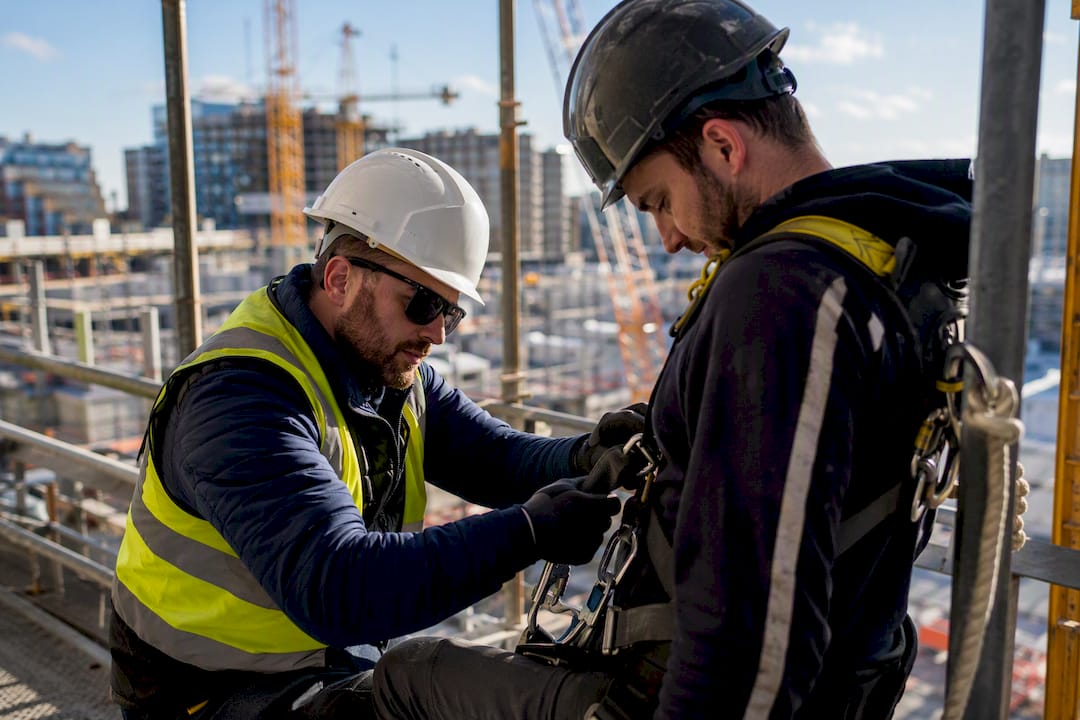
Working-at-height incidents remain among the most persistent risks on vertical developments, particularly during facade and scaffolding work where multiple trades operate simultaneously. Supervisors address this through daily permit checks and visible enforcement of fall-arrest systems rather than relying on posted signage alone.
Heat stress is a distinctly local hazard given Singapore’s year-round humidity and temperature. Supervisors build hydration breaks and shaded rest areas into the schedule, and they watch for early symptoms among workers doing sustained physical labor in direct sun.
Language and communication gaps across a diverse migrant workforce complicate toolbox talks and safety briefings. Effective supervisors use visual aids, translated safety signage, and repeated verbal confirmation rather than assuming a single briefing in English covers the crew.
Confined space work, common in MRT and utility tunneling projects, demands strict permit-to-work discipline and atmospheric testing before entry. Supervisors on these projects typically hold additional confined-space certifications on top of BCSS.
Digital tools are increasingly part of the response to these hazards. Construction safety technology like digital checklists and wearable alerts is helping supervisors catch hazards faster than paper-based systems allowed, though the fundamentals of inspection discipline haven’t changed.
Which Safety Standards and Codes Should Supervisors Know?
Beyond the WSH Act itself, a handful of codes and standards shape what “good practice” looks like on a Singapore construction site, and employers expect supervisors to at least recognize them even if they aren’t the one implementing them directly.
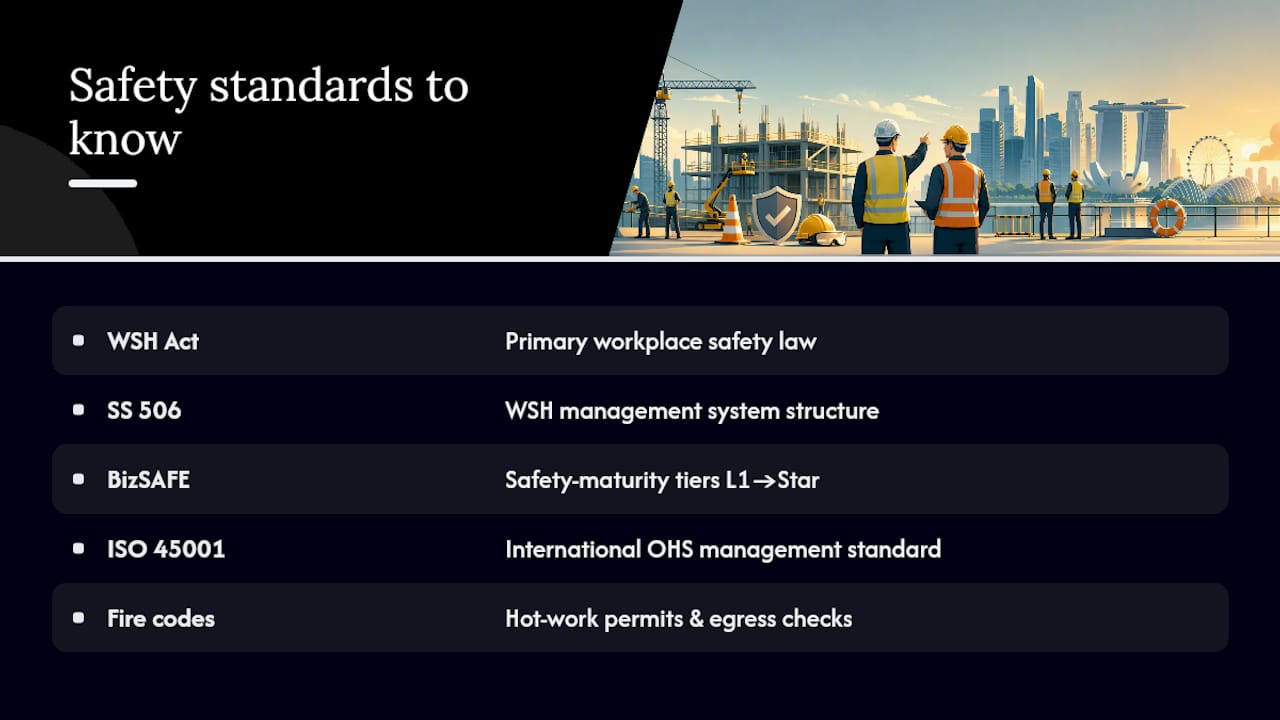
SS 506: Code of Practice for WSH Management System sets out the structure for how a site’s overall safety management system should be built, covering hazard identification, risk assessment, and management review cycles. Supervisors don’t usually write the management system, but their daily inspections feed directly into it.
BizSAFE, MOM’s own certification framework, ranks companies by safety management maturity from Level 1 through Level Star. A supervisor working for a BizSAFE Star contractor should expect tighter documentation standards and more frequent internal audits than at a lower-tier firm, since Star certification requires a certified ISO 45001 system.
ISO 45001, the international occupational health and safety management standard, is increasingly common among Tier 1 contractors and is often a tender requirement for public infrastructure work. Supervisors on ISO 45001-certified sites will notice more structured audit trails and formal non-conformance reporting compared to smaller uncertified firms.
Fire safety codes also intersect with a supervisor’s daily duties, particularly around hot works permits and means-of-egress checks. External guidance like this fire safety guide for contractors covers documentation expectations that overlap closely with what a site safety supervisor already tracks under WSH inspection routines.
Can Foreign Workers Apply for Site Safety Supervisor Roles in Singapore?
Work pass status shapes eligibility for this role more than most candidates realize, and it’s worth checking before investing time in BCSS training if your pass situation is uncertain.
Employment Pass and S Pass holders can generally take up site safety supervisor roles, provided the hiring employer sponsors the appropriate pass category and the role meets the relevant salary and qualification thresholds MOM sets for each pass type. WSHO registration specifically has its own eligibility criteria tied to work pass status, listed directly on the MOM registration page, so confirm your pass qualifies before applying for registration rather than after paying the fee.
Work Permit holders in the construction sector typically fill trade and general labor roles rather than supervisory safety positions, since supervisor roles usually require the higher qualification and salary bar tied to EP or S Pass categories.
If you’re relocating to Singapore specifically for this career path, sequence your paperwork carefully: secure the work pass sponsorship first, then complete BCSS locally once you’re eligible to work, since some course providers restrict enrollment to holders of a valid pass or citizenship status. Employers hiring foreign candidates for safety roles also weigh whether your home-country safety qualifications translate cleanly to Singapore’s WSH framework, so a locally recognized BCSS certificate carries more weight in an application than an equivalent overseas credential.
What Do Employers Ask in Site Safety Supervisor Interviews?
Interview panels for this role tend to test practical judgment over textbook knowledge, since the job is fundamentally about catching problems in real time.
Expect scenario-based questions like “a worker refuses to wear fall protection on a scaffold, what do you do?” or “you find an expired lifting certificate on a crane mid-shift, walk me through your next steps.” Panels are listening for whether you escalate appropriately and stop unsafe work without hesitation, not for a scripted textbook answer.
You’ll also likely be asked to describe a specific incident you handled: how you identified it, who you reported it to, and what documentation you produced afterward. Vague answers here are the fastest way to lose credibility, so prepare two or three concrete examples with dates and outcomes before you walk in.
Technical questions typically cover permit-to-work systems, PPE standards for specific trades, and your familiarity with SS 506 or BizSAFE requirements at the employer’s certification level. Panels also probe communication skills directly, sometimes asking you to explain a safety concept as if briefing a multilingual crew, since that reflects a real daily task rather than a theoretical one.
Finally, expect a direct check on your paperwork: current BCSS certificate, refresher status if you hold a WSHC appointment, and any additional qualifications like NEBOSH or ISO 45001 auditor training. Bring physical or digital copies rather than promising to send them later.
Why the Standard Job-Hunting Advice Falls Short Here
Most career guides treat safety roles like generic office jobs: polish the CV, apply widely, wait for callbacks. That approach underperforms badly in this field because employers are screening for verified paperwork before they ever assess personality or communication skills. The candidates who get hired fastest aren’t necessarily the most experienced; they’re the ones whose BCSS, refresher certificates, and documented incident history are already organized and ready to hand over.
The bigger gap I see in typical advice is the assumption that a single certificate settles the matter. It doesn’t. Sector specialization and a stacked credential set, BCSS plus something like NEBOSH or ISO 45001 auditor training, move pay and job security far more than tenure alone ever will.
If you take one thing from this, prioritize documentation discipline over almost everything else. A supervisor with three well-documented incident reports and a current refresher certificate will out-compete someone with twice the years but a messy paper trail, every time.
— Aman
Get Support Meeting Singapore’s Site Safety Requirements
Com is the practical alternative to piecing together certifications and compliance paperwork on your own. For candidates building toward supervisor or coordinator roles, and for employers who need site documentation that survives an MOM audit without a drawn-out hiring cycle, Com provides direct support across training alignment, audit readiness, and certification pathways rather than leaving you to interpret WSH requirements alone.

Whether you’re a jobseeker confirming your BCSS is enough or a contractor preparing for BizSAFE Star certification, our environmental compliance guide for Singapore construction projects outlines exactly where consultancy support fits into your timeline. If certification is the immediate goal, review our BizSAFE Star certification support page and reach out for a assessment of where your current documentation stands against MOM’s expectations.
Sources
- Safety Supervisor Jobs in Singapore (with Salaries) – Jobstreet
- 500+ Safety Supervisor Jobs, Employment August 22, 2026
- Supervise Construction Work for WSH (BCSS) — SkillsFuture / GoBusiness course directory
- Apply to be a registered workplace safety and health officer – MOM