Introduction
Mitigating hallucinations in compliance LLMs demands structured verification frameworks purpose-built for the precision ISO lead auditors require when conducting quality, environmental, and safety assessments. As large language models become embedded in audit workflows-drafting nonconformity reports, mapping corrective actions, cross-referencing regulatory clauses-the risk of factually incorrect outputs reaching certification documents has escalated from theoretical concern to operational threat. Hallucination rates in LLMs range from 15% to 52%, and in legal queries specifically, hallucination rates can reach 88%. For ISO lead auditors, even a single erroneous AI output can trigger significant compliance incidents, failed audits, and lost trust.
This article covers LLM verification frameworks applicable to ISO 9001, 14001, and 45001 auditing processes, focusing on retrieval augmented generation, multi-stage validation pipelines, confidence scoring, and audit trail documentation. It excludes general AI safety measures unrelated to compliance documentation and does not address consumer-facing AI applications. The target audience is ISO lead auditors, compliance managers, and QES consultants who manage AI-assisted audit documentation and evidence verification in regulated industries.
ISO lead auditors can address hallucinations in compliance language models by applying structured verification frameworks aligned with standards like ISO/IEC 42001. These frameworks combine retrieval augmented generation (RAG) with multi-stage validation pipelines and comprehensive audit trail documentation to ensure that every factual claim in an audit deliverable traces back to an authoritative source.
After reading this article, you will gain:
-
A precise understanding of hallucination risk categories specific to ISO audit contexts
-
Practical knowledge for implementing RAG-based verification systems grounded in compliance standards
-
Methods for establishing confidence scoring thresholds for compliance decisions
-
Blueprints for building audit-ready documentation trails that satisfy certification body requirements
-
Frameworks for creating human-in-the-loop validation workflows for critical findings
Understanding LLM Hallucinations in ISO Compliance Contexts
Hallucinations occur when language models generate plausible but unsupported or factually incorrect content-presenting fabricated information with the same confidence as verified facts. Large language models are powerful in audit workflows, but their reliability must be tightly controlled because an ai hallucination can undermine evidence quality and trust in the final report. In ISO compliance contexts, this article focuses on compliance LLMs used in audit workflows, not a general-purpose AI assistant, because auditors produce reports that certification bodies, regulators, and clients treat as authoritative documented evidence. Hallucinations can lead to financial losses exceeding $250M annually across industries, and legal settlements from incorrect citations alone can reach $47M.
For ISO lead auditors managing integrated management systems across ISO 45001, ISO 14001, and ISO 9001, the stakes are especially pronounced. Every nonconformity report, corrective action recommendation, and compliance assessment must withstand scrutiny from external certification bodies and regulatory authorities. That is why verification layers and source-grounded review steps are necessary to reduce hallucinations before outputs are used in formal documentation.
Compliance-Specific Hallucination Risks
Three distinct categories of hallucination present significant risks in ISO audit documentation:
Factual hallucinations are an AI hallucination in which models generate incorrect information-for instance, citing ISO 9001 clause “8.5.3” when the relevant evidence pertains to clause “8.5.1,” or fabricating audit findings that describe nonconformities unsupported by any collected evidence. These are particularly dangerous because they can look like the correct answer in a formal audit report while remaining unsupported or false.
Contextual hallucinations ignore provided information or conversation history. A model encounters queries about environmental monitoring under ISO 14001 but generates responses drawing from occupational health requirements under ISO 45001, conflating standards in ways that produce misleading corrective action recommendations.
Reasoning hallucinations involve logical inconsistencies or invalid inferences-such as inventing corrective action timelines that conflict with actual organizational procedures or proposing mitigation measures that violate local regulatory requirements like Singapore’s Workplace Safety and Health Act.
These errors directly undermine certification credibility. Nonconformity reports become invalid or unwarranted, corrective action plans misalign with actual conditions, and certification bodies may reject entire audit reports. AI hallucinations can also lead to a 22% drop in customer satisfaction, and fines for AI-generated errors can reach $110,000 per incident. Regulatory compliance errors can multiply costs significantly when they cascade through integrated management systems. Verification frameworks are designed to reduce hallucinations in high-stakes compliance use cases.
Verification Framework Components
A verification framework is a systematic approach that validates LLM outputs against authoritative sources before those outputs enter audit deliverables. It encompasses managed processes, tools, architecture, and controls-not merely a single technique. No single technique eliminates hallucinations entirely; rather, layered defenses are required.
These frameworks align directly with existing ISO documentation requirements and audit trail standards. ISO 19011:2018 already mandates traceable evidence, versioned records, and reviewer accountability. Compliance frameworks demand strict traceability for outputs in regulatory environments, and a verification framework extends these same principles to AI-assisted processes-requiring source attribution for every generated statement, version-controlled standard references, timestamped reviewer signoffs, and exportable evidence logs.
Model-Agnostic Verification Frameworks quantify hallucination risk by measuring semantic alignment between generated text and authoritative sources. This approach works regardless of which underlying model generates the output, making it adaptable as ai systems evolve and organizations adopt new tools.
The implementation dimensions span knowledge base design, retrieval strategy, output evaluation, confidence metrics, human oversight protocols, audit trail architecture, the use of multiple models to compare agreement and uncertainty, and integration with existing QMS/EHS procedures. With these foundations established, the next critical step is grounding LLM outputs in verified compliance documentation through retrieval augmented generation.
RAG-Based Grounding for ISO Compliance Documentation
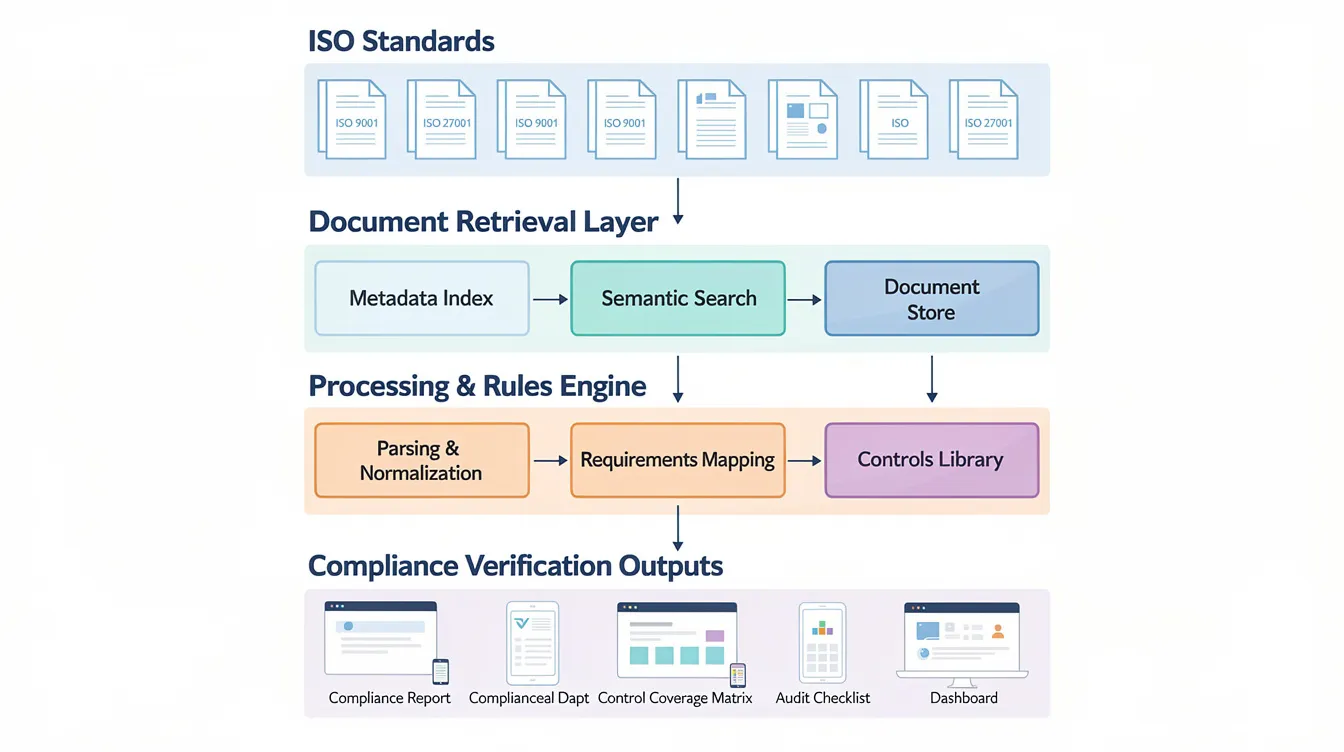
Building on the verification framework components, retrieval augmented generation serves as the primary grounding mechanism that prevents compliance LLMs from relying solely on parametric knowledge-the statistical patterns and training data patterns absorbed during pre-training that may be outdated, incomplete, or simply wrong for knowledge intensive tasks. RAG systems retrieve relevant documents to ground AI responses in authoritative, current sources rather than generating answers from the model’s internal weights alone. Retrieval-augmented generation can reduce hallucination rates by 50%, making it the most impactful single intervention available.
ISO Standard Knowledge Base Construction
The foundation of any compliance-grade RAG system is a curated knowledge base containing the full text of relevant ISO standards-ISO 9001:2015, ISO 14001:2015, ISO 45001:2018-along with guidance documents, approved interpretation sources, and applicable local regulations. The Five-Layer Grounded Defense Pipeline restricts the model’s working memory to pre-vetted regulatory texts, ensuring that outputs cannot draw from unverified sources.
Construction of this knowledge base requires careful structuring: documents chunked by clause with metadata capturing jurisdiction, publication date, standard version, and amendment status. Internal policies and organization-specific procedures must be cross-linked to their corresponding ISO requirements. For Singapore-based operations, this means integrating the WSH Act provisions, NEA environmental regulations, and Enterprise Singapore guidance alongside international standards.
Version control is non-negotiable. When a standard is revised or amended, the knowledge base must reflect this promptly, with deprecated clauses clearly marked. Auditors must evaluate whether compliance models operate on verified legal or regulatory data-a requirement that becomes critical as standards evolve. Systems like ComplianceAI demonstrate this approach using local LLM inference combined with vector stores and versioned knowledge bases, protecting both intellectual property and data currency.
Compliance-Specific Retrieval Strategies
Effective retrieval for ISO compliance requires more than basic semantic search. Hybrid retrieval architectures that combine exact clause-number matching with semantic embedding search consistently outperform either approach alone. Hybrid RAG architectures achieve 35-60% error reduction compared to single-method retrieval.
The retrieval hierarchy must reflect compliance authority: official standard text takes precedence over internal procedures, which take precedence over third-party guidance. Query expansion techniques adapted for ISO terminology ensure that when an auditor asks about “emergency preparedness under ISO 45001,” the system retrieves not only clause 8.2 but also related requirements from clauses 6.1.2.1 (hazard identification) and 10.2 (incident investigation) that provide essential context.
Research using the RAGAS framework for compliance auditing compared retrieval paradigms and found that knowledge graph-based traversal yielded the highest faithfulness scores (0.570) compared to rule-based (0.524) and vector embedding approaches (0.509). However, context recall remained low across all methods (≤22.4%), highlighting that retrieval optimization must focus on completeness-not just the accuracy of retrieved documents but whether all relevant retrieved context has been captured.
Citation and Traceability Requirements
ISO lead auditors must ensure every compliance recommendation contains verifiable pointers to official regulatory text. This means every model’s output-whether a drafted nonconformity, a corrective action recommendation, or a gap analysis finding-must link to a specific clause, quoting the exact document title, clause number, version, and date.
Ground outputs in approved sources and log all decisions and blocking actions for accountability in compliance frameworks. The infrastructure must store evidence spans: the exact retrieved passage used, the model prompt version, the model version, and the timestamp of retrieval. Compliance-grade RAG systems emphasize that consumer-grade retrieval augmented generation fails under audit scrutiny; compliance applications require verbatim quotes, versioned standard clause references, and traceable evidence spans rather than mere hyperlinks.
These citation requirements create a natural bridge to confidence scoring mechanisms-because even with authoritative sources retrieved, the system must quantify how reliably the generated output actually reflects those sources.
Multi-Stage Verification Pipeline Implementation
With RAG providing the grounding layer, a multi-stage verification pipeline adds successive validation checkpoints that catch ai generated errors before they reach audit deliverables. This pipeline architecture mirrors the defense-in-depth principle familiar to ISO lead auditors from safety management-multiple independent barriers, each capable of catching failures the previous layer missed.
Confidence Scoring for Compliance Decisions
Confidence Threshold Calibration ensures models suppress low-confidence compliance interpretations instead of generating plausible-sounding fabrications. When the model encounters queries where retrieved context is sparse or ambiguous, the system must flag explicit uncertainty rather than producing authoritative-sounding but unreliable content.
Implementation involves several complementary techniques:
-
Token probability analysis examines the internal signals-specifically, the probabilities the LLM assigns to generated tokens when producing clause references and compliance statements. Low token probabilities on critical terms (standard numbers, clause identifiers, regulatory requirements) indicate potential hallucination.
-
Semantic consistency checking runs the same compliance query through multiple responses or multiple model runs, comparing outputs for agreement. Divergence across runs signals unstable knowledge gaps where hallucinations are likely.
-
Threshold setting establishes empirically-calibrated boundaries for high-stakes compliance determinations. Production systems like the RAG compliance audit system implement human-in-the-loop escalation when confidence falls below 85%, routing low-confidence outputs to qualified reviewers rather than allowing automatic correction into audit documents.
-
Risk scoring integration adjusts thresholds based on consequence severity. A clause reference error in a low risk internal document review warrants different treatment than a factually incorrect nonconformity finding in a high risk safety audit for construction compliance.
Prompt engineering techniques improve response accuracy by 15-82%, and utilizing structured prompts with explicit constraints can mitigate hallucination effects in compliance language models. System instructions that enforce output formatting-requiring clause numbers, evidence references, and confidence indicators-create structural barriers against free form text hallucinations.
Cross-Validation Framework Comparison
Different verification approaches suit different ISO audit scenarios. The following comparison helps auditors select the appropriate verification level based on compliance risk assessment:
|
Verification Method |
Accuracy Rate |
Implementation Complexity |
ISO Audit Suitability |
|---|---|---|---|
|
Single LLM + RAG |
85–90% |
Low |
Basic compliance checks, SOP verification |
|
Dual LLM Cross-validation |
92–95% |
Medium |
Nonconformity assessment, management reviews |
|
Multi-agent Verification |
96–98% |
High |
Critical audit findings, regulatory reporting |
Multi-agent validation systems demonstrate 92% detection rates for hallucinated content. In the medical systems domain, the “Trust but Verify” multi-agent framework deployed five ai agents in specialized roles-some proposing findings, others verifying them-and reduced hallucination error rates by approximately 53%. While developed for medical information contexts, the architecture translates directly to ISO compliance: separate autonomous agents for finding generation, clause verification, evidence validation, cross-standard consistency, and final quality review.
A five-gate verification framework can improve compliance-related language model outputs by ensuring authority, traceability, applicability, independent verification, and recordability. The CAAB benchmark (Compliance–Audit Authority Benchmark) establishes six criteria for AI audit authority: Traceability, Explainability, Evidence Integrity, Adaptability, Action Governance, and Reasoning-providing a structured lens for evaluating verification pipeline effectiveness.
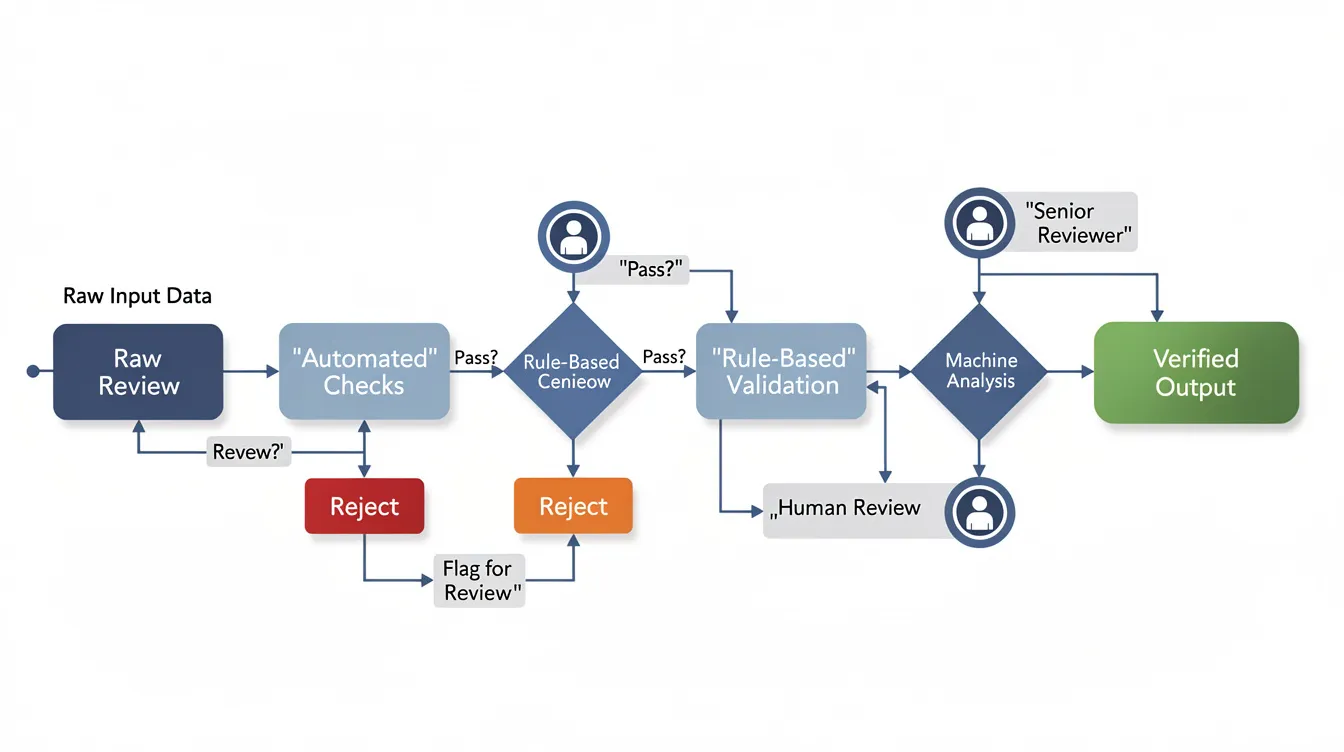
Empirical evidence supports this layered approach. In the ISO/IEC 27002 gap-analysis study conducted at Chalmers University, RAG improved clause-prediction accuracy from approximately 43% (baseline raw accuracy) to 79.6% for GPT-5.1. Mitigation quality in RAG outputs won approximately 80.7% in pairwise comparisons against baseline outputs, confirming that grounded generation with verification layers produces substantially more reliable compliance content.
Auditors should construct adversarial compliance questions to test models against hallucinations-deliberately probing edge cases, superseded clauses, and cross-standard conflicts to calibrate system performance before deployment.
Common Challenges in ISO Compliance LLM Implementation
Even well-designed verification pipelines face persistent challenges specific to regulated ISO audit environments. Addressing these proactively prevents the gradual erosion of system reliability that can turn ai tools from assets into liabilities.
Regulatory Standard Evolution and Knowledge Currency
Systematic surveillance is needed because language models experience drift and behavioral shifts over time. ISO standards undergo periodic review, and the underlying data in a knowledge base can become stale without active maintenance. When a standard is revised, any compliance LLM still referencing obsolete clauses produces outputs that are not merely inaccurate-they are actively misleading.
Automated monitoring systems should track ISO publication announcements, local adoption timelines (through Enterprise Singapore and the Singapore Accreditation Council), and regulatory amendments. Version control protocols must ensure that when an updated standard enters the knowledge base, the previous version is archived but flagged-not deleted-so that historical audit references remain valid while new assessments use current requirements.
The ISO 42001 standard, published in December 2023, addresses AI management and requires documented AI management systems. The EU AI Act mandates compliance by August 2026 for high-risk systems-directly relevant to generative ai systems used in compliance workflows. Taiwan’s AI Basic Act emphasizes transparency requirements for AI use, and the FCA Consumer Duty requires firms to demonstrate fairness in AI decisions. These converging regulatory frameworks expect documented evidence of AI-assisted decisions, creating additional currency requirements for any compliance LLM deployment.
Continuous monitoring and re-testing are necessary to catch model drift and performance degradation as regulatory standards shift. Organizations should establish quarterly review cycles at minimum, with event-triggered updates whenever standards bodies publish amendments.
Multi-Standard Cross-References and Conflicts
Organizations implementing integrated management systems combining ISO 14001 and ISO 45001 frequently encounter scenarios where requirements overlap or conflict. A compliance LLM must navigate these intersections without generating recommendations that satisfy one standard while violating another.
Resolution frameworks require establishing hierarchy for standard precedence in compliance decisions. Safety requirements under ISO 45001 typically take precedence when imminent risk to human life exists. Environmental obligations under ISO 14001 may take precedence in scenarios involving ecological damage. Domain specific validation rules encoded in the verification pipeline can flag outputs that reference multiple standards and route them for additional cross-standard consistency checking.
Internal policies and local laws may override certain ISO standard provisions-Singapore’s Workplace Safety and Health Act, for instance, imposes specific requirements that complement but sometimes exceed ISO 45001 provisions. The knowledge base must capture these relationships through explicit hierarchy mappings, not rely on the LLM to infer precedence from training data.
Audit Trail and Documentation Compliance
Structured Audit Trails make hallucinated reasoning traceable during non-conformity investigations. Every interaction with the compliance LLM must generate comprehensive logs: input queries, retrieved documents with version identifiers, model version, confidence scores, human reviewer identity and comments, and timestamps.
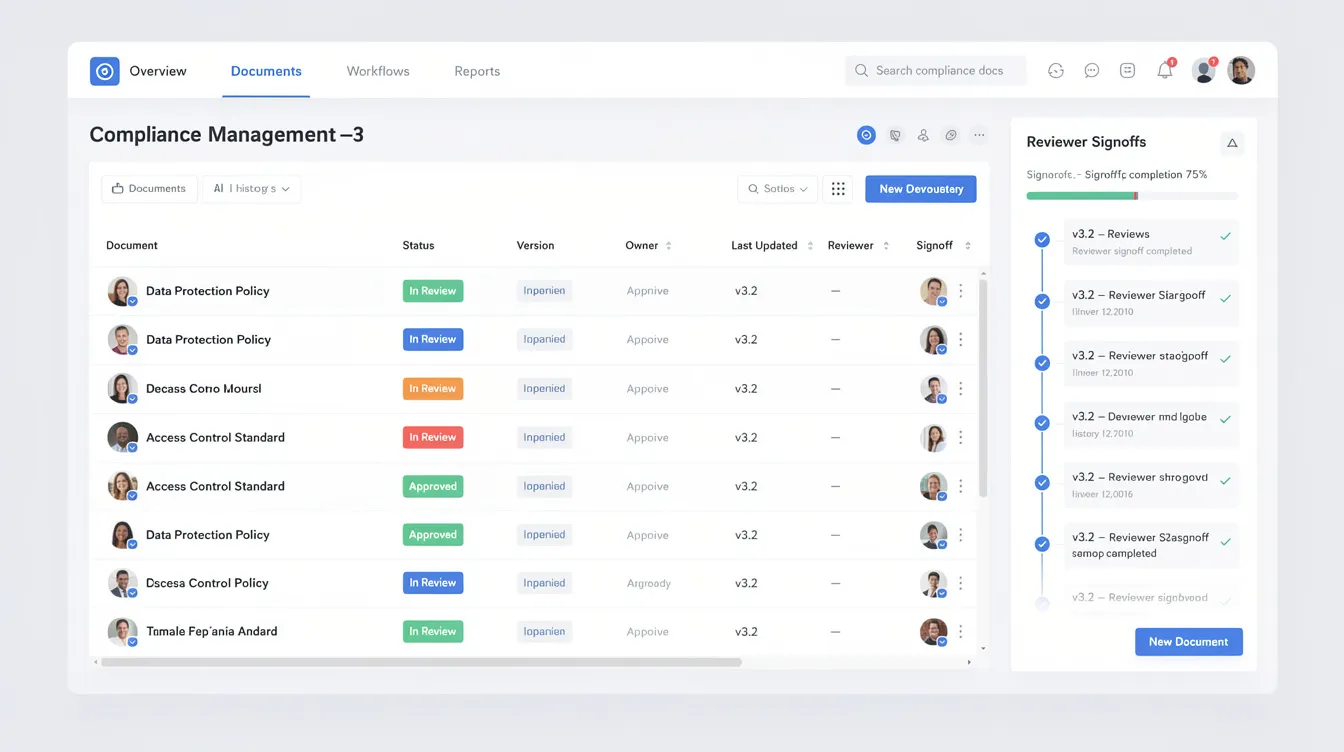
Systems like Complyra incorporate full audit logging, human approval gates, and role-based access control to enforce who can approve ai outputs before they enter formal audit documentation, with approvals and escalations routed to the compliance team rather than generic approvers. Upon detecting hallucinations, organizations should systematically log findings for retraining and prompt engineering fixes-creating a feedback loop that continuously improves system performance.
Regulatory frameworks increasingly require this level of documentation. The EU AI Act mandates event logging (Article 12) and human oversight (Article 14) for high-risk AI systems. For organizations managing AI-assisted audit processes, these requirements are not optional enhancements-they are regulatory obligations that must be built into system architecture from the outset, with flagged-output review workflows, response SLAs, and final decision accountability owned by the compliance team under human oversight.
Managing sensitive data privacy adds another layer of complexity. Client documents and source documents used for grounding must be handled under strict confidentiality protocols. Running models on local or private cloud infrastructure-rather than sending client data to external API endpoints-reduces exposure risk while maintaining the pattern recognition capabilities that make AI-assisted auditing valuable.
Conclusion and Next Steps
Verification frameworks are essential for maintaining ISO compliance integrity when using large language models in audit processes. No single technique eliminates hallucinations entirely, but layered defenses-combining retrieval augmented generation with multi-stage validation, confidence scoring, and human-in-the-loop checkpoints-dramatically reduce hallucination rates and create the traceability that certification bodies require. Human review remains essential: human review reduces AI-related incidents by 32% in compliance contexts, and human reviewers assess subtle logical inconsistencies in ai generated content that automated systems miss.
To begin implementing these frameworks, ISO lead auditors and compliance managers should take these immediate steps:
-
Assess current LLM usage in compliance workflows and establish a hallucination baseline by testing against adversarial compliance questions-measuring where models generate plausible but unsupported outputs
-
Implement RAG-based grounding by constructing a versioned knowledge base of all relevant ISO standards, local regulatory statutes, and internal company policies
-
Establish confidence thresholds for audit decisions, routing outputs below empirically-determined thresholds (e.g., 85–90% confidence) to mandatory human review
-
Design human validation protocols with defined reviewer roles, escalation criteria for critical findings, and preparation procedures aligned with safety audit best practices
-
Build comprehensive audit trails logging every interaction-source documents, model versions, retrieval evidence, reviewer decisions, and timestamps
For organizations exploring advanced implementations, related topics worth investigating include multi agent systems for adversarial verification, industry-specific fine-tuning for construction and environmental compliance, and integration with existing QMS documentation platforms. As ai governance standards like ISO 42001 mature, the frameworks described here will become not just best practice but regulatory expectation.
Additional Resources
-
ISO 19011:2018 – Guidelines for auditing management systems, providing the foundation for extending audit evidence requirements to AI-assisted verification processes
-
ISO/IEC 42001:2023 – The first international standard for AI management systems, establishing requirements for managing AI risks including hallucination mitigation in organizational contexts
-
CAAB (Compliance–Audit Authority Benchmark) – Six-criterion evaluation framework for assessing whether AI systems meet audit authority standards: Traceability, Explainability, Evidence Integrity, Adaptability, Action Governance, and Reasoning
-
Template verification protocols – Auditors should develop standardized testing procedures including adversarial query sets, cross-standard conflict scenarios, and version currency checks before deploying compliance LLMs in production
-
MOSAIC’s ISO certification consulting services – Supporting organizations in implementing AI-enhanced compliance workflows within robust quality, environmental, and safety management systems