To qualify for bizSAFE Level 2, appoint a Risk Management (RM) Champion who completes an accepted Workforce Skills Qualifications (WSQ) course, then submit your enterprise application with that Statement of Attainment (SOA) to the Workplace Safety and Health (WSH) Council. The certificate arrives within roughly 10 working days and stays valid for six months, non-renewable. Here is the exact sequence:
- Train: Send your RM Champion through Develop a Risk Management Implementation Plan (MF-COM-402E-1) or Workplace Safety and Health Control Measures (WPH-WSH-4075-1.1), or use an accepted legacy qualification.
- Appoint: Confirm the RM Champion has real supervisory or management authority, not just a training certificate.
- Submit: File the enterprise application through the WSH Council’s bizSAFE portal with the SOA attached. There is no application fee.
- Track: Expect approval in about 10 working days, barring verification issues.
- Plan ahead: Treat the six-month window as a runway toward bizSAFE Level 3, since Level 2 cannot be renewed.
Key Takeaways
Meeting bizSAFE Level 2 requirements comes down to appointing an RM Champion with real authority, submitting complete documentation, and using the non-renewable six-month window to prepare for Level 3.
| Point | Details |
|---|---|
| Train the right person | Choose an RM Champion with supervisory authority, not just the fastest available employee. |
| Submit a clean application | Attach the SOA, confirm company registration, and expect about 10 working days for approval. |
| Six months, no renewal | Level 2 expires after six months and cannot be renewed, so start Level 3 prep immediately. |
| Document continuously | Auditors verify dated evidence like meeting minutes and photos, not last-minute paperwork. |
| Get expert support | MOSAIC provides training guidance, RM documentation templates, and mock audits for Level 2 to Level 3 readiness. |
Table of Contents
- What Are the bizSAFE Level 2 Requirements for Eligibility and Training?
- How Do You Submit the bizSAFE Application and Required Documents?
- Why Is the bizSAFE Level 2 Certificate Only Valid for Six Months?
- How Do You Prepare for bizSAFE Level 3 During the Six-Month Window?
- What Should the RM Champion Actually Deliver Day to Day?
- What Do bizSAFE Level 2 Courses Cost and How Long Do They Take?
- How MOSAIC Helps Construction Companies Meet bizSAFE Level 2 Requirements
- What Safety Officers Consistently Get Wrong About Level 2
- Get Help Meeting bizSAFE Level 2 Requirements and Preparing for Level 3
- Sources
What Are the bizSAFE Level 2 Requirements for Eligibility and Training?
Your company must be registered in Singapore. Beyond that, the entire Level 2 requirement hinges on one person: the RM Champion.
The WSH Council accepts a defined list of routes to satisfy this. Your RM Champion needs one of the following:
- The WSQ course Develop a Risk Management Implementation Plan (course code MF-COM-402E-1)
- The WSQ course Workplace Safety and Health Control Measures (WPH-WSH-4075-1.1)
- A recognized legacy risk management certificate issued under an earlier bizSAFE course structure
- A relevant specialist diploma or university degree in occupational safety, safety engineering, or a related field, as listed by the WSH Council
- A current MOM-registered WSH Officer license
Course selection matters less than most safety officers assume. What matters more is who you nominate. A junior admin staffer with a fresh SOA technically satisfies the paperwork requirement, but an RM Champion with no standing on-site cannot enforce a risk management plan, chase corrective actions, or brief workers credibly during an audit. Nominate someone who already carries operational weight, ideally a site supervisor, safety coordinator, or department manager who can act on findings without waiting for permission.
Pro Tip: If your organization runs multiple sites, consider training a backup RM Champion at the same time. The Level 2 validity period continues to run without pause even if your primary champion leaves the company mid-application.
How Do You Submit the bizSAFE Application and Required Documents?
The application itself is straightforward, but small gaps in documentation are the most common reason companies get delayed at this stage.
- Confirm company registration. Your Unique Entity Number (UEN) must match an active Singapore-registered entity.
- Gather the RM Champion’s SOA. This is the single non-negotiable attachment; without it, the application cannot proceed.
- Nominate a contact person. This should ideally be the RM Champion or someone empowered to answer follow-up questions from the Council.
- Submit through the WSH Council’s bizSAFE application page. Applying carries no cost.
- Wait for the e-Certificate. Once approved, it appears in your company’s bizSAFE account for download and display.
Processing typically takes about 10 working days, though that estimate assumes clean records on the first pass. Applications that stall usually do so because of mismatched company details, an SOA under a different legal entity name, or an incomplete contact record.
Auxiliary Enforcement Officers (AEOs) occasionally run sample verification checks during processing. These are not a formality. If a verification flags a mismatch or missing evidence, expect the timeline to extend well past 10 working days while the issue gets resolved.
Why Is the bizSAFE Level 2 Certificate Only Valid for Six Months?
Level 2 recognition is valid for six months from the approval date and cannot be renewed. The WSH Council designed it this way deliberately, as a bridge credential rather than a permanent compliance status.
That six-month ceiling changes how you should talk about it externally. The Council has been explicit that phrasing like “bizSAFE Level 2-recognized” is acceptable, but describing your firm as a “bizSAFE Level 2 company” risks misleading clients about your long-term safety standing.
- Level 2 rarely satisfies tender prequalification on its own; most main contractors and government procurement specs ask for Level 3.
- Certain regulated sectors, cleaning businesses applying for specific license classes among them, must hold Level 3 or higher as a baseline, not Level 2.
- Because the clock cannot be extended, the moment your Level 2 certificate is issued is the moment your Level 3 preparation should start.
Pro Tip: Mark your Level 2 approval date on a shared team calendar immediately. Treat month four as your internal deadline for starting the Level 3 audit process, since scheduling a SAC-accredited Auditing Organisation often takes weeks.
How Do You Prepare for bizSAFE Level 3 During the Six-Month Window?
Level 3 requires a formal risk management audit conducted by a SAC-accredited Auditing Organisation, backed by documented evidence that your risk management plan is actually implemented, not just written. Auditors expect a signed WSH policy, completed risk assessments with controls in place, and training records that trace back to real activity on-site.
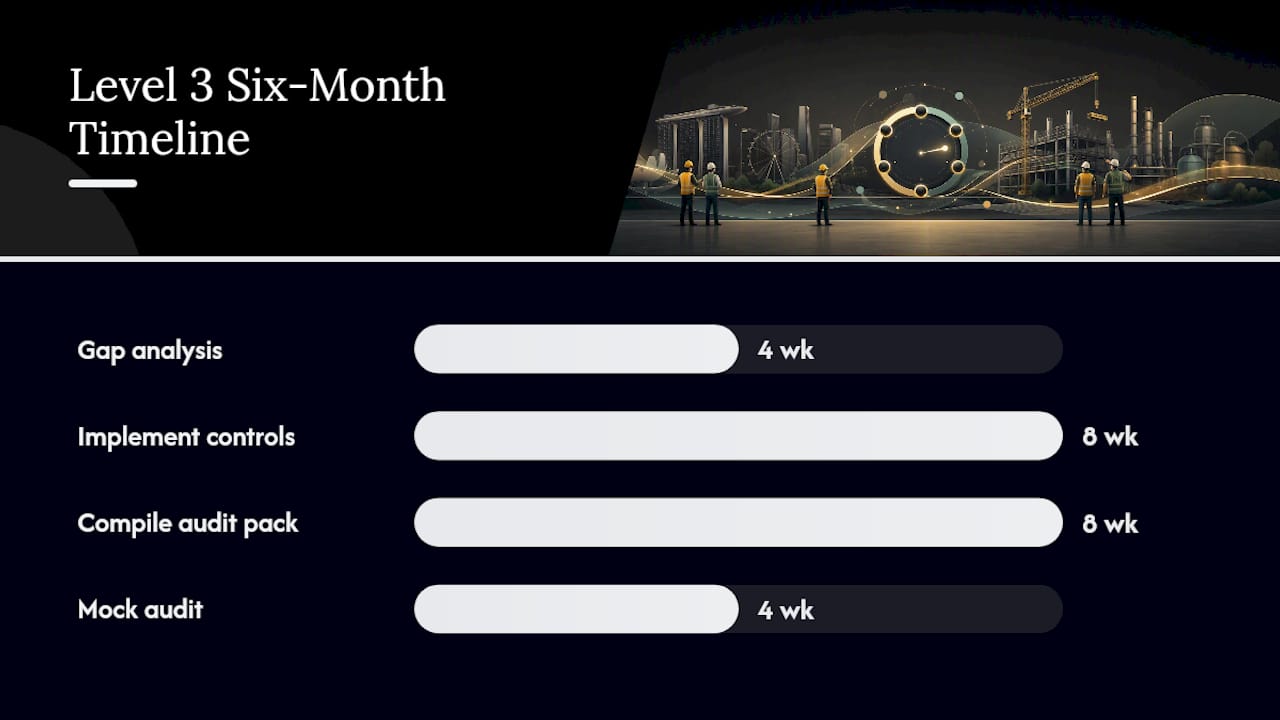
A workable four-step timeline inside the six months:
- Weeks 1 to 4: Gap analysis. Compare your current risk assessments and controls against what a Level 3 auditor will check.
- Weeks 5 to 12: Implement controls. Close the gaps identified, prioritizing hazards with the highest severity or likelihood.
- Weeks 13 to 20: Compile the audit pack. Bring together your signed WSH policy, RM implementation plan, risk assessments, training logs, meeting minutes, and photographic evidence of controls into one organized file.
- Weeks 21 to 24: Run a mock audit. Test the pack against the same checklist a real AO would use before booking the actual audit.
Most Level 3 audits that fail do so for the same handful of reasons:
- Risk assessments exist on paper but controls were never physically implemented.
- Training records are incomplete or don’t match the workers actually on-site.
- Meeting minutes are missing, making it impossible to prove ongoing risk management activity.
If your internal team lacks bandwidth to run this cycle cleanly, engaging a MOM-registered auditing organisation or a consultancy early reduces the risk of a failed first attempt, since a failed verification forces a repeat audit rather than a quick fix.
What Should the RM Champion Actually Deliver Day to Day?
Passing an audit depends less on the RM Champion’s title and more on the paper trail they generate. Auditors verify activity, not intentions.
- Schedule recurring risk management team meetings and keep dated minutes for each one.
- Run hazard identification sessions on-site and convert findings into written risk assessments with named controls.
- Draft an RM implementation plan structured around the hierarchy of controls, elimination and substitution first, administrative controls and personal protective equipment last.
- Keep a running file of training logs, photographs of controls in place, and any toolbox talk or briefing records.
Pro Tip: Photograph controls immediately after implementation, not weeks later. Auditors have learned to spot staged photos taken the night before a visit, and dated, contextual images carry far more weight.
Briefing workers matters as much as briefing management. An RM Champion who can show that frontline workers understand the risk assessment, not just that a document exists, gives auditors confidence the whole system is real rather than cosmetic.
What Do bizSAFE Level 2 Courses Cost and How Long Do They Take?
Most accepted WSQ courses for Level 2 run about 8 to 16 hours, typically spread across one to two days, and conclude with an assessment leading to the SOA. Some providers use a graded written test; others assess through a practical exercise tied to a workplace scenario.
- Course fees vary by provider, and many companies offset the cost through SkillsFuture credit or employer-sponsored training grants.
- Confirm funding eligibility directly with the training provider before booking, since subsidy criteria and required documentation (company UEN, employee NRIC, course completion proof) differ by scheme.
- If you have several employees needing training across sites, a private group class often works out cheaper per head than sending individuals to public runs, and it lets you align the training date with your target application window.
How MOSAIC Helps Construction Companies Meet bizSAFE Level 2 Requirements
MOSAIC Ecoconstruction Solutions works directly inside the steps above rather than around them. Its Quality, Environment, and Safety (QES) consultancy team supports construction firms through the exact sequence a Level 2 application demands.
- Training facilitation: Guidance on selecting and scheduling the right WSQ course for your RM Champion nominee.
- RM plan development: Drafting a risk management implementation plan structured to satisfy both Level 2 documentation expectations and the deeper evidence Level 3 auditors require.
- Documentation templates: Ready-made formats for risk assessments, training logs, and meeting minutes so your RM Champion isn’t building a system from scratch.
- Mock audits: A practice run against the same checklist a SAC-accredited Auditing Organisation would use, surfacing gaps before they cost you a failed verification.
Pro Tip: Book a mock audit around month four of your Level 2 window. It leaves enough runway to fix findings before your real Level 3 audit and before Level 2 expires.
A typical engagement runs alongside your six-month Level 2 window: onboarding and gap analysis in the first month, documentation build-out through months two to four, and mock audit plus corrective actions in months five and six, timed to hand off directly into a Level 3 audit booking.
What Safety Officers Consistently Get Wrong About Level 2
The single biggest mistake I see is nominating an RM Champion for their availability rather than their authority. A well-trained RM Champion with no real standing on-site cannot get controls implemented, and that failure shows up later as a failed Level 3 audit, not as an obvious problem at the Level 2 stage.
The second mistake is treating documentation as something to assemble right before submission. Auditors and AEO verification checks respond to evidence built over time, dated meeting minutes, photos taken as controls went in, training logs that match actual attendance, not a folder compiled the week before a deadline.
Level 2 was never meant to be a destination. It’s a six-month proving ground the WSH Council built specifically to push companies toward the three-year recognition that actually matters for tenders and insurers. Treat it that way from day one, and the Level 3 audit stops being a scramble.
Get Help Meeting bizSAFE Level 2 Requirements and Preparing for Level 3
Most construction firms lose time on bizSAFE not because the rules are unclear, but because building the evidence trail (risk assessments, training logs, meeting minutes, photographic proof) competes with the actual job of running a site. MOSAIC handles that build-out directly, working alongside your RM Champion to produce documentation that holds up under AEO verification and Level 3 audit scrutiny, not just paperwork that looks complete.

Beyond training guidance, MOSAIC can supply the templates your RM Champion needs from week one and run a mock audit before you book your real Level 3 assessment, cutting the risk of a failed verification forcing a repeat. If your Level 2 clock is already running, review the top safety training topics for 2026 and get in touch to scope out a Level 2 to Level 3 readiness plan before the six-month window closes.
Sources
- Frequently Asked Questions — bizSAFE (WSH Council)
- Apply for bizSAFE — WSH Council
- Guidebook — bizSAFE Level 3 requirements for cleaning businesses (NEA)