

A construction sustainability rating is a third-party assessment that scores a project’s environmental, social, and economic performance against a published standard. It validates claims that would otherwise rest on a developer’s word alone, using independent auditors and documented evidence rather than self-reported marketing copy.
The frameworks driving this discipline globally include:
- LEED (USGBC), the point-based system widely used across the United States and internationally
- BREEAM (BRE), the United Kingdom-originated holistic assessment covering buildings and infrastructure
- BCA Green Mark, Singapore’s own scheme calibrated for the tropical, high-density built environment
Each operates on the same premise: performance claims mean little until an accredited third party checks the math.
Key Takeaways
Construction sustainability ratings work because they force environmental, economic, and social performance into one comparable, third-party-verified scorecard rather than three disconnected claims.
| Point | Details |
|---|---|
| Life-cycle focus drives credibility | LCA and LCCA trace impact and cost across a building’s full life, not just its opening day. |
| Match the scheme to the project | BCA Green Mark fits local regulatory needs; LEED or BREEAM add international recognition when tenants require it. |
| Early integration prevents rework | Documentation started at pre-design avoids the evidence gaps that stall certification mid-construction. |
| Ratings validate, they don’t guarantee | Actual performance still depends on operation matching the assumptions built into the model. |
| Com supports the documentation gap | Pre-assessment audits and workflow support help project teams keep evidence trails assessor-ready from day one. |
Table of Contents
- What Does a Sustainability Rating Actually Measure?
- Which Rating Systems and Standards Matter Most?
- How Does the Assessment Process Actually Work?
- What Do You Gain, and What Won’t a Rating Guarantee?
- What Does a Project-Ready Certification Checklist Look Like?
- How Does a QES Consultant Support the Rating Process?
- What Do Singapore Certification Successes Actually Look Like?
- Who Owns the Rating Inside the Project Team?
- How Do You Choose the Right Sustainability Consultant?
- A Consultant’s View on Getting This Right
- How MOSAIC Turns Rating Requirements Into a Manageable Workflow
- Where to Go for Scheme Details and Standards
- Sources
What Does a Sustainability Rating Actually Measure?
A rating is not a single environmental score. It is a composite of measurements taken across the entire life of a structure, from the carbon embedded in its steel to the water consumed once tenants move in.
Most systems assess:
- Operational and embodied energy
- Carbon emissions, typically quantified through life-cycle assessment (LCA)
- Water consumption and management
- Material sourcing, health, and circularity
- Construction and demolition waste
- Site ecology and biodiversity impact
- Social factors, including occupant well-being and community impact
- Whole-life cost, calculated through life-cycle cost analysis (LCCA)
LCA traces a material or building’s environmental burden from extraction through disposal, rather than judging it solely on how it performs the day it opens. LCCA runs the parallel financial calculation, tracking acquisition, operation, maintenance, and end-of-life costs over the asset’s full lifespan. A 2023 study published in Sustainability found that project stakeholders frequently lack effective tools to compare materials and methods on sustainability grounds, and recommended integrated assessments that combine LCA, LCCA, and social indicators rather than judging any one metric in isolation. That’s the real function of a rating: it forces environmental, economic, and social data into one comparable scorecard instead of three disconnected reports.
Which Rating Systems and Standards Matter Most?
Choosing a scheme depends on where you build, what you build, and who is asking for the certificate. Here’s how the major players compare.
- LEED (USGBC): point-based credits across categories like energy, water, and materials; strong global brand recognition and frequently requested by multinational tenants and investors. See the LEED rating system for credit structure details.
- BREEAM (BRE): one of the oldest schemes, covering new construction, in-use operation, and infrastructure with a category-weighted score converted into Pass through Outstanding ratings. Full methodology is available through BREEAM’s certification framework.
- BCA Green Mark: Singapore’s scheme, tuned to tropical climate performance, energy efficiency in high-rise residential and commercial stock, and alignment with local building codes.
- ISO 21931-1: not a certification itself, but the international standard that defines the principles for assessing sustainability of construction works, underpinning how many national schemes structure their methodology. Details sit within ISO 21931-1.
- BS EN 15643: the European framework standard requiring assessment to consider whole-life impacts rather than just the finished building, reinforcing the life-cycle logic behind LCA and LCCA. The BS EN 15643 framework sets out this scope.
For a project delivered and occupied in Singapore, BCA Green Mark typically carries the most direct regulatory relevance, while LEED or BREEAM often get layered on top when a multinational owner or tenant requires international recognition for portfolio reporting.
How Does the Assessment Process Actually Work?
Getting rated is a sequence, not a single audit visit. Skipping a step early tends to cost double later.
- Select the rating path. Match the scheme to the building type, jurisdiction, and client requirement before design finalizes.
- Integrate at pre-design. Set numerical targets for energy, water, and materials before schematic design locks in the building form.
- Collect documentation continuously. Energy models, material declarations, and site records need to be gathered as work happens, not reconstructed afterward.
- Submit for third-party verification. An accredited assessor reviews evidence against the scheme’s published credit list or scoring thresholds.
- Receive scoring and certification. Ratings convert into tiers, whether that’s LEED’s Certified through Platinum bands or BREEAM’s Pass through Outstanding scale.
Timelines commonly run several months to over a year depending on project size, and delays usually surface at the documentation stage, when as-built records don’t match what design drawings promised.
Cost drivers worth budgeting for:
- Assessor and certification body fees
- Energy modeling and LCA/LCCA consultant time
- Additional commissioning and reporting labor
- Design changes triggered by unmet credit thresholds; for example, understanding the cost and tax considerations in decoupling property in Singapore can provide valuable local financial context when planning budgeting.
What Do You Gain, and What Won’t a Rating Guarantee?
A certificate delivers real, measurable advantages. It gives procurement teams and tenants objective third-party validation instead of a developer’s own claims, it often strengthens tender competitiveness on government and institutional projects, and it typically reduces operating costs through the energy and water efficiencies the scoring process forces into the design.
What it won’t do is guarantee performance. A rating reflects the design intent and documented evidence submitted at the time of assessment, not a warranty that the building will run efficiently for the next thirty years. Ratings depend heavily on the assumptions built into energy models, and gaps between predicted and actual performance are a well-documented limitation across schemes.
Pro Tip: Set your rating target to match your project’s actual priorities, not the highest tier available. Chasing Platinum-equivalent credits that don’t align with tenant needs wastes budget better spent on the metrics your client actually cares about.
What Does a Project-Ready Certification Checklist Look Like?
Preparation beats correction. Most certification headaches trace back to decisions made, or skipped, months before anyone called an assessor.
Pre-design:
- Select the rating system and confirm the target tier
- Appoint the sustainability consultant or assessor early
- Establish a documentation workflow with clear ownership
Design:
- Run energy modeling against the chosen scheme’s benchmarks
- Collect material declarations and health data
- Finalize water strategy and landscape/ecology plans
Construction:
- Track waste diversion and disposal on site
- Log commissioning evidence as systems get tested
- Maintain as-built documentation in real time, not retroactively
Handover and operation:
- Compile the full verification package for submission
- Prepare operations and maintenance manuals aligned to rating requirements
- Set up post-occupancy monitoring to confirm modeled performance
The most common failure pattern is starting the certification conversation mid-construction, when as-built evidence trails are already incomplete and inconsistent measurement boundaries make the LCA numbers hard to defend.
How Does a QES Consultant Support the Rating Process?
Most project teams don’t fail certification because their building underperforms. They fail because documentation is scattered across contractors, consultants, and site logs that were never designed to talk to each other.
Com works this exact gap for construction teams pursuing sustainability certification, offering support that includes:
- Target-setting and rating-path selection before design locks in
- Documentation workflows built for assessor liaison and audit readiness
- Pre-assessment audits that catch gaps before submission, not after rejection
- Design for Safety advisory that overlaps directly with sustainability documentation needs
If your team is weighing which scheme fits your project, that’s a conversation worth having before drawings finalize.
What Do Singapore Certification Successes Actually Look Like?
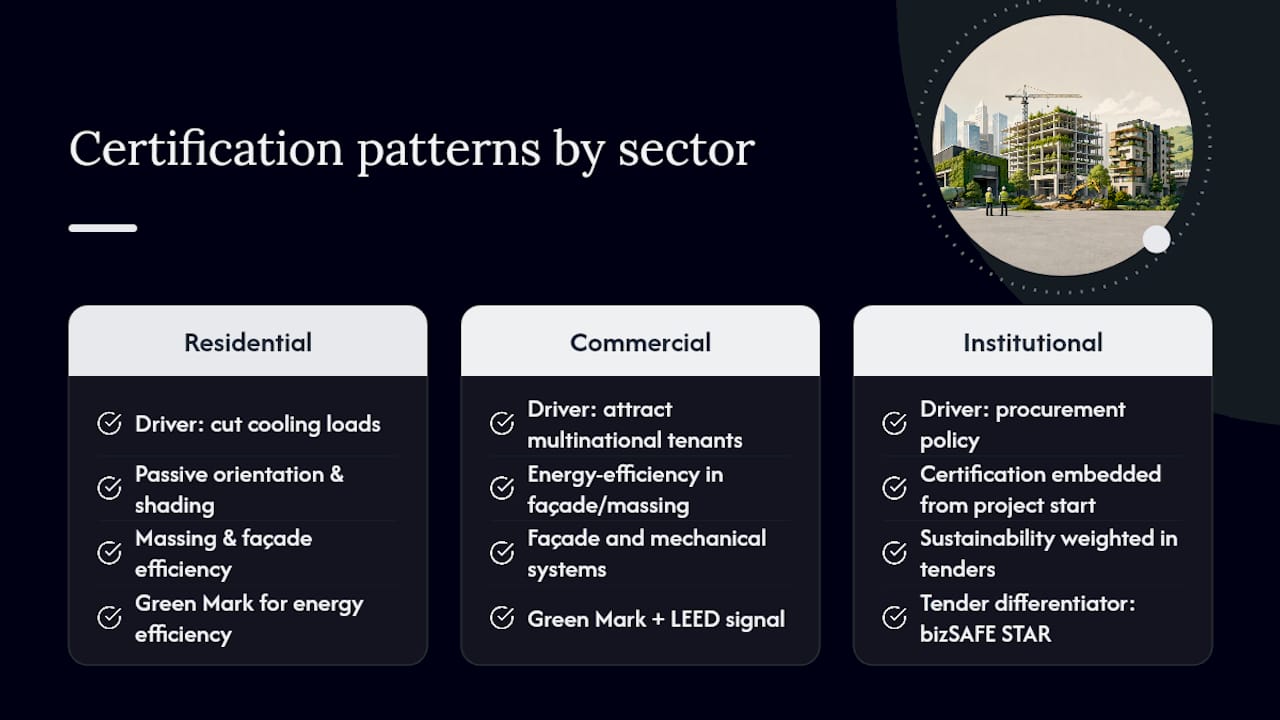
Singapore’s built environment has produced a steady run of certified projects across residential, commercial, and institutional stock, largely driven by BCA’s Green Mark scheme working alongside national decarbonization targets. The pattern across these projects tends to repeat: energy efficiency measures baked into massing and façade design from the earliest schematic stage, rather than bolted on after the building form was fixed.
High-rise residential developments pursuing Green Mark typically lean on passive design, orientation, and shading to cut cooling loads before mechanical systems even enter the conversation, since cooling represents the dominant energy draw in a tropical climate. Commercial towers chasing both Green Mark and an international scheme like LEED often use the dual certification as a signal to multinational tenants who need sustainability metrics for their own corporate reporting, not just local compliance.
Institutional and government-linked projects show a different pattern. These tend to treat certification as embedded procurement policy from project inception, since public tenders increasingly weight sustainability credentials alongside cost and safety accreditation. That mirrors how bizSAFE STAR functions as a tender differentiator in government contracting: a credential that started as a compliance requirement becomes a genuine competitive lever once enough of the market holds it.
What separates the projects that clear certification smoothly from the ones that scramble is rarely design ambition. It’s whether documentation discipline started on day one.
Who Owns the Rating Inside the Project Team?
Certification fails when everyone assumes someone else is tracking the paperwork. A clear division of labor prevents that.
The developer or client sets the target tier and budget, and that decision needs to happen before the architect finalizes concept design, not after. The project sustainability lead or appointed consultant owns the rating pathway day to day, translating scheme credit requirements into concrete design and construction instructions the rest of the team can act on.
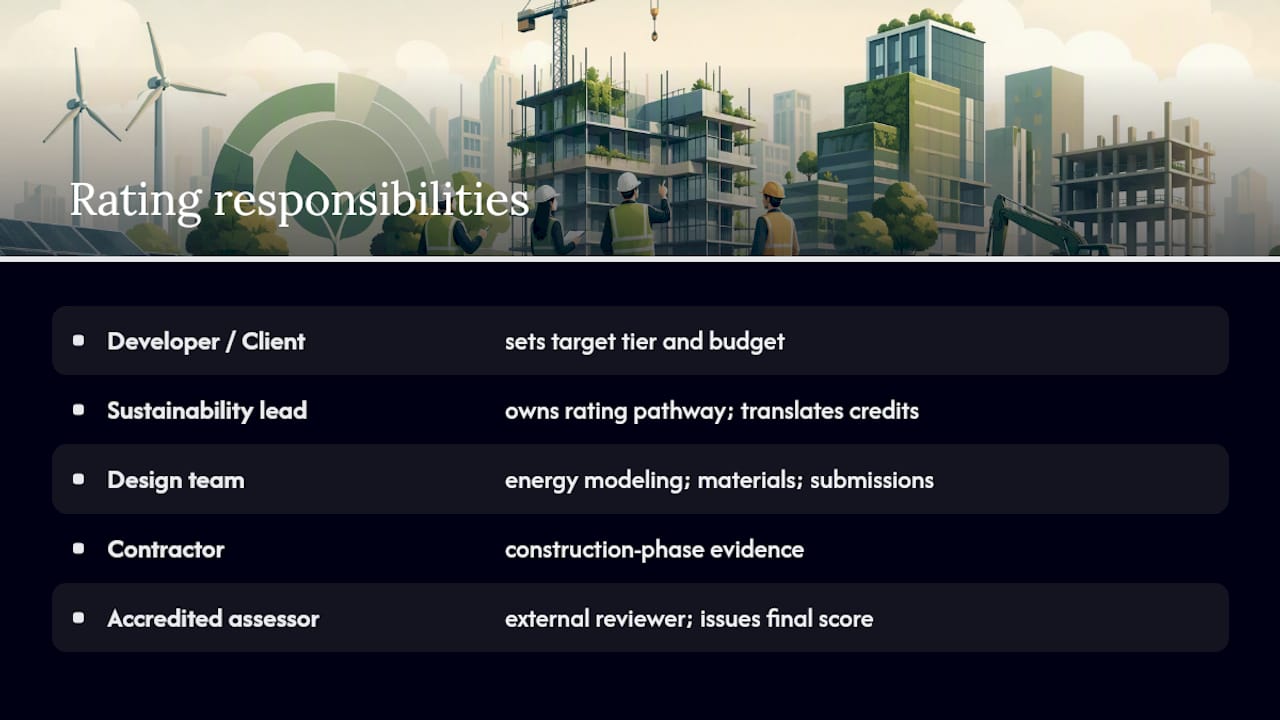
The design team, architects and MEP engineers, carries responsibility for energy modeling, material selection, and the technical submissions that back up credit claims. The contractor owns construction-phase evidence: waste tracking, commissioning records, and as-built documentation that has to match what the design team promised on paper. This is where certification most often unravels, because site teams are rarely trained on what documentation an assessor will actually demand.
The accredited assessor, external to the project, reviews submitted evidence against the scheme’s published criteria and issues the final score. Their independence is the entire point of a third-party rating; a project cannot self-certify and expect the credential to carry weight with tenants or regulators.
One role often missing from smaller projects: a single point of accountability who checks that documentation from design and construction actually lines up before submission. Without that check, gaps surface at the worst possible moment, during formal review, when fixing them costs far more than catching them early would have.
How Do You Choose the Right Sustainability Consultant?
Not every consultant who claims sustainability expertise has actually run a project through full certification. Ask for specifics before signing anything.
Look for a track record with the specific scheme you’re targeting, whether that’s Green Mark, LEED, or BREEAM, since credit structures and documentation expectations differ meaningfully between them. Ask how they structure the pre-assessment audit: a consultant who can’t describe a concrete gap-analysis process is likely to discover problems at submission instead of before it.
Confirm they understand life-cycle methodology, not just checklist compliance. A consultant who talks fluently about LCA boundaries and LCCA assumptions understands that ratings measure whole-life performance, not a static snapshot of the finished building. That distinction shows up in how thoroughly they interrogate your material specifications and energy model inputs.
Ask about their relationship with accredited assessors and certification bodies. A consultant who has liaised directly with assessors on prior submissions knows which documentation gaps trigger rejection and which ones get waved through with a clarifying note.
Finally, weigh how they integrate with your existing compliance work. Sustainability documentation frequently overlaps with safety certification and audit processes already running on the project, and a consultant who treats these as separate silos will duplicate effort your team is already paying for twice.
A Consultant’s View on Getting This Right
Most certification failures I’ve seen traced back to design teams treating the rating as a documentation exercise bolted on after the fact, instead of a life-cycle discipline that should shape material and energy decisions from concept design onward. LEED, BREEAM, and Green Mark all reward that early integration and penalize retrofitted paperwork. If you lead a project team, run a pre-design sustainability scan before schematic design locks in, not after.
How MOSAIC Turns Rating Requirements Into a Manageable Workflow
Chasing a Green Mark or LEED credential while managing a live construction site is where most teams lose momentum, not because the standards are unreasonable, but because nobody owns the documentation trail full time. Com closes that gap with pre-assessment audits, documentation workflows built for assessor scrutiny, and Design for Safety advisory that overlaps directly with the evidence a certification body wants to see.

If your project is heading toward BCA Green Mark, LEED, or BREEAM and you’re not confident your evidence trail will survive review, a safety audit built for compliance is the fastest way to find out where the gaps sit before an assessor does. Reach out to scope a pre-assessment review for your project.
Where to Go for Scheme Details and Standards
For scoring rules and technical thresholds, go directly to the scheme’s own documentation rather than secondhand summaries.
- LEED rating system for credit categories and certification tiers
- BREEAM certification framework for category weighting and rating bands
- ISO 21931-1 for the international sustainability assessment principles underpinning most schemes
- BS EN 15643 framework for the European whole-life assessment standard
- GSAS Construction Management Assessment for construction-phase, class-based rating criteria
- GRIHA Version 6.0 for percentile-based scoring in national contexts
Assessor directories and accreditation lists are typically published on each scheme’s own certification body website, and confirming an assessor’s current accreditation status there before engagement is worth the five minutes it takes.
Sources
- Certification for Sustainable Buildings | BREEAM
- ISO 21931-1 | ISO
- MDPI — Sustainability article (2023)
- GRIHA Version 6.0 (PDF)