
A third-party inspection gives decision-makers independent, evidence-based verification against an agreed scope, tied to a specific reference and lot, so they can release, hold, sort, or reject with confidence rather than guesswork. That evidence is what turns a subjective supplier claim into a documented basis for a commercial decision.
The inspector’s job is not to guarantee perfection. It is to sample a defined lot against a specification the buyer already approved, then report what was found so someone with contractual authority can act. TradeAider’s breakdown of what inspection agencies actually do frames this well: the value sits in linking a reference, a scope, a response, and a verification step into one usable record. Sampling has limits, too. A passed inspection on a sample does not mean zero defects exist in the other units; it means the defect rate observed falls within an agreed acceptable quality limit.
Three accreditation anchors matter more than any brand name on a report:
- ISO sets the baseline management and quality vocabulary inspection bodies operate within.
- ISO/IEC 17020 defines the competence and impartiality requirements for bodies that perform inspection.
- ILAC is the international cooperation that recognizes national accreditation bodies as credible signatories to that standard.
Pro Tip: Bring the inspector in at contract signing, not at shipment week. Naming the inspection stage and acceptance criteria inside the purchase order gives you contractual leverage the inspector’s findings can actually trigger, instead of a report nobody agreed to act on.
Key Takeaways
The value of third-party inspection lies in producing independent, decision-ready evidence tied to an agreed reference and lot, which supports release, hold, sort, or rework decisions with a documented trail.
| Point | Details |
|---|---|
| Independence defines TPI | A third-party inspector has no financial stake in the supplier, buyer, or outcome, unlike first- or second-party checks. |
| Accreditation is the trust signal | Look for ISO/IEC 17020 compliance and ILAC-signatory accreditation before hiring a provider. |
| Scope and sampling drive report quality | Vague specifications and undefined acceptance rules are the top cause of weak, unusable reports. |
| Match inspection stage to the decision | Pre-production, in-process, and pre-shipment inspections each answer a different question. |
| MOSAIC closes the readiness gap | MOSAIC’s QES consultancy prepares specifications, documentation, and corrective-action plans so TPI findings translate into closed compliance loops. |
Table of Contents
- What Is Third-Party Inspection and How Does It Differ From Internal Checks?
- Why Do Organizations Commission Third-Party Inspection?
- When Should You Use Third-Party Inspection?
- What Are the Main Steps and Types of Third-Party Inspection?
- How Does TPI Compare With In-House or Buyer Checks?
- What Are the Duties and Responsibilities of a Third-Party Inspector?
- What Mistakes Should You Avoid Before a Third-Party Inspection?
- How Should You Read and Act on an Inspection Report?
- What Does Research Say About the Growth of Private Assurance?
- Publisher’s Note on QES Consultancy and TPI
- How MOSAIC Helps You Prepare For and Act On Inspection Findings
- Standards and Resources Worth Consulting
- Frequently Asked Questions
- Sources
What Is Third-Party Inspection and How Does It Differ From Internal Checks?
Third-party inspection is an independent assessment performed by a body with no financial stake in the supplier, the buyer, or the outcome of the inspection. StandardsPortal’s definition of third-party conformity assessment ties independence directly to this lack of interest in the object being inspected or in who uses it. That independence is what distinguishes TPI from the two other kinds of checks every supply chain relies on.
First-party inspection is the supplier checking its own work. It is fast, cheap, and inherently biased toward passing the goods, since the inspector’s paycheck depends on the same production line being inspected. Second-party inspection is the buyer, or the buyer’s staff, checking a supplier’s output directly. It carries more weight than first-party checks because the buyer has skin in the game, but it still isn’t neutral. The buyer’s team may lack specialized testing equipment, or may face pressure to approve a shipment because a container booking is already paid for.
Third-party inspection sits outside both relationships. ISO/IEC 17020 describes this as a “Category A” inspection body: one that is organizationally and financially separate from the design, manufacture, supply, installation, or use of the items it inspects. That separation is what makes a TPI report acceptable evidence to a bank, an insurer, or a regulator in a way a supplier’s own quality certificate rarely is.
In practice, the same TPI provider might be called in for very different jobs on the same project: a pre-production readiness check before the first units are made, a during-production checkpoint at the halfway mark, a pre-shipment release inspection, physical loading supervision at the port, or a witness test where the inspector simply confirms that a lab test happened as claimed and that the numbers weren’t fabricated afterward.

| Check type | Who pays / benefits | Typical use case | Main limit |
|---|---|---|---|
| In-house QC | Supplier pays, supplier benefits from a fast pass | Routine production line checks | Built-in incentive to overlook defects |
| Buyer audit | Buyer pays, buyer benefits directly | Supplier onboarding, factory capability review | Limited technical scope, buyer staff often generalists |
| Third-party inspection | Buyer (usually) pays, both parties benefit from neutral evidence | Pre-shipment release, safety-critical components, regulatory submission | Sampling based, not a full audit |
Why Do Organizations Commission Third-Party Inspection?
The return on a third-party inspection shows up long before a dispute ever reaches a courtroom. It shows up the moment a lender, an insurer, or a regulator asks for evidence a supplier’s own paperwork simply cannot supply.
The core benefits break down into five categories:
- Independence and objectivity. The inspector has no incentive to hide a defect or inflate a pass rate.
- Specialist expertise. Structural steel, lifting gear, and electrical panels each demand different technical literacy that a generalist buyer team rarely has in-house.
- Documented traceability. A defined lot, timestamped photos, and measurement records create a paper trail that survives a dispute months later.
- Regulatory and buyer confidence. ACCO’s guide to third-party inspection notes that accreditation credentials and technical inspector expertise are what actually drive lender and regulator acceptance of a report.
- Dispute avoidance. A neutral record settles a “you shipped defective goods” argument faster than competing claims from two interested parties.
None of this makes TPI a cure-all. Sampling inspections cannot catch every unit-level defect, and no visual or dimensional check substitutes for a proper laboratory test when chemical composition or electrical safety is what’s actually at stake. A vague specification handed to an inspector produces a vague report, regardless of how skilled the inspector is. And every inspection adds cost and, often, a day or two of schedule friction that needs to be planned for rather than discovered at the last minute.
The cost-versus-value math tends to favor TPI whenever the stakes justify it: a high-value shipment where the loss from rejection at destination dwarfs the inspection fee, a safety-critical component like a crane hook or a pressure vessel where failure risks lives, or any contract where a lender or regulator has written the inspection requirement directly into the financing or approval terms. QCADVISOR’s overview of third-party inspection makes the point plainly: TPI complements internal QA rather than replacing it, and the value compounds when it’s paired with a clear specification from the start.
Pro Tip: Write the inspection outcome directly into payment terms. A clause that reads “final payment released upon passed pre-shipment inspection report” converts a QA activity into contractual leverage the supplier has to respect, not a courtesy check they can ignore.
When Should You Use Third-Party Inspection?
Not every purchase order needs an independent inspector standing on the factory floor. The decision usually comes down to a handful of concrete triggers:
- Safety risk. Anything that could injure a worker or end user if it fails.
- High unit value. A single rejected shipment would cost far more than the inspection fee.
- A contractual or regulatory clause. A lender, insurer, or regulator has already written the requirement into financing or approval terms.
- Complex technical specifications. The buyer’s own team lacks the expertise to judge conformance reliably.
- Remote or first-time sourcing. No established trust exists with the supplier yet.
- A supplier with a shaky track record. Past defects or late corrections justify closer scrutiny going forward.
Certain sectors treat TPI as close to standard practice rather than an optional extra:
- Construction relies on it for structural steel, concrete testing, and mechanical, electrical, and plumbing systems before handover.
- Manufacturing uses it across pre-production, in-process, and final inspection stages on export orders.
- Oil and gas depends on it for pressure equipment, welding certification, and pipeline integrity checks.
- Power generation requires it for turbines, transformers, and other capital equipment with long lead times.
- Medical devices need it for regulatory submission evidence tied to strict conformity standards.
- Electronics use it heavily for pre-shipment inspection given short product cycles and high defect sensitivity.
- Heavy equipment manufacturers lean on witness testing for load-bearing components.
- Export and import supply chains generally use pre-shipment inspection as a default risk control before goods leave the origin country.
Stage selection matters as much as the decision to inspect at all. A factory audit early in supplier selection answers a different question than a pre-shipment inspection does, and mixing them up wastes both budget and schedule.
What Are the Main Steps and Types of Third-Party Inspection?
A TPI engagement follows a fairly consistent flow, regardless of industry:
- Define scope. Agree on what’s being checked, against which specification, and for which lot.
- Set the sampling plan. Decide the acceptable quality limit and the number of units to sample.
- Conduct on-site checks. Inspect appearance, dimensions, function, packing, and marking against the approved reference.
- Report findings. Document measurements, photos, and defect classifications in a structured report.
- Trigger a response. The buyer decides to release, hold, sort, rework, retest, or reinspect.
- Verify the fix. Confirm corrective action actually resolved the issue before final release.
Different inspection types answer different questions at different points in production:
- Pre-production inspection (PPI) checks raw materials and components before the line even starts running.
- During-production inspection (DPI) catches problems at the midpoint, while there’s still time to correct the process.
- Pre-shipment inspection (PSI) is the final go/no-go check before goods leave the factory.
- Loading supervision confirms the right goods, in the right condition, actually go into the right container.
- Witness testing verifies that a lab test was performed correctly and the results weren’t altered afterward.
- Factory audits assess the supplier’s overall capability and systems rather than a specific product batch.
A typical inspection checklist covers appearance and workmanship, dimensional tolerance, functional testing, packing integrity, labeling and marking accuracy, and documentation completeness. TradeAider’s guide on why inspections matter for importers recommends buyers request the sampling method and acceptable quality limit in writing before the inspection date, not after the report lands. Skipping that step is one of the most common reasons a report ends up useless for the decision it was supposed to support.
How Does TPI Compare With In-House or Buyer Checks?
No single check type wins on every axis, which is exactly why procurement teams end up using a blend depending on the contract’s risk profile.
| Factor | First-party (supplier QC) | Second-party (buyer audit) | Third-party inspection |
|---|---|---|---|
| Objectivity | Low | Moderate | High |
| Cost | Lowest | Moderate | Highest |
| Speed | Fastest | Fast | Slower, needs scheduling |
| Technical scope | Limited to supplier’s own tools | Depends on buyer team’s expertise | Broadest, specialist inspectors available |
| Contractual acceptance | Rarely accepted alone by lenders/regulators | Sometimes accepted | Generally accepted as neutral evidence |
The decision rules that fall out of this are fairly intuitive once you see them laid out:
- TPI is necessary when a lender, insurer, or regulator has written it into the contract, or when safety-critical components are involved.
- TPI is sufficient on its own for most pre-shipment release decisions on standard goods.
- TPI is optional for low-value, low-risk repeat orders with a supplier that has a strong track record.
The commercial action each check type supports differs, too. A first-party defect finding usually just triggers an internal line adjustment. A second-party audit finding typically produces a supplier corrective action request. A third-party inspection finding is what regulators and lenders actually accept as the basis for a release decision or a formal compliance submission.
What Are the Duties and Responsibilities of a Third-Party Inspector?
A competent inspector’s job breaks into a specific set of duties, and a buyer’s scope of work should spell each one out rather than leaving it implied:
- Verify the approved reference sample matches what’s actually being inspected.
- Select the sample according to the agreed sampling plan and acceptable quality limit.
- Record measurements, functional test results, and photographic evidence.
- Classify defects as critical, major, or minor according to the agreed criteria.
- Verify supporting documentation, certificates, and markings.
- Escalate any critical nonconformity immediately, rather than waiting for the final report.
Contracts and scopes of work should include an independence declaration, a clear scope-to-lot mapping, the sampling and AQL method, a reporting format with a defined turnaround time, confidentiality terms, and explicit conflict-of-interest controls. Inspector qualifications should reference ISO/IEC 17020 compliance and, ideally, accreditation through an ILAC-signatory national body, since that combination is the strongest available signal that the inspector’s competence and impartiality have actually been checked by someone else.
What Mistakes Should You Avoid Before a Third-Party Inspection?
Most weak inspection reports trace back to the buyer’s own preparation, not the inspector’s competence. The recurring mistakes are predictable:
- Sending a vague scope with no reference to a specific specification or drawing.
- Failing to provide an approved sample the inspector can compare units against.
- Scheduling the inspection at the wrong production stage, either too early or too late to catch anything actionable.
- Leaving acceptance rules undefined, so nobody agrees in advance what “pass” actually means.
- Poor lot mapping, where the inspected units don’t clearly correspond to the shipment or batch in question.
- Never defining how corrective action will be verified once a defect is found.
A short pre-inspection checklist solves most of this: send the approved sample, purchase order details, the exact lot range, drawings, labeling requirements, expected test methods, and name a decision owner along with the acceptance rules before the inspector ever arrives.
Pro Tip: Ask the inspector for time-stamped photo proof and same-day preliminary findings rather than waiting for the full formal report. Catching a critical defect on inspection day, while the line is still running, saves days of rework compared to discovering it after the report lands a week later.
How Should You Read and Act on an Inspection Report?
A report is only useful if it answers a clear question: release, hold, sort, or rework. A well-structured report typically includes:
- Scope and lot mapping.
- Sample method and acceptable quality limit used.
- Measurements and functional test results.
- Photographic evidence tied to specific defect findings.
- Defect classification (critical, major, minor).
- Decision options for the buyer to choose from.
The action flow from there follows a consistent chain: finding leads to a named response owner, who assigns corrective action, which then needs verification before the buyer decides whether a reinspection or retest is required. ECQA’s overview of third-party inspection in quality assurance points out that this traceability is exactly what strengthens supplier performance evaluation over time, not just the single shipment in question.
Judge report quality against four markers: traceability back to a specific lot, transparency about the sampling method used, consistent photo standards, and clear inspector identity with accreditation stated and every entry timestamped.
What Does Research Say About the Growth of Private Assurance?
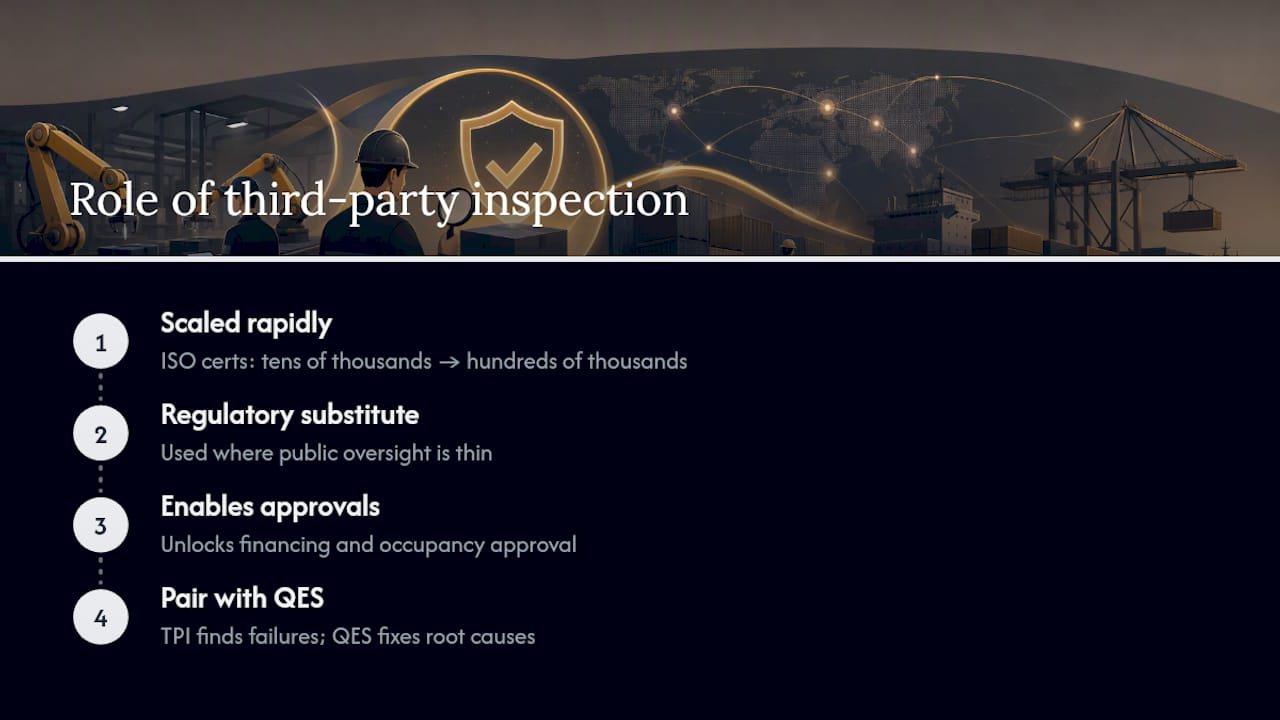
Academic research on private regulation shows third-party assurance has expanded from a niche contract facilitation service into something closer to compliance infrastructure in its own right. A Vanderbilt faculty review of private regulation and standards-based compliance documents ISO certification counts growing from tens of thousands of sites in the 1990s to hundreds of thousands by the early 2000s, evidence of just how fast standard-based assurance activity scaled globally.
That growth carries a practical implication for anyone relying on inspection reports today: private assurance increasingly substitutes for public regulation in markets where government oversight capacity is thin. A lender or overseas buyer often trusts a TPI report precisely because it functions as a stand-in for regulatory verification that may not exist locally, or may exist but move too slowly to support a transaction timeline.
On a construction project, this plays out concretely at handover. A structural steel package inspected and documented by an accredited third party gives a bank financing the project, and the authority approving occupancy, evidence that doesn’t depend on trusting the contractor’s own paperwork. That documented chain of custody, tying an approved reference to a specific inspection date and inspector, is frequently what unlocks the final disbursement or the occupancy certificate.
Pro Tip: Pair third-party inspection findings with a structured QES compliance review. A TPI report tells you what failed; a compliance advisory process tells you why it failed against your management system and closes the gap before the next audit cycle, rather than repeating the same nonconformity project after project.
Publisher’s Note on QES Consultancy and TPI
Third-party inspection tells a construction firm what happened on a given day, at a given lot. It doesn’t fix a weak specification or a gap in your safety management system on its own. At MOSAIC Eco-construction Solutions, we see the strongest client outcomes when inspection findings feed directly into a broader Quality, Environment, and Safety framework, not when they sit in a filing folder after the shipment clears.
Pro Tip: Treat every TPI nonconformity as an input to your corrective-action register, not a closed file. That habit is what separates a firm that passes its next audit from one that repeats the same finding.
How MOSAIC Helps You Prepare For and Act On Inspection Findings
Passing a third-party inspection on the first attempt comes down to preparation most firms underestimate until it costs them a schedule slip. MOSAIC’s QES consultancy work sits directly upstream and downstream of the inspection itself, closing the gaps that generic TPI providers were never scoped to touch.

Our services map onto the practical pain points this guide has walked through: pre-inspection readiness reviews that catch a vague specification before the inspector ever shows up, spec alignment work so your acceptance criteria are unambiguous, and corrective-action planning that turns a nonconformity into a closed loop rather than a repeat finding. For construction clients specifically, our safety audit examples for Singapore construction compliance show how we structure that readiness work, and our ConSASS assessment support helps you turn inspection outcomes into the documentation a regulator or lender actually wants to see.
If your project has a TPI milestone coming up and you’re not confident your documentation, scope, or corrective-action process will hold up under scrutiny, request a consultation with our QES team before that inspection date lands on the calendar.
Standards and Resources Worth Consulting
Reference these when setting up or auditing your inspection program:
- ISO for the general quality management vocabulary underlying most inspection scopes.
- ISO/IEC 17020 when verifying an inspection body’s competence and impartiality requirements.
- ISO 9001 for aligning your own supplier quality system with what inspectors expect to see.
- ILAC for confirming a national accreditation body’s international recognition.
- TradeAider’s practical guides for procurement-level detail on scope writing and sampling plans.
Frequently Asked Questions
What is the main role of third-party inspection in quality control?
The main role of third-party inspection is producing independent verification against an agreed specification, giving buyers, lenders, and regulators evidence they can trust without relying on the supplier’s own claims.
How does third-party inspection support regulatory compliance?
It supplies documented, accredited evidence that a product, process, or installation meets a required standard, which regulators and lenders often accept in place of, or alongside, the supplier’s own certification.
Why use third-party inspection instead of relying on supplier QA alone?
Supplier QA carries an inherent conflict of interest since the same team responsible for production also judges whether it passed. Third-party inspection removes that conflict and adds specialist technical expertise most buyer teams don’t have in-house.
What accreditation should a third-party inspection provider hold?
Look for compliance with ISO/IEC 17020 and accreditation through a national body that is an ILAC signatory. Both signal that the provider’s competence and impartiality have been independently verified.
Can third-party inspection replace in-house quality checks entirely?
No. TPI is a sampling-based check that complements internal QA rather than replacing it; it cannot catch every unit-level defect, and it isn’t a substitute for proper laboratory testing on safety-critical characteristics.
Sources
- ISO/IEC 17020 — Conformity assessment — Requirements for the operation of various types of bodies performing inspection
- Third‑party conformity assessment — StandardsPortal
- What 3rd Party Inspection Agencies Do · TradeAider
- Private regulation, third‑party assurance and the growth of standards-based compliance (Vanderbilt faculty publications)
- Third‑Party Inspection: Definition, Process, Benefits and Preparations – QCADVISOR