

Workplace emergency response is the set of planned actions, roles, and communications an employer deploys to protect personnel and stabilize operations when an unforeseen situation threatens employees, customers, or the public; disrupts or shuts down operations; or causes physical or environmental damage. Under U.S. regulatory frameworks, OSHA and FEMA provide the primary authoritative guidance on which every employer should anchor their program. Three actions you can take this week:
- Confirm your emergency alarm system is functional, audible in all occupied areas, and uses distinctive signals for different hazard types.
- Identify and formally designate an emergency coordinator with documented authority to initiate protective actions and contact external responders.
- Schedule a site hazard review to inventory natural, technological, and human-caused risks specific to your facility.
OSHA and FEMA’s CPG-101 together form the authoritative U.S. foundation for workplace emergency response planning — OSHA sets the legal floor; FEMA’s framework raises it to a resilience standard.
Table of Contents
- What counts as a workplace emergency?
- What does U.S. law actually require from employers?
- What an Emergency Action Plan must and should include
- How do you alert workers and communicate during an incident?
- Who does what? Roles and responsibilities in emergency response
- How often should you train workers and run drills?
- Evacuation, shelter-in-place, and lockdown: when and how to execute each
- How do you develop an emergency response plan from scratch?
- How do you keep the plan current and effective?
- What does it realistically take to build and run an EAP?
- An 8-step checklist to start or strengthen your program
- Key Takeaways
- The organizational case for treating emergency response as a strategic priority
- Authoritative resources and where to use them
What counts as a workplace emergency?
OSHA defines a workplace emergency as any unforeseen situation that threatens workers, customers, or the public; disrupts or shuts down operations; or causes physical or environmental damage. That definition is deliberately broad, and for good reason: the hazard profile of a downtown office tower differs sharply from that of a chemical processing plant or an active construction site.
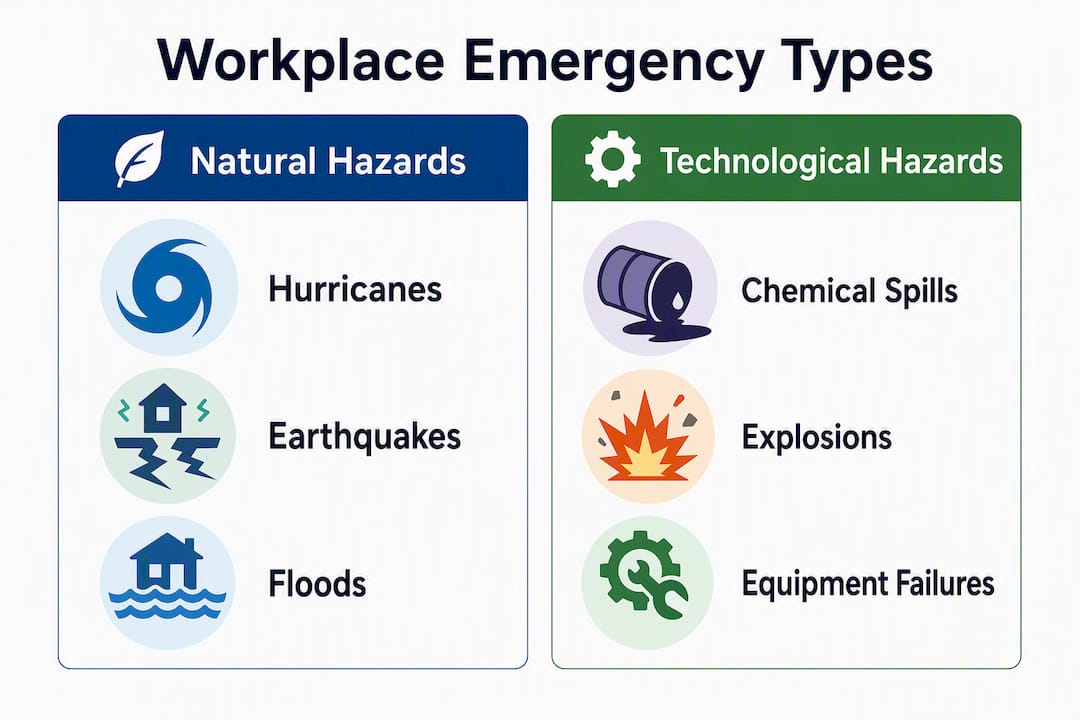
Emergencies generally fall into four categories:
Natural hazards include hurricanes, tornadoes, earthquakes, floods, and wildfires. These are geographically predictable to a degree, which means your planning should reflect your region’s specific exposure.
Technological and industrial hazards cover chemical spills or releases, explosions, HAZMAT incidents, unplanned equipment shutdowns, and radiological or biological accidents. Manufacturing facilities and construction sites carry disproportionate exposure here.
Human-caused hazards encompass workplace violence, civil disturbances, terrorist or criminal attacks, and arson. These are the category most frequently underweighted in plans that focus exclusively on fire and weather.
Health-related emergencies include disease outbreaks, pandemic events, and medical emergencies affecting individual workers or the broader workforce.
“Many types of emergencies can be anticipated in the planning process, which can help employers and workers plan for other unpredictable situations.” — OSHA, How to Plan for Workplace Emergencies and Evacuations
Classification matters operationally, not just taxonomically. A chemical release demands shelter-in-place protocols and HAZMAT-trained responders; a tornado demands immediate movement to interior shelter; an active-threat scenario demands lockdown. Choosing the wrong protective action because the hazard was misclassified can be as dangerous as having no plan at all. For construction sites specifically, the hazard inventory typically spans structural collapse risk, confined-space incidents, fall-from-height events, and environmental hazards that can escalate rapidly if not contained.
What does U.S. law actually require from employers?
The legal foundation for workplace emergency response in the United States rests primarily on 29 CFR 1910.38, OSHA’s Emergency Action Plan standard for general industry, and 29 CFR 1926.35 for construction. Both standards specify minimum EAP elements and training requirements. FEMA’s Comprehensive Preparedness Guide 101 (CPG-101) and NFPA codes operate as planning frameworks and technical standards rather than direct legal mandates, but they carry significant weight in demonstrating due diligence.
OSHA requirements under 29 CFR 1910.38:
- A written EAP is required wherever an OSHA standard explicitly calls for one; employers with 10 or fewer employees may communicate the plan orally, though a written document is best practice for accountability.
- The plan must address procedures for reporting emergencies, evacuation routes and assignments, employee accounting after evacuation, rescue and medical duties, and alarm systems.
- The plan must be reviewed with each employee when it is first developed, when the employee’s responsibilities change, and when the plan itself is updated.
FEMA CPG-101 treats emergency planning as a continuous, iterative process aligned to five mission areas: prevention, protection, mitigation, response, and recovery. Plans built to CPG-101 are living documents, updated after every drill and incident.
NFPA standards, particularly NFPA 101 (Life Safety Code) and NFPA 72 (National Fire Alarm and Signaling Code), govern egress design, alarm system performance, and fire drill requirements. These are adopted by reference in many state and local codes, making them effectively mandatory in most jurisdictions.
The American Red Cross provides supplementary training resources, including first-aid certification, CPR/AED programs, and sheltering guidance, that complement OSHA-mandated training without substituting for it.
Do I need a written EAP? If your business is covered by any OSHA standard that explicitly requires one (including 29 CFR 1910.38(a) and 29 CFR 1926.35), yes. If you have more than 10 employees, a written plan is required regardless of whether your hazard profile seems simple. Employers with 10 or fewer employees may use an oral plan, but documented plans are strongly recommended for consistency and legal defensibility.
What an Emergency Action Plan must and should include
An EAP is not a single document so much as a structured system of procedures, assignments, and communications. OSHA’s minimum required elements under 29 CFR 1910.38 are the non-negotiable floor; the recommended additions transform a compliant document into an operationally effective one.
OSHA-required elements
- Procedures for reporting a fire or other emergency — who calls 911, who activates the alarm, and in what sequence.
- Evacuation procedures and emergency escape route assignments — including floor plans, exit diagrams, and designated assembly areas.
- Procedures for employees who remain to perform critical operations before evacuating (e.g., utility shutdowns, process stabilization).
- Procedures to account for all employees after evacuation — a headcount or roll-call system at the assembly area.
- Rescue and medical duties — identifying which employees are trained and authorized to perform first aid, CPR, or AED use.
- Preferred means of reporting emergencies — internal alarm, PA announcement, phone tree, or mass-notification system.
- Names or job titles of persons who can be contacted for further information about the plan.
Recommended additions
- Hazard-specific procedures for the site’s top three to five identified risks (e.g., chemical spill containment, confined-space rescue, severe weather sheltering).
- Pre-scripted communications templates for each protective action (evacuate, shelter-in-place, lockdown, medical emergency).
- Business continuity linkages that identify critical functions, data backup locations, and alternate work sites.
- Accommodations for employees with disabilities — personal emergency evacuation plans (PEEPs), buddy systems, and accessible assembly areas.
- Post-incident recovery steps — return-to-work criteria, incident investigation triggers, and employee support resources.
- Visitor and contractor protocols — how non-employees are alerted, accounted for, and escorted during an emergency.
Sample EAP section headings (adaptable as a template framework):
Purpose and Scope / Hazard Inventory / Protective Actions Decision Matrix / Evacuation Routes and Assembly Areas / Shelter-in-Place Procedures / Lockdown Procedures / Medical Emergency Procedures / Alarm and Notification Systems / Roles and Responsibilities / Training and Drill Schedule / Accountability Procedures / Accommodations for Persons with Disabilities / Coordination with External Responders / Post-Incident Recovery / Plan Review and Update Log.
Pro Tip: Produce the EAP in every language spoken by your workforce and in accessible formats (large print, audio) for employees with visual or hearing impairments. OSHA’s alarm guidance explicitly requires that employees with disabilities be accounted for in alerting procedures — a plan that only works for able-bodied, English-speaking workers is an incomplete plan.
How do you alert workers and communicate during an incident?
Effective alerting is the difference between an orderly response and a chaotic one. No single channel is sufficient; redundancy is the governing principle.

| Channel | Best Use Case | Key Limitation |
|---|---|---|
| Audible alarm / horn | Immediate building-wide alert | Cannot convey specific instructions |
| PA / intercom system | Protective action instructions, updates | Requires working power and coverage |
| Mass notification (SMS/email/app) | Multi-site, remote, or off-shift workers | Dependent on cellular/internet infrastructure |
| Phone tree / call cascade | Small teams, after-hours contact | Slow; relies on human availability |
| Two-way radios | Warden-to-coordinator communication | Limited range; requires charged equipment |
| Digital safety apps | Real-time status, accountability check-in | Requires smartphone and app adoption |
Redundancy means designating a primary channel and at least one fallback for every scenario. A power outage that disables your PA system should not also disable your ability to communicate; battery-powered megaphones and pre-charged two-way radios are low-cost backstops.
Sample alert message templates:
- Evacuate: “Attention all personnel: an emergency has been declared. Evacuate the building immediately using your designated exit routes. Proceed to your assigned assembly area and await further instructions. Do not use elevators.”
- Shelter-in-place: “Attention all personnel: a shelter-in-place order is in effect. Move immediately to your designated interior shelter area, close all doors and windows, and await further instructions.”
- Lockdown: “Attention all personnel: a lockdown is in effect. Move to the nearest secure room, lock or barricade the door, silence your phone, and do not open the door until an all-clear is issued by [coordinator name or title].”
- Medical emergency: “Attention: a medical emergency has been reported at [location]. Trained first-aid responders, please respond immediately. All other personnel, clear the area.”
Coordination with local emergency services for external communications is a distinct requirement. Ready.gov recommends establishing communication protocols with public responders before an incident, including sharing site maps, hazardous materials inventories, and primary contact names.
Pro Tip: Pre-script every alert message and store copies at every communications station, including the security desk, the coordinator’s workstation, and a laminated card in the server room. Message escalation should follow a hierarchy: alarm activation first, PA announcement second, mass notification third, direct phone contact to external responders fourth. Improvised messages under stress introduce errors that cost critical seconds.
Who does what? Roles and responsibilities in emergency response
A well-structured emergency response program assigns clear authority and specific tasks before an incident occurs. Ambiguity about who can order an evacuation or who contacts the fire department is itself a hazard.
Core roles and their responsibilities:
- Emergency Coordinator / Incident Commander: Holds overall authority to declare an emergency, initiate protective actions, and serve as the primary liaison with external responders. Must be trained in incident command principles and have documented authority to act without seeking management approval during an active incident. Alternates must be designated for every shift.
- Evacuation Wardens / Floor Wardens: Direct personnel along evacuation routes, conduct sweep checks of assigned areas, and report accountability status to the coordinator at the assembly area. A best-practice staffing ratio is one warden per 20 employees on site; facilities with shift work should plan alternates for 24/7 coverage.
- First-Aid / Medical Responders: Provide immediate care pending EMS arrival, operate AEDs, and document injuries. American Red Cross first-aid and CPR/AED certification is the baseline competency standard for this role.
- Communications Liaison: Manages internal mass-notification systems, coordinates messaging with the coordinator, and handles media or family inquiries according to pre-approved protocols.
- Facilities / Utility Shutdown Lead: Executes pre-planned utility isolation procedures (gas, electrical, HVAC) to prevent escalation and supports fire department access to building systems.
Authority and delegation checklist:
- Document who holds primary and alternate authority for each role in writing.
- Confirm that each role holder has received role-specific training and demonstrated competency, not just acknowledged receipt of the plan.
- Establish a clear chain of succession: if the coordinator is the person who discovers the emergency, who assumes command?
- Verify that external responders (fire, police, EMS) have current contact information for the coordinator and the alternate.
- Review authority assignments after every organizational change that affects staffing, shift structure, or site layout.
OSHA’s eTool on evacuation plans emphasizes that designation alone is insufficient; each assigned employee must understand their specific duties and be trained to carry them out under stress.
How often should you train workers and run drills?
Training is where plans become competencies. A plan that exists only as a PDF on a shared drive has not been trained; it has been filed. OSHA’s guidance on drills is explicit: drills should be practical and frequent enough to demonstrate competence, and after-action reviews must identify weaknesses and feed corrective actions back into the plan.
Recommended training cadence
- Onboarding training for every new employee before they begin independent work, covering evacuation routes, alarm signals, assembly areas, and their specific role responsibilities.
- Role-specific training for coordinators, wardens, first-aid responders, and utility leads, conducted at assignment and refreshed annually. Competency checks, not just acknowledgement signatures, are the standard.
- Annual all-employee refresher covering any plan updates, changes to routes or assembly areas, and a review of the alarm system.
- Post-change training triggered by significant staffing changes, facility modifications, or process changes that alter the hazard profile.
Drill types and their purposes
- Full evacuation drill: Tests the complete evacuation procedure from alarm activation to accountability at the assembly area. Recommended at least annually; more frequently for high-hazard sites.
- Tabletop exercise: A facilitated discussion-based exercise in which the coordinator and key role holders walk through a scenario without physical movement. Highly efficient for testing decision logic and communications protocols.
- Functional drill (shelter-in-place or lockdown): Tests a specific protective action procedure with actual physical execution. Particularly valuable for scenarios that are rarely practiced, such as chemical release sheltering or active-threat lockdown.
- HAZMAT spill drill: Relevant for construction sites, chemical facilities, and manufacturing environments; tests containment procedures, PPE donning, and coordination with HAZMAT responders.
After-action documentation
- Record the date, scenario, participants, and observed deficiencies for every drill.
- Assign a corrective action owner and due date for each identified gap.
- Update the EAP within 30 days of a drill or incident that reveals a procedural deficiency.
- Retain training and drill records to satisfy OSHA documentation expectations and support any post-incident investigation.
Evacuation, shelter-in-place, and lockdown: when and how to execute each
The three primary protective actions are not interchangeable. Choosing the correct one requires a decision logic framework built into the EAP before an incident occurs.
Decision logic
- Evacuate when the hazard is inside the building or approaching it, and the exterior environment is safer than the interior. Primary triggers: fire, structural damage, gas leak with ignition risk, bomb threat with evacuation order from law enforcement.
- Shelter-in-place when the hazard is in the exterior environment and the building provides meaningful protection. Primary triggers: outdoor chemical or biological release, severe weather (tornado, hurricane), radiological incident, or law enforcement direction during an external threat.
- Lockdown when there is an active human threat inside or immediately adjacent to the facility. Primary triggers: active shooter, armed intruder, or law enforcement direction.
Stepwise actions: evacuation
- Activate the alarm and initiate PA announcement.
- Wardens direct personnel along designated routes; sweep assigned areas and confirm no one remains.
- Prohibit elevator use; direct personnel with mobility limitations to designated areas of rescue assistance.
- Proceed to the assigned assembly area; do not re-enter the building.
- Coordinator conducts accountability check against the employee roster and visitor log.
- Report status (all accounted for, or missing persons) to the arriving fire department Incident Commander.
Stepwise actions: shelter-in-place
- Announce shelter-in-place via PA and mass notification.
- Personnel move to designated interior rooms; close and seal doors, windows, and HVAC vents if a chemical release is involved.
- Coordinator monitors external communications (emergency broadcasts, law enforcement updates) and relays information to sheltering personnel.
- Account for all personnel in shelter; report status to external responders.
- Await official all-clear before releasing personnel.
Stepwise actions: lockdown
- Announce lockdown via PA; avoid specifying the nature of the threat over open channels.
- Personnel move to the nearest secure room, lock or barricade the door, silence devices, and move away from doors and windows.
- Do not open the door for anyone until law enforcement provides an in-person all-clear using pre-established protocols.
- Coordinator contacts 911 and provides location, nature of threat, and number of personnel on site.
- After law enforcement all-clear, account for all personnel and document any injuries.
Accessibility must be built into each procedure. Personnel with mobility limitations require pre-planned areas of rescue assistance with two-way communication to the coordinator. Employees with hearing impairments need visual alert systems (strobe lights) in addition to audible alarms, as OSHA’s evacuation guidance explicitly requires.
How do you develop an emergency response plan from scratch?
The development process is sequential but iterative. OSHA’s guidance notes that plan complexity should match site-specific processes, materials, and workforce size; a simple plan can suffice for a small office with few hazards, while a complex worksite with hazardous materials demands a more elaborate written EAP and trained personnel.
Eight-step development process
- Conduct a hazard assessment. Identify all credible natural, technological, human-caused, and health-related hazards for the specific site. Review incident history, process materials, geographic exposure, and occupancy characteristics. Construction hazard inventories should include fall risks, confined spaces, and chemical storage.
- Define objectives and scope. Specify what the EAP is expected to accomplish (protect life, stabilize operations, coordinate with external responders) and which facilities and populations it covers.
- Inventory resources. Document available emergency equipment (AEDs, fire extinguishers, spill kits, PPE), communications systems, first-aid-trained personnel, and physical features (exits, assembly areas, utility shutoffs).
- Write procedures. Draft stepwise procedures for each identified hazard and protective action, using the decision logic framework described above.
- Assign roles and designate personnel. Fill every role in the organizational structure, confirm alternates, and document authority lines.
- Train personnel. Deliver onboarding and role-specific training before the plan goes live; schedule the first full drill within 90 days of plan completion.
- Test the plan. Run a tabletop exercise first, then a full evacuation drill, then scenario-specific functional drills. Document findings and update the plan.
- Coordinate with public responders. Proactively invite local fire, police, and EMS to pre-incident facility walkthroughs so responders are familiar with access points, hazardous materials locations, and site-specific risks before an incident occurs.
Stakeholder checklist
- Legal / compliance: confirm which OSHA standards apply and whether additional EPA or DHS requirements govern the site.
- Human Resources: provide employee roster, disability accommodation records, and language access requirements.
- Facilities management: supply floor plans, utility schematics, and equipment inventories.
- Union or employee representatives: involve in plan development and review to build workforce trust and identify practical gaps.
- Local emergency services: share site maps, hazardous materials inventories, and coordinator contact information; confirm expected response times.
Liaison checklist for external responders
- Provide the fire department with current floor plans, HAZMAT storage locations, and utility shutoff locations.
- Confirm the primary access point and any access restrictions (gate codes, locked areas) with police and EMS.
- Schedule an annual walkthrough with the local fire marshal and, where applicable, the HAZMAT team.
- Exchange direct contact information between your emergency coordinator and the dispatch center.
How do you keep the plan current and effective?
A plan that was accurate when written but has not been updated since the last facility renovation or staffing change is a liability, not an asset. FEMA’s CPG-101 frames planning as a continuous process; organizations that update plans after drills and incidents are measurably more resilient.
Recommended review cadence and triggers:
- Annual review: Verify that all role assignments, contact information, evacuation routes, and equipment inventories remain current.
- Post-drill review: Within 30 days of any drill, complete an after-action report and assign corrective actions with owners and due dates.
- Post-incident review: After any actual emergency, conduct a structured debrief to identify what worked, what failed, and what must change before the next incident.
- Change-triggered review: Any significant staffing change, facility modification, new process or chemical introduction, or change in occupancy warrants an immediate partial or full plan review.
After-action and corrective action template items:
- Date, location, and type of drill or incident.
- Observed deficiencies by procedure category (alerting, evacuation, accountability, communications, medical response).
- Root cause for each deficiency (training gap, equipment failure, procedural ambiguity, staffing gap).
- Corrective action description, assigned owner, and due date.
- Verification method: how will the corrective action be confirmed as complete?
- Plan update required: yes/no, and which sections.
Recordkeeping requirements: OSHA expects employers to retain evidence of training delivery and drill completion. At minimum, maintain signed training attendance records, drill observation notes, after-action reports, and a version-controlled log of plan updates. These records support both internal accountability and any post-incident regulatory review.
What does it realistically take to build and run an EAP?
Decision-makers need honest estimates to allocate resources appropriately. The investment varies substantially by organization size and hazard complexity, but the phased approach below allows smaller teams to achieve core compliance quickly before building toward a fully mature program.
| Organization Size | Phase 1: Core Compliance (0–90 days) | Phase 2: Full Program (90–180 days) | Phase 3: Mature Program (extended duration) |
|---|---|---|---|
| Small office (few employees) | Hazard assessment, written EAP, alarm check, coordinator designated | First full drill, tabletop exercise, training records established | Annual review cycle, post-drill updates, liaison with local fire |
| Medium facility (moderate number of employees) | Hazard assessment, written EAP, roles assigned, alarm and PA verified | Role-specific training, first full drill, mass notification system tested | Functional drills (shelter-in-place, lockdown), AAR process formalized |
| Large or construction site (many employees) | Hazard assessment, written EAP, full role structure, communications redundancy | Full evacuation drill, HAZMAT drill if applicable, external responder walkthrough | Quarterly drills, integrated business continuity plan, formal corrective action tracking |
Primary cost drivers:
- Training hours (staff time away from production is typically the largest cost).
- Mass notification system licensing or setup.
- PPE and emergency equipment (AEDs, spill kits, two-way radios).
- External drill facilitation or HAZMAT team participation.
- Consultancy or legal review for complex regulatory environments.
Low-cost priorities for resource-constrained organizations: Designate a coordinator (zero cost), conduct a tabletop exercise (staff time only), post evacuation routes (printing cost), and establish a phone tree (zero cost). These four actions deliver disproportionate risk reduction relative to their investment.
An 8-step checklist to start or strengthen your program
This checklist is sequenced by impact-to-effort ratio, so organizations with limited bandwidth can achieve meaningful compliance in the first 30 days before advancing to more resource-intensive steps.
- Confirm alarm systems are functional and distinctive (1–2 hours). Test audibility in all occupied areas; verify that different signals are used for different hazard types per OSHA guidance. Estimated time: 1–2 hours.
- Designate an emergency coordinator and at least one alternate (2–4 hours). Document authority in writing; confirm both individuals accept and understand the role. Estimated time: 2–4 hours.
- Conduct a site hazard assessment (4–8 hours for small sites; 1–2 weeks for large or complex facilities). Use OSHA’s hazard assessment framework and site-specific risk data to identify your top five credible hazards.
- Draft or update the written EAP using OSHA’s minimum required elements as the structural framework. Estimated time: 8–16 hours depending on complexity.
- Post evacuation routes and assembly area signs in all occupied areas, including accessible formats. Estimated time: 2–4 hours.
- Deliver onboarding and role-specific training to all current employees and new hires. Estimated time: 2–4 hours per employee for initial training.
- Run a tabletop exercise with the coordinator, wardens, and key role holders to test decision logic and communications protocols before a full drill. Estimated time: 2–3 hours.
- Schedule and execute a full evacuation drill, document findings in an after-action report, and assign corrective actions. Estimated time: 1–2 hours for the drill; 2–4 hours for the AAR.
Pro Tip: If your organization cannot execute all eight steps simultaneously, prioritize steps 1, 2, and 4 in the first two weeks. A functional alarm, a designated coordinator, and a written EAP that meets OSHA’s minimum elements constitute the legal and operational floor. Everything else builds on that foundation.
For authoritative templates and checklists, OSHA’s Emergency Preparedness Getting Started page and FEMA’s CPG-101 are the primary download sources. The American Red Cross provides first-aid and CPR training program locators, and NFPA’s website hosts the Life Safety Code and fire alarm standards for reference.
Key Takeaways
A workplace emergency response program is only as effective as the specificity of its procedures, the competency of its designated personnel, and the regularity with which it is tested and updated.
| Point | Details |
|---|---|
| OSHA sets the legal floor | 29 CFR 1910.38 mandates minimum EAP elements; employers with more than 10 employees must have a written plan. |
| Classification drives protective action | Correctly identifying a hazard as evacuation, shelter-in-place, or lockdown is the first decision that determines all others. |
| Roles require demonstrated competence | Designating a warden is insufficient; each role holder must be trained and competency-checked, not just acknowledged. |
| Plans must be living documents | FEMA’s CPG-101 requires updates after every drill and incident; a static plan degrades in accuracy and reliability over time. |
| Low-cost actions deliver high impact | Designating a coordinator, confirming alarms, and running a tabletop exercise cost primarily staff time but substantially reduce response risk. |
The organizational case for treating emergency response as a strategic priority
The prevailing tendency in many organizations is to treat emergency response planning as a compliance checkbox: produce the document, file it, revisit it when an auditor asks. That framing is both strategically and operationally mistaken. OSHA’s safety management guidance is explicit that effective programs are proactive rather than reactive, with routine hazard identification and correction embedded in daily operations rather than isolated in a binder.
The organizations that perform best during actual emergencies are those that have integrated response planning into their operational rhythm. Tabletop exercises surface procedural gaps that no document review would catch. Pre-incident walkthroughs with the local fire marshal mean that when responders arrive, they already know where the gas shutoff is and which stairwell is the safest egress. These are not theoretical benefits; they are the direct product of deliberate investment in preparedness before the incident clock starts.
For construction sector organizations in particular, the hazard density and workforce variability of active sites make this investment especially consequential. A site with rotating subcontractors, variable shift schedules, and concurrent HAZMAT and structural risks cannot rely on a generic office-oriented EAP. The plan must be site-specific, role-specific, and tested against the actual conditions workers face. Leadership sponsorship of EAP development and training is not a safety department function delegated downward; it is a strategic decision that determines whether the organization can protect its people and continue operations after an adverse event.
Authoritative resources and where to use them
The following primary sources provide templates, checklists, and in-depth technical guidance that safety officers and managers can download and apply directly.
- OSHA — Emergency Preparedness and Response: The primary U.S. legal reference for EAP requirements under 29 CFR 1910.38 and 29 CFR 1926.35. Use for the minimum required EAP elements, training obligations, and the official EAP checklist. Access at osha.gov/emergency-preparedness/getting-started.
- FEMA — CPG-101 (Comprehensive Preparedness Guide): The authoritative planning process framework for developing and maintaining emergency operations plans across the five mission areas. Use for plan structure, lifecycle management, and resilience benchmarking. Download directly from FEMA’s website.
- American Red Cross: Provides first-aid, CPR, and AED training program locators, sheltering guidance, and community preparedness resources. Use to identify and schedule role-specific medical training for designated first-aid responders.
- NFPA (National Fire Protection Association): NFPA 101 (Life Safety Code) and NFPA 72 (National Fire Alarm and Signaling Code) govern egress design, alarm performance, and fire drill requirements. Use when specifying alarm systems, exit signage, and evacuation drill frequency. Access standards at nfpa.org.
- Ready.gov — Business Emergency Response Plan template: Provides a downloadable template covering evacuation, shelter-in-place, medical emergency, and fire emergency procedures, along with communications system documentation. Use as a starting framework for drafting or auditing your EAP.