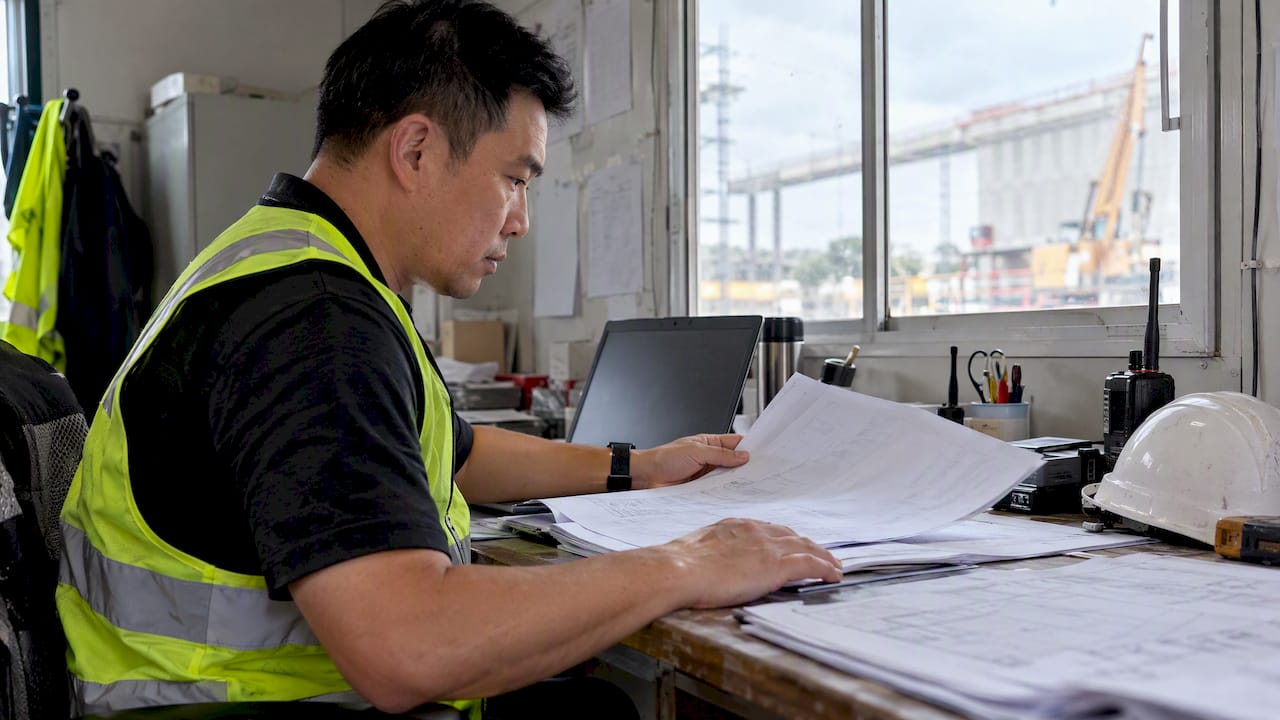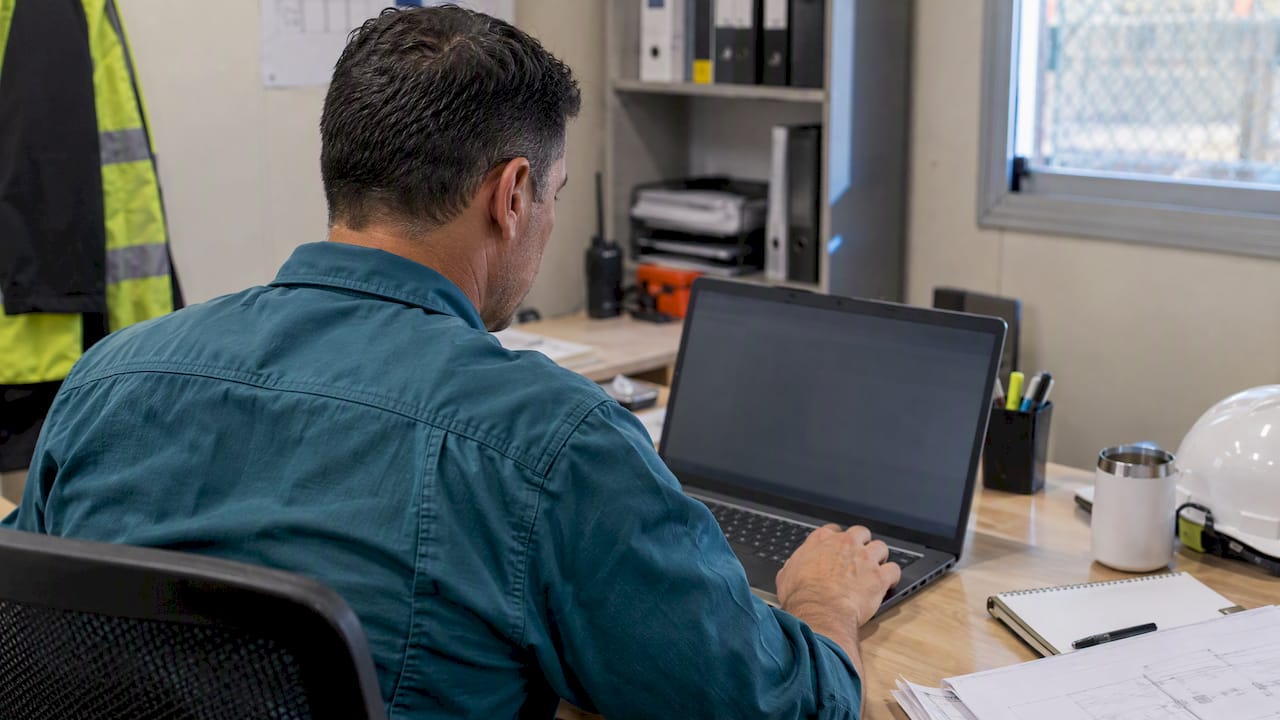

Incident investigation in construction prevents repeat accidents by identifying root causes and fixing systems, not blaming individuals. OSHA’s guidance is unambiguous: investigations that stop at fault-finding miss the systemic failures that will produce the next incident. The standard, defensible framework is a four-step systems approach — preserve the scene, collect information, determine root causes, implement corrective actions — and every construction safety professional should be able to execute it without hesitation.
Why incident investigation in construction is non-negotiable:
- Prevent recurrence. Root-cause analysis surfaces the program-level deficiencies behind individual events, breaking the cycle of repeat incidents.
- Meet OSHA expectations. Federal regulators expect documented investigations with assigned corrective actions; absence of records is itself a compliance liability.
- Avoid financial exposure. Litigation costs, insurance premium increases, project shutdowns, and repeat remediation typically exceed OSHA fines by a wide margin.
- Build a learning culture. Transparent, non-punitive investigations signal to the workforce that the organization treats safety as a systemic obligation, not a disciplinary mechanism.
Table of Contents
- What incident investigation actually means on a construction site
- How OSHA’s four-step approach maps to construction incidents
- Step-by-step on-site investigation actions for site managers
- Which root-cause analysis technique fits your construction investigation
- What typical construction investigations actually find: three case vignettes
- Who belongs on the investigation team and what each role does
- What the incident report must include and when each section is due
- Turning investigation findings into lasting prevention
- The business case for rigorous incident investigations
- How MOSAIC supports incident investigations for construction clients
- Key Takeaways
- The investigation gap that costs construction firms the most
- MOSAIC’s investigation support services for construction clients
- Authoritative sources and further reading
What incident investigation actually means on a construction site
Incident investigation is a structured, evidence-based process for determining why an unplanned event occurred and what organizational conditions allowed it. The operative word is why, not who. On a construction site, that distinction matters enormously in practice: a worker who slipped on an unguarded floor opening is not the root cause; the absence of a fall-protection inspection protocol is.
The primary objectives are fourfold: prevent recurrence by correcting system deficiencies; satisfy OSHA’s expectation of documented corrective action; protect workers from foreseeable harm; and preserve contemporaneous evidence that may be required for insurance claims, litigation, or regulatory review. Each objective reinforces the others. An investigation that achieves genuine root-cause resolution simultaneously satisfies the compliance record requirement and reduces the evidentiary exposure that drives litigation costs.
Near misses and low-consequence events deserve the same investigative rigor as recordable injuries. CCOHS guidance makes the case plainly: near misses share the same causal chain as serious incidents but occur before harm materializes, creating a window for candid analysis and corrective action that a fatality investigation never affords. On active construction sites, where hazard density is high and conditions change daily, near-miss investigation is among the highest-leverage prevention activities available to a safety team.
How OSHA’s four-step approach maps to construction incidents
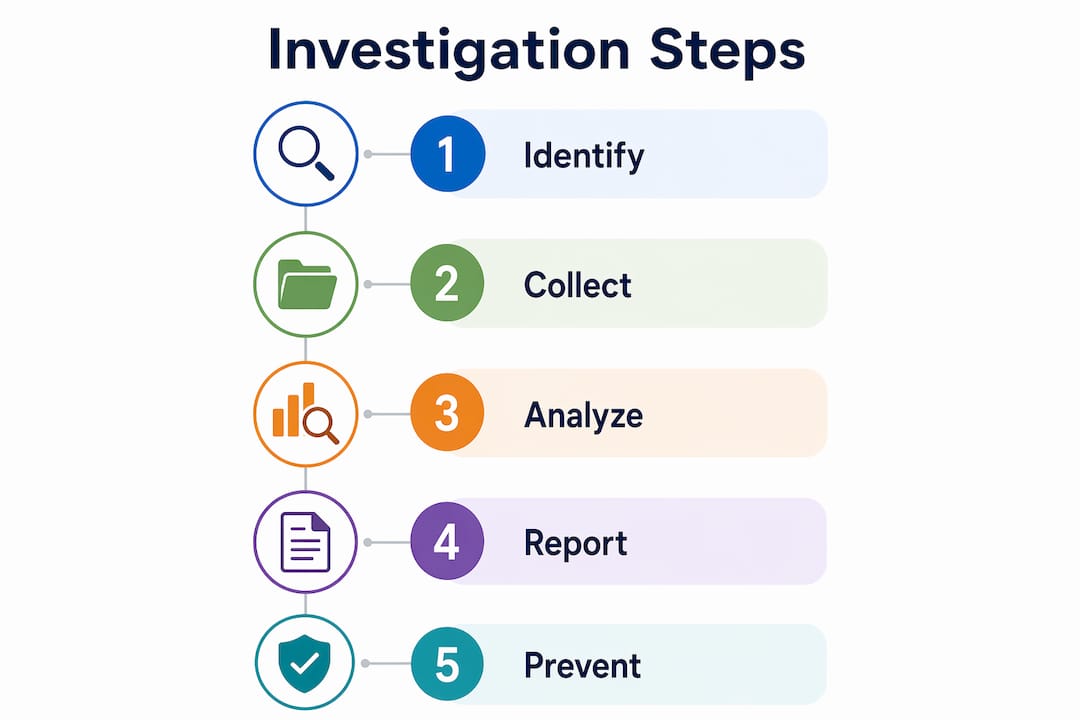
OSHA’s four-step systems approach provides the authoritative process framework that construction safety teams are expected to follow. Each step carries specific field requirements that differ from generic corporate investigation protocols.
-
Preserve and document the scene. Render medical aid first, then secure the area to prevent evidence loss or secondary injury. Photograph the scene before anything is moved. Mark the positions of equipment, materials, and personnel with cones or tape. Restrict access to authorized investigation team members only.
-
Collect information. Gather physical evidence (tools, PPE, materials, equipment), review relevant records (inspection logs, permits, training records, maintenance histories), and conduct structured witness interviews as early as possible. Memory degrades rapidly; interviews delayed beyond 24 hours produce materially less reliable accounts.
-
Determine root causes. Apply a systematic root-cause analysis method — 5 Whys, Ishikawa fishbone, or a fault/event tree for complex incidents — to trace the causal chain from the immediate event back to the program-level conditions that permitted it. OSHA’s root-cause guidance explicitly warns against stopping at the proximate cause; doing so leaves the underlying system failure intact.
-
Implement corrective actions with owners and deadlines. Each identified root cause must map to a specific corrective action, an accountable owner, a completion deadline, and a verification method. Investigations are not complete until those actions are confirmed effective.
Statistic callout: OSHA’s root-cause analysis publication notes that thorough root-cause analysis prevents recurrence and yields financial benefits by avoiding litigation, insurance increases, project shutdowns, and repeat remediation costs that typically exceed OSHA fines.
Pro Tip: Assemble the investigation team within two hours of the incident, before witnesses disperse and before site supervisors inadvertently consolidate a single narrative. Premature convergence on one explanation is the most common cause of shallow root-cause analysis on construction sites.
Step-by-step on-site investigation actions for site managers
The first minutes after an incident determine the quality of everything that follows. A disciplined sequence prevents evidence loss and protects the investigation’s defensibility.
Immediate priorities (first 30 minutes):
- Activate emergency response and confirm medical aid is en route or rendered.
- Designate a scene control perimeter; assign one person to enforce it.
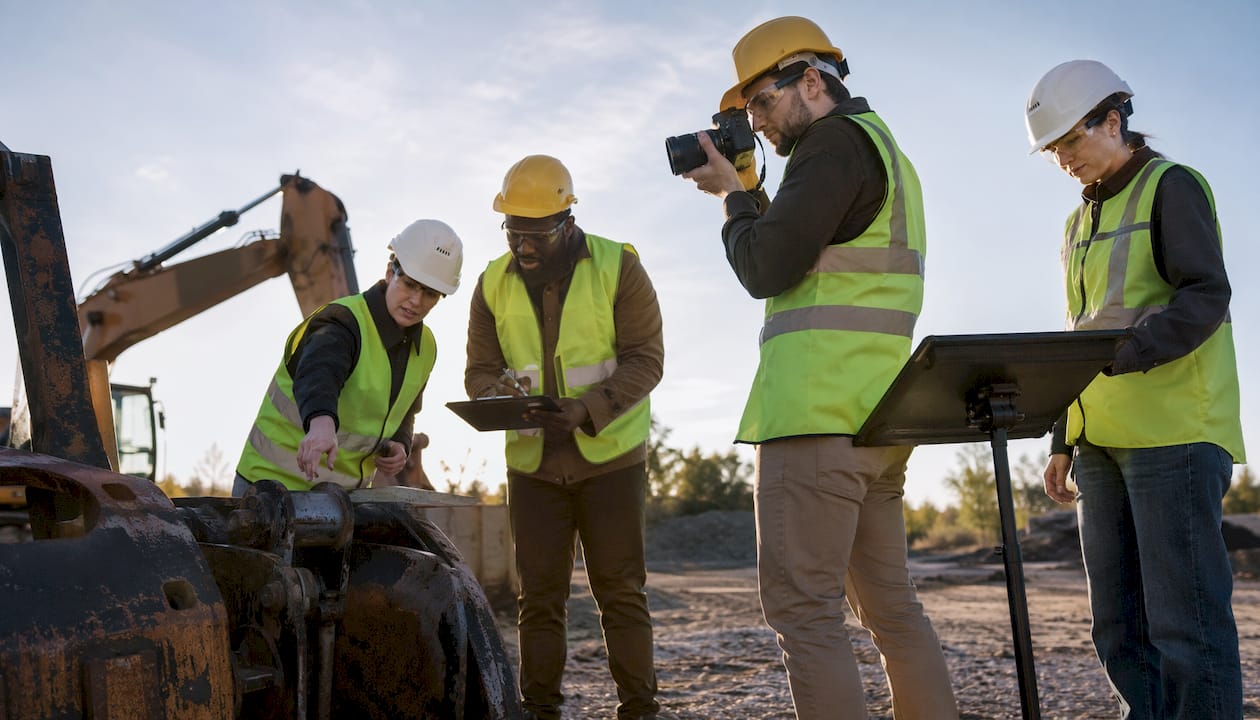
- Photograph the scene comprehensively before any cleanup or repositioning: wide establishing shots, mid-range context shots, and close-up detail shots of every relevant surface, tool, and piece of equipment.
- Record measurements: distances between objects, heights of fall points, clearances, and equipment positions.
- Collect physical evidence (PPE worn, tools used, materials involved) and label each item with location, time, and collector’s name.
Witness interview approach:
Separate witnesses before interviewing them to prevent cross-contamination of accounts. Interview each person individually, beginning with open-ended questions (“Walk me through what you observed from the beginning”) before moving to specific who/what/when/where/why/how probes. Marsh McLennan Agency guidance recommends collecting signed statements from all witnesses, and also from workers present on site who did not directly observe the event. Those “no direct knowledge” statements prevent contradictory testimony from emerging later and substantially strengthen the investigation’s legal defensibility.
Documentation practices:
- Label every photograph with a sequential number, GPS coordinates or grid reference, and timestamp.
- Maintain a chain-of-custody log for physical evidence.
- Use a short-form field checklist (scene secured, photos taken, measurements recorded, witnesses identified, evidence collected) to confirm completeness before leaving the scene.
Construction safety technology — time-stamped photo capture apps, digital evidence repositories, and cloud-based incident logs — significantly speeds evidence preservation and reduces the risk of losing perishable site data.
Pro Tip: Never allow the site supervisor who was directly responsible for the work area to lead the scene documentation. That individual is a witness and potentially a subject of the investigation; their involvement in evidence collection creates a conflict that undermines the record’s credibility.
Which root-cause analysis technique fits your construction investigation
Root-cause analysis is not a single method; it is a family of techniques with different levels of rigor, resource requirements, and applicability. Selecting the right tool for the incident type is itself a professional judgment.
| RCA Method | Best For | Complexity | Typical Construction Application |
|---|---|---|---|
| 5 Whys | Single-factor incidents, near misses | Low | Slip/trip events, tool misuse, PPE non-compliance |
| Ishikawa (fishbone) | Multi-factor incidents with several contributing causes | Medium | Scaffold failures, equipment incidents with multiple causal branches |
| Fault/event tree | Complex, high-consequence incidents with probabilistic branching | High | Structural collapses, crane failures, multi-fatality events |
| Timeline/sequence diagram | Incidents where timing and sequence are disputed | Medium | Struck-by events, material handling incidents with multiple parties |
5 Whys example — scaffold slip incident:
- Why did the worker slip? The scaffold platform was wet.
- Why was the platform wet? Rain had accumulated overnight and no pre-shift inspection was conducted.
- Why was no pre-shift inspection conducted? The inspection checklist did not include a wet-weather protocol.
- Why was there no wet-weather protocol? The site safety plan was not updated after the project entered an outdoor phase.
- Why was the safety plan not updated? No formal trigger exists for plan review when project scope changes.
The corrective action at step five — a formal scope-change review trigger — addresses the root cause. Stopping at step one produces only a “clean the platform” instruction, which does nothing to prevent the next rain event.
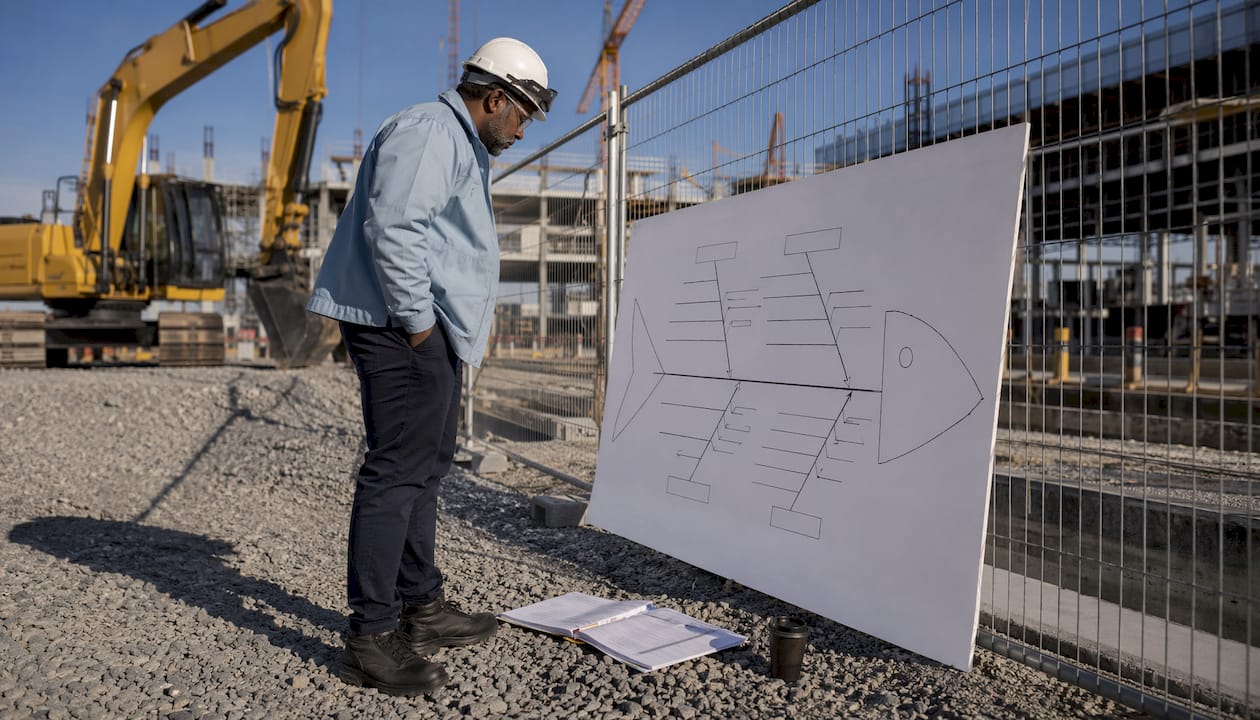
The Ishikawa fishbone diagram is particularly effective when a construction incident involves simultaneous failures across multiple categories: equipment condition, supervision, training, materials, environment, and procedure. Mapping causes visually onto the fishbone structure prevents the investigation team from fixating on a single causal branch and missing contributing factors in adjacent categories.
For catastrophic events, OSHA and EPA guidance under Process Safety Management and Risk Management Program frameworks requires formal root-cause analysis using fault or event trees, given the potential for multi-fatality or community-impact consequences.
What typical construction investigations actually find: three case vignettes
Understanding common root-cause patterns accelerates recognition on your own site. The following vignettes reflect the types of findings that recur across construction incident investigations.
Vignette 1: Scaffold fall due to missing guardrail
- Immediate cause: Worker fell 12 feet from an unguarded scaffold edge.
- Root causes: Guardrail was removed to facilitate material loading and not reinstated; no re-inspection was required before work resumed; the permit-to-work system did not cover temporary guardrail removal.
- Corrective actions: Revise the permit-to-work procedure to require guardrail reinstatement sign-off before resuming work at height; assign the site safety officer as owner; complete within 14 days.
- Lesson: Temporary modifications to fall-protection systems are among the highest-risk activities on any site. Procedures must explicitly govern reinstatement, not assume it.
Vignette 2: Equipment crush from lockout/tagout bypass
- Immediate cause: Worker’s hand was caught in a concrete mixer while performing maintenance.
- Root causes: The lockout/tagout procedure was posted but not enforced during maintenance tasks under time pressure; supervisors had implicitly accepted bypass as a productivity accommodation; training records showed the procedure had not been refreshed in over two years.
- Corrective actions: Mandatory LOTO refresher training for all maintenance-adjacent workers; supervisory accountability added to the LOTO audit checklist; unannounced LOTO compliance audits quarterly.
- Lesson: Procedural non-compliance that supervisors tolerate becomes the de facto standard. Investigations must examine supervisory behavior, not only worker behavior.
Vignette 3: Near miss during manual material handling
- Immediate cause: A bundle of rebar shifted during manual carry, narrowly missing a second worker.
- Root causes: No task-specific lift plan existed for the rebar bundle size; workers had not been briefed on the two-person carry requirement; the construction hazard examples relevant to manual handling had not been incorporated into the site’s daily toolbox talk rotation.
- Corrective actions: Develop a manual handling matrix specifying team-lift thresholds by load weight and geometry; integrate into pre-task planning.
- Lesson: Near misses in material handling are frequently dismissed as “almost nothing happened.” They are, in fact, the highest-value investigation targets because the causal chain is intact and no one is injured, allowing candid witness accounts.
Who belongs on the investigation team and what each role does
Team composition is not a formality. OSHA’s guidance is explicit that investigations should be a collaborative effort involving both managers and employees, because frontline workers possess operational knowledge that supervisors and safety specialists do not. Inclusive teams surface practical corrective actions that the workforce will actually accept and implement.
| Role | Responsibility | Required For |
|---|---|---|
| Team lead (safety specialist or senior manager) | Directs the investigation, maintains scope, produces the final report | All incidents |
| Operations representative | Provides process and task-specific knowledge; validates findings | All incidents |
| Frontline worker / trade representative | Surfaces practical realities of the work; validates corrective-action feasibility | All incidents |
| Technical expert (structural, mechanical, electrical) | Analyzes equipment or structural failure modes | Moderate to serious incidents |
| Legal / HR representative | Advises on privilege, documentation standards, and employment implications | Serious injuries, fatalities, regulatory notifications |
For minor incidents and near misses, a three-person team (team lead, operations rep, and one frontline worker) is generally sufficient. Serious injuries and fatalities warrant the full composition above, with legal counsel engaged from the outset to assess privilege considerations.
Collaborative planning approaches in construction consistently demonstrate that inclusive team structures produce more implementable outcomes than top-down investigations, precisely because the workers who must execute corrective actions have had a hand in designing them.
Confidentiality guidance: witness statements and interview notes should be treated as investigation records, not general site documents. Restrict distribution to team members and designated reviewers. Where a union is present, the worker representative’s role should be defined in the site’s safety management system before an incident occurs, not improvised afterward.
A transparent, non-punitive investigation approach also builds worker trust and improves morale. When workers believe that reporting an incident will trigger a systems review rather than a disciplinary action, reporting rates improve and the organization gains access to the near-miss data it needs to prevent serious harm.
What the incident report must include and when each section is due
A defensible incident report is not a narrative summary; it is a structured evidentiary document with discrete sections, each serving a specific legal, regulatory, or operational purpose.
Sample report outline:
- Executive summary: One-page synopsis of the incident, root causes, and corrective actions for leadership distribution.
- Incident description: Date, time, location, work activity, personnel involved, and a factual sequence of events.
- Evidence inventory: Photographs (numbered and labeled), physical evidence log, equipment inspection records, and relevant permits or work orders.
- Witness statements: Signed individual statements, including “no direct knowledge” statements from workers present on site.
- Root-cause analysis: The RCA method used, the causal chain documented, and the program-level deficiencies identified.
- Corrective actions: Each action mapped to a root cause, with owner, deadline, priority level, and verification method.
- Verification plan: Scheduled follow-up dates, responsible reviewer, and criteria for confirming effectiveness.
Typical investigation timeline:
- Immediate (0–2 hours): Scene secured, medical aid confirmed, team assembled, evidence collection initiated.
- 24–72 hours: Preliminary incident report completed; witness interviews finalized; physical evidence secured.
- 7–14 days: Full root-cause analysis complete; corrective actions assigned with owners and deadlines.
- 30 days: Initial corrective actions verified as implemented; report distributed to leadership.
- 60–90 days: Effectiveness verification completed; lessons-learned summary fed into safety program and toolbox talk schedule.
Document retention: OSHA’s recordkeeping regulations require employers to retain OSHA 300 logs and related records for five years. Investigation files should be retained for the same period at minimum; legal counsel may advise longer retention for serious injury or fatality cases.
Turning investigation findings into lasting prevention
Corrective action management is where most construction investigations fail. The root-cause analysis is completed, the report is filed, and the actions are never verified. OSHA’s guidance is unambiguous: an investigation is not complete until corrective actions are assigned, owned, and confirmed effective.
Corrective action template fields:
- Description of the action required
- Root cause it addresses (mapped explicitly)
- Accountable owner (named individual, not a department)
- Completion deadline
- Priority level (immediate, short-term, long-term)
- Verification method (physical inspection, training record review, audit, etc.)
- Verification date and reviewer
Verification and metrics:
- Track corrective action closure rate as a leading indicator; a rate below 90% within the assigned deadline signals a systemic follow-through problem.
- Monitor time-to-verify as a measure of investigation quality; actions that remain unverified 30 days past their deadline are effectively abandoned.
- Track recurrence rate for incident types that have previously generated corrective actions; recurrence is the clearest evidence of learning failure.
Lessons learned should be reported to project leadership in a brief, structured format: what happened, what the root causes were, what was changed, and what other site teams should check. Feeding findings into the toolbox talk schedule, the site safety management system, and the next pre-task planning cycle converts a single investigation into organization-wide prevention.
Pro Tip: Assign corrective action verification to someone other than the action owner. Self-verification is a structural conflict of interest and produces optimistic closure rates that mask incomplete implementation.
Organizations that treat incidents as indicators of program failure rather than individual error are significantly more likely to implement organizational-level changes that prevent recurrence. This is the central finding of research on learning failure and incident repetition: the distinction between “worker error” and “system failure” is not semantic; it determines whether the corrective action addresses the cause or merely reassigns blame.
The business case for rigorous incident investigations
The financial argument for thorough construction safety investigations is grounded in cost avoidance across multiple categories, not merely OSHA fine mitigation.
Direct cost avoidance:
- Litigation and workers’ compensation claims represent the largest single cost category; a well-documented investigation with verified corrective actions substantially reduces both exposure and settlement value.
- Insurance premium increases following a recordable incident can persist for three to five policy cycles; a demonstrated corrective-action program is the primary mechanism for moderating that trajectory.
- Project shutdown costs during an OSHA inspection or regulatory review can exceed the cost of the investigation itself by orders of magnitude.
Indirect and program-level benefits:
- Reduced repeat incidents translate directly to fewer project delays, lower subcontractor turnover, and improved bid competitiveness on safety-prequalified contracts.
- A documented investigation program supports Design for Safety integration by feeding field findings back into design-phase hazard reviews.
- Reputational gains with owners, developers, and public-sector clients who require safety performance data as a prequalification criterion are increasingly material to contract award decisions.
Regulatory compliance note: OSHA’s General Duty Clause requires employers to provide a workplace free from recognized hazards. A documented investigation program is the primary evidentiary basis for demonstrating that the employer identified and corrected hazards in a timely manner. For facilities subject to Process Safety Management (29 CFR 1910.119) or EPA Risk Management Program requirements, formal root-cause analysis is a regulatory obligation, not merely a best practice.
Statistic callout: OSHA’s root-cause analysis guidance identifies litigation costs, insurance increases, project shutdowns, and repeat remediation expenses as the primary financial drivers that make thorough investigation economically superior to superficial fault-finding, even before OSHA penalties are considered.
The best ways to reduce site incidents consistently include investigation-driven corrective action programs as a foundational element, precisely because they address root causes rather than symptoms.
How MOSAIC supports incident investigations for construction clients
MOSAIC Ecoconstruction Solutions provides end-to-end incident investigation support for construction clients, from immediate on-site response through final corrective-action verification and management briefing. The service portfolio is structured to address the full investigation lifecycle.
Core investigation services:
- On-site investigation support: deployment of qualified safety specialists to the incident scene within agreed response windows to lead or co-lead the investigation team.
- Report drafting: preparation of structured, legally defensible incident investigation reports incorporating all required evidentiary sections.
- Root-cause analysis facilitation: structured facilitation of 5 Whys, Ishikawa fishbone, and fault/event tree analyses with the client’s investigation team.
- Corrective-action tracking: implementation of a tracked corrective-action register with owner assignments, deadlines, and verification scheduling.
- Management briefings: preparation and delivery of executive-level summaries and lessons-learned presentations for project leadership and board-level stakeholders.
Adjacent services that strengthen investigation programs:
- QES audits and site inspection programs that generate the baseline documentation investigations rely on.
- Design for Safety advisory, which integrates investigation findings into design-phase hazard reviews to prevent recurrence at the source.
- BizSAFE and ISO certification support, ensuring investigation programs meet the documentary and procedural standards required for certification maintenance.
- Training and competency development for site managers and safety officers in investigation methodology, RCA techniques, and corrective-action management.
MOSAIC’s approach to improving contractor safety culture positions incident investigation not as a reactive compliance obligation but as the primary mechanism through which construction organizations learn, adapt, and build the systemic resilience that distinguishes high-performing safety programs from compliant-but-static ones.
Key Takeaways
Incident investigation in construction is the primary mechanism for preventing repeat accidents: it identifies root causes, produces verified corrective actions, satisfies OSHA expectations, and converts individual events into organization-wide safety improvements.
| Point | Details |
|---|---|
| Investigate every incident and near miss | Near misses share the same causal chain as serious injuries; investigating them prevents harm before it occurs. |
| Follow OSHA’s four-step systems approach | Preserve the scene, collect information, determine root causes, and implement verified corrective actions with named owners and deadlines. |
| Use the right RCA method for the incident type | Apply 5 Whys for simple events, Ishikawa fishbone for multi-factor incidents, and fault/event trees for complex or high-consequence failures. |
| Verify corrective actions before closing the investigation | OSHA’s guidance is explicit: an investigation is not complete until corrective actions are confirmed effective, not merely assigned. |
| MOSAIC provides full-cycle investigation support | From on-site response and root-cause facilitation to report drafting and corrective-action tracking, MOSAIC supports construction clients at every stage. |
The investigation gap that costs construction firms the most
The conventional wisdom in construction safety holds that the hardest part of incident investigation is the root-cause analysis. In practice, the hardest part is resisting the organizational pressure to close the investigation quickly and return to production.
Premature closure is the dominant failure mode in construction incident investigations. A team assembles, identifies an immediate cause, assigns a corrective action to a supervisor, and files the report within 48 hours. The action is never verified. The next incident, often months later, has an identical causal chain. This pattern is not a failure of analytical method; it is a failure of organizational will. The 5 Whys technique is straightforward. Sustaining the investigation through five levels of “why” when the third level implicates a management decision is where most teams stop.
The systems-based, non-punitive approach that OSHA advocates is not primarily a methodological choice; it is a cultural one. When workers trust that an investigation will examine systems rather than assign blame, they provide the candid, detailed accounts that make genuine root-cause analysis possible. When they expect punishment, they provide the minimum information required to satisfy the record. The quality of the investigation is therefore a direct function of the safety culture that precedes it. Organizations that invest in transparent investigation practices are not merely complying with OSHA expectations; they are building the informational infrastructure that makes prevention possible.
MOSAIC’s investigation support services for construction clients
Construction firms that have experienced a recordable incident, a near miss with serious potential, or a regulatory inquiry face a specific, time-sensitive challenge: producing a defensible, root-cause-complete investigation record while simultaneously managing site operations and stakeholder communications. MOSAIC Ecoconstruction Solutions addresses that challenge directly.

MOSAIC’s QESH consultancy services cover the full investigation lifecycle: on-site specialist deployment, structured root-cause facilitation, legally defensible report drafting, corrective-action register management, and executive briefing preparation. For clients seeking to build internal investigation capability rather than outsource it, MOSAIC delivers targeted training programs in investigation methodology, RCA techniques, and corrective-action verification for site managers and safety officers.
The practical next step is a consultation to assess your current investigation program against OSHA’s four-step systems framework and identify the specific gaps that represent the greatest compliance and financial exposure. Contact MOSAIC to request a program assessment or to discuss on-site investigation support for a current incident.
Authoritative sources and further reading
The following primary sources and reference materials underpin the guidance in this article and provide additional depth for safety teams building or refining investigation programs.
- OSHA Incident Investigation Guide for Employers: The authoritative four-step systems approach framework, including scene preservation, information collection, root-cause determination, and corrective-action implementation. Includes field checklists and report templates.
- OSHA Root Cause Analysis Publication (OSHA3895): Detailed guidance on RCA methodology, financial justification for thorough investigation, and PSM/RMP applicability. Essential reference for safety specialists conducting formal investigations.
- OSHA Incident Investigation Overview: Summary page covering team-based investigation principles, non-punitive approach guidance, and links to sector-specific resources.
- Canadian Centre for Occupational Health and Safety (CCOHS) — Incident Investigation: Comprehensive procedural guidance on near-miss investigation, evidence collection, and causal analysis; particularly strong on the near-miss rationale.
- Construction Safety Research Alliance (CSRA): Research-based resources on construction-specific investigation methods, causal taxonomies, and prevention strategies developed for the U.S. construction sector.
- Marsh McLennan Agency — Strong Accident Investigation Guide: Practical guidance on scene control, photography protocols, witness statement collection, and signed “no direct knowledge” statements for construction projects.
- MDPI — Learning Failure and Incident Repetition Research: Peer-reviewed research on organizational learning failure as a driver of incident recurrence; supports the systems-over-blame argument with empirical evidence.