
Contractor prequalification is defined as the systematic screening process construction professionals use to evaluate a contractor’s safety record, financial stability, insurance coverage, licenses, and operational capacity before awarding contracts or issuing bid invitations. The formal industry term is “contractor prequalification,” and it functions as a front-end risk control mechanism embedded within project procurement frameworks. Regulatory bodies including OSHA, state Departments of Transportation, and international standards bodies such as ISO have all recognized prequalification as a core due diligence requirement. When applied rigorously, formal prequalification programs report up to a 40% reduction in worksite incidents. That figure alone signals why this process deserves far more than administrative attention.
What is contractor prequalification and what data does it require?
Contractor prequalification is the structured process of collecting, verifying, and scoring a contractor’s credentials before they are permitted to bid on or perform work. The goal is not paperwork compliance. The goal is to build a trustworthy contractor pool capable of executing specific work scopes without creating safety, financial, or schedule risk for the project owner.
The primary intake document is the Prequalification Questionnaire, commonly abbreviated as PQQ. The PQQ standardizes data collection across all contractors and creates a consistent basis for comparison. Without a standardized form, evaluators compare apples to oranges, and critical gaps go undetected.
The core data categories collected in a PQQ include:
- Financial statements. Audited or reviewed financials for the past two to three years, including balance sheets, income statements, and bonding capacity letters from surety agents.
- Insurance documentation. Certificates of insurance with endorsements confirming general liability, workers’ compensation, and umbrella coverage at required limits.
- Safety metrics. Experience Modification Rate (EMR), OSHA 300 logs, total recordable incident rate (TRIR), and a written description of the contractor’s safety program.
- Licenses and certifications. Jurisdiction-specific contractor licenses, trade certifications, and any statutory safety certifications such as BizSAFE in Singapore.
- Project history and references. A list of completed projects of comparable scope, with owner and project manager contacts for direct verification.
- Operational capacity. Current workload, key personnel, equipment inventory, and subcontracting practices.
Each category carries weight in the final scoring model. Financial data protects against mid-project insolvency. Safety metrics predict incident probability. Operational capacity confirms the contractor can actually staff and execute the work.
Pro Tip: Request a current bonding capacity letter, not just a certificate of insurance. The bonding letter reveals the contractor’s aggregate and single-project limits, which directly indicates their financial ceiling for project execution.

How is the contractor prequalification process conducted?
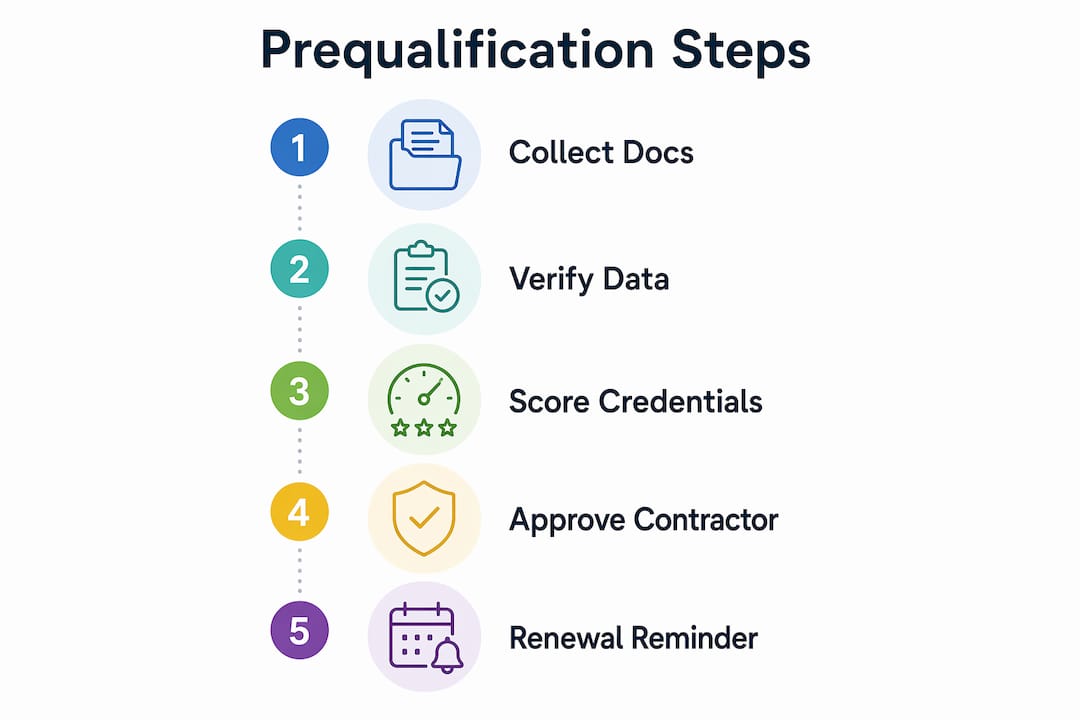
The standard prequalification process follows five core phases: defining evaluation criteria, distributing the PQQ, verifying submitted data, scoring and assigning approval tiers, and maintaining annual renewals. Each phase builds on the last, and skipping any one of them creates measurable risk.
-
Define evaluation criteria. Before distributing any questionnaire, the project owner or general contractor must establish minimum thresholds. These include EMR limits (commonly 1.0 or below), minimum bonding capacity, required licenses, and any project-specific certifications. Criteria must be documented and applied consistently to every applicant.
-
Distribute the PQQ. The questionnaire goes to all contractors being considered for the approved list. A defined submission deadline and a clear point of contact for questions are non-negotiable. Ambiguous submission processes produce incomplete responses that delay evaluation.
-
Verify submitted data. This phase separates rigorous programs from superficial ones. Verification means contacting bonding agents, calling licensing boards, and speaking directly with project references. Calling bonding agents and references is the most reliable method to confirm that self-reported data is accurate. A contractor who inflates their bonding capacity or omits an OSHA citation will not survive direct verification.
-
Score and assign approval tiers. Scoring models typically weight safety metrics, financial strength, and project experience. Tier assignment determines which work types and contract values a contractor is approved for. A contractor approved for Tier 1 may handle projects up to $500,000, while Tier 3 approval covers complex, multi-million-dollar scopes. Tier structures prevent over-awarding contracts to contractors who lack the capacity to perform.
-
Maintain annual renewals. Annual renewal with a Q1 submission target is the standard industry practice. Contractors who miss the renewal deadline are suspended from the active bid list until they resubmit and are re-evaluated. Off-cycle requalification is triggered by major safety incidents, project failures, or significant changes in financial condition.
Most prequalification programs fail on maintenance. Lacking automated alerts leads to outdated records and allows unqualified contractors to remain on active bid lists. A management system with automated expiration alerts is not optional for programs managing more than a dozen contractors.
Pro Tip: Set automated calendar reminders 90 days before each contractor’s renewal deadline. This gives both your team and the contractor enough lead time to gather updated financials, insurance certificates, and OSHA logs without last-minute scrambling.
Why is contractor prequalification critical for safety and project success?
Prequalification is a fundamental safety control and due diligence measure, not an administrative formality. It shifts risk management upstream, before a single worker sets foot on site. That upstream positioning is what makes it so effective.
“The goal of prequalification is to build an approved contractor list capable of performing their work scope, thereby preventing failure modes such as schedule delays, cost overruns, and worksite incidents before they occur.”
The safety case is direct. Organizations with formal prequalification programs report up to 40% fewer worksite incidents compared to those without structured vetting. Fewer incidents mean lower workers’ compensation costs, protected EMR scores, and reduced exposure to OSHA penalties. A single recordable incident can push a contractor’s EMR above 1.0, triggering exclusion from future bids on major projects.
The financial and schedule case is equally compelling:
- Upstream filtering removes contractors who lack the bonding capacity or manpower to complete the scope, preventing mid-project defaults.
- Approved contractor pools reduce bid preparation time because owners already know every invited contractor meets baseline standards.
- Contractual risk transfer is cleaner when prequalification documentation confirms insurance limits and license validity before contract execution.
- Regulatory compliance is easier to demonstrate when prequalification records show documented due diligence, which matters during OSHA inspections or post-incident investigations.
Connecting site incident reduction strategies to prequalification programs creates a layered defense. No single control eliminates risk, but prequalification removes the most predictable failure modes before they reach the field.
What are common pitfalls in contractor prequalification programs?
The most common failure in prequalification is accepting self-reported data without independent verification. A contractor can submit a clean PQQ while concealing OSHA citations, lapsed licenses, or inflated bonding figures. Verification strategies must include direct contact with bonding agents, state licensing boards, and project references, not just a review of submitted documents.
Relying solely on EMR as a safety indicator is another documented weakness. A clean EMR alone is insufficient for assessing true safety risk. A contractor may have a low EMR due to underreporting or a favorable claims history in low-risk work, while their actual safety program lacks training documentation, leadership engagement, and hazard identification protocols. Evaluating the internal safety program alongside EMR and OSHA data provides a far more accurate risk picture.
Capability fit is often overlooked by programs that focus exclusively on financial and safety gatekeeping. A contractor may pass every financial and safety threshold but lack the specialized equipment, certified personnel, or project management experience required for the specific scope. Capability fit assessment must be built into the scoring model as a distinct criterion.
Key pitfalls to address in any prequalification program:
- Accepting self-reported financials without audited statements or bonding agent confirmation
- Using EMR as the sole safety metric without reviewing OSHA logs, TRIR, and safety program documentation
- Failing to define clear disqualifying thresholds, such as an EMR above 1.0 or an unresolved OSHA willful citation
- Allowing expired prequalifications to remain on active bid lists due to absent renewal tracking
- Skipping capability fit review for project-specific technical requirements
Pro Tip: Build a one-page capability fit matrix for each project type. List the specific equipment, certifications, and personnel roles required. Score every contractor against this matrix separately from the standard PQQ scoring. It takes 30 minutes per contractor and prevents the most expensive mismatches.
Connecting prequalification to a broader construction site risk assessment framework reinforces the program’s integrity. Prequalification is one layer of a multi-control safety system, not a standalone solution.
Key Takeaways
Contractor prequalification is the most cost-effective front-end control available to construction professionals, reducing incidents, protecting project budgets, and ensuring regulatory compliance before work begins.
| Point | Details |
|---|---|
| Define thresholds first | Set EMR limits, bonding minimums, and license requirements before distributing any questionnaire. |
| Verify, do not just collect | Contact bonding agents, licensing boards, and references to confirm all self-reported data. |
| Score capability fit separately | Assess project-specific technical requirements beyond standard financial and safety metrics. |
| Enforce annual renewal deadlines | Suspend contractors from bid lists immediately when renewal deadlines pass without resubmission. |
| Treat prequalification as safety control | Formal programs report up to 40% fewer worksite incidents compared to unstructured vetting. |
Prequalification is a front-end control, not a filing exercise
The construction industry has a persistent habit of treating prequalification as a procurement formality rather than a safety and quality assurance mechanism. I have seen projects where the prequalification file was complete and the contractor still failed spectacularly, because no one verified the data, the capability fit was never assessed, and the renewal had lapsed by eight months before the contract was awarded.
What I have found actually works is treating the prequalification program as a living system. That means automated renewal alerts, a dedicated reviewer who calls references rather than just reading them, and a capability fit matrix that gets updated for every new project type. The paperwork is the least important part. The discipline behind it is everything.
The other insight that rarely appears in standard guidance is this: prequalification protects the contractor too. A contractor who is genuinely qualified benefits from a process that filters out undercapitalized competitors who win on price and then fail on delivery. Rigorous prequalification raises the floor for everyone on the approved list.
Integrating prequalification with design-stage risk management creates the strongest possible safety posture. When the contractors executing the work were screened against the same risk profile used to design the project, alignment between design intent and field execution improves measurably. That connection is underutilized in most programs.
Automated tools for managing prequalification data are no longer optional for programs of any meaningful scale. The cost of a missed renewal is always higher than the cost of the system that prevents it. Adopt the tools, enforce the deadlines, and treat every PQQ as a risk document, not a compliance checkbox.
— Aman
How Com supports contractor prequalification and site safety compliance
Construction professionals managing contractor qualification programs need more than a checklist. They need a consultancy partner who understands the regulatory environment, the documentation requirements, and the audit standards that govern contractor selection in Singapore and the broader region.

Com provides safety consultancy services tailored for construction compliance, including support for contractor vetting frameworks, BizSAFE certification guidance, and safety audit programs that align with statutory requirements. Com’s team conducts safety audits that verify contractor safety program quality beyond surface-level documentation, giving project owners the independent assurance their prequalification programs require. Contact Com to build a contractor qualification framework that holds up under regulatory scrutiny.
FAQ
What is contractor prequalification in construction?
Contractor prequalification is the structured process of evaluating a contractor’s safety record, financial stability, insurance, licenses, and operational capacity before awarding contracts or issuing bid invitations. It functions as a front-end risk control that filters unqualified contractors before work begins.
What documents are required for contractor prequalification?
Standard contractor qualification requirements include audited financial statements, certificates of insurance with endorsements, OSHA 300 logs, EMR documentation, jurisdiction-specific licenses, and a completed project history with verifiable references.
How often should contractor prequalification be renewed?
Annual renewal with a Q1 submission target is the standard industry practice. Contractors who miss the renewal deadline should be suspended from active bid lists until they resubmit and pass re-evaluation.
Why is EMR not enough as a safety metric?
EMR reflects past claims history but does not reveal the quality of a contractor’s current safety program. Evaluating safety program documentation, leadership engagement, and training records alongside EMR provides a more accurate assessment of actual safety risk.
What triggers off-cycle requalification?
Major worksite incidents, project failures, significant changes in financial condition, or lapsed insurance coverage all trigger off-cycle requalification. Any event that materially changes a contractor’s risk profile warrants immediate re-evaluation outside the standard annual cycle.