A subcontractor safety compliance checklist is defined as a structured verification tool that confirms every subcontractor on a construction site meets applicable OSHA standards, holds valid credentials, and follows documented safety protocols before and during work. Construction accounts for about 20% of workplace deaths despite representing only 8% of the workforce. That disparity makes systematic compliance verification not a procedural formality but a legal and moral obligation. OSHA penalties for willful violations reach up to $170,181 per violation as of 2026, and general contractors bear direct liability for subcontractor failures under the Multi-Employer Citation Policy. A well-structured safety checklist for subcontractors is the primary instrument for closing that liability gap.
What does a subcontractor safety compliance checklist require?
The foundational layer of any compliance program is documentation. Before a subcontractor sets foot on site, the general contractor must collect and verify a defined set of records. This “hard gate” approach, where paperwork is confirmed before contract execution, reduces OSHA liabilities and establishes the audit trail that regulators expect during inspections.
The core documents required for a complete subcontractor safety compliance checklist include:
- Business license and insurance certificates (general liability, workers’ compensation, and umbrella coverage)
- Company safety policy and site-specific safety plan
- OSHA 10-hour or OSHA 30-hour training cards for workers and supervisors respectively
- Competent person designations for excavation, scaffolding, and fall protection under 29 CFR 1926
- Trade-specific certifications such as IPAF for elevated work platforms and PASMA for mobile scaffold towers
- First aid and CPR certifications for at least one worker per crew
- Equipment inspection logs and operator licenses for cranes, forklifts, and aerial lifts
Each document carries a different renewal cycle. Tracking them manually across multiple subcontractors creates gaps that lead to work stoppages and project delays.
| Document | Renewal Cycle |
|---|---|
| OSHA 10/30 training card | Every 3–5 years (varies by state) |
| First aid/CPR certification | Every 2 years |
| IPAF/PASMA certification | Every 5 years |
| Equipment operator license | Annually or per manufacturer |
| Insurance certificates | Annually |
| Competent person designation | Project-specific, reviewed quarterly |
Pro Tip: Set automated renewal alerts at 30 days before expiration for every certificate in your tracking system. Many project managers use a traffic-light flagging system: green for current, amber for expiring within 30 days, and red for expired. Proactive certificate tracking prevents the last-minute scrambles that stop work and delay schedules.
How do you conduct daily and periodic safety compliance checks?

Ongoing compliance is not a monthly event. It is a daily discipline built into the rhythm of site operations. The subcontractor safety requirements under OSHA 29 CFR 1926 demand that hazards be identified and controlled continuously, not just at project kickoff.
A structured daily and periodic inspection process follows these steps:
- Pre-shift walkthrough. The site supervisor or designated competent person inspects all work zones before crews begin. This covers fall protection systems, scaffold integrity, electrical hazard controls, and housekeeping. Document findings in a dated inspection log.
- Toolbox talk. Conduct a 10-to-15-minute briefing with all subcontractor crews. Address the day’s specific hazards, review any near-miss reports from the previous shift, and confirm that personal protective equipment is available and in serviceable condition. Documenting toolbox talks as active records, not retrospective summaries, is a requirement that OSHA inspectors verify directly.
- Permit verification. Confirm that hot work permits, confined space entry permits, and excavation permits are current and posted at the work location.
- Equipment check. Verify that all subcontractor-operated equipment has been inspected by the operator and that inspection tags are current. Flag any defective equipment for immediate removal from service.
- Weekly supervisory inspection. A senior supervisor or safety officer conducts a structured walkthrough of all subcontractor work areas. This inspection covers the Fatal Four hazards: falls, struck-by incidents, electrocution, and caught-in/between events. The Fatal Four cause nearly 60% of all construction fatalities, making them the non-negotiable focus of every periodic review.
- Monthly management review. Project management and the safety officer review all inspection records, near-miss reports, and corrective action logs. This meeting produces a written summary that feeds the project’s master audit binder.
Pro Tip: Grant every subcontractor worker explicit stop-work authority in writing. Document this authority in the site-specific safety plan. When workers know they can halt operations without fear of retaliation, hazard reporting rates increase and near-miss data becomes a genuine early-warning system rather than a liability record.
What are common compliance challenges and how do you avoid them?
The most frequent compliance failures on construction sites are not caused by ignorance of OSHA standards. They result from poor administrative discipline: incomplete documentation, expired certificates that no one tracked, and inspection records that exist as paper forms in a truck cab rather than as a searchable audit trail.
OSHA’s Multi-Employer Citation Policy holds general contractors responsible for subcontractor violations when the general contractor knew or should have known about the hazard. That legal standard means a general contractor cannot claim ignorance if a subcontractor’s fall protection certification expired three months ago. General contractors must enforce safety requirements contractually and document that enforcement throughout the project lifecycle.
“Maintaining an audit trail before incidents occur is the single biggest difference between passing and failing a safety audit. Inspectors do not want to see a binder assembled the night before their visit. They want to see a living record that proves compliance was active every day.”
Common mistakes that undermine an otherwise sound safety audit for subcontractors include:
- Relying on paper-only systems that cannot generate alerts, track renewal dates, or produce instant audit reports
- Accepting photocopies of certifications without verifying authenticity against the issuing body’s registry
- Skipping near-miss documentation because the incident “wasn’t serious,” which eliminates the early-warning data that prevents fatalities
- Treating toolbox talks as a checkbox rather than a documented, signed record with specific hazard content
- Failing to update the site-specific safety plan when subcontractor scope changes mid-project
Reactive compliance, where documentation is assembled only after an incident or inspection notice, exposes the general contractor to maximum OSHA penalties. Digital audit trails that document verification of credentials and daily safety activities are the accepted best practice for demonstrating reasonable diligence.
How can technology improve subcontractor safety checklist management?
Digital tools have fundamentally changed what a safety compliance guide can accomplish on a live construction site. The shift from paper-based checklists to digital platforms eliminates the documentation gaps that cause OSHA citations and creates a chronological record that is immediately accessible during inspections.
The technology categories most relevant to subcontractor safety compliance fall into three tiers:
| Technology Category | Primary Function | Compliance Benefit |
|---|---|---|
| Digital checklist platforms | Replace paper forms with timestamped digital records | Instant audit trail, searchable by date and subcontractor |
| Automated certificate tracking | Monitor expiration dates and trigger renewal alerts | Eliminates expired-credential work stoppages |
| AI drones and wearable sensors | Real-time site inspection and hazard detection | Reduces accidents and improves inspection coverage |
Integrating AI drones and wearable sensors into site safety programs reduces accidents by up to 35% and improves operational efficiency by 20%. Those are not marginal gains. They represent a measurable shift in the risk profile of a project. Drones can inspect elevated work areas, scaffold systems, and perimeter fall protection without requiring a person to access a hazardous zone. Wearable sensors monitor worker fatigue, heat stress, and proximity to moving equipment in real time.
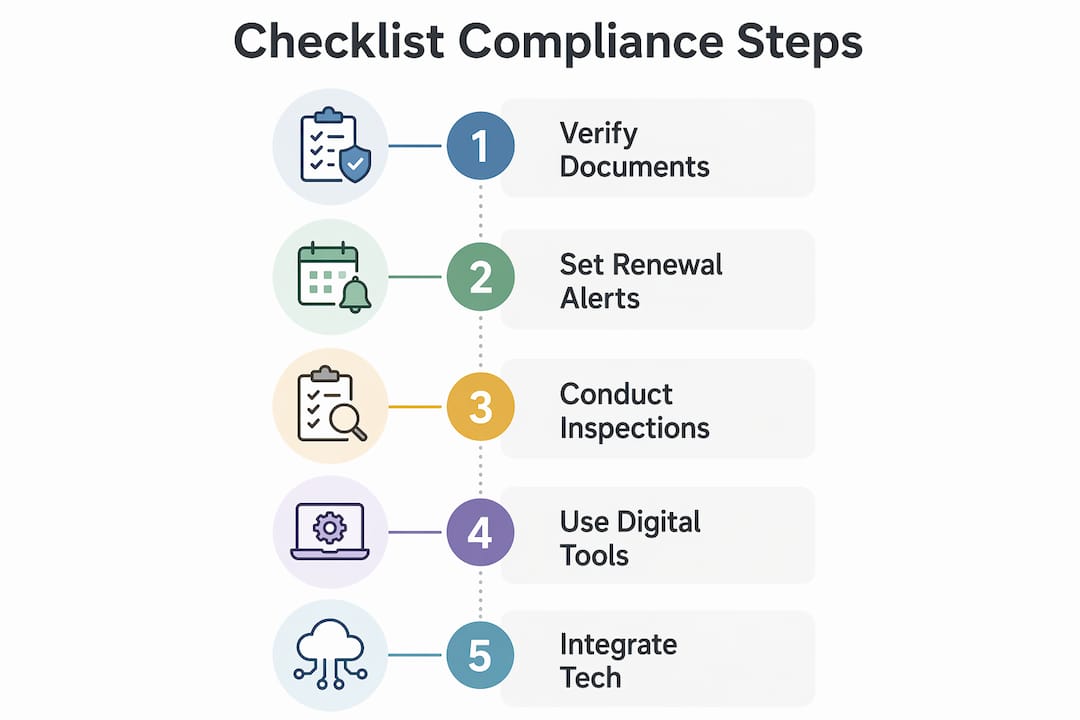
For site documentation, digital platforms that use standardized workflows improve consistency and accountability compared to disconnected manual systems. They also simplify the safety audit process by generating reports on demand rather than requiring manual compilation. Construction measurement tools and site survey equipment, when integrated with digital safety platforms, further enhance inspection accuracy across complex project environments.
Pro Tip: Do not deploy technology in isolation. Integrate your digital checklist platform with your existing safety management system so that inspection data, certificate records, and toolbox talk logs all feed into one master audit binder. A fragmented tech stack creates the same documentation gaps as a paper system.
Key Takeaways
A subcontractor safety compliance checklist is the primary instrument for preventing OSHA violations, protecting workers, and establishing the documented audit trail that determines liability outcomes.
| Point | Details |
|---|---|
| Documentation is the first gate | Verify licenses, insurance, and certifications before any subcontractor begins work on site. |
| Daily checks are non-negotiable | Pre-shift walkthroughs, toolbox talks, and permit verifications must be documented every working day. |
| Audit trails determine liability | General contractors are held responsible for subcontractor violations under OSHA’s Multi-Employer Citation Policy. |
| Expired certificates cause stoppages | Automate renewal alerts at 30 days prior to expiration to prevent work interruptions and compliance gaps. |
| Technology multiplies compliance capacity | Digital platforms and AI-assisted inspection tools reduce accidents and produce inspection-ready records automatically. |
Why most compliance programs fail before the first inspection
After working across multiple construction projects and safety audits, the pattern is consistent. The compliance programs that fail are not the ones with the wrong checklist template. They are the ones where the checklist exists as a document but not as a practice.
The most common failure I observe is the treatment of the audit binder as a closeout task. Project teams collect documentation at the start of a project, file it, and then stop updating it. When an OSHA inspector arrives, the binder reflects week one of a six-month project. That gap is indefensible. Effective compliance requires treating audit records as living documents updated daily, not retrospective summaries assembled under pressure.
The second failure is cultural. General contractors who treat subcontractor safety as a contractual transfer of liability, rather than a shared operational responsibility, consistently produce the worst compliance outcomes. The subcontractors who perform best on safety audits are the ones whose general contractor actively participates in toolbox talks, reviews inspection records weekly, and enforces corrective actions within 24 hours. That level of engagement cannot be replicated by a checklist alone. It requires a contractor safety culture where compliance is a daily expectation, not a periodic event.
Technology is the third pillar, and it is the one most underutilized by mid-sized contractors. The argument that digital platforms are too expensive or complex does not hold up against the cost of a single willful violation citation. The investment calculus is straightforward. The barrier is organizational inertia, not economics.
— Aman
How Com supports your compliance program
Construction safety compliance at the subcontractor level requires more than a checklist template. It requires structured auditing, credentialed oversight, and the institutional knowledge to identify gaps before regulators do.

Com, operating as MOSAIC Ecoconstruction Solutions, provides safety audit services specifically designed for construction firms managing multiple subcontractors. These audits produce documented findings, corrective action plans, and the audit trail evidence that OSHA inspections require. For firms that need dedicated compliance oversight without the overhead of a full in-house team, Com’s outsourced safety manpower program places qualified safety officers directly on site. The result is continuous compliance monitoring, not periodic snapshots.
FAQ
What is a subcontractor safety compliance checklist?
A subcontractor safety compliance checklist is a structured verification tool that confirms a subcontractor holds valid credentials, follows OSHA standards, and maintains documented safety practices throughout a construction project. It covers documentation, daily inspections, training records, and hazard controls.
What OSHA standard governs subcontractor safety in construction?
OSHA 29 CFR 1926 is the primary standard governing construction safety, covering fall protection, scaffolding, excavation, electrical hazards, and personal protective equipment requirements for all workers on site, including subcontractors.
How often should subcontractor safety checks be conducted?
Safety checks should occur daily through pre-shift walkthroughs and toolbox talks, weekly through supervisory inspections, and monthly through management reviews. Routine site inspections require documented paper trails to be valid during OSHA audits.
Who is responsible for subcontractor safety compliance on a job site?
The general contractor holds primary responsibility under OSHA’s Multi-Employer Citation Policy. General contractors must verify subcontractor credentials, enforce safety requirements contractually, and document that enforcement throughout the project.
What are the most common OSHA violations involving subcontractors?
Fall protection is the most cited OSHA violation in construction, with nearly 6,000 citations issued in fiscal year 2025. The Fatal Four hazards, which include falls, struck-by incidents, electrocution, and caught-in/between events, account for nearly 60% of all construction fatalities.