
Safety leadership is defined as the active practice of influencing, motivating, and inspiring employees at every organizational level to treat safety as a core value rather than a compliance obligation. This concept goes beyond the formal functions of a safety manager. It draws on transformational leadership theory and Behavior-Based Safety principles to embed safety into daily decisions, not just policy documents. Organizations governed by frameworks like OSHA regulations increasingly recognize that compliance alone does not prevent accidents. What prevents accidents is a culture where every person, from the CEO to a junior crew lead, owns safety as a personal responsibility.
What is safety leadership and how does it work?
Safety leadership is a behavioral set that anyone can adopt, regardless of job title or seniority level. That distinction matters enormously. A site supervisor who consistently wears PPE, asks workers about hazards, and addresses concerns without blame is exercising safety leadership. So is a project director who allocates budget for safety training before a contract begins.
The mechanism is influence, not authority. Safety leadership affects subordinates by shaping their attitudes toward risk and reinforcing safety-conscious behaviors through daily interaction. When leaders model the behaviors they expect, workers internalize those standards rather than simply following rules when supervisors are present.
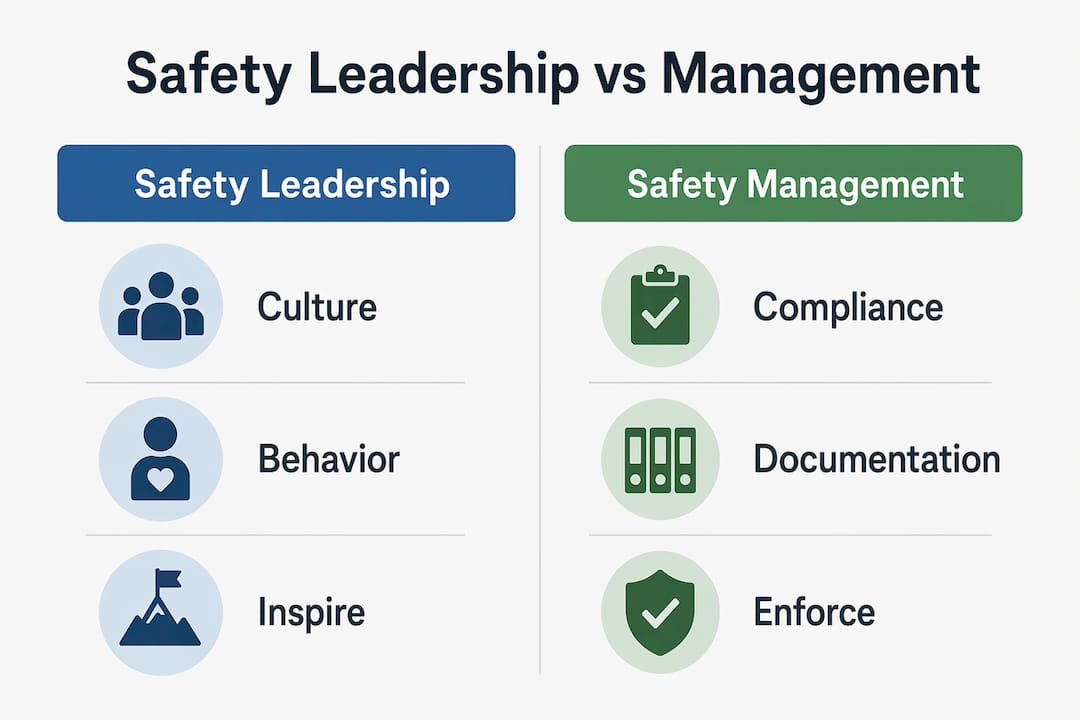
This distinction separates safety leadership from safety management. Management enforces. Leadership inspires. Both are necessary, but organizations that rely solely on enforcement tend to produce reactive safety cultures that respond to incidents rather than prevent them.
How does safety leadership differ from safety management?
Safety leaders create safety culture proactively; safety managers focus on compliance with occupational health and safety laws and respond to incidents after they occur. The two roles are complementary but structurally different in their orientation.
A safety manager’s core duties include maintaining documentation, conducting incident investigations, ensuring regulatory compliance, and enforcing OHS policies. A safety leader’s core behaviors include modeling safe practices, building trust, communicating expectations clearly, and motivating teams to internalize safety values. The safety manager role is primarily reactive and administrative. The safety leader role is proactive and cultural.
| Dimension | Safety leader | Safety manager |
|---|---|---|
| Primary focus | Culture and behavior change | Compliance and documentation |
| Orientation | Proactive risk prevention | Reactive incident response |
| Key behaviors | Modeling, motivating, communicating | Auditing, enforcing, reporting |
| Scope of influence | All organizational levels | Defined by role and authority |
| Success metric | Safety culture strength | Regulatory compliance rate |
The practical implication is significant. A construction site with strong safety management but weak safety leadership will pass audits and still experience preventable incidents. The missing variable is always culture, and culture is built by leaders, not policy manuals.
What are the core principles of effective safety leadership?
Modern safety leadership combines Behavior-Based Safety methodology with transformational leadership theory to motivate employees and embed safety as a lived organizational value. The principles below define what that looks like in practice.
-
Lead by example. Leaders who consistently use PPE, follow site protocols, and visibly participate in safety checks signal that safety standards apply to everyone. Workers notice when leaders bypass the rules they enforce.
-
Build psychological safety. Safety leadership fosters psychological safety by creating channels where employees can report hazards, near-misses, and concerns without fear of retaliation. Without this, hazard reporting drops and risk accumulates silently.
-
Establish personal accountability at every level. Safety responsibility cannot sit only with the safety department. Effective leaders distribute ownership across teams, making safety a shared obligation from Day 1 of employment.
-
Communicate with clarity and consistency. Safety expectations must be communicated in plain language, repeated regularly, and reinforced through feedback. Ambiguity about safety standards is itself a risk factor.
-
Invest in continuous education. Effective safety leadership requires continuous education and adaptation of leadership styles to the organization’s evolving culture and operational needs. One-time training programs do not sustain culture change.
Pro Tip: Conduct brief, informal safety conversations with workers during site walk-arounds rather than relying solely on scheduled toolbox talks. These unscripted interactions reveal real attitudes toward risk that formal meetings rarely surface.
Transformational safety leadership prioritizes emotional motivation and personal development over regulatory compliance. That means recognizing workers who raise safety concerns, not just those who avoid incidents. Recognition programs that reward proactive behavior shift the culture from fear-based compliance to genuine ownership.
Pro Tip: When a worker reports a near-miss, treat it as a leadership opportunity. Acknowledge the report publicly, act on it visibly, and close the feedback loop by telling the team what changed. That sequence builds the trust that sustains a reporting culture.
What are practical examples of safety leadership across industries?
Safety leadership manifests differently depending on the operating environment, but the behavioral principles remain consistent. The following examples illustrate how those principles translate across sectors.
-
Construction sites: A project manager who begins every morning with a five-minute hazard check, wears a hard hat throughout the site visit, and stops work when an unsafe condition is identified is demonstrating safety leadership in construction. The behavior signals that production schedules do not override safety standards.
-
Office environments: Safety leadership in low-risk settings focuses heavily on psychological safety. A team leader who responds to ergonomic complaints without dismissal, addresses workload-related stress openly, and encourages reporting of near-misses in digital workflows is exercising safety leadership in a white-collar context.
-
Manufacturing facilities: A floor supervisor who halts a production line to address a machine guard issue, rather than waiting for the next scheduled maintenance window, demonstrates that safety decisions override output pressure. That single act communicates organizational priorities more clearly than any policy document.
-
High-rise construction: Leaders who conduct regular leadership walk-arounds, actively check in with workers at height, and address PPE non-compliance immediately rather than documenting it for later review are building the contractor safety culture that reduces serious incidents.
Leaders must be approachable and accessible, actively checking in with workers and modeling safety behaviors consistently. WCB PEI research confirms that approachability is not a soft skill in safety contexts. It is a structural requirement for hazard reporting to function. Workers who fear their leader’s reaction to bad news simply do not report bad news.
How can organizations develop effective safety leaders?
Building safety culture starts on the first day of employment and requires leaders to be accessible, approachable, and consistent in modeling safety behaviors. Organizations that wait until an incident occurs to address leadership development have already paid a significant cost.
The following framework outlines a structured development path for safety leadership at the organizational level.
| Development stage | Key actions | Responsible party |
|---|---|---|
| Onboarding | Introduce safety values, not just rules, from Day 1 | Senior leadership and HR |
| Supervisory training | Transformational leadership and communication skills | Safety consultants and L&D teams |
| Mentorship programs | Pair emerging leaders with experienced safety practitioners | Department heads |
| Audit and feedback cycles | Regular safety culture audits with structured feedback | WSH consultants and safety officers |
| Recognition programs | Reward proactive safety behaviors, not just incident-free records | All management levels |
Safety leadership drives business resilience and employee trust beyond injury prevention. Organizations that invest in leadership development see measurable improvements in reporting rates, worker engagement, and incident frequency. The return is not only human. It is operational and reputational.
Engaging a WSH safety culture consultant accelerates this process by providing structured audit frameworks, culture gap analysis, and targeted training programs. Internal development alone often lacks the external perspective needed to identify blind spots in leadership behavior. Certification pathways such as BizSAFE and ISO frameworks further institutionalize safety leadership by embedding measurable standards into organizational governance.
Safety mindset means safety is embedded in company processes and lived by employees every day, not checked off as a compliance exercise. That distinction defines the difference between organizations that manage safety and organizations that lead it.
Key takeaways
Effective safety leadership is the single most reliable predictor of a strong safety culture, requiring proactive behavioral modeling, psychological safety, and continuous development at every organizational level.
| Point | Details |
|---|---|
| Leadership vs. management | Safety leaders build culture proactively; safety managers enforce compliance reactively. |
| Behavioral accessibility | Safety leadership is a set of behaviors anyone can adopt, not a title or formal role. |
| Psychological safety | Open hazard reporting only functions when workers trust leaders will not retaliate. |
| Day 1 culture building | Safety values must be introduced at onboarding, not after an incident occurs. |
| Continuous development | One-time training does not sustain culture change; feedback loops and audits are required. |
What I have learned about safety leadership that most guides miss
Most articles on safety leadership spend considerable time on frameworks and checklists. The harder truth is that culture does not change through documentation. It changes through repeated, visible behavior from people with influence.
The most common gap I observe in construction environments is not a lack of safety knowledge. It is a lack of psychological safety. Workers know the hazards. They often know the solutions. What they lack is confidence that raising a concern will be received without consequence. When a site supervisor responds to a near-miss report with blame rather than curiosity, that single interaction can suppress reporting for months.
The second gap is consistency. Safety leadership is not what leaders do during audits or toolbox talks. It is what they do when no one is formally watching. A project director who removes their hard hat the moment they leave the active work zone has communicated something precise to every worker who noticed. That signal travels faster than any safety briefing.
The organizations that build genuinely strong safety cultures treat safety leadership as a daily practice, not a periodic program. They recognize that trust is built in small moments, and that every interaction between a leader and a worker is either reinforcing or eroding the culture they claim to want.
— Aman
How Com supports safety leadership in construction

Com, operating as MOSAIC Ecoconstruction Solutions, works directly with construction companies and developers to embed safety leadership practices at every level of their organizations. The consultancy services include structured safety culture audits, BizSAFE and ISO certification support, and targeted leadership development programs designed for the construction sector. For organizations seeking to move beyond compliance and build a culture where safety is genuinely lived, safety consultancy for construction provides the external expertise and audit rigor that internal teams cannot always supply. Com’s team also conducts construction safety audits that identify leadership gaps and translate findings into concrete development plans.
FAQ
What is safety leadership in simple terms?
Safety leadership is the practice of actively influencing and motivating people to prioritize safety as a core value, not just a rule to follow. It applies to anyone in an organization, regardless of their formal title.
How does safety leadership differ from safety management?
Safety leaders build proactive safety culture through behavior and influence; safety managers enforce compliance with OHS regulations and respond to incidents. Both roles are necessary, but they operate with different orientations.
What skills define an effective safety leader?
Effective safety leaders demonstrate approachability, consistent modeling of safe behaviors, clear communication, and the ability to build psychological safety so workers report hazards without fear.
Can safety leadership apply outside high-risk industries?
Safety leadership applies in every work environment, including offices, where it focuses on psychological safety, ergonomic awareness, and open communication about workplace concerns.
How do organizations build safety leadership capability?
Organizations build safety leadership through structured onboarding, transformational leadership training, mentorship programs, regular culture audits, and recognition systems that reward proactive safety behaviors.