
A construction safety management system (CSMS) is defined as a structured, documented framework that organizes safety policies, hazard controls, training protocols, and audit mechanisms to minimize workplace risk and maintain regulatory compliance on construction sites. The industry standard term for this framework is a Health, Safety, and Environment Management System (HSEMS), though project-level documents are formally called Construction Phase Plans (CPPs). A proper construction safety management system setup is not a one-time administrative exercise. It is the operational backbone of every compliant, high-performing project, and in 2026, ISO 45001 certification is now required by major project financiers including the IFC, AfDB, and EBRD.
What does a construction safety management system setup require?
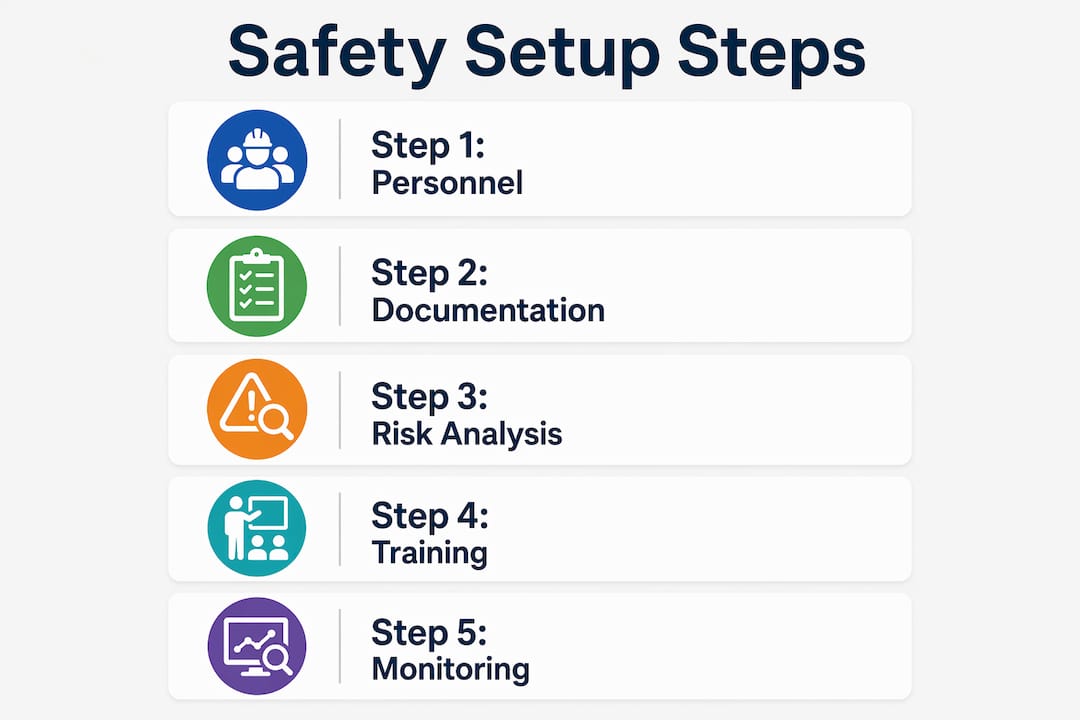
Before deploying any system, you need the right personnel, documentation, and baseline assessments in place. Skipping this preparation phase is the single most common reason CSMS implementations fail within the first six months.

Key personnel roles
Every effective setup requires clearly defined roles. The core team typically includes:
- HSE Officer: Owns day-to-day compliance, conducts weekly site inspections, and maintains the risk register.
- Project Manager / Site Supervisor: Responsible for daily walk-downs and enforcing safety protocols at the work-face.
- HSE Manager: Conducts monthly audits, chairs management reviews, and reports to senior leadership.
- Workers and Subcontractor Representatives: Participate in toolbox talks, hazard identification, and Safe Work Method Statement (SWMS) reviews.
Documentation and tools you need at the start
A risk register as a living document is foundational. It must capture hazards, risk ratings, assigned controls, accountable persons, and scheduled review dates. Beyond the risk register, your prerequisite documentation package includes:
| Document | Purpose |
|---|---|
| Site Hazard Analysis | Identifies site-specific risks before work begins |
| Risk Register | Tracks hazards, controls, and accountability |
| Inspection Checklists | Standardizes daily and weekly site reviews |
| Emergency Response Plan | Defines procedures for incidents and evacuations |
| Training Records | Demonstrates worker competency and induction completion |
Digital platforms such as MapTrack or SafetyCulture (iAuditor) consolidate these documents and enable real-time compliance tracking. Paper-based systems are still permissible but create significant audit trail gaps.
Pro Tip: Conduct your initial site hazard analysis before mobilization, not after. Hazards identified post-mobilization are already active risks.
How do you implement a construction safety management system step by step?
The Plan-Do-Check-Act (PDCA) cycle is the universal framework for modern safety systems. It requires dynamic management reviews to adapt to changing site hazards. The PDCA cycle is not a linear checklist. It is a continuous loop that governs every phase of your CSMS.
The PDCA implementation sequence
- Plan: Define your safety policy, conduct the site hazard analysis, establish the risk register, and assign roles. This phase produces your CPP or Site-Specific Safety Plan (SSSP), which must address the unique hazards of that project, not generic corporate policy.
- Do: Deploy safety controls following the Hierarchy of Controls. Elimination and engineering controls take strict priority over administrative controls and PPE. PPE is the last line of defense, never the first response to a hazard.
- Check: Execute the inspection and audit schedule. SWMS are mandatory for high-risk construction tasks and must be integrated into your audit workflows. Inspections should follow a daily, weekly, and monthly cadence aligned to supervisor, HSE officer, and HSE manager responsibilities respectively.
- Act: Close corrective actions with full documentation. Each corrective action record must include the hazard description, the responsible person, the corrective steps taken, and the closure date.
CPP vs. SMS: a critical distinction
| Document | Scope | Owner | Update Frequency |
|---|---|---|---|
| Corporate SMS | Company-wide policies and procedures | Senior Management / HSE Director | Annual or triggered by incident |
| Construction Phase Plan (CPP) | Project-specific hazards and controls | Project HSE Officer | Continuous, as site conditions change |
Confusing the corporate SMS with the site-specific CPP is common and carries serious compliance risk. The CPP must specifically address the unique hazards of each project. A corporate SMS copied and relabeled as a CPP will fail any competent authority audit.
Pro Tip: Treat your CPP as a live site document, not a submission artifact. Update it every time a new trade or high-risk activity is introduced to the site.
Training and communication as system components
Training is not a prerequisite to the CSMS. It is a core component of the “Do” phase. Every worker must receive site induction before accessing the work area. Toolbox talks should be conducted at minimum weekly, covering the specific hazards of the upcoming work. Training records must be retained and available for inspection.
How do you maintain and update the system for ongoing effectiveness?
A construction safety management system is a dynamic framework, not a static manual. Continuous review and adaptation are what separate compliant sites from those that accumulate unresolved hazards.
Inspection cadence and responsibilities
OSHA 29 CFR 1926.20 requires frequent inspections by competent persons but does not mandate fixed frequencies. Best practice establishes the following schedule:
- Daily: Site supervisor walk-downs covering access routes, PPE compliance, housekeeping, and active work areas.
- Weekly: HSE officer inspections using standardized checklists covering all active trades, equipment, and permit-to-work compliance.
- Monthly: HSE manager audits assessing system performance, corrective action closure rates, and training compliance.
This tiered audit cadence creates overlapping layers of oversight. No single hazard should survive more than one inspection cycle without a documented corrective action.
Leading vs. lagging indicators
Industry leaders prioritize leading indicators such as the number of audits completed, toolbox talks delivered, and near-miss reports filed over lagging injury statistics. Lagging indicators tell you what went wrong. Leading indicators tell you whether your system is functioning before an incident occurs.
Corrective action documentation must include the hazard description, the responsible person, corrective steps taken, and the closure date to demonstrate effective compliance. Incomplete corrective action records are the most frequently cited deficiency in third-party safety audits.
Integrating digital tools in safety management enables real-time visibility, simplifying compliance and eliminating duplicated manual processes. Platforms that push corrective action notifications directly to responsible persons reduce average closure times significantly compared to paper-based systems.
What are the most common challenges in setting up a CSMS?
Even experienced safety professionals encounter predictable obstacles during safety system implementation. Recognizing these pitfalls before they occur is a measurable competitive advantage.
The most frequent setup failures
- SMS and CPP confusion: Submitting a corporate SMS as a project CPP is a statutory compliance failure. Each document serves a distinct function and must be authored separately.
- Under-documented corrective actions: Closing a hazard observation without recording the responsible person and closure date renders the corrective action unverifiable during audits.
- Inadequate worker engagement: A CSMS built entirely by management and delivered to workers as a finished document generates low compliance rates. Frontline workers identify hazards that supervisors miss.
- Management buy-in gaps: When senior leadership treats the CSMS as a compliance checkbox rather than an operational priority, resource allocation for training, inspections, and corrective actions degrades rapidly.
- Failure to update the CPP: Sites that treat the CPP as a submission document rather than a live operational tool accumulate undocumented hazards as project scope evolves.
Pro Tip: Schedule a formal CPP review at every major project milestone, such as structural completion, fit-out commencement, and commissioning. These transitions introduce new hazard profiles that the original CPP did not address.
A safety compliance checklist tailored to your jurisdiction provides a structured mechanism for identifying documentation gaps before an external audit does.
Key takeaways
A construction safety management system setup succeeds when it combines a site-specific CPP, a tiered inspection schedule, documented corrective actions, and continuous PDCA-driven management review.
| Point | Details |
|---|---|
| Separate SMS from CPP | The corporate SMS and the project CPP are distinct documents with different scopes and owners. |
| Follow the Hierarchy of Controls | Elimination and engineering controls must precede PPE in every risk control decision. |
| Use tiered inspection schedules | Daily, weekly, and monthly audits create overlapping oversight that prevents hazards from persisting. |
| Prioritize leading indicators | Track audits completed and toolbox talks delivered, not just injury rates, to measure system health. |
| Document every corrective action | Each record must include hazard description, responsible person, corrective steps, and closure date. |
Why leadership commitment is the variable most CSMS guides underestimate
I have reviewed safety management systems across dozens of construction projects, and the pattern is consistent. The technical components, the risk register, the inspection checklists, the SWMS library, are rarely the point of failure. The failure point is almost always leadership behavior in the first 90 days after system deployment.
When a project director walks past a PPE violation without stopping, every worker on that site recalibrates their understanding of what the CSMS actually requires. No document overrides observed behavior from senior personnel. This is why I advocate for making management review a visible, scheduled event rather than a back-office administrative function. When workers see the HSE manager and project director conducting a joint monthly audit together, the signal is unambiguous.
The second underestimated variable is frontline worker participation in hazard identification. Workers operating at the work-face identify hazards that supervisors conducting walk-downs consistently miss, particularly in confined spaces, elevated work areas, and multi-trade interfaces. A safety management review process that formally incorporates worker-reported near-misses into the risk register produces a materially more accurate hazard picture than one that relies solely on supervisor observations.
Digital tools are genuinely useful, but they are enablers, not substitutes for the above. A platform that sends corrective action notifications and tracks closure rates removes friction from the compliance process. It does not create the safety culture that makes workers report hazards in the first place. Build the culture first. Then deploy the technology to support it.
— Aman
How Com supports your construction safety management system

Com, operating as MOSAIC Ecoconstruction Solutions, provides specialist consultancy for construction safety management system setup, from initial site hazard analysis through full HSEMS documentation and BizSAFE certification support. The team conducts structured safety audits aligned to Singapore’s regulatory framework and international standards including ISO 45001, delivering findings with documented corrective action plans rather than generic recommendations. For construction managers seeking a verified compliance baseline, Com’s Singapore construction safety audits provide the structured external review that internal teams cannot objectively perform on themselves. Whether you are establishing a new system or strengthening an existing one, Com’s consultancy approach is built around your specific project conditions, not a templated corporate framework.
FAQ
What is the difference between an SMS and a CPP?
A Safety Management System (SMS) is a company-wide policy framework governing organizational safety standards. A Construction Phase Plan (CPP) is a project-specific document that addresses the unique hazards and controls for a single site.
How often should construction safety audits be conducted?
Best practice requires daily supervisor walk-downs, weekly HSE officer inspections, and monthly audits by the project HSE manager. OSHA 29 CFR 1926.20 mandates frequent inspections by competent persons without fixing a specific interval.
What is the Hierarchy of Controls in construction safety?
The Hierarchy of Controls is a priority sequence requiring that elimination and engineering controls be applied before administrative measures or PPE. PPE is the last resort, not the primary control measure.
What documents are required to set up a CSMS?
The core documentation set includes a risk register, site hazard analysis, inspection checklists, emergency response plan, training records, and project-specific SWMS for high-risk tasks.
How does ISO 45001 relate to construction safety management?
ISO 45001 is the international standard for occupational health and safety management systems. As of 2026, major project financiers including the IFC and EBRD require ISO 45001-aligned HSEMS documentation for major construction projects.