
Safety management maturity is defined as the degree to which an organization has integrated risk management into its operations and culture, progressing from reactive incident response toward proactive, systemic safety governance. The concept draws on established frameworks including Hudson’s Safety Ladder and the DuPont Bradley Curve, both of which map this evolution across discrete, measurable stages. For safety managers and compliance officers in the construction sector, understanding where your organization sits on this continuum is not an academic exercise. It determines whether your safety management systems prevent incidents or merely document them after the fact.
What is safety management maturity and why does it matter?
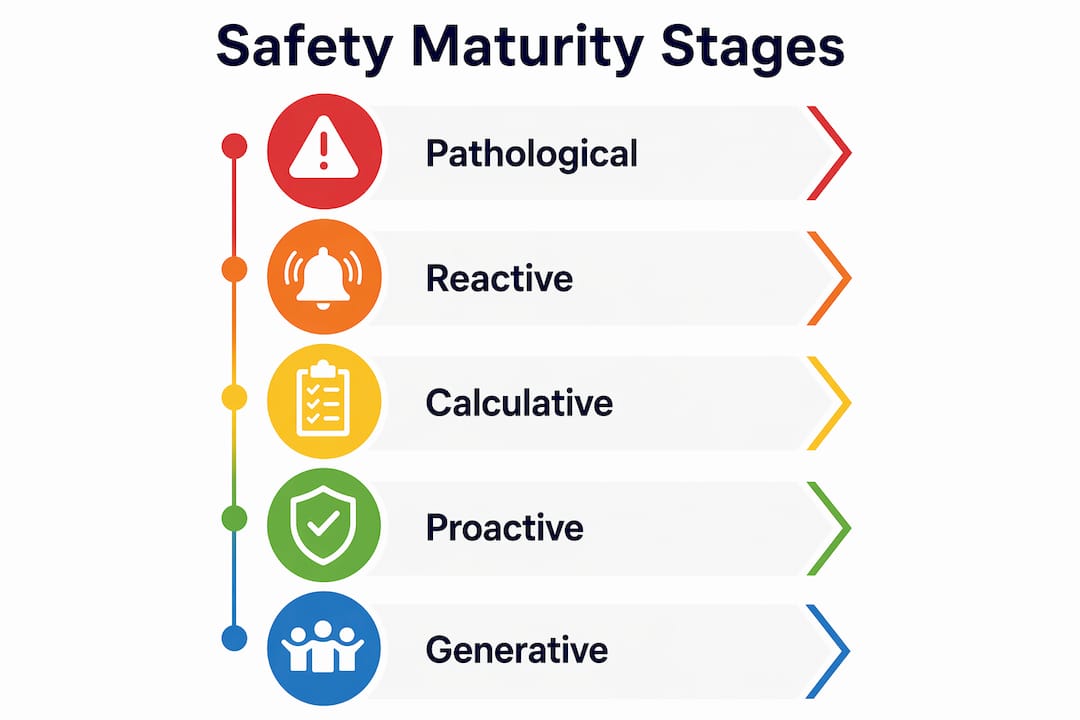
Safety management maturity measures how deeply risk management is integrated across an organization’s leadership, operations, and workforce culture, spanning levels from Pathological through Reactive, Calculative, Proactive, and Generative. At the lowest level, organizations treat safety as a cost burden and conceal incidents. At the highest, safety is a shared value embedded in every operational decision, and workers at all levels actively contribute to hazard identification and control. The distance between these two states is not measured in policies written but in behaviors demonstrated daily.
Compliance is the baseline, not the destination. Mature safety systems progress from reactive “Safety I” thinking, where the goal is minimizing failures, to adaptive “Safety II” thinking, where safety is a daily business decision integrated into how work is actually performed. This distinction matters enormously for construction organizations operating under Singapore’s Workplace Safety and Health Act and BizSAFE certification requirements, where regulatory compliance sets the floor but operational excellence demands far more.

Organizations often mistake a formal safety management system for true safety maturity. Systems can exist on paper while lacking any embedded cultural or operational integration. A documented hazard register that no supervisor references during a toolbox meeting is a compliance artifact, not a maturity indicator.
What are the common safety maturity models and their stages?
Two frameworks dominate professional practice in safety maturity assessment: Hudson’s Safety Ladder and the DuPont Bradley Curve. Both describe a progression from failure-tolerant, reactive cultures to interdependent, self-sustaining safety cultures, though they differ in structure and emphasis.
Hudson’s five-level Safety Ladder defines the following stages:
- Pathological: Safety is seen as a problem created by workers. Management prioritizes production over protection and punishes incident reporting.
- Reactive: Safety receives attention only after incidents occur. Organizations invest in safety after being forced to by events or regulators.
- Calculative: Organizations implement formal safety management systems, collect data, and track metrics. Compliance is the primary driver.
- Proactive: Leadership actively seeks out hazards before incidents occur. Worker input is solicited and acted upon. Leading indicators are tracked alongside lagging ones.
- Generative: Safety is fully integrated into organizational identity. All levels of the workforce take ownership. Incident rates approach near zero as interdependent safety cultures develop.
The DuPont Bradley Curve maps a parallel trajectory across four stages: Instinctive, Dependent, Independent, and Interdependent. The critical insight from the Bradley Curve is that the transition from Independent to Interdependent safety culture, where workers hold each other accountable without management prompting, represents the most significant cultural shift and the hardest to engineer.
| Model | Stages | Primary Focus | Key Transition Point |
|---|---|---|---|
| Hudson’s Safety Ladder | 5 levels: Pathological to Generative | Cultural integration of safety values | Calculative to Proactive |
| DuPont Bradley Curve | 4 stages: Instinctive to Interdependent | Behavioral and cultural safety ownership | Independent to Interdependent |
Both models converge on a central principle: advancing maturity requires moving from externally imposed compliance to internally driven safety culture. For construction organizations, this means the BizSAFE Level 3 or Star certification process marks entry into the Calculative stage, not the destination.
What are the key indicators for assessing safety management maturity?
A safety maturity assessment evaluates leadership commitment, risk management processes, worker engagement, training quality, and performance measurement to produce an improvement roadmap. These dimensions are not equally weighted. Leadership and governance commitment is the paramount driver, because safety culture cannot exceed the level modeled by senior management.
The core dimensions to evaluate in any structured assessment are:
- Leadership and governance: Does senior management demonstrate visible safety ownership, or is safety engagement delegated downward? Leadership commitment beyond symbolic support is a non-negotiable prerequisite for SMS effectiveness.
- Risk management and hazard identification: Are hazard identification processes systematic and proactive, or triggered only by near-misses and incidents?
- Employee engagement and culture: Do workers report hazards without fear of reprisal? Is psychological safety present at the workface?
- Training and competency development: Are training programs competency-based and role-specific, or generic compliance tick-boxes?
- Performance measurement: Does the organization track leading indicators alongside lagging ones, including leadership visibility scores, near-miss reporting rates, and safety conversation frequency?
The distinction between leading and lagging indicators is where most organizations expose their actual maturity level. Lagging indicators such as Lost Time Injury Frequency Rate measure failures that have already occurred. Leading indicators measure the conditions that predict future performance. An organization tracking only LTIFR is, by definition, operating in a reactive or calculative posture regardless of what its safety policy documents claim.
Pro Tip: When conducting an internal maturity assessment, benchmark your leading-to-lagging indicator ratio. If your organization tracks fewer than three leading indicators for every lagging metric, your measurement system is structurally biased toward reactive safety management.
How can organizations assess and improve their safety management maturity?
The first step is selecting or tailoring a maturity model suited to your organizational context, sector, and regulatory environment. A Tier 1 main contractor operating across multiple Singapore construction sites has different assessment requirements than a specialist subcontractor with a workforce of 40. Applying Hudson’s full five-level framework to both without calibration produces misleading results.
A structured assessment covers all core dimensions simultaneously, not sequentially. Conducting a leadership commitment review without simultaneously evaluating worker engagement produces a partial picture that overstates maturity. The assessment process must turn findings into prioritized, time-bound improvement plans with clear ownership, allocated resources, and measurable metrics integrated into governance structures.
Common pitfalls that undermine assessment validity and improvement programs include:
- Over-reliance on compliance metrics: Treating regulatory conformance as evidence of maturity conflates the floor with the ceiling.
- Lagging indicator dominance: Relying solely on incident statistics provides no predictive capability and no cultural insight.
- Mismatched maturity and strategy: Pushing an organization to the highest maturity level without organizational readiness generates cynicism and system rejection among the workforce.
- Absent leadership visibility: Senior managers who delegate safety engagement to HSE officers signal to the workforce that safety is a compliance function, not a business priority.
- Checkbox culture: Completing assessment templates without genuine inquiry produces documentation that satisfies auditors but changes nothing operationally.
Translating assessment findings into improvement requires governance mechanisms that sustain momentum beyond the initial exercise. Continuous improvement cycles, structured feedback loops, and quarterly governance reviews prevent maturity programs from stalling after the first corrective action plan is filed. For construction organizations pursuing proactive risk management at the design stage, integrating maturity improvement into project governance from inception produces measurably better outcomes than retrofitting safety culture onto an active site.
Pro Tip: Assign a named senior leader as the accountable owner for each maturity dimension identified in the assessment. Diffuse ownership is the single most reliable predictor of stalled improvement programs.
What benefits do mature safety management systems deliver beyond compliance?
Organizations advancing from compliance-driven to mature safety management report fewer incidents, reduced operational costs, and improved workforce retention. The trajectory is not linear, but the direction is consistent: incident rates approach near zero as organizations develop genuinely interdependent safety cultures where workers hold each other accountable without management prompting.
The operational cost argument for safety maturity is frequently underestimated by construction organizations focused on project margins. Direct incident costs including medical treatment, investigation time, regulatory penalties, and project delays represent only a fraction of total incident-related expenditure. Indirect costs, covering reputational damage, workforce morale deterioration, insurance premium increases, and client relationship impacts, consistently exceed direct costs by a significant multiplier.
“Mature safety management is not a cost center. It is the operational infrastructure that protects project delivery timelines, workforce capability, and organizational reputation simultaneously.”
Employee engagement and retention represent a third category of benefit that safety managers should present explicitly to organizational leadership. Construction workforces operating in psychologically safe environments, where hazard reporting is encouraged and acted upon, demonstrate measurably higher engagement scores and lower voluntary turnover. For Singapore construction organizations competing for skilled labor in a constrained market, this is a material competitive advantage. Implementing effective safety and health management systems that embed worker involvement at every level is the mechanism through which this advantage is created and sustained.
Key takeaways
Safety management maturity is the degree to which risk management is culturally embedded and proactively executed across an organization, not merely documented in a safety management system.
| Point | Details |
|---|---|
| Maturity is not compliance | Regulatory conformance marks the Calculative stage, not the destination of a mature safety culture. |
| Models provide a diagnostic map | Hudson’s Safety Ladder and the DuPont Bradley Curve both identify the Proactive-to-Generative transition as the most strategically significant shift. |
| Leading indicators reveal true maturity | Organizations tracking only lagging metrics like LTIFR are structurally operating in reactive or calculative safety postures. |
| Mismatched strategy causes failure | Forcing rapid maturity advancement without organizational readiness generates workforce cynicism and system rejection. |
| Leadership visibility is non-negotiable | Senior management must demonstrate visible safety ownership; delegating this responsibility downward undermines SMS effectiveness at every level. |
Why fit-for-purpose maturity beats chasing the highest level
The most consequential mistake I observe in safety maturity programs is the pursuit of the Generative level as an immediate target, regardless of where the organization actually sits today. An organization operating at the Reactive stage that attempts to implement Generative-level safety culture mechanisms, peer accountability systems, voluntary safety leadership programs, and self-directed hazard elimination, will encounter resistance that hardens into permanent cynicism. The workforce reads the gap between the aspiration and the operational reality as evidence that management does not understand how work actually happens.
What I have found to be far more effective is an incremental, fit-for-purpose approach that advances maturity one stage at a time, with each stage consolidating before the next is pursued. A Reactive organization that successfully transitions to Calculative has achieved something real and measurable. That transition builds the organizational credibility and workforce trust that makes the subsequent move to Proactive achievable. Skipping stages does not accelerate progress. It creates the appearance of progress while the underlying culture remains unchanged.
The second observation I would offer is that safety maturity programs fail most reliably when senior leadership treats the assessment as a one-time event rather than an ongoing governance commitment. Maturity is not a certification you achieve and retain. It is a dynamic organizational state that requires continuous reinforcement, particularly through visible leadership behavior. The organizations I have seen sustain genuine maturity advancement share one characteristic: their senior leaders talk about safety in operational terms, not compliance terms, and they do so consistently, not only after incidents.
— Aman
How Com supports your safety maturity advancement

Com, operating through MOSAIC Ecoconstruction Solutions, provides structured safety consultancy services designed to help construction organizations assess their current maturity level and build credible, governance-backed improvement programs. Whether your organization is preparing for BizSAFE certification, advancing toward ISO 45001 conformance, or seeking to move beyond compliance-driven safety management, Com’s team delivers tailored assessment frameworks and audit support calibrated to Singapore’s regulatory environment. Explore safety audit examples for Singapore construction compliance, or review Com’s audit preparation guidance to understand how a structured assessment translates into measurable maturity advancement.
FAQ
What is safety management maturity in simple terms?
Safety management maturity is the extent to which an organization has moved beyond basic regulatory compliance to embed proactive, culturally integrated risk management into its daily operations and leadership behavior.
How many stages does the safety maturity model have?
Hudson’s Safety Ladder defines five stages: Pathological, Reactive, Calculative, Proactive, and Generative. The DuPont Bradley Curve maps four parallel stages from Instinctive to Interdependent, with both models converging on cultural integration as the defining characteristic of the highest levels.
What is the difference between a safety management system and safety maturity?
A safety management system is a documented framework of policies, procedures, and controls. Safety maturity measures how deeply that system is operationally and culturally embedded. An organization can have a fully documented SMS and still operate at the Calculative or Reactive maturity level if the system exists on paper but not in practice.
How do you assess safety management maturity?
A structured assessment evaluates leadership commitment, risk management processes, worker engagement, training quality, and the balance between leading and lagging performance indicators, then translates findings into prioritized improvement plans with named ownership and measurable metrics.
Why do safety maturity improvement programs fail?
The most common causes are mismatched strategy and organizational readiness, over-reliance on lagging indicators, absent senior leadership visibility, and treating the assessment as a one-time compliance exercise rather than a continuous governance commitment.