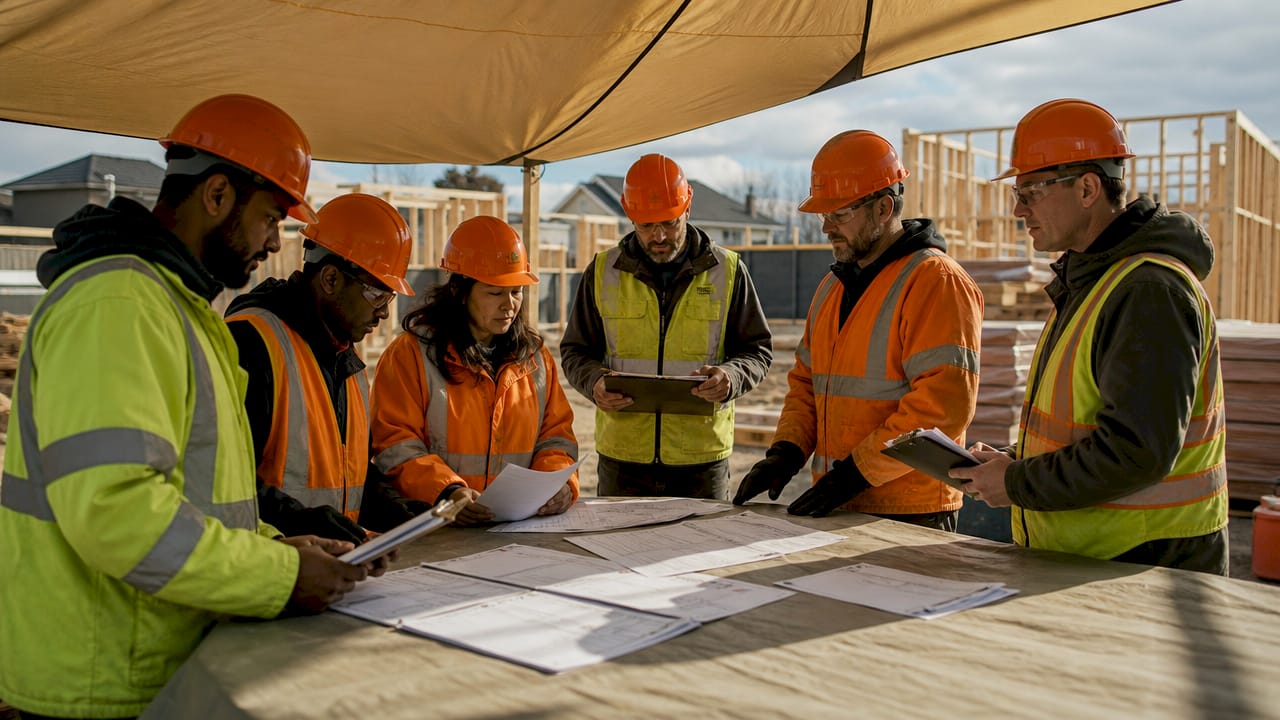
Site safety committees are defined as joint management-worker bodies responsible for identifying workplace hazards, reviewing incidents, and driving continuous safety improvements on construction sites. In the construction sector, where fall hazards, equipment failures, and confined-space risks converge daily, the role of site safety committees extends well beyond regulatory compliance. These committees serve as the primary mechanism through which frontline workers and project management address safety collaboratively, translating statutory obligations into predictable, site-specific safety actions. Understanding how they function, what they require to succeed, and how to implement them effectively is a non-negotiable competency for any safety manager or project developer operating in today’s construction environment.
What are the key functions and responsibilities of site safety committees?
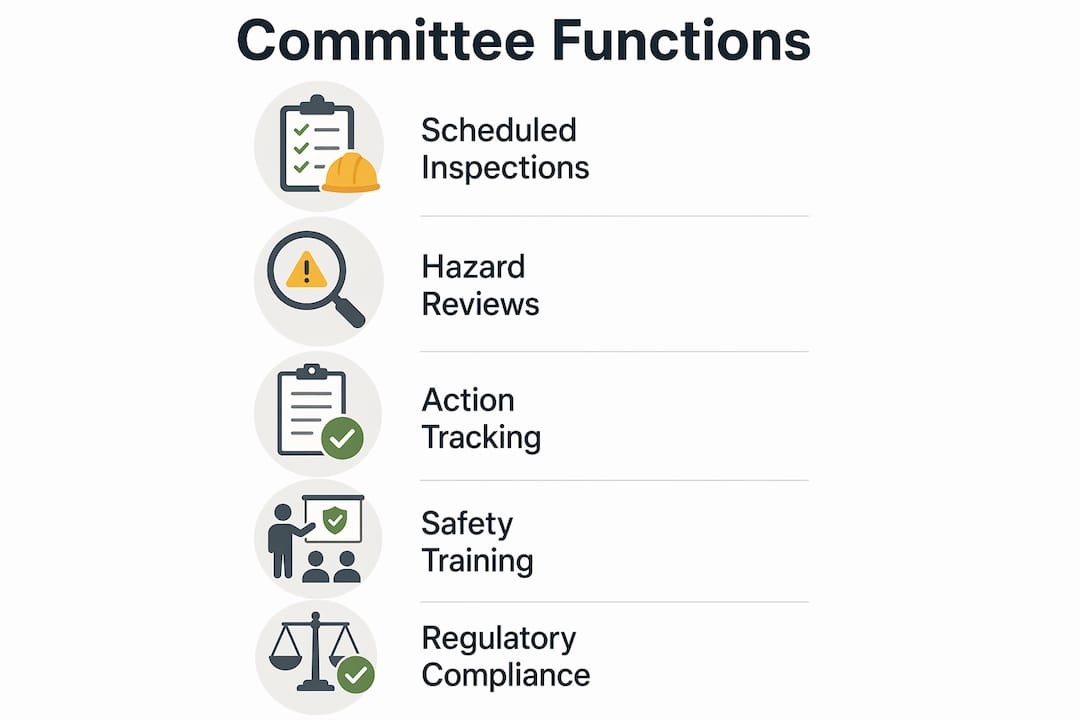
Site safety committee functions encompass a structured set of duties that collectively reduce risk exposure and strengthen safety culture across a project site. Singapore’s Workplace Safety and Health Committees Regulations 2008 codifies these duties explicitly, requiring committees to conduct inspections, investigate incidents, organize safety activities, and develop safety guidelines. This statutory framework reflects a universal principle: committees must act, not merely deliberate.
The core responsibilities of a site safety committee include:
- Workplace inspections and audits: Committees conduct scheduled and unscheduled site walkthroughs to identify physical hazards, unsafe behaviors, and non-compliant conditions before incidents occur.
- Incident and near-miss review: Every reported injury, near-miss, or dangerous occurrence is analyzed to determine root causes and systemic failures, not just immediate triggers.
- Corrective and preventive action tracking: Committees recommend specific remediation measures and monitor their implementation to closure, creating an accountability loop.
- Safety training coordination: Identifying training gaps and organizing toolbox talks, competency assessments, and emergency drills falls within the committee’s operational mandate.
- Policy and guideline development: Committees draft, review, and update site-specific safety procedures, method statements, and emergency response plans.
- Safety KPI monitoring: Tracking both leading indicators (training completion rates, inspection frequency) and lagging indicators (lost-time injury rates, near-miss counts) provides a data-driven view of site safety performance.
The table below maps each core function to its direct safety outcome:
| Committee function | Safety outcome |
|---|---|
| Scheduled site inspections | Early hazard identification before incidents occur |
| Incident root cause analysis | Systemic fixes rather than surface-level corrections |
| Corrective action tracking | Closed-loop accountability for safety improvements |
| Training coordination | Competent workforce with current hazard awareness |
| Policy development | Standardized, site-specific safety procedures |
| KPI monitoring | Measurable evidence of safety performance trends |
Pro Tip: Assign a dedicated action register to every committee meeting. Each corrective action must carry a named owner, a due date, and a verification method. Without this structure, recommendations evaporate between meetings.
How do effective site safety committees operate to achieve impact?
Operational effectiveness separates committees that produce measurable safety improvements from those that generate paperwork. The distinction lies in structure, composition, and the discipline with which meetings are conducted.
A well-functioning committee follows a defined operational model:
- Establish a clear, documented purpose. Clearly defined objectives prevent committees from degrading into discussion forums. Purposes should include promoting employee safety interest, integrating safety culture, reducing risk exposure, and supporting regulatory compliance.
- Balance committee composition. Committees should comprise 6 to 12 members with balanced representation from management and elected worker representatives covering different departments, trades, and shifts. Roles include a chair, vice-chair, and secretary with defined term limits.
- Structure every meeting agenda. A practical agenda covers review of incidents and corrective actions, inspection findings, regulatory updates, training needs, worker safety concerns, KPI performance, and emergency preparedness status. This format, drawn from leading safety management frameworks, transforms meetings from compliance exercises into operational safety reviews.
- Apply leading and lagging indicators. Measuring both what has happened (lagging) and what predicts future performance (leading) at every meeting gives the committee a forward-looking control function, not just a historical audit role.
- Secure active leadership participation. Management support and member training correlate directly with successful committee outcomes. When senior project managers attend and act on committee recommendations, the entire site workforce recognizes that safety decisions carry organizational weight.
- Document and distribute meeting minutes. Minutes must be circulated to all committee members and posted in accessible locations on site within 48 hours of each meeting to maintain transparency and accountability.
Pro Tip: Rotate the role of meeting chair among worker representatives on a quarterly basis. This prevents management dominance of the agenda and builds genuine worker ownership of the safety process. Engagement levels rise measurably when frontline workers lead the discussion.
What challenges hinder site safety committees and how can construction sites overcome them?

The most common failure mode for site safety committees is not structural collapse but gradual irrelevance. Without deliberate countermeasures, even well-formed committees drift toward passive compliance rather than active hazard control.
Construction sites face specific challenges that accelerate this drift:
- Absence of documented objectives: Without clearly defined purposes, committees become talk shops where concerns are raised but never resolved. Every committee must have a written charter specifying its scope, authority, and measurable goals.
- Insufficient management buy-in: When project directors treat committee meetings as administrative obligations rather than operational priorities, the signal to the workforce is unambiguous. Safety managers must secure explicit leadership commitment before the committee is formed, not after problems emerge.
- Member fatigue and role ambiguity: Long-tenured members without rotating responsibilities lose engagement. Unclear accountability for action items compounds the problem, creating a culture where recommendations are made but never verified.
- Resource constraints: Committees that lack authority to allocate budget for corrective actions or training are structurally limited. Management must grant committees a defined resource mandate, even if modest, to demonstrate that recommendations translate into physical changes on site.
Overcoming these challenges requires SMART goal-setting at the committee level, meaning each safety objective must be specific, measurable, achievable, relevant, and time-bound. Construction firms that recognize committee contributions formally, through safety awards, project-level recognition, or inclusion in performance reviews, report sustained member engagement over multi-year projects. For practical strategies specific to Singapore construction sites, the construction safety compliance guide published by Com provides a structured framework aligned with local regulatory requirements.
How do site safety committees support compliance with occupational safety regulations?
Site safety committees are a primary compliance mechanism under multiple occupational safety regulatory frameworks. Their documentation, inspection records, and training logs constitute the evidentiary foundation that regulators examine during site audits and incident investigations.
The table below summarizes key jurisdictional requirements and committee mandates:
| Jurisdiction | Regulatory framework | Committee mandate |
|---|---|---|
| Singapore | WSH (WSH Committees) Regulations 2008 | Mandatory for workplaces above prescribed workforce thresholds; functions include inspections, incident investigation, and safety guideline development |
| United States (select states) | OSHA and state-level mandates | Several states require joint labor-management safety committees; committees provide documentation during OSHA inspections |
| General international | ISO 45001:2018 | Worker participation and consultation mechanisms, which committees fulfill, are a core requirement of the standard |
Singapore’s regulatory model is particularly instructive. Factory site managers operationalize committee functions by pre-scheduling inspections and establishing incident triggers, translating legal duties into predictable safety workflows. Without this operationalization, statutory functions remain theoretical obligations rather than embedded site practices. Construction professionals working under Singapore’s Workplace Safety and Health Act should review the Singapore construction safety standards to understand how committee obligations integrate with broader WSH compliance requirements.
Safety committees support OSHA compliance by maintaining records of safety activities, inspections, and training that demonstrate due diligence. During regulatory inspections, a committee’s documented action register and meeting minutes provide concrete evidence that the organization identifies hazards proactively and closes corrective actions systematically. This documentation function alone justifies the administrative investment in a well-run committee.
What steps should safety managers take to implement site safety committees?
Establishing a site safety committee on a construction project requires deliberate sequencing to avoid the structural weaknesses that undermine effectiveness from the outset.
- Define scope and legal obligations. Confirm whether your jurisdiction mandates a committee and identify the applicable regulatory requirements. In Singapore, the WSH (WSH Committees) Regulations 2008 specifies workforce thresholds, composition requirements, and minimum meeting frequencies.
- Determine composition and elect worker representatives. Form a committee of 6 to 12 members with management appointees and elected worker representatives drawn from different trades and work shifts. Assign formal roles: chair, vice-chair, and secretary with documented responsibilities.
- Draft a committee charter. Document the committee’s purpose, scope of authority, meeting frequency (monthly is the standard minimum for active construction sites), and the process for escalating unresolved safety concerns to senior management.
- Develop a standing meeting agenda template. The agenda must cover incident reviews, corrective action status, inspection findings, training needs, regulatory updates, worker concerns, and KPI performance. Standardizing the agenda prevents meetings from drifting off-topic.
- Integrate risk assessment into committee workflows. Committees should receive and review site risk assessments, method statements, and Design for Safety documentation as standing agenda items, particularly when new work phases begin or site conditions change.
- Evaluate and adjust continuously. Measure committee effectiveness through both leading indicators (inspection completion rates, training hours delivered) and lagging indicators (incident frequency rates). Review the committee’s charter annually and adjust composition or scope as the project evolves.
Pro Tip: Use safety management software such as SafetyCulture (iAuditor) or Intelex to digitize inspection checklists, action registers, and meeting minutes. Digital records are searchable, auditable, and far less vulnerable to loss than paper-based systems. This matters significantly during regulatory inspections.
Key takeaways
Effective site safety committees require documented objectives, balanced composition, structured meeting agendas, and active management support to deliver measurable safety improvements rather than procedural compliance.
| Point | Details |
|---|---|
| Defined objectives are non-negotiable | Committees without documented purposes degrade into discussion forums that produce no safety improvement. |
| Composition determines credibility | Balanced management and worker representation, with elected worker reps from all trades, drives genuine hazard reporting. |
| Meeting structure drives outcomes | Agendas covering incidents, KPIs, training, and corrective actions transform meetings into operational safety reviews. |
| Regulatory compliance is a direct benefit | Documented committee records provide the evidentiary foundation regulators examine during site audits and investigations. |
| Leadership support is the multiplier | Management participation and resource allocation determine whether committee recommendations translate into physical site changes. |
Why committees fail when leadership treats them as administrative overhead
In my experience working across construction safety consultancy, the single most reliable predictor of committee failure is not poor meeting structure or weak member composition. It is senior leadership treating the committee as an administrative obligation to be delegated rather than a strategic safety control to be owned.
I have observed projects where committees produced technically sound inspection reports and well-documented corrective action registers, yet incident rates remained stubbornly elevated. The common factor was always the same: project directors who attended the first committee meeting and then sent junior staff as proxies thereafter. The workforce reads this signal with precision. When management’s physical presence disappears from the committee, worker engagement follows within two to three meeting cycles.
The second pattern I find consistently underappreciated is the distinction between lagging and leading indicators in committee measurement. Most committees track lost-time injuries and near-miss counts because these are the metrics regulators request. Committees that also track inspection completion rates, training hours delivered per trade, and the average time to close corrective actions operate with a fundamentally different level of control. They identify deteriorating safety conditions before incidents occur rather than analyzing them afterward.
The practical implication is direct: if you are establishing or restructuring a site safety committee, invest the first month not in drafting procedures but in securing explicit, visible, and sustained leadership commitment. Everything else, composition, agenda structure, KPI selection, can be refined over time. Leadership engagement cannot be retrofitted after the committee’s credibility has eroded.
— Aman
How Com supports construction site safety committee success
Com, operating as MOSAIC Ecoconstruction Solutions, provides specialized consultancy for construction firms seeking to establish, restructure, or audit their site safety committees against Singapore’s WSH regulatory framework and international best practices. Com’s consultancy team conducts structured safety audits that assess committee documentation, meeting effectiveness, corrective action closure rates, and regulatory compliance gaps. For project developers and safety managers who need a clear benchmark of where their committee stands, Com’s safety audit services deliver site-specific findings with prioritized remediation roadmaps. Whether you are forming a committee on a new project or strengthening an existing one, Com provides the technical depth and regulatory knowledge to make it work.

Contact Com directly through the MOSAIC Safety website to discuss how their QES consultancy services can support your site safety committee objectives and compliance obligations.
FAQ
What is the primary role of a site safety committee?
A site safety committee is a joint management-worker body responsible for identifying hazards, reviewing incidents, and driving corrective actions to improve workplace safety. Its primary role is to provide a structured channel through which frontline workers and management address safety issues collaboratively and systematically.
How many members should a site safety committee have?
A site safety committee should have 6 to 12 members, with balanced representation from management and elected worker representatives covering different departments and shifts. Formal roles include a chair, vice-chair, and secretary with defined responsibilities.
Are site safety committees legally required in Singapore?
Singapore’s WSH (Workplace Safety and Health Committees) Regulations 2008 mandates safety committees for workplaces meeting prescribed workforce thresholds, with defined functions including inspections, incident investigation, and safety guideline development. Construction firms operating under the Workplace Safety and Health Act must comply with these requirements or face regulatory penalties.
What should a safety committee meeting agenda include?
A structured safety committee agenda covers review of incidents and corrective actions, inspection findings, regulatory updates, training needs, worker safety concerns, KPI performance, and emergency preparedness status. This format ensures meetings function as operational safety reviews rather than procedural formalities.
What is the biggest risk to safety committee effectiveness?
The greatest risk is the absence of clearly defined, documented objectives, which causes committees to become ineffective discussion forums rather than active safety control mechanisms. Wolters Kluwer’s safety guidance identifies this as the primary structural failure point for safety committees across industries.